
LES-116 · Lesson 9 of 12 · 20 min
Responding to calls for service
▶ Video coming soon A video version of this lesson is on the way.
At 21:30, dispatch sent car 14 to 77 Kingsway, apartment 4B, for a 911 hang-up. The call-taker had heard a few seconds of what might have been a man's voice, then the line went dead. Two callbacks went to voicemail. The address had no previous calls. Reyes wrote the details on her notepad while Malhotra drove. He asked her to think aloud. 'Could be a pocket dial,' she said. 'Could be a medical problem. Could be someone who can't talk because someone else is there.' Malhotra nodded. 'All three. So we go like it's the worst one and we behave like it might be the most ordinary one.'
They arrived at 21:36. Malhotra parked one building short of 77 Kingsway, and they walked the last forty meters, looking up at the fourth-floor windows. The lights in 4B were on. At the door, they stood on either side and listened for a few seconds: a television, and then a faint voice saying something that sounded like 'help'. Reyes knocked and announced, 'Port Ardent police! We got a 911 call from this apartment. Is everyone okay?' The faint voice answered, 'In here.' The door was unlocked. Reyes called out again and stepped in, with Malhotra behind her. In the bedroom, Walter Brandt, eighty-one, lay on the floor beside the bed, unable to get up. He had fallen an hour earlier, pulled his phone off the night table and dialled 911, but the phone had slid under the bed before he could speak.
Reyes knelt beside him and asked where he was hurt while Malhotra radioed for an ambulance and checked the rest of the apartment for anyone else. Mr. Brandt had pain in his hip but was alert. Paramedics arrived nine minutes later and took him to hospital. Reyes found his daughter's number on the fridge and called her. In the car afterwards, Malhotra said, 'That's a good call. Not because it was dangerous. Because we were ready if it was, and we were kind when it wasn't.'
The phases of a call
Every call for service moves through a series of phases, from the moment it is received to the moment the officer clears it. Thinking in phases helps officers prepare at each stage and avoid rushing from receiving the call straight to acting on it.
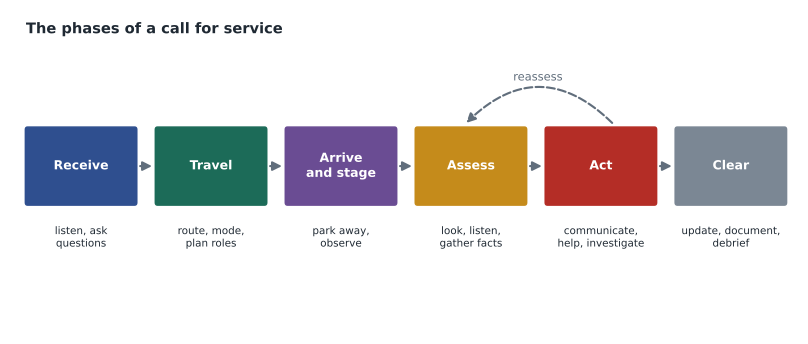
- Receive: listen to the dispatch information, ask for missing details and check the system for history and flags.
- Travel: choose a route and response mode, and plan roles and approach with your partner.
- Arrive and stage: park where you are not exposed, observe before committing, and wait for backup when the situation calls for it.
- Assess: look and listen, speak to the people involved and gather information.
- Act: communicate, provide help, investigate and take whatever action the situation requires.
- Clear: update dispatch, complete notes and reports, and debrief with your partner if useful.
Getting information
The information officers receive with a call is usually incomplete. Callers are often frightened, upset or confused, and call-takers must work quickly. Some details get lost, and some are wrong. Officers should treat dispatch information as a starting point, not a complete picture. Asking dispatch for more details is part of the job: whether there are weapons, whether anyone is injured, whether the caller is still on the line, whether there is a history at the address, and whether other units or agencies are responding. Malhotra asked dispatch on the way to Kingsway whether the callbacks had gone to a cell phone or a landline, and whether the building had a superintendent who could provide access.
Officers should also be careful about information that can create a false expectation. A call described as a minor dispute can turn out to be serious, and a call described as violent may turn out to be a misunderstanding. Haddad tells the students that the two most dangerous words in a dispatch are 'just' and 'only', as in 'just a noise complaint' or 'only a hang-up', because they invite officers to lower their guard before they have any information of their own. She also warns them about the opposite problem: arriving at a call described as dangerous so keyed up that they misread an innocent person's movement.
Response mode and getting there safely
Getting to a call safely is part of responding. Police vehicle collisions are a significant cause of officer injury and death, and of injury to the public. Services have policies on when officers may drive with emergency lights and siren and exceed speed limits, and when they must drive normally. Urgency must be weighed against risk. A 911 hang-up with no sounds of distress usually does not justify high-speed driving through a busy area, while a report of someone being assaulted may. In Ohio and across the United States, state law and agency policy govern emergency driving and pursuits, and many agencies restrict pursuits to violent felonies because of the risk to the public. Even with lights and siren, officers must drive with due regard for others' safety, slowing at intersections and remembering that many drivers do not hear or see them in time.
Officers should use the travel time to plan. Reyes and Malhotra used the six minutes to Kingsway to agree on roles: Reyes would knock and lead, Malhotra would stand beside the door, watch and handle the radio. They also agreed on what they would do if nobody answered: try the superintendent, and if they heard or saw signs that someone needed help, go in. Desjardins calls this the planning conversation and says that partners who have it on every call make fewer mistakes than partners who do not.
# Is speeding worth it? Time saved over a short distance
distance_km = 3.2
for kmh in [50, 70, 90]:
    minutes = distance_km / kmh * 60
    print(f"{kmh} km/h -> {minutes:4.1f} minutes")
saved = distance_km / 50 * 60 - distance_km / 90 * 60
print(f"time saved by 90 instead of 50: {saved:.1f} minutes")50 km/h -> 3.8 minutes 70 km/h -> 2.7 minutes 90 km/h -> 2.1 minutes time saved by 90 instead of 50: 1.7 minutes
The example shows that driving at ninety instead of fifty over three kilometers saves less than two minutes. In a true emergency, those minutes may matter. For many calls they do not, and the extra risk to the officer and the public is not worth it. Haddad tells her officers to ask themselves a simple question before driving fast: would those two minutes change the outcome?
Arriving and staging
How officers arrive shapes what happens next. Parking directly in front of the address can expose officers to view from windows and doors, alert someone who may flee or prepare to resist, and block the street for ambulances and fire trucks. Parking a little short, as Malhotra did, gives officers a chance to observe, listen and approach on their own terms. Officers should look for signs of what is happening: people outside, vehicles, broken windows, open doors and the sounds of shouting or crying. They should report their arrival to dispatch and, if useful, what they see.
Staging means waiting at a safe distance before entering a scene, usually for backup or for another agency. On calls involving reports of weapons or serious violence, officers often stage until enough officers arrive to handle the situation safely. Paramedics and firefighters often stage near violent scenes until police tell them it is safe. But staging must be balanced against urgency. If there are signs that someone inside is being hurt or is in danger of dying, officers may need to act before backup arrives, and the law recognizes their power and duty to do so. At Kingsway, the faint call for help changed the situation from one in which waiting for more information was reasonable to one in which going in was necessary.
Entering a home in an emergency
In Brigham City v. Stuart (2006), the Supreme Court held that police may enter a home without a warrant when they have an objectively reasonable basis for believing that an occupant is seriously injured or imminently threatened with such injury. In Michigan v. Fisher (2009), it confirmed that officers do not need ironclad proof of a serious injury. In Caniglia v. Strom (2021), the Court held that there is no general community caretaking exception that allows warrantless entry into homes; entry must fit an established exception, such as the emergency aid exception. The scope of an emergency entry is limited to what the emergency requires. Desjardins tells the students that on the Kingsway call, the officers' entry was lawful because of the 911 call, the unanswered callbacks and the voice calling for help. Malhotra's quick check of the other rooms was justified to make sure nobody else was in danger. Opening drawers or reading papers would not have been.
| Call type | Information to seek | Common safety considerations |
|---|---|---|
| 911 hang-up | Callback results, background sounds, history at address | Unknown situation; possible medical emergency or person unable to speak |
| Family or domestic dispute | Injuries, weapons, children, history, court orders | High emotion; may involve violence; separate parties |
| Alarm | Type of alarm, keyholder, recent false alarms | Usually false, but treat as real until checked |
| Suspicious person | Description, behavior, direction of travel | Often innocent; avoid assumptions |
| Person in crisis | Weapons, threats, mental health history, family contact | Time and communication are key; consider crisis resources |
| Collision | Injuries, number of vehicles, hazards such as fuel | Traffic is the main hazard; protect the scene |
Acting and clearing
Once officers have assessed the situation, they act: they help people, investigate offenses, keep the peace, make arrests or refer people to other services. Most calls require some combination. Throughout this phase, officers keep reassessing, because new information can change what is needed. A medical call can reveal signs of abuse; a noise complaint can lead to a person in crisis. Officers should not be so focused on the original reason for the call that they miss something new.
Clearing a call means updating dispatch with the outcome, completing notes and any required reports, and making any referrals. It is also a good moment for a quick debrief with a partner: what went well, what would they do differently? After Kingsway, Reyes wrote her notes in the car while the details were fresh. She used the structure Haddad had taught: what she knew, what she saw, what options she considered and what she did. Malhotra read them and suggested one addition: the time she heard the voice saying 'help', because that was the fact that justified entry.
Calls that change
Many calls change while officers are on the way or after they arrive. A caller may phone back to say the situation has calmed down, or that someone now has a weapon. A second caller may give a different description. Dispatch should pass these updates on immediately, and officers should acknowledge them so that dispatch knows they were heard. Officers should also expect changes on arrival. The Kingsway call began as a possible pocket dial and became a medical emergency. Other calls begin as medical emergencies and turn out to involve violence, or begin as disputes and turn out to involve a person in crisis. Haddad tells the students that the best defense against surprise is an open mind: keep gathering information and keep asking what else might be going on.
Worked problem
Planning a response
Dispatch sends an officer to a report of a man shouting and banging on the door of a townhouse at 1 a.m. The caller, a neighbor, does not know whether he lives there. There is no history at the address. Describe how the officer should approach the phases of the call.
Show solution
- Receive: ask dispatch whether the caller can see weapons, whether anyone inside has called, and whether the neighbor can describe the man.
- Travel: drive at a speed suited to the information, request a second unit and agree on roles if one is coming.
- Arrive and stage: park a few houses away, observe the man and the door, and report arrival and what is visible.
- Assess: approach with a partner if possible, speak to the man from a safe distance, and find out who he is and what he wants; check on the people inside.
- Act and clear: resolve the situation, which might mean helping a locked-out resident, mediating a dispute or making an arrest; then update dispatch and document.
Answer: Working through the phases gives the officer information and options before committing.
Common mistakes
MistakeDispatch information is always complete and accurate.
InsteadIt is a starting point; officers should ask for more and expect surprises.
MistakeLights and siren make fast driving safe.
InsteadMany drivers do not see or hear them in time; officers must still drive with due regard for safety.
MistakeA 911 hang-up allows a full search of the home.
InsteadEntry is limited to finding the caller and making sure they and others are safe.
MistakeStaging always means waiting for backup.
InsteadStaging must be balanced against urgency; signs of serious harm may require acting first.
Summary and key terms
- Calls move through phases: receive, travel, arrive and stage, assess, act and clear.
- Dispatch information is a starting point; ask for more and beware of 'just' and 'only'.
- Response mode must balance urgency against the risk of emergency driving.
- Parking short and observing before approaching gives officers information and options.
- Brigham City v. Stuart allows emergency entry on an objectively reasonable belief of serious injury; Caniglia v. Strom rejects a general community caretaking exception for homes.
- Reassess throughout, and clear calls with updates, notes and a quick debrief.
- Emergency aid exception
- The rule allowing warrantless entry when officers reasonably believe someone is seriously injured or imminently threatened.
- Staging
- Waiting at a safe distance before entering a scene, usually for backup or for another agency.
- Response mode
- Whether an officer drives normally or with emergency lights and siren.
- Clearing a call
- Updating dispatch, completing notes and reports, and making referrals.
Practice problems
Work each problem on paper first, then reveal the answer to check.
Why did Malhotra park one building short of 77 Kingsway?
Show answer
To observe, listen and approach on their own terms without being exposed.
What fact justified going into apartment 4B?
Show answer
The faint voice calling for help, along with the 911 call and unanswered callbacks.
In the code example, how many minutes are saved by driving 90 instead of 50 over 3.2 km?
Show answer
About 1.7 minutes.
What two words does Haddad call dangerous in a dispatch?
Show answer
'Just' and 'only'.
Lesson quiz · 5 questions
Score 60% or more to complete this lesson.
Create a free account to save your progress, take quizzes and earn a certificate.