
LES-116 · Lesson 1 of 12 · 20 min
Officer safety on patrol: purpose, principles and the data
▶ Video coming soon A video version of this lesson is on the way.
Professor Ray Desjardins starts the course by projecting a single line of text: Everyone goes home. He leaves it on the screen for a long moment before he speaks. 'Most of you have heard that phrase,' he tells the class. 'Most people hear it as a promise that the officer goes home at the end of the shift. That is part of it. But the phrase means everyone: the officer, the partner, the person being stopped, the bystanders on the sidewalk and the driver who slows down beside a collision. Officer safety is not a separate subject from public safety. It is the same subject seen from the front seat of a patrol car.'
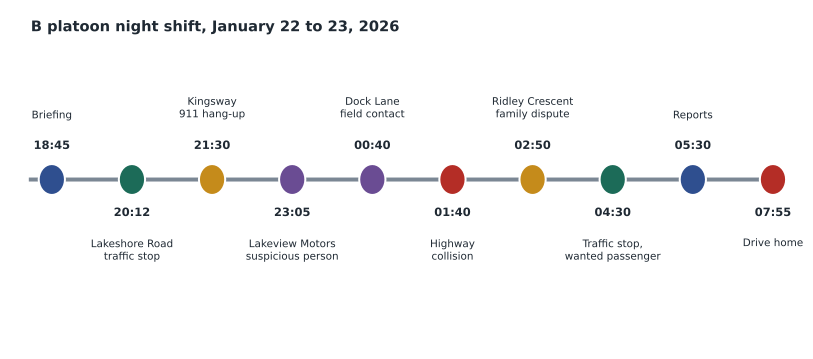
The course follows one real-feeling night on patrol in the fictional city of Port Ardent. On Thursday, January 22, 2026, B platoon worked the twelve-hour night shift from seven in the evening to seven the next morning. Officer Dev Malhotra, a nine-year patrol officer and field training officer, spent the shift coaching Probationary Officer Sofia Reyes, eight months out of the academy. Sergeant Lisa Haddad, the platoon supervisor, ran the briefing and backed them up twice. The shift had seven calls and stops, from a burned-out plate light to a passenger with a warrant, and none of them made the news. That is exactly why Desjardins chose it. 'The calls that hurt officers and the public are usually ordinary calls that went wrong,' he says. 'If you learn to do the ordinary ones well, you will be ready for the rare ones.'
Sergeant Haddad joins the class as a guest throughout the course. She has twenty-one years on the job, teaches the service's annual use-of-force requalification, and reviews every use-of-force report her platoon writes. She tells the students what she tells every recruit on the first night: 'Safety is a set of habits, not a feeling. You can feel safe and be in a terrible position. You can feel nervous and be doing everything right. We are going to build the habits.'
What officer safety means
Officer safety is the set of knowledge, habits and decisions that reduce the chance that anyone is hurt during police work. It includes physical safety on the road and at the door, but it also includes the legal safety of acting within one's authority, the safety of the evidence and the case, and the long-term safety of an officer's mental and physical health. An officer who wins a confrontation through force that the law does not allow is not safe. That officer may face criminal charges, discipline, a civil action and the loss of a career, and the public's trust in the whole service is damaged. Desjardins puts it plainly: 'The law of force, the habits of safety and the skills of communication are one package. Leave any of them behind and the other two fail.'
Safety work also has to be honest about risk. Police officers do face real danger, but the danger is not evenly spread and it is not always where people expect it. Officers are injured far more often in traffic, in struggles during arrests and in the slow damage of fatigue and stress than in the dramatic incidents shown on television. A course that trained recruits to see every person as a threat would make policing more dangerous, not less, because suspicion that is not grounded in facts makes people defensive and makes ordinary encounters escalate. The goal is calibrated awareness: noticing what is actually there, judging it against experience and evidence, and responding in proportion.
Why it matters: the data
In the United States, the FBI's Law Enforcement Officers Killed and Assaulted program, known as LEOKA, collects national data each year. Its special report for 2024 counted 64 officers feloniously killed in the line of duty, about the same as the two years before, and 85,730 assaults on officers, a rate of 13.5 assaults per 100 officers that was the highest in ten years. In the first eight months of 2024, the most common circumstance for felonious deaths was investigative or enforcement activity, followed by unprovoked attacks and ambushes. Accidental deaths, most of them traffic-related, are counted separately and add significantly to the total each year.
Desjardins asks the students what they notice. Priya Sandhu points out that the numbers are small compared with the number of officers and the number of calls answered each year. Marco DiSanto says that small numbers do not make the deaths less important. Both are right, Desjardins says. A single death or serious injury devastates a family, a service and a community, and many serious injuries never appear in national totals. At the same time, decisions should be based on the actual pattern of risk. The data point toward a few recurring themes: traffic, the first moments of contact with a person, calls where information is incomplete, and the cumulative strain of the job.
# Practice: compare counts with exposure, using made-up round numbers for one city
officers = 160            # sworn patrol officers in the service
calls_per_officer = 900   # calls and stops each officer handles in a year
assaults = 24             # assaults on officers reported in the year
injuries = 9              # assaults that caused an injury

contacts = officers * calls_per_officer
print("contacts in the year:", contacts)
print("assaults per 10,000 contacts:", round(assaults / contacts * 10000, 2))
print("injuries per 100 officers:", round(injuries / officers * 100, 1))
print("share of assaults that caused injury:", round(injuries / assaults, 2))contacts in the year: 144000 assaults per 10,000 contacts: 1.67 injuries per 100 officers: 5.6 share of assaults that caused injury: 0.38
The made-up example shows why analysts look at rates and not just counts. Twenty-four assaults sounds like a lot until it is compared with 144,000 contacts, and nine injuries among 160 officers is still a serious occupational hazard that a service must reduce. Haddad adds that good data also tells a service where to focus training. When her service studied its own reports, it found that most officer injuries happened in the first minute of a struggle during an arrest and in collisions, not in armed confrontations, so it increased time spent on communication, ground control and driving.
Principles of officer safety
Throughout the course, Desjardins returns to a short list of principles. They are not rules to be applied mechanically but habits of thinking that apply to every call and stop.
- Plan before you arrive. Use the information available, think about what could happen, and decide roles with your partner.
- Use time, distance and cover. Time lets you gather information and lets people calm down. Distance gives you room to react. Cover, meaning something that can stop a threat, and concealment, meaning something that hides you, protect you while you assess.
- Communicate early and clearly. Most encounters are resolved with words, and good communication prevents most escalations.
- Work as a team. Two officers who know their roles are far safer than two officers acting separately.
- Stay within the law. Know your authority for every step, because unlawful action is unsafe action.
- Reassess constantly. Situations change; your plan has to change with them.
- Look after yourself. Fatigue, stress and poor health erode every other skill.
Haddad stresses the last principle. 'I have seen excellent officers make poor decisions at five in the morning in the eleventh hour of a shift,' she says. 'Not because they forgot their training, but because a tired brain does not process information well. You will learn more about that later in the course. For now, understand that looking after yourself is part of the job, not a break from it.'
Safety, legitimacy and trust
Officer safety and community trust are connected. When people believe that police treat them fairly, explain what they are doing and act within the law, they are more likely to cooperate, call for help and give information. Cooperation makes encounters calmer and safer. When people believe police are arbitrary or disrespectful, they are more likely to argue, resist or flee, and every one of those reactions increases the risk to everyone. Earlier courses in the program introduced procedural justice: voice, neutrality, respect and trustworthy motives. Desjardins tells the students that procedural justice is also an officer-safety tool. A clear explanation at the start of a traffic stop does more for safety than a hard stare.
In the United States, the Fourth Amendment governs seizures and the use of force, and state law and training standards add further requirements. In Ohio, the Ohio Peace Officer Training Commission sets basic and continuing training requirements, and the Ohio Collaborative Community-Police Advisory Board has created statewide standards, including on use of force, that agencies certify they follow. Courts assess police conduct against the Constitution, and evidence gathered through unlawful practices may be suppressed. The legal details come later in the course. For now, the point is that safety practices must fit within the law, and that the law expects officers to make reasonable, careful decisions.
How this course is organized
The course moves through the shift in roughly the order that skills are needed. It starts with situational awareness and the mindset that supports it, then turns to risk assessment and the legal framework for force, and then to the preparation that happens before an officer leaves the station. The middle of the course covers communication and de-escalation, positioning and the contact and cover roles, approaching people, traffic stops and roadside safety, and responding to calls for service. The last lessons cover radio discipline and backup, officer wellness, and the documentation and after-action review that turn a shift into lessons learned.
Each lesson returns to a part of the January 22 shift. Some of the decisions Reyes and Malhotra made were excellent. Some were understandable mistakes that Haddad later used for coaching. One was a near miss that could have ended very differently. Desjardins promises the students that by the end of the course they will be able to review the whole shift as a supervisor would, and explain what went well, what could be better and why.
| Part of the shift | Main skills | Lessons |
|---|---|---|
| Briefing and preparation | Planning, information, equipment and vehicle checks | 4 |
| Lakeshore Road stop | Traffic stop location, approach and communication | 8 |
| Kingsway 911 hang-up | Dispatch information, arrival and unknown situations | 9 |
| Lakeview Motors suspicious person | Awareness, contact and cover, field contacts | 2, 6, 7 |
| Dock Lane contact | Grounds, detention and rights | 7 |
| Highway collision | Roadside safety and moving traffic | 8 |
| Ridley Crescent family dispute | Communication, separation and de-escalation | 5 |
| Stop with a wanted passenger | Radio, queries and waiting for backup | 10 |
| Reports and the drive home | Documentation and fatigue | 11, 12 |
Learning from the ordinary
Desjardins asks the class why a course on officer safety would spend so much time on a quiet shift. Amara Okafor suggests that ordinary calls are where habits are formed. He agrees, and adds a second reason: ordinary calls are where most risk actually lives, simply because there are so many of them. A patrol officer may go a whole career without facing an armed person, but will make thousands of traffic stops, knock on thousands of doors and drive tens of thousands of kilometers. A small improvement in how each of those ordinary tasks is done adds up to a large reduction in risk. He calls this the arithmetic of safety. It is also why the course pays attention to small details, such as where an officer parks or how they open a conversation, that might seem too minor to matter. Each detail is small; together they are the difference between a career of safe shifts and a single bad night.
Worked problem
Seeing the whole picture
A new officer is asked to list everyone whose safety is affected by a routine daytime traffic stop on a busy four-lane road. List them and one way each could be harmed.
Show solution
- The officer can be struck by passing traffic while standing beside the stopped car or walking between vehicles.
- The driver and passengers of the stopped car can be struck if they get out on the traffic side, or hurt if the encounter escalates.
- Other drivers can collide while slowing to look, or while changing lanes suddenly near the stop.
- Pedestrians and cyclists can be endangered if the stop blocks a sidewalk or bike lane.
- A partner or backup officer arriving on scene can be struck while parking or walking up.
Answer: Everyone on and near the road is part of the safety picture, which is why stop location and positioning matter so much.
Common mistakes
MistakeOfficer safety means treating everyone as a threat.
InsteadOfficer safety means calibrated awareness: noticing real risk factors and responding in proportion.
MistakeMost officer injuries come from armed confrontations.
InsteadMany injuries come from traffic, struggles during arrests, and fatigue and stress.
MistakeSafety and legality are separate subjects.
InsteadUnlawful action is unsafe action; safety practices must fit within the law.
MistakeExplaining yourself is a courtesy that slows you down.
InsteadClear explanation reduces resistance and is itself a safety tool.
Summary and key terms
- Officer safety covers everyone affected by police work: officers, the people they deal with and the public.
- It includes physical safety, legal safety, the safety of the case and long-term health.
- The FBI's LEOKA data for 2024 recorded 64 felonious deaths and 85,730 assaults on officers, the highest assault rate in ten years.
- Recurring themes are traffic, the first moments of contact, incomplete information and the strain of the job.
- Core principles are planning, time, distance and cover, communication, teamwork, legality, reassessment and self-care.
- Procedural justice and trust make encounters calmer and safer.
- Officer safety
- Knowledge, habits and decisions that reduce the chance of harm in police work.
- Calibrated awareness
- Noticing real risk factors and responding in proportion to them.
- Cover
- Something that can stop a threat, such as an engine block or a concrete wall.
- Concealment
- Something that hides a person from view but will not stop a threat.
- LEOKA
- The FBI program that collects national data on officers killed and assaulted in the line of duty.
- Procedural justice
- Fair process in police encounters: voice, neutrality, respect and trustworthy motives.
Practice problems
Work each problem on paper first, then reveal the answer to check.
What does 'everyone goes home' mean in this course?
Show answer
That the officer, partner, people stopped and the public should all be safe; it is not only about the officer.
In the code example, how many assaults were there per 10,000 contacts?
Show answer
About 1.67.
Name three settings where officers are often hurt that are not armed confrontations.
Show answer
Traffic, struggles during arrests, and fatigue and stress.
Why is procedural justice an officer-safety tool?
Show answer
Fair, explained treatment reduces resistance and escalation, which makes encounters safer.
Lesson quiz · 5 questions
Score 60% or more to complete this lesson.
Create a free account to save your progress, take quizzes and earn a certificate.