
LES-116 · Lesson 7 of 12 · 20 min
Approaching people: field contacts and detentions
▶ Video coming soon A video version of this lesson is on the way.
At 00:40, during proactive patrol in Harbourside, Reyes and Malhotra saw a man walking slowly along Dock Lane, stopping beside parked cars and shining his phone's light through the windows. It was the time and place of the theft pattern Haddad had described at briefing, and the man looked into four cars in the space of a block. Reyes pulled over and asked Malhotra what they had. He asked her the question back: 'What do you think? Can we stop him, or can we just talk to him?' Reyes thought for a moment and said she believed they had reasonable grounds to suspect he was connected to the thefts, which would allow a brief investigative detention. Malhotra agreed, but asked her to start as a conversation and see what she learned before deciding.
This lesson covers one of the most legally sensitive parts of patrol work: approaching people on the street. It explains the difference between a voluntary conversation and a detention, the legal standards for each, the rights a detained person has, and the safety practices that support lawful, respectful contacts. Desjardins reminds the class that a contact that starts as a friendly conversation can become a detention through what officers say and do, and that courts look carefully at that transition. Getting the law right is not separate from officer safety. A stop that a court later finds unlawful may lead to excluded evidence, civil liability and damaged trust.
Voluntary contacts
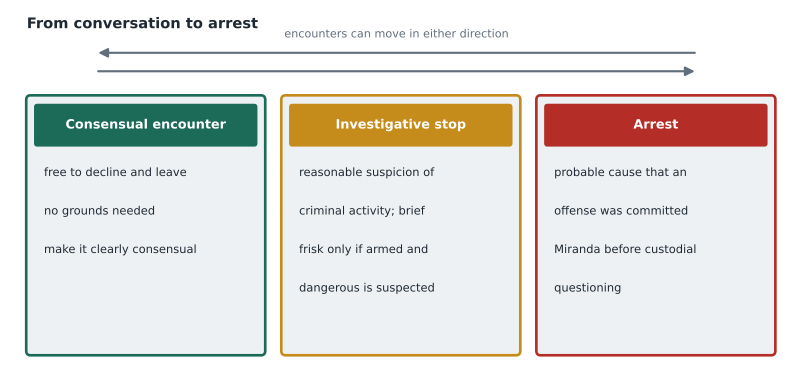
Police officers, like anyone else, can approach a person and ask questions. In a voluntary contact, the person is free to decline to answer and to walk away, and the officer has no power to make them stay. Officers use voluntary contacts to gather information, check on people's welfare, build relationships and ask about incidents they are investigating. No particular grounds are needed, but how the contact is conducted matters, both legally and for trust.
In the United States, the key question is whether the person was seized under the Fourth Amendment. In United States v. Mendenhall (1980), the Supreme Court said a person is seized if, in view of all the circumstances, a reasonable person would have believed they were not free to leave. In Florida v. Bostick (1991), the Court refined the test for situations such as buses, asking whether a reasonable person would feel free to decline the officers' requests or otherwise end the encounter. Factors include the threatening presence of several officers, the display of a weapon, physical touching, and language or tone indicating that compliance might be compelled. Officers do not have to tell people they are free to leave, but doing so helps show that a contact was voluntary.
Haddad tells the students that the safest and fairest voluntary contacts are clearly voluntary. Officers should approach in a relaxed manner, explain who they are and why they are talking to the person, avoid blocking the person's path, and avoid language that sounds like an order. 'If you want it to be a conversation, make it a conversation,' she says. 'If you need to detain, have grounds and say so.' Ambiguous contacts, in which officers act as though the person must stay but have no lawful reason to keep them, are a common source of excluded evidence and complaints.
Investigative detention
An investigative stop, often called a Terry stop after Terry v. Ohio (1968), is a brief seizure to investigate possible criminal activity. Officers need reasonable suspicion: specific and articulable facts which, taken together with rational inferences from those facts, reasonably warrant the intrusion. A hunch is not enough. In Illinois v. Wardlow (2000), the Supreme Court held that presence in a high-crime area alone is not enough, but that unprovoked flight on seeing police, in such an area, can contribute to reasonable suspicion. In Brown v. Texas (1979), the Court held that police cannot stop a person and demand identification without reasonable suspicion. Ohio courts apply these rules and look at the totality of the circumstances.
Detained people have rights. Officers should tell a detained person why they have been stopped. A person in a brief investigative stop is not usually in custody for Miranda purposes, but if the stop becomes custodial, such as by arrest or by restraint equivalent to arrest, Miranda warnings are needed before interrogation. In Hiibel v. Sixth Judicial District Court of Nevada (2004), the Supreme Court upheld a state law requiring a person stopped on reasonable suspicion to give their name. Ohio's statute on failure to disclose personal information, section 2921.29 of the Revised Code, makes it an offense for a person to refuse to give their name, address or date of birth when an officer reasonably suspects the person is committing, has committed or is about to commit a crime, or is a witness to certain offenses. Outside those situations, people are generally not required to identify themselves.
Protective searches
In Terry, the Court also held that officers may frisk a person for weapons during a stop if they have reasonable suspicion that the person is armed and dangerous. The frisk is a limited pat-down of outer clothing for weapons. In Minnesota v. Dickerson (1993), the Court held that officers may seize an object felt during a lawful frisk only if its identity as contraband is immediately apparent; manipulating an object to identify it goes beyond the frisk. Desjardins tells the class that in the evidence course in second year they will study a Port Ardent case in which an officer opened a backpack during what he called a pat-down, and the court excluded what he found. Protective searches protect officers, but they are narrow, and the officer must be able to explain the specific safety concern.
Back on Dock Lane
Reyes stepped out of the cruiser, called out 'Evening!' and walked toward the man at an angle, with Malhotra on cover. She said, 'I'm Officer Reyes. We've had a lot of thefts from cars around here at night, and I noticed you looking into a few vehicles. Can you tell me what you're up to?' The man, Kevin Ostrowski, thirty-eight, said he had lost his dog's leash and wallet somewhere on his evening walk and was looking to see whether he had dropped them by the cars. He was polite but nervous. Reyes asked whether he lived nearby; he pointed to a building half a block away.
At this point Reyes had to decide whether to continue as a voluntary conversation or to detain him. She had specific facts: the time, the location of the theft pattern and his behavior of shining a light into several cars. She also had an innocent explanation that fit some of the facts. She decided that she had reasonable suspicion and that a brief detention was justified to confirm his identity and story, and she told him so. 'Mr. Ostrowski, I'm going to ask you to stay here for a few minutes while I look into the car thefts. You're not under arrest.' He said that was fine. He gave his name and date of birth. A records check showed no warrants and no record of thefts. While Malhotra watched, Reyes walked with him along the lane with her flashlight. Two cars back, under the edge of a snowbank, they found a leather wallet with his license inside, and a red dog leash. Reyes thanked him for his patience and told him he was free to go. The detention had lasted eleven minutes.
In the car, Malhotra asked her why she had not patted him down. She said she had no reason to think he was armed or that anyone's safety was at risk: he was calm, his hands were visible and there was nothing about him that suggested a weapon. Malhotra agreed. 'If you had patted him down, you would have needed to explain why,' he said. 'Reasonable suspicion of a property crime is not the same as a reasonable belief that someone is dangerous.' He also pointed out that she had done something important: she had documented her grounds in her notebook before she got out of the car, writing the time, the location and what she had seen.
# Documenting grounds: list each fact and whether it is specific and observed
facts = [
    ("time 00:40, within theft pattern window 00:00-04:00", True),
    ("location Dock Lane, inside Harbourside pattern area", True),
    ("shone light into four parked cars in one block", True),
    ("man seemed nervous", False),   # common, not specific on its own
    ("wearing dark clothing", False),  # common in winter
]
specific = [f for f, ok in facts if ok]
print("specific, observed facts:", len(specific))
for f in specific:
    print(" -", f)
print("facts that add little on their own:", [f for f, ok in facts if not ok])specific, observed facts: 3 - time 00:40, within theft pattern window 00:00-04:00 - location Dock Lane, inside Harbourside pattern area - shone light into four parked cars in one block facts that add little on their own: ['man seemed nervous', 'wearing dark clothing']
The example reflects the kind of thinking courts expect. Facts that are specific and observed, such as the time, place and behavior, can support reasonable suspicion when taken together. Facts that are common among innocent people, such as nervousness or dark clothing in winter, add little on their own and can be a sign that an officer is relying on stereotype or hunch. Haddad tells the class that if most of their listed grounds are in the second category, they probably do not have grounds.
Bias and fairness in stops
Decisions about whom to approach and detain are where bias can do the most harm. Research in both countries has found that racialized people, especially Black and Indigenous people, have been stopped, questioned and searched by police at higher rates than others in many places, and that these experiences shape how communities view police. Many states and agencies, including several in Ohio, collect data on stops by race and have policies prohibiting biased policing. The federal constitution's equal protection guarantee prohibits intentionally discriminatory enforcement, and agency policies typically go further. Desjardins tells the students that the legal tests protect against bias only if officers apply them honestly. Asking 'Would I stop this person if they looked different?' is one practical check.
Ending a contact well
How an officer ends a contact matters as much as how it begins. A person who has been detained and released should be told clearly that they are free to go, thanked for their patience if that is appropriate, and given a brief explanation of why they were stopped if they did not fully understand. Officers should answer reasonable questions and tell the person how to make a complaint or get more information if they ask. Reyes did all of this with Mr. Ostrowski, and Malhotra pointed out that the man's last memory of the encounter would be the officer helping him find his wallet, not the detention. 'People remember how you made them feel,' he said. 'He'll tell his neighbors about tonight. You want that story to be a good one.'
Desjardins adds that a well-ended contact is also good police work. A person who leaves feeling respected is more likely to call police with information in the future, more likely to cooperate in the next encounter and less likely to complain. In a neighborhood with a theft pattern, residents who trust the officers patrolling at night are one of the best sources of information an investigation can have.
Worked problem
Voluntary or detention?
An officer sees a teenager standing outside a closed convenience store at 1 a.m. She pulls up, gets out and says, 'What are you doing here? Let me see some ID.' The teenager hands over a student card. Was this a detention, and what would have been better?
Show solution
- The officer singled out the teenager, asked a pointed question and demanded identification, which would lead a reasonable young person to believe they had to comply.
- A court would likely find that the teenager was detained, and the officer would need reasonable suspicion of a specific offense.
- Standing outside a closed store at night is not, on its own, reasonable suspicion of anything.
- A better approach would be a clearly voluntary conversation: 'Hi, everything okay? It's pretty late to be out here.'
- If the officer develops specific facts that give reasonable suspicion, she can then detain, explain why and give the required rights.
Answer: Demanding identification without grounds turns a contact into an unlawful detention; a clearly voluntary approach avoids that.
Common mistakes
MistakeOfficers can always ask for identification.
InsteadThey can ask, but in a voluntary contact people may decline; demanding it can create a detention that needs grounds.
MistakeBeing in a high-crime area is enough for a stop.
InsteadPresence in such an area alone is not enough; officers need specific facts about the person.
MistakeA pat-down is allowed in every detention.
InsteadA protective search needs a specific safety concern and is limited to what safety requires.
MistakeDetention rights only apply after arrest.
InsteadStopped people must be told why; Miranda applies once the encounter becomes custodial.
Summary and key terms
- Voluntary contacts need no grounds, but the person may decline and leave.
- A seizure occurs when a reasonable person would not feel free to leave or decline.
- Terry allows brief stops on reasonable suspicion and frisks only when the person is reasonably suspected to be armed and dangerous.
- Reasonable suspicion must rest on specific, objective facts, not hunches or stereotypes.
- Ohio requires people to give their name, address and date of birth only in specified situations.
- Bias can affect who is stopped, so officers should test their grounds honestly.
- Terry stop
- A brief investigative stop based on reasonable suspicion.
- Seizure
- A restraint of liberty under the Fourth Amendment, such as a stop or arrest.
- Voluntary contact
- A conversation the person is free to decline and leave.
- Reasonable suspicion
- A reasonable possibility, based on specific objective facts, of involvement in a crime.
- Protective search
- A limited pat-down for safety, not a search for evidence.
Practice problems
Work each problem on paper first, then reveal the answer to check.
What specific facts did Reyes have on Dock Lane?
Show answer
The time, the location within the theft pattern and the man shining a light into four cars.
Why did Reyes not pat Ostrowski down?
Show answer
She had no reason to believe he was armed or that safety was at risk.
In the code example, which two facts added little on their own?
Show answer
Nervousness and dark clothing.
How long did the Dock Lane detention last?
Show answer
Eleven minutes.
Lesson quiz · 5 questions
Score 60% or more to complete this lesson.
Create a free account to save your progress, take quizzes and earn a certificate.