
LES-116 · Lesson 3 of 12 · 20 min
Risk assessment, decision-making and the law of force
▶ Video coming soon A video version of this lesson is on the way.
Sergeant Haddad begins this lesson with a question she says she asks every officer who writes a use-of-force report: 'What did you know, what did you see, and what were your options?' She explains that every decision an officer makes on patrol, from where to park to whether to put hands on a person, will eventually be measured against those three questions. The law does not expect officers to be perfect, but it does expect their decisions to be reasonable in light of what they knew at the time. This lesson covers how officers assess risk, how decision-making models help them think, and the legal framework that governs the use of force.
Desjardins adds a caution. This course covers the legal principles and decision-making at a foundation level. Defensive tactics, control techniques and the use of weapons are taught hands-on by certified instructors in academy and requalification training, and later courses in this program cover arrest and control and less-lethal options in more depth. 'Nothing you read here replaces practical training,' he says. 'What you will get here is the thinking that has to sit behind every technique.'
Assessing risk
Risk assessment is the ongoing process of judging the likelihood and severity of harm in a situation and choosing actions that reduce it. On patrol, officers assess risk informally and constantly, often in seconds. The assessment draws on several kinds of information: what dispatch or a query has reported, what the officer sees and hears on arrival, the behavior of the people involved, the environment, and the resources available. It also draws on the officer's own condition, such as fatigue, injury or emotional state.
Several factors tend to raise or lower risk. Information that a person has threatened violence, has access to weapons or is in crisis raises it. So does being alone, being in an unfamiliar or confined place, or having limited ways to call for help. Factors that lower risk include clear information, a calm and cooperative person, good lighting and space, a partner in a known role, and time to plan. Desjardins stresses that most of these factors are not fixed. Officers can change many of them, for example by waiting for backup, moving a conversation into better light, or simply slowing down.
| Category | Examples that raise risk | Examples that lower risk |
|---|---|---|
| Information | Reports of weapons, threats or previous violence; no information at all | Clear, recent, confirmed information |
| Behavior | Escalating anger, threats, refusal to show hands, signs of crisis or intoxication | Calm conversation, cooperation, visible hands |
| Environment | Darkness, traffic, confined spaces, crowds, unknown layout | Good light, open space, known layout, few bystanders |
| Resources | Alone, far from backup, poor radio coverage | Partner present, backup close, good communications |
| Officer condition | Fatigue, injury, anger, distraction | Rested, focused, calm |
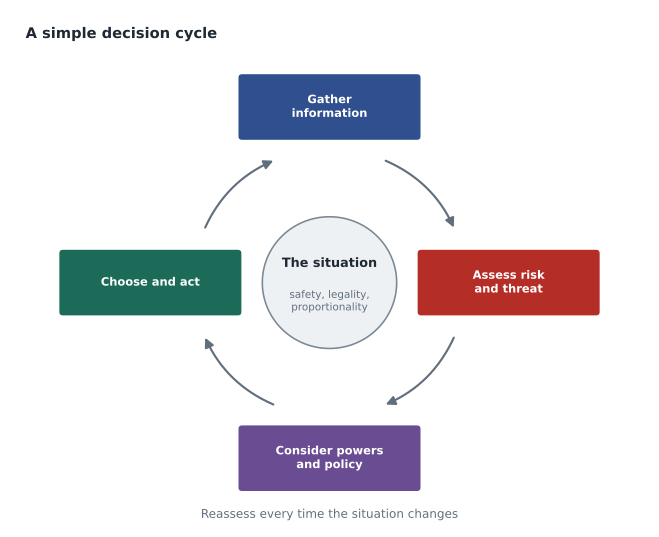
Decision-making models
Police services use decision-making models to help officers think through situations in a structured way and to help them explain their decisions afterwards. In the United States, many agencies use decision-making models such as the Critical Decision-Making Model promoted by the Police Executive Research Forum, which asks officers to gather information, assess the situation and threats, consider their powers and policy, identify options and choose the best course of action, and then review and reassess. Older use-of-force continuums presented force as a ladder of steps; many agencies have moved away from rigid ladders toward models that stress that officers can move between options in any direction as a situation changes. Whatever the model, it is a training tool, not law.
Haddad tells the students that the most important part of any model is the arrow that points back to the start. 'The person you are dealing with changes, you change, the environment changes. If you hold onto the decision you made thirty seconds ago, you will be wrong,' she says. Models also make one point very clearly: communication is present at every level. Even when an officer must use physical force, talking continues, because words can still end the confrontation.
The legal framework for force
In the United States, the use of force during an arrest, stop or other seizure is governed mainly by the Fourth Amendment's protection against unreasonable seizures. In Graham v. Connor (1989), the Supreme Court held that claims of excessive force in the course of a seizure are judged by a standard of objective reasonableness: whether the officer's actions were objectively reasonable in light of the facts and circumstances confronting them, without regard to their underlying intent. The Court listed factors including the severity of the crime, whether the suspect posed an immediate threat to the safety of officers or others, and whether the suspect was actively resisting or attempting to evade arrest by flight. In Tennessee v. Garner (1985), the Court held that deadly force may not be used to prevent the escape of a fleeing suspect unless the officer has probable cause to believe that the suspect poses a significant threat of death or serious physical injury to the officer or others, and that a warning should be given where feasible. State law and agency policy often add further limits.
In Barnes v. Felix (2025), the Supreme Court unanimously rejected the so-called moment-of-threat rule, which some lower courts had used to look only at the instant when an officer used force. The Court held that courts must consider the totality of the circumstances, including relevant events leading up to the use of force, with no fixed time limit. The Court left open how, if at all, an officer's own creation of a dangerous situation affects the analysis. Graham also says that reasonableness is judged from the perspective of a reasonable officer on the scene, rather than with the 20/20 vision of hindsight, allowing for the fact that officers often make split-second judgments.
Desjardins asks the students what these principles have in common across both countries. Jesse Morningstar answers: the force has to be necessary for a lawful purpose, it has to be proportionate to what the officer is facing, and the officer's decision will be judged on what a reasonable officer would have done with the same information. Desjardins agrees and adds a fourth point that both legal systems now emphasize in different ways: the events leading up to the use of force matter. Officers who rush, isolate themselves or create avoidable confrontations may find that the whole sequence, not just the final moment, is examined.
Proportionality and alternatives
Proportionality means that the response must fit the threat and the lawful objective. Pushing a person who is merely refusing to answer questions is not proportionate; controlling a person who is actively assaulting a partner may be. Proportionality is assessed against what the officer reasonably perceived. It does not require officers to use the least possible force or to wait until they are injured, but it does require that they consider whether lesser options were reasonably available. Time, distance, communication, backup and containment are often the most important alternatives, because they reduce the need for any force at all.
Haddad describes the habit she wants every officer to have before a planned physical intervention: a quick internal check of three questions. Is there a lawful reason to act now? Is there a safer way to achieve the same goal? Am I ready, with my partner, for what happens next? 'If you cannot answer the first question, do not act,' she says. 'If the second answer is yes, use the safer way. If the third answer is no, get ready before you act, if you possibly can.'
# Structuring an after-action explanation: what did the officer know, see and consider?
decision = {
    "knew": ["dispatch: 911 hang-up, no callback answer", "address had no prior calls"],
    "saw": ["door ajar", "elderly man on floor", "no other person visible"],
    "options": ["wait for partner", "announce and enter", "call fire and ambulance first"],
    "chose": "announce and enter with partner, request ambulance",
    "why": "risk to the man's life outweighed risk of waiting; partner present",
}
for key in ["knew", "saw", "options"]:
    print(f"{key.upper():8}", "; ".join(decision[key]))
print("CHOSE   ", decision["chose"])
print("WHY ", decision["why"])KNEW dispatch: 911 hang-up, no callback answer; address had no prior calls SAW door ajar; elderly man on floor; no other person visible OPTIONS wait for partner; announce and enter; call fire and ambulance first CHOSE announce and enter with partner, request ambulance WHY risk to the man's life outweighed risk of waiting; partner present
The example shows how Reyes later organized her notes about the 911 hang-up on Kingsway, a call covered in more detail in a later lesson. Haddad likes this structure because it matches the questions a court, a review board or a supervisor will ask. Officers who think in this structure during a call, not only afterwards, tend to make better decisions, because they are actively looking for information and options instead of reacting to the first thing they see.
Duty to intervene and accountability
Officers have responsibilities not only for their own use of force but also when they see another officer using force that is clearly unlawful or excessive. In the United States, many states and agencies now require officers to intervene to prevent clearly excessive force by another officer and to report it, and federal courts have recognized that an officer who has a realistic opportunity to prevent another officer's use of excessive force and fails to do so may be liable. Ohio's statewide standards and many Ohio agency policies include intervention and reporting requirements. Haddad tells the class that intervention is also an officer-safety practice. A partner who calmly says 'I've got him, step back' can prevent an injury, a complaint and a prosecution.
Use-of-force reporting is part of accountability. Officers must document what happened, why they acted and what options they considered, usually on a standard form and in their notes. Supervisors review reports, and services analyze them to find training needs. Honest, detailed reports protect officers who acted reasonably, and they help services learn. A report that leaves out the events leading up to the force, or that uses stock phrases instead of specific facts, will not survive scrutiny.
Explaining a decision afterwards
Haddad tells the students that the time to think about how they will explain a decision is before they make it. When officers write use-of-force reports or testify, they must describe what they perceived, what they believed and why they acted. Reports that simply state a conclusion, such as 'force was necessary', are weak. Reports that describe specific observations, such as the person's words, movements and distance, the officer's options and the reasons one option was chosen, allow a reader to judge whether the decision was reasonable. Officers who think in terms of facts, options and reasons during an incident find it much easier to write accurate reports later. Haddad also warns against the opposite error: adding details afterwards that the officer did not actually perceive at the time, because the decision will be judged on what the officer knew then, and any invented detail destroys credibility.
Desjardins adds that training records matter too. A court or review body may ask what training an officer had received, when it was last refreshed and whether the officer followed it. Officers who keep their requalifications current, take de-escalation training seriously and follow their service's model are in a much stronger position than officers who improvise. Training is not only a requirement; it is the foundation on which a reasonable decision is built and explained.
Worked problem
Applying the factors
Two officers are sent to a store where a man has stolen a bottle of shampoo and is walking away along an empty sidewalk. He is not threatening anyone and has no weapon visible. One officer suggests running up behind him and tackling him before he can get away. Use the principles in this lesson to assess that plan.
Show solution
- The offense is minor and nobody is in immediate danger, so the severity and threat factors are low.
- Tackling a person from behind creates a real risk of injury to the man, the officer and anyone nearby, which is not proportionate to a shampoo theft.
- Less risky options are available: catching up, identifying themselves, calling him by description, and speaking to him; backup can help contain him if he runs.
- If he refuses to stop and flees, the officers can follow at a safe distance, report his description and direction, and consider whether pursuit is worth the risk for the offense involved.
- Any force used later would be judged on the whole sequence, including whether officers chose a calm approach first.
Answer: The tackle plan is disproportionate; a communication-first approach is safer and more defensible.
Common mistakes
MistakeA use-of-force model is the law.
InsteadModels are training tools; the law is in statutes and court decisions.
MistakeOnly the moment force is used matters legally.
InsteadCourts look at the whole situation, including events leading up to the force.
MistakeOfficers must use the least possible force.
InsteadForce must be necessary, proportionate and reasonable; officers must consider reasonably available alternatives.
MistakeTalking stops once physical force begins.
InsteadCommunication continues at every stage and can still end a confrontation.
Summary and key terms
- Risk assessment is continuous and draws on information, behavior, environment, resources and the officer's own condition.
- Many risk factors can be changed by officer choices, such as waiting for backup or creating distance.
- Decision-making models structure thinking and explanation but are not law.
- Graham v. Connor requires objectively reasonable force judged from the perspective of a reasonable officer on the scene; Garner limits deadly force against fleeing suspects; Barnes v. Felix requires looking at the totality of the circumstances.
- Proportionality and alternatives such as time, distance, communication and backup are central.
- Officers have duties to intervene in and report excessive force, and to document their own use of force honestly.
- Graham v. Connor
- The 1989 Supreme Court case setting the objective reasonableness standard for force during seizures.
- Tennessee v. Garner
- The 1985 Supreme Court case limiting deadly force against fleeing suspects.
- Risk assessment
- Judging the likelihood and severity of harm and choosing actions that reduce it.
- Proportionality
- A response that fits the threat and the lawful objective.
- Duty to intervene
- An obligation to act to prevent another officer's clearly excessive force, and to report it.
Practice problems
Work each problem on paper first, then reveal the answer to check.
What three questions does Haddad ask about every use of force?
Show answer
What did you know, what did you see, and what were your options?
Name two alternatives that often reduce the need for force.
Show answer
Time and distance; also communication, backup and containment.
What did Barnes v. Felix (2025) reject?
Show answer
The moment-of-threat rule that looked only at the instant force was used.
Why is a duty to intervene also an officer-safety practice?
Show answer
Stepping in calmly can prevent injuries, complaints and prosecutions.
Lesson quiz · 5 questions
Score 60% or more to complete this lesson.
Create a free account to save your progress, take quizzes and earn a certificate.