
LES-115 · Lesson 6 of 12 · 20 min
Victims' rights: the Crime Victims' Rights Act and Marsy's Law
▶ Video coming soon A video version of this lesson is on the way.
Margaret Liu, the assistant prosecutor who reviews Port Ardent's charges each week, joins the class for this lesson. She begins with a confession. 'When I started practicing, I thought of victims as witnesses,' she says. 'Important witnesses, but witnesses. My client was the public, and the victim was one source of evidence. The law has changed that, and I have had to change with it.' The change, she explains, did not make the victim a party to the prosecution. The case is still the State of Ohio against the defendant, and the prosecutor still decides what charges to pursue. What changed is that victims now have legal rights of their own, and the police, prosecutors, courts and corrections officials have legal duties to respect them.
Why victims' rights laws exist
Liu describes the problem the laws were designed to solve. In the traditional criminal process, the state replaced the victim. The victim reported, testified if called, and otherwise had no formal role. There was no duty to tell them about bail, pleas or sentencing, no right to be present, no right to describe the harm, and often no realistic route to recover their losses. The research on secondary victimization in Lesson 5 showed what that cost. Victims' rights laws give victims a defined place: rights to be informed, to be protected, to participate and to seek repair, while leaving the core decisions of the prosecution with the state.
Brooks adds that rights on paper and rights in practice are different things. A right to information means little if nobody tells the victim it exists. That is why many of these laws place their first duties on police, who are usually the first officials a victim meets.
The federal Crime Victims' Rights Act
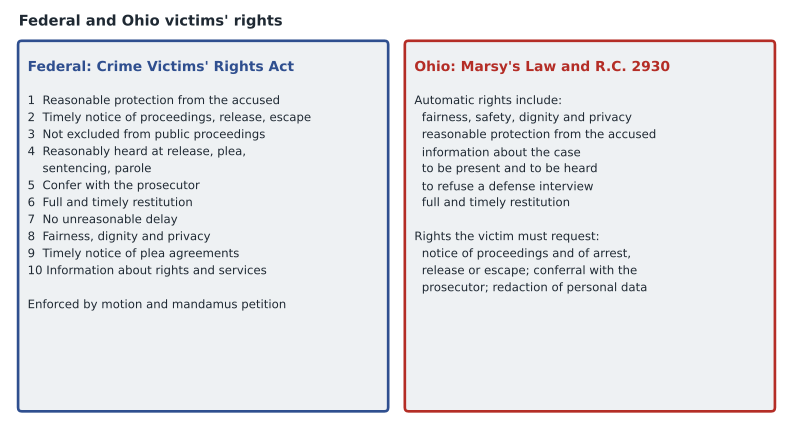
The federal Crime Victims' Rights Act, passed in 2004 and codified at 18 USC 3771, lists ten rights for victims of federal crimes: reasonable protection from the accused; reasonable, accurate and timely notice of public court and parole proceedings and of any release or escape; the right not to be excluded from public court proceedings unless the court finds that the victim's testimony would be materially altered by hearing other testimony; the right to be reasonably heard at public proceedings on release, plea, sentencing or parole; the reasonable right to confer with the prosecutor; full and timely restitution as provided by law; proceedings free from unreasonable delay; the right to be treated with fairness and with respect for the victim's dignity and privacy; timely notice of any plea bargain or deferred prosecution agreement; and information about these rights and the services available. The last two were added in 2015.
Federal investigators and prosecutors must make their best efforts to see that victims are notified of and given these rights. The Act is enforceable in a limited way: a victim, the victim's representative or the government's attorney can ask the district court to enforce a right, and if the court refuses, the victim can petition the court of appeals for a writ of mandamus, which the appeals court must decide within 72 hours. The Act creates no right to sue for damages. Because it applies to federal crimes, most victims in Port Ardent are protected instead by Ohio law.
Ohio's Marsy's Law
In November 2017 Ohio voters approved Marsy's Law, an amendment to Article I, Section 10a of the Ohio Constitution, which took effect in 2018. The General Assembly rewrote Revised Code chapter 2930 to carry it out, with changes that took effect in 2023. Some rights apply automatically: to be treated with fairness and respect for the victim's safety, dignity and privacy; to reasonable protection from the accused; to information about the status of the case; to be present at public proceedings; to be heard at proceedings involving release, plea, sentencing, disposition or parole; to refuse a defense request for an interview, deposition or other discovery; to proceedings free from unreasonable delay; and to full and timely restitution. Other rights the victim must request, such as notice of court proceedings and of the accused's arrest, release or escape, the chance to confer with the prosecutor, and redaction of personal information from public records. The victim, the victim's attorney or the prosecutor can assert these rights in court, and the Ohio Supreme Court has recognized a victim's right to appeal decisions that deny them. The Court has also held that a city is not a victim for the purposes of Marsy's Law, so a municipality cannot claim restitution under it for the costs of responding to a crime.
Liu tells the class that Marsy's Law has changed daily practice in Ohio courtrooms. Victims can now have their own attorney stand up in court to assert their rights, prosecutors must confirm that they attempted to give required notices, and judges must ask about restitution. It has also created new tensions, for example between a victim's right to privacy and a defendant's right to obtain records needed for a defense, and between a victim's right to be present and the usual practice of keeping witnesses out of the courtroom until they testify. The courts are still working out how to balance them.
Rights after sentencing
Victims' rights do not end when the sentence is imposed. For many victims of serious crime, the hardest moments come years later, when the offender becomes eligible for release. Victims of offenders in Ohio state prisons can register with the Office of Victim Services in the Ohio Department of Rehabilitation and Correction to receive notice of release hearings, releases and escapes, and can submit statements to the Ohio Parole Board or meet with board staff before a hearing. Ohio also uses an automated system called VINE, through which victims can register by phone or online to receive calls, texts or emails when an offender held in a county jail or state prison is released or transferred.
Brooks tells the class that she has sat with victims preparing statements for parole hearings fifteen years after the crime, and that many say the system forgot them long before they forgot what happened. Registration is voluntary, and some victims prefer not to be reminded. But victims cannot choose to register if no one tells them it exists, which brings the class back to the gateway right.
When rights are not respected
Desjardins asks what a victim can do when an officer fails to tell them about their rights or never calls back. The first step is usually the simplest: contact the officer's supervisor or the service's victim liaison and ask. Most failures are oversights, and most are fixed by a phone call. If that does not work, the victim can make a formal complaint. Complaints about the Port Ardent Police Department can go to the department's internal affairs unit or the Civilian Police Review Board, and a victim whose rights are being denied in a case can ask the prosecutor, or their own attorney, to raise the issue in court. Brooks says she would rather officers never let it get that far. A complaint means a victim was failed twice: once by the offender, and once by the system that was supposed to help.
What the police must do
Liu and Brooks list the duties that fall on police officers in Port Ardent. Officers must give the victim a written notice of their rights under Marsy's Law and chapter 2930 at first contact, including information about compensation, the victim's right to request notices, and how to contact the investigating agency and the prosecutor. Port Ardent officers use a rights card with a tear-off request form; the victim can tick the notices they want and the form goes into the file and to the prosecutor's victim-witness division. Officers must tell victims, on request, about the arrest and release of the accused, and must consider victims' safety and privacy in what they disclose. Officers also pass on the victim's concerns, for example about bail, to the prosecutor.
The program below shows how the service checks whether victims are getting the information the law requires. It compares the date of each report with the date the victim received the written rights information, and counts how many were informed within the service's target of the same day.
# Did victims receive written rights information on the day they reported?
from datetime import date
files = [
    ("break and enter", date(2026, 3, 14), date(2026, 3, 14)),
    ("assault", date(2026, 4, 2), date(2026, 4, 4)),
    ("fraud", date(2026, 4, 9), date(2026, 4, 9)),
    ("robbery", date(2026, 4, 11), date(2026, 4, 11)),
    ("assault", date(2026, 4, 18), date(2026, 4, 25)),
    ("threats", date(2026, 4, 20), date(2026, 4, 20)),
    ("break and enter", date(2026, 4, 23), date(2026, 4, 24)),
    ("fraud", date(2026, 4, 30), date(2026, 4, 30)),
]
same_day = 0
for kind, reported, informed in files:
    gap = (informed - reported).days
    same_day += gap == 0
    print(f"{kind:16} reported {reported}  informed {informed}  gap {gap} days")
print("informed on the same day:", same_day, "of", len(files))
print("longest gap:", max((i - r).days for k, r, i in files), "days")break and enter reported 2026-03-14 informed 2026-03-14 gap 0 days assault reported 2026-04-02 informed 2026-04-04 gap 2 days fraud reported 2026-04-09 informed 2026-04-09 gap 0 days robbery reported 2026-04-11 informed 2026-04-11 gap 0 days assault reported 2026-04-18 informed 2026-04-25 gap 7 days threats reported 2026-04-20 informed 2026-04-20 gap 0 days break and enter reported 2026-04-23 informed 2026-04-24 gap 1 days fraud reported 2026-04-30 informed 2026-04-30 gap 0 days informed on the same day: 5 of 8 longest gap: 7 days
Daniel's assault on April 2 is the file with the two-day gap: he left in an ambulance without any written information, as Malhotra admitted in Lesson 5. The file with the seven-day gap was a man assaulted outside a bar who was arrested at the scene himself for causing a disturbance and was never treated as a victim until a detective reviewed the video. Haddad used both cases in a training bulletin.
Rights and the rights of the accused
Students sometimes ask whether victims' rights take something away from the accused. Liu's answer is that the two sets of rights are meant to coexist, and that in most cases they do. The accused keeps the presumption of innocence, the right to a fair trial, the right to make full answer and defense, and the right to disclosure. A victim's right to information does not entitle them to the Crown's or prosecutor's whole file, and a victim's views about a plea or a sentence are considered but do not bind the court. Where real conflicts arise, such as a defense request for a victim's counseling records, the courts weigh both sets of interests, and Ohio courts hold hearings to decide whether the records are material to the defense and whether privacy can be protected, for example by reviewing them privately first.
Brooks adds a point from the victim's side. Most victims do not want to make the accused's trial unfair. They want to know what is happening, to be safe, to have their harm recognized and to be treated as a person rather than as a piece of evidence. When officers and prosecutors meet those needs, conflicts between the two sets of rights are much rarer than people expect.
Worked problem
Applying the rights to Ruth Lindqvist
On the morning of March 14, Ruth asks Malhotra whether the man who broke in will be released, and whether she will be told if he is. What does the law entitle her to, and what should Malhotra do?
Show solution
- Identify her status: she is a victim under Marsy's Law because the offense was committed against her business and she was directly harmed.
- Explain her right to information: she is entitled to information about the case and can request notice of the defendant's release and of court proceedings by completing the request form.
- Give her the information in writing: the file number, the investigator's name and the victim services contact.
- Pass on her views: if she has concerns about release, record them for the prosecutor, because she has the right to be heard at release proceedings.
- Follow through: when the release decision is made later that morning, someone must tell her the conditions, as Haddad did.
Answer: Ruth is a victim with rights to information, protection and participation; Malhotra must give her written information, record her views and make sure she is told about the release and its conditions.
Common mistakes
MistakeVictims' rights laws make the victim a party to the prosecution.
InsteadThe state still prosecutes; victims gain rights to information, protection, participation and restitution.
MistakeVictims can sue for damages under the federal Crime Victims' Rights Act.
InsteadThe Act creates no damages action; enforcement is by motion and mandamus petition.
MistakeVictims must ask before police have to tell them anything.
InsteadPolice must give basic information about rights and services at first contact; some further information is on request.
MistakeVictims' rights override the rights of the accused.
InsteadThe two sets of rights coexist, and courts balance them where they conflict.
Summary and key terms
- Victims' rights laws give victims a defined place without making them parties to the prosecution.
- The federal Crime Victims' Rights Act lists ten rights for victims of federal crimes.
- Ohio's Marsy's Law gives automatic and requested rights to victims of state crimes, enforceable in court.
- Police have first-contact duties to inform, refer, keep victims updated and pass on their views.
- Information is the gateway right: without it victims cannot use any of the others.
- Victims' rights and the rights of the accused coexist, with courts balancing real conflicts.
- Crime Victims' Rights Act
- The 2004 federal law listing ten rights for victims of federal crimes.
- Marsy's Law
- Ohio's 2017 constitutional amendment giving victims broad rights in state cases.
- Mandamus
- A court order directing an official or lower court to perform a duty.
- Victim's representative
- A person appointed at the victim's request to exercise the victim's rights.
- Gateway right
- The right to information, without which other rights cannot be used.
- Cause of action
- A legal basis for suing someone for damages.
Practice problems
Work each problem on paper first, then reveal the answer to check.
Name three automatic rights under Ohio's Marsy's Law.
Show answer
For example: fairness and respect for safety, dignity and privacy; to be present at public proceedings; to refuse a defense interview; full and timely restitution.
Why is information called the gateway right?
Show answer
Because victims cannot use their other rights unless they know about them.
In the code example, how many victims were informed on the same day they reported?
Show answer
5 of 8.
Does a victim's view about a plea bind the court?
Show answer
No. It must be considered, but the decision remains with the prosecutor and the court.
Lesson quiz · 5 questions
Score 60% or more to complete this lesson.
Create a free account to save your progress, take quizzes and earn a certificate.