
LES-115 · Lesson 11 of 12 · 19 min
Restorative approaches: restorative justice and victim-offender dialogue
▶ Video coming soon A video version of this lesson is on the way.
Two weeks after Kyle Brandt pleaded guilty, his lawyer told Margaret Liu that Brandt wanted to apologize to Ruth Lindqvist in person. Liu passed the message to Brooks, who called Ruth. Ruth's first reaction was a firm no. 'I don't want him near my shop,' she said. Then, after a pause: 'Why does he want to?' Brooks explained that the city had a restorative justice program that could arrange a meeting, if Ruth wanted one, with trained facilitators, careful preparation and the freedom to stop at any time. Ruth said she would think about it. This lesson is about what restorative justice is, where it came from, what the evidence shows, and the conditions that make it safe and worthwhile for victims.
A different set of questions
Desjardins writes two lists on the board. The first is the set of questions the criminal courts ask: What law was broken? Who did it? What punishment do they deserve? The second comes from Howard Zehr, an American criminologist whose 1990 book Changing Lenses helped shape the restorative justice movement: Who has been harmed? What are their needs? Whose obligations are these? Restorative justice, Zehr argued, sees crime first as harm to people and relationships, and justice as an effort to repair that harm, with the people most affected taking part in deciding how.
An earlier influence came from the Norwegian criminologist Nils Christie, who argued in a 1977 article called Conflicts as Property that the state had stolen conflicts from the people involved in them. Victims, he wrote, are left out of their own cases, represented by professionals and reduced to witnesses, and lose the chance to confront the offender, to be heard and to see the harm acknowledged. Restorative justice tries to give some of that back. Brooks stresses that it does not replace the criminal justice system and is not a soft option. For many offenders, sitting across from the person they harmed and hearing what they did is much harder than standing silently in a courtroom.
Origins
The modern restorative justice movement began in Canada. In 1974 in Elmira, Ontario, two young men pleaded guilty to vandalizing 22 properties. A probation officer and a Mennonite volunteer suggested they meet their victims, and with the judge's approval they went door to door, apologized and later paid restitution. The model spread to the United States, where one of the first victim-offender reconciliation programs opened in Elkhart, Indiana, in 1978, and from there to programs across the country. Other strands came from Indigenous justice traditions, including circles, which emphasize healing and the restoration of relationships within a community; from New Zealand, which made family group conferences the center of its youth justice system in 1989, drawing on Maori practice; and from Australia and England, where police-led conferencing programs were developed in the 1990s.
Forms of restorative practice
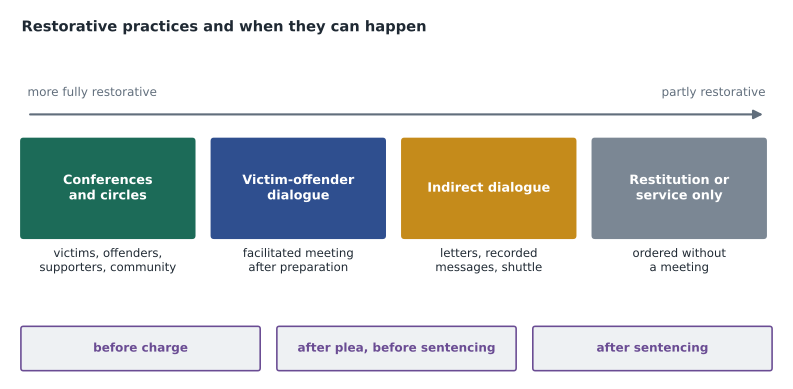
Brooks describes the main forms. Victim-offender mediation or dialogue brings a victim and offender together with a trained facilitator, after separate preparation with each, to talk about what happened, its effects and what can be done to repair the harm. Conferencing widens the circle to include supporters of both the victim and the offender, such as family members, and sometimes a police officer; the group discusses the harm and agrees on a plan. Circles, drawn from Indigenous traditions, bring together the victim, the offender, their supporters and community members, often with an Elder or Knowledge Keeper, to talk through the harm in turn and reach decisions by consensus. Indirect forms include letters, recorded messages and shuttle dialogue, in which the facilitator carries messages back and forth when a meeting is not possible or not wanted.
Restorative processes can happen at different points in the justice system. Some divert cases before charges or before trial. Some happen after a guilty plea and before sentencing, with the outcome reported to the court. Some take place years after sentencing, often in prison, at the request of victims of serious violence who want answers only the offender can give. In the United States, restorative programs are run by courts, prosecutors, probation departments, schools and community organizations, often for juveniles and lower-level offenses. Many states, including Ohio, offer victim-offender dialogue in their prison systems, through which victims of serious crimes, including the families of homicide victims, can ask to meet the offender after careful preparation, sometimes many years later.
Indigenous justice and restorative practice
Jesse Morningstar points out that what the textbooks call restorative justice is, for many Indigenous nations, simply justice: ways of responding to harm that existed long before European courts arrived and that focus on healing the victim, the offender and the relationships between them and their community. In the United States, many tribal nations operate peacemaking courts and circles based on their own traditions, the best known being the Navajo Nation's peacemaking program, which uses respected community members to help the parties talk through the harm and reach agreement. Jesse's own tribe runs a peacemaking program that works with victims as well as offenders. Brooks adds a caution Jesse agrees with: these processes belong to the communities that practice them, and borrowing their forms without their values and authority can do harm.
What the evidence shows
Restorative justice has been studied more rigorously than most criminal justice programs. In 2007 Lawrence Sherman and Heather Strang reviewed dozens of studies, including randomized trials in Australia, England and the United States, in which cases were randomly assigned either to a restorative conference in addition to the usual process or to the usual process alone. Victims who took part in conferences were consistently more satisfied with how their cases were handled than victims who went through court alone. They were more likely to receive an apology, less likely to feel angry or fearful toward the offender, and less likely to want revenge. In one English trial, victims of burglary and robbery who took part in conferences showed fewer symptoms of post-traumatic stress afterward.
The effects on offenders were also encouraging, though more varied. On average, conferences modestly reduced repeat offending, and the reductions were larger for violent crimes than for property crimes, and for offenders with a victim willing to meet them. Restorative processes did not work equally well everywhere, and they did not work for every offender. But in no rigorous study did they make outcomes worse for victims who chose to take part. Desjardins tells the class that he had doubts when Port Ardent started referring cases to the program, and that he changed his mind after sitting in on a conference with a teenager who had stolen from an elderly neighbor.
The program below summarizes outcomes from Port Ardent's restorative justice program over two years, compared with similar cases that went through court only. Brooks calls the figures illustrative: the cases were not randomly assigned, so victims who chose a conference may have differed from those who did not.
# Port Ardent victim survey, two years: restorative conference plus court versus court only (illustrative)
groups = {
    "conference": {"victims": 84, "satisfied": 71, "received apology": 78, "still fearful": 13},
    "court only": {"victims": 210, "satisfied": 118, "received apology": 23, "still fearful": 71},
}
for name, g in groups.items():
    n = g["victims"]
    print(f"{name:11} satisfied {g['satisfied'] / n:.2f}  apology {g['received apology'] / n:.2f}  still fearful {g['still fearful'] / n:.2f}")
gap = groups["conference"]["satisfied"] / 84 - groups["court only"]["satisfied"] / 210
print("difference in satisfaction:", round(gap, 2))conference satisfied 0.85 apology 0.93 still fearful 0.15 court only satisfied 0.56 apology 0.11 still fearful 0.34 difference in satisfaction: 0.28
Conditions for safe practice
Brooks insists that restorative justice is only as good as the way it is done, and lists the conditions her agency requires before it supports a referral. Participation must be voluntary for the victim at every stage, with no pressure from police, prosecutors, the offender or anyone else, and no suggestion that refusing will affect the case. The offender must accept responsibility for the harm; a meeting is not a place to argue about guilt. Both sides must be prepared separately, often over several sessions, so that the facilitator understands their needs and fears and can judge whether a meeting is safe. Facilitators must be trained and impartial. Agreements must be realistic and monitored. And the victim must be able to stop the process at any time.
Some kinds of cases call for special caution. In intimate partner violence and sexual violence, the offender may use the process to manipulate or intimidate the victim, and the victim may feel pressure to participate or to agree. Many American jurisdictions restrict or prohibit mediation in domestic violence cases, and programs that offer restorative options for sexual violence use specialized facilitators and protocols. Brooks does not believe restorative approaches should never be used in these cases, because some survivors want them and benefit, but she believes they must be led by the survivor's wishes and handled by people with specialized training.
Police officers have specific roles. They can identify cases that might be suitable and tell victims that restorative options exist, without promoting them. They can provide information to the program, with the appropriate permissions. In some models, officers facilitate or attend conferences. And they must never use a restorative option as a way of avoiding the work of an investigation or of closing a file that should be charged.
Ruth and Kyle Brandt
Ruth agreed to meet Brandt after three preparation sessions with a facilitator from the Ardent County Court's restorative justice program. She brought her nephew; Brandt brought his older sister. The meeting took ninety minutes. Brandt said he had been out of work and behind on rent, that he had chosen her store because it looked easy, and that he had not thought about who owned it. Ruth told him about the twenty-two years she had spent building the business, the morning she found the broken door, and the nights she had lain awake listening to cars. Brandt apologized. He said he had not expected to feel as bad as he did.
The agreement they reached had three parts: the restitution already ordered, a letter from Brandt to Ruth's two employees, and forty hours of volunteer work at the community tool library run by the public library, which lends tools to people who cannot afford them. The facilitator reported the agreement to the court before sentencing. Ruth told Brooks afterward that the meeting had not changed what happened, but that she no longer pictured a faceless stranger at her door at night. 'He is just a young man who did something stupid,' she said. 'I can live with that.'
Worked problem
Responding when a victim is asked about a restorative meeting
Grace Whitford's daughter calls the detective after reading about restorative justice. She asks whether her mother can meet the people who defrauded her, and says she thinks it would be good for her mother whether or not her mother wants it. How should the detective respond?
Show solution
- Explain the conditions: a restorative meeting requires an identified offender who accepts responsibility, and in Grace's case the people who received her money were never identified.
- Explain voluntariness: any process would depend on Grace's own wishes, not her family's, and she could refuse or stop at any time.
- Offer what is possible: the courier arrested for a different victim's fraud is part of the same network; if he pleads guilty, the program could explore whether he would take part in a broader dialogue or write a letter, if Grace wanted that.
- Refer to experts: put Grace and, with her consent, her daughter in touch with the restorative justice program and victim services, who can explain options.
- Avoid promoting it: the detective should give information, not pressure, and record the conversation.
Answer: The detective explains that a meeting needs an offender who accepts responsibility and Grace's own free choice, describes what might be possible and refers to the program without promoting it.
Common mistakes
MistakeRestorative justice is a soft option for offenders.
InsteadFacing the person harmed and taking responsibility is often harder than a court appearance.
MistakeVictims should be encouraged to take part because it is good for them.
InsteadParticipation must be the victim's free choice, without pressure from anyone.
MistakeRestorative justice replaces the criminal justice system.
InsteadIt usually works alongside it, before charge, before sentencing or after sentence.
MistakeRestorative processes are always appropriate for intimate partner violence.
InsteadThese cases call for special caution, specialized facilitators and survivor-led decisions.
Summary and key terms
- Restorative justice asks who was harmed, what they need and whose obligation it is to repair the harm.
- Its modern roots include the 1974 Elmira case, Indigenous circles, New Zealand family group conferences and police-led conferencing.
- Forms include victim-offender dialogue, conferences, circles and indirect dialogue, at different points in the process.
- Randomized trials show higher victim satisfaction, less fear and anger and modest reductions in reoffending.
- Safe practice requires voluntariness, accepted responsibility, preparation, trained facilitators and the right to stop.
- Police can identify cases and inform victims but must not pressure them or use restorative options to avoid investigating.
- Restorative justice
- An approach that treats crime as harm and brings affected people together to repair it.
- Victim-offender dialogue
- A facilitated meeting between a victim and an offender after separate preparation.
- Conference
- A restorative meeting including supporters of the victim and offender.
- Circle
- A restorative process drawn from Indigenous traditions, involving community members and consensus.
- Shuttle dialogue
- A facilitator carrying messages between a victim and offender who do not meet.
- Voluntariness
- The principle that the victim chooses freely whether and how to take part.
Practice problems
Work each problem on paper first, then reveal the answer to check.
What three questions did Zehr propose in place of the court's questions?
Show answer
Who has been harmed? What are their needs? Whose obligations are these?
What happened in the Elmira case?
Show answer
Two young men who vandalized 22 properties met their victims, apologized and paid restitution, leading to the first victim-offender reconciliation program.
In the code example, what share of conference victims were satisfied?
Show answer
71 of 84, about 0.85.
Why are restorative processes in intimate partner violence cases handled with special caution?
Show answer
Because the offender may manipulate or intimidate the victim, and the victim may feel pressure to agree.
Lesson quiz · 5 questions
Score 60% or more to complete this lesson.
Create a free account to save your progress, take quizzes and earn a certificate.