
LES-115 · Lesson 5 of 12 · 20 min
Trauma-informed first response and avoiding secondary victimization
▶ Video coming soon A video version of this lesson is on the way.
Brooks starts with a short exercise. She asks each student to write down the worst thing a police officer, nurse, teacher or other official ever said to them at a bad moment in their life. Most of the class writes something. Priya Sandhu wrote that after her car was broken into, the officer on the phone said, 'What did you expect, parking there?' Marco DiSanto wrote about an army medic who told him to stop complaining while he waited with a broken wrist. Brooks collects the cards and reads a few aloud. 'Think about how long you have remembered these,' she says. 'Now imagine it was the night you were assaulted. This lesson is about not being the person on somebody's card.'
What trauma-informed means
A trauma-informed approach starts from the knowledge in Lesson 4: that many of the people police deal with have experienced trauma, that trauma affects how people behave, remember and react, and that the response of officials can either help recovery or make things worse. The term does not mean that officers become therapists, or that they stop investigating. It means that they investigate in a way that does not cause unnecessary harm, and that they understand behavior that might otherwise seem suspicious or uncooperative.
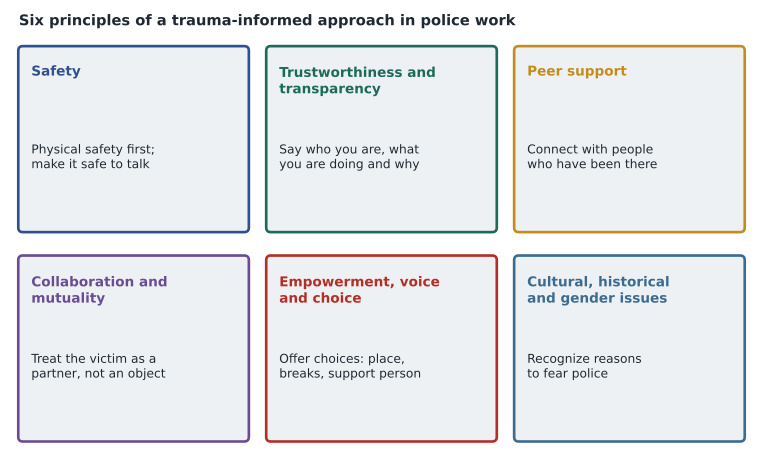
In 2014 the United States Substance Abuse and Mental Health Services Administration described six principles of a trauma-informed approach that are now widely used in both countries: safety; trustworthiness and transparency; peer support; collaboration and mutuality; empowerment, voice and choice; and attention to cultural, historical and gender issues. Brooks translates them into police practice. Safety means physical safety first, but also making the person feel safe enough to talk. Transparency means explaining who you are, what you are doing and why. Collaboration means treating the victim as a partner in the investigation, not an object of it. Choice means giving the victim as much control as the situation allows, because crime takes control away. Attention to culture and history means recognizing that some victims have good reasons to fear police, and that what feels respectful differs across communities.
The first minutes
The first officer on scene has several jobs at once: securing the scene, making sure everyone is safe, getting medical help, broadcasting a description, and identifying witnesses. Brooks does not ask officers to neglect any of them. She asks them to remember that the victim is watching how they do it. Psychological first aid, a set of practices promoted by the World Health Organization and others for the hours after a crisis, gives a simple framework: look, listen and link. Look for safety risks and for people with urgent needs. Listen to the person without pressing them to talk about the worst parts. Link them with information, practical help and the people they trust.
In practice, Brooks gives the class a short list. Introduce yourself by name and explain your role. Tell the person they are safe now, if they are. Attend to their physical needs: medical care, warmth, water, a place to sit away from onlookers. Ask who they would like to call. Explain what will happen in the next few minutes and hours. Let them know they can take a break, ask questions or ask for someone to be with them. Avoid touching without asking. Keep your voice calm and your body relaxed; a victim who has just been attacked may react strongly to sudden movements, raised voices or an officer standing over them.
Officer Malhotra did most of this on Front Street, though he admits he did not do it all. He knelt beside Daniel instead of standing over him, told him his name, said an ambulance was a minute away and asked if there was someone he wanted to call. Daniel asked for his roommate. Malhotra did not ask him to describe the attack in detail; he asked only for what he needed for the broadcast: how many attackers, which way they went, and what they looked like. What he forgot to do, he tells the class, was give Daniel anything in writing. Daniel left in the ambulance with no file number and no name, and spent two days not knowing who to call.
Interviewing traumatized victims
The full interview usually comes later, sometimes hours, sometimes days. LES-104 taught the class the basics of interviewing victims and witnesses. Brooks adds what trauma-informed practice changes. Start by explaining the purpose of the interview and how the information will be used, including that it may be disclosed to the defense. Let the victim choose, where possible, the time, the place and whether a support person is present. Begin with free recall: ask the person to tell you what they remember, in their own words and in whatever order it comes, and do not interrupt. Many victims remember in fragments and need to circle back. Forcing a strict chronological order too early can make recall harder.
Then follow up with open questions, building on what the person has said: 'You mentioned his shoes. Tell me more about them.' Questions about senses, such as what the person heard, smelled or felt, can help bring back details stored that way. Ask about the person's thoughts and feelings at the time when it helps understand what happened, for example why they did not run, but never in a way that suggests they should have. Save specific, closed questions for the end, and avoid leading questions entirely: the probationary officer's question to Mira Osei in LES-104, 'He had a crowbar, didn't he?', is the classic example of what not to do.
Many Ohio agencies use forensic interviewing approaches drawn from child advocacy and sexual assault training, and record victim interviews. A recorded interview cannot usually replace a victim's live testimony at trial, but a thorough first interview reduces the number of times the victim must tell the story. Brooks emphasizes the cost of repetition. A victim may tell the story to the 911 call-taker, the first officer, a paramedic, a nurse, a detective, a prosecutor and finally a court. Each telling is a chance to be disbelieved, and each one can bring the experience back. Coordinating so that the full account is taken once, well, is one of the most effective ways to reduce harm.
Some phrases are almost guaranteed to cause harm, and Brooks lists them. Why questions that sound like blame: why were you walking there, why did you open the door, why did you send the money? Statements of disbelief: that does not make sense, are you sure? Minimizing: at least you were not badly hurt, it was only money. Promises the officer cannot keep: we will get him, you will get your money back. She offers alternatives. 'Help me understand what happened next.' 'What was going through your mind at that point?' 'I am going to do everything I can, and I will tell you honestly what happens.'
Language, support persons and accessibility
Daniel's first language is Portuguese. His English is good for work, but in the hospital, in pain and on medication, he struggled to find words. Brooks tells the class that victims should be interviewed in a language they are comfortable in, through a qualified interpreter when needed, and that family members, roommates and especially children should not be used to interpret, except for the briefest safety questions in an emergency. A family interpreter may soften, omit or change what the victim says, may be connected to the offender, and learns private details the victim may not want them to know. Port Ardent uses a telephone interpreting service available at all hours, and the detective arranged an in-person Portuguese interpreter for Daniel's second interview.
The same thinking applies to other needs. A victim who is deaf may need a sign language interpreter, not a notepad. A victim with a cognitive disability may need shorter questions, more time and a support person they trust. Victims can usually have a support person present during an interview, as long as that person is not a witness and does not answer for them. The goal in every case is the same: an account given as fully and accurately as the victim can give it, with as little added distress as possible.
Secondary victimization
Secondary victimization is harm caused not by the crime but by the response to it. It can come from police, prosecutors, defense lawyers, judges, medical staff, employers, the media, friends and family. Common examples include being disbelieved or blamed, being questioned insensitively, waiting for long periods without information, being made to retell the story many times, having property held as evidence for months without explanation, learning about developments in the case from the news, and seeing one's personal details made public.
Brooks gives the class a sobering example from each country. In the 2000s and 2010s, investigators found hundreds of thousands of untested sexual assault kits stored in police evidence rooms across the United States, some for decades. Each kit represented a victim who had undergone a long forensic examination and then heard nothing. In Ohio, the Attorney General's testing initiative tested nearly 14,000 kits submitted by police agencies around the state, producing DNA matches that led to many prosecutions, and Ohio law now sets deadlines for submitting kits to a laboratory. Both stories, she says, are about a system that did not take victims seriously, and both led to reforms that new officers inherit.
Giving control back
Because crime takes control away, giving choices back is one of the most powerful things an officer can do, even when the choices are small. Where would you like to sit? Would you like a break? Would you like someone with you? Do you want me to call victim services now, or would you prefer the number for later? Some choices are not the victim's to make: the decision to lay a charge belongs to the police and the prosecutor, and officers must not promise otherwise. But even then, transparency is a form of respect. Explaining who decides, and why, and how the victim's views will be heard, is very different from simply announcing a decision.
The service surveys victims a month after their case is assigned. Sergeant Haddad was struck by one pattern in the results, shown in the program below: victims who were told what would happen next and given a named contact were far more satisfied, regardless of whether anyone had been charged.
# Victim follow-up survey: satisfied respondents by what the officer did
groups = {
    ("told next steps", "charged"): (142, 121),
    ("told next steps", "not charged"): (118, 89),
    ("not told", "charged"): (64, 33),
    ("not told", "not charged"): (97, 26),
}
for (told, outcome), (n, sat) in groups.items():
    print(f"{told:15} {outcome:12} {sat:3}/{n:3}  {sat / n:.2f}")
told = [v for k, v in groups.items() if k[0] == "told next steps"]
not_told = [v for k, v in groups.items() if k[0] == "not told"]
rate = lambda vs: sum(s for n, s in vs) / sum(n for n, s in vs)
print("told next steps:", round(rate(told), 2), " not told:", round(rate(not_told), 2))told next steps charged 121/142 0.85 told next steps not charged 89/118 0.75 not told charged 33/ 64 0.52 not told not charged 26/ 97 0.27 told next steps: 0.81 not told: 0.37
Victims who were told what would happen next but saw no charge were more satisfied than victims who saw a charge but were never told what to expect. Desjardins tells the class that this is procedural justice in a single table: people care about outcomes, but they care at least as much about being treated as if they matter.
Worked problem
Re-interviewing Grace Whitford
Detective Ellen Park of the fraud unit needs a full statement from Grace Whitford, who is embarrassed, has said twice that she feels stupid, and is anxious about coming to the police station. How should Park plan the interview?
Show solution
- Offer choices: ask whether Grace would prefer to be interviewed at home or at the station, and whether she would like her daughter or a victim services worker present.
- Explain the purpose and process at the start: what the interview is for, how long it will take, that it will be recorded and why, and that she can take breaks.
- Address the shame directly but briefly: explain that these frauds are run by organized groups who target thousands of people, including people with professional backgrounds, and that the fault is entirely theirs.
- Use free recall, then open questions about the calls, the caller's voice, the instructions given and how the money was sent, without why questions that imply she should have known.
- End with information: what happens next, the realistic chances of recovering money, the referral to victim services, and a named contact and phone number.
Answer: Park gives Grace control over the setting, explains the process, takes the blame off her, uses free recall and open questions, and closes with clear next steps and a named contact.
Common mistakes
MistakeBeing trauma-informed means not investigating.
InsteadIt means investigating in a way that avoids unnecessary harm and understands trauma-related behavior.
MistakeA good interview always goes in strict chronological order.
InsteadBegin with free recall in the victim's own order; sequence can be clarified later.
MistakeWhy questions are the best way to understand a victim's choices.
InsteadWhy questions often sound like blame; ask what was going through their mind instead.
MistakeVictims care only about whether someone is charged.
InsteadBeing informed and treated with respect strongly shapes satisfaction regardless of outcome.
Summary and key terms
- A trauma-informed approach recognizes the effects of trauma and avoids causing further harm.
- The six principles are safety, transparency, peer support, collaboration, choice and attention to culture, history and gender.
- Psychological first aid can be summarized as look, listen and link.
- Interviews should begin with free recall, follow with open questions and avoid leading or blaming questions.
- Secondary victimization comes from disbelief, blame, delay, repetition and lack of information.
- Giving victims choices and information restores some of the control the crime took away.
- Trauma-informed approach
- A way of working that recognizes the effects of trauma and avoids re-traumatizing people.
- Psychological first aid
- Early support after a crisis built around looking, listening and linking.
- Free recall
- Inviting a person to tell what they remember in their own words and order.
- Leading question
- A question that suggests its own answer.
- Unfounded
- A police classification meaning officers concluded no offense occurred.
- Secondary victimization
- Harm caused by the response of officials or others rather than by the crime itself.
Practice problems
Work each problem on paper first, then reveal the answer to check.
What are the three actions in psychological first aid?
Show answer
Look, listen and link.
Why should a victim interview usually begin with free recall?
Show answer
Because traumatic memories are fragmented, and the victim's own order helps recall more than imposed questions.
In the code example, what share of victims who were not told next steps were satisfied?
Show answer
59 of 161, about 0.37.
Give one alternative to asking a victim why they did something.
Show answer
'What was going through your mind at that point?' or 'Help me understand what happened next.'
Lesson quiz · 5 questions
Score 60% or more to complete this lesson.
Create a free account to save your progress, take quizzes and earn a certificate.