
LES-114 · Lesson 8 of 12 · 19 min
Mental health law and emergency hospitalization
▶ Video coming soon A video version of this lesson is on the way.
By 22:40 on Calder Street, Adam was calmer, but his situation had not changed. He had not slept properly in five days, had eaten almost nothing, still believed the lights were watching him and said that he would 'deal with' the neighbor if the watching did not stop. Morales asked whether he would come to the hospital to talk to a doctor about sleep and the cameras. He said no. His sister Claire, on speakerphone, asked him to go. He said no again, quietly. Kaplan now had a legal decision to make, and Desjardins tells the class that this is the moment where knowing the law exactly matters most.
Voluntary first
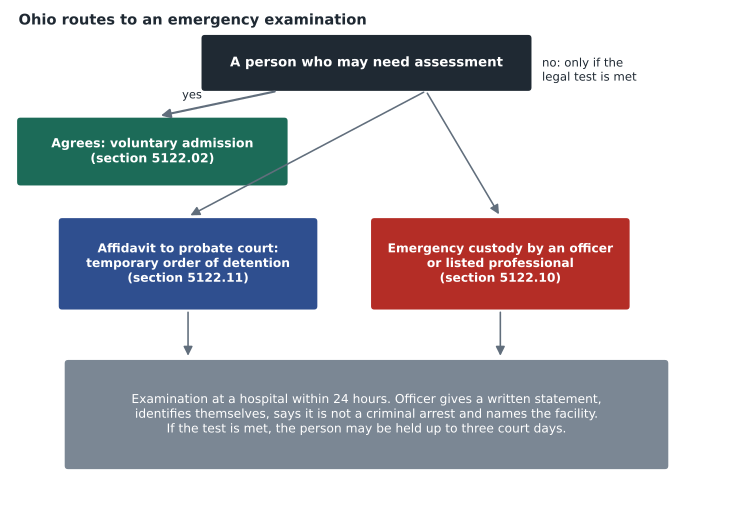
Ohio law is built on the principle that people should receive care voluntarily wherever possible. Section 5122.02 of the Revised Code allows a person to apply for voluntary admission to a hospital, and most people admitted to psychiatric units are voluntary patients. A person who agrees to go to hospital with officers, as Maya did in lesson 7, is not taken into custody; they are being helped. The law's powers to take a person to hospital against their will are exceptions, with strict tests, because detaining a person who has committed no offense is one of the most serious things the state can do. Other states have their own emergency detention laws with similar structures but different wording and time limits.
Two routes to an emergency examination
Ohio law provides two main routes for bringing a person to a hospital against their will. Under section 5122.11, any person can file an affidavit with the probate court describing why they believe a person has a mental illness and is subject to a court order; the court can issue a temporary order of detention directing that the person be taken to a hospital for examination. Under section 5122.10, certain professionals, including a police officer or sheriff, a psychiatrist, a licensed physician or clinical psychologist, certain psychiatric nurses, a health officer and some parole officers, can take a person into custody immediately and transport them to a hospital for an emergency examination, without a court order.
The section 5122.10 test
Section 5122.10 has two main parts, and Desjardins insists that officers be able to state each one in their notes. First, the officer must have reason to believe that the person is a person with a mental illness subject to court order, which under section 5122.01 includes a person whose illness makes them a substantial risk of physical harm to themselves or others, as shown by threats, attempts or behavior, or who is unable to provide for basic needs such as food, clothing and shelter, or who would benefit from treatment and is at risk of serious harm without it. Second, the officer must believe the person represents a substantial risk of physical harm to themselves or others if allowed to remain at liberty pending examination. If both are met, the officer may take the person into custody and transport them immediately to a hospital.
Kaplan walks the class through her reasoning on Calder Street. Mental illness subject to court order: Adam had a known diagnosis of psychosis, was not taking treatment, had smashed the hallway light, had told Mrs. Halverson through her door that he would make the watchers stop, and had not slept or eaten for days. Substantial risk if left at liberty: he held fixed beliefs that his neighbor was watching him and had said he would deal with her, so leaving him alone that night, next door to the woman he blamed, posed a substantial risk of physical harm to her, and his lack of sleep and food was a risk to him. Morales, as a clinician, agreed with the assessment. Desjardins notes that her agreement helped but did not replace Kaplan's own judgment, because the legal power belonged to the officer.
Desjardins stresses what the test does not allow. A diagnosis alone is not enough. Odd behavior, being homeless or refusing treatment are not enough. A family member's wish that the person go to hospital is not enough. An officer who uses the power simply because it is late and the person is difficult is acting unlawfully. Courts treat taking a person into custody for a mental health examination as a seizure under the Fourth Amendment, so it must be supported by probable cause that the person is dangerous to themselves or others, and any force used must be reasonable under Graham v. Connor.
Carrying out the apprehension
Kaplan explained her decision to Adam before acting. 'Adam, I'm worried about you and about your neighbor. You haven't slept in days and you're frightened. I'm going to take you to the hospital tonight to see a doctor. This isn't a criminal arrest. My name is Nora Kaplan, I'm a Port Ardent police officer, and I'm taking you to Port Ardent General Hospital to be examined.' She asked whether he wanted to bring his jacket and his phone, and whether he wanted Claire to meet them there. He was upset, but he put on his jacket. Ohio law requires the person taking someone into custody to identify themselves by name, profession and affiliation, to tell the person that the custody is not a criminal arrest, to tell them the name of the facility where they are being taken, and to act as discreetly as possible. Kaplan's words met each of those duties.
Port Ardent policy allows officers to transport a person taken under mental health law without handcuffs when an assessment shows it is safe, and requires officers to record their reasons either way. Kaplan judged that Adam was calm and cooperative, conducted a pat-down search for safety with his agreement, explaining each step before she did it, and transported him in the back of the co-response car with Morales following. Desjardins tells the class that handcuffs on a person who has committed no crime and is cooperating can feel deeply humiliating and can damage trust for years, but that officers must also protect themselves and the person. The decision should be made thoughtfully, not by habit.
At the hospital: the written statement and the examination
Section 5122.10 requires the person who takes someone into custody to give the hospital a written statement describing the circumstances and the reasons for the belief that the person met the test. The person or their attorney can ask for a copy. The hospital must examine the person within 24 hours of arrival. If the clinician in charge decides the person does not meet the test, the person must be released at once unless a court has issued a detention order. If they do, the person may be held for up to three court days, during which they may become a voluntary patient or the hospital may file an affidavit with the probate court. A general hospital that is not a psychiatric facility must transfer the person to one within 24 hours. Kaplan stresses that the written statement is the officer's legal record, and that a vague statement such as 'acting strange' will not support the detention.
Kaplan and Adam arrived at Port Ardent General at 23:05. Kaplan handed the triage nurse her written statement within ten minutes, but Adam was not moved to a secure room and handed over to hospital staff until 01:40, two hours and 35 minutes later. Kaplan and Morales stayed with him the whole time. Claire arrived at midnight. Morales says the wait was not wasted: Adam talked with his sister and became calmer, and the doctor who saw him at 01:40 knew a great deal about him from Morales's notes.
Port Ardent hospital waits
Waiting at hospital is one of the largest costs of mental health calls. The program below summarizes the time from arrival at hospital to the hospital accepting the person, for Port Ardent's mental health transports in 2025.
# Minutes from arrival at hospital to handover, Port Ardent mental health transports, 2025
# (minutes rounded up to the group's upper limit, number of transports)
groups = [(30, 41), (60, 73), (120, 118), (180, 96), (240, 52), (360, 31), (480, 9)]
n = sum(c for m, c in groups)
cum = 0
for limit, count in groups:
    cum += count
    print(f"within {limit:3} minutes: {cum:3} of {n}  ({cum / n:.2f})")
officer_hours = sum(limit * count for limit, count in groups) / 60 * 2   # two officers each
print("upper estimate of officer-hours spent waiting:", round(officer_hours))within 30 minutes: 41 of 420 (0.10) within 60 minutes: 114 of 420 (0.27) within 120 minutes: 232 of 420 (0.55) within 180 minutes: 328 of 420 (0.78) within 240 minutes: 380 of 420 (0.90) within 360 minutes: 411 of 420 (0.98) within 480 minutes: 420 of 420 (1.00) upper estimate of officer-hours spent waiting: 2167
Only about one transport in ten was handed over within half an hour, and about one in four within an hour. Almost half waited more than two hours. Desjardins says that hospitals face real pressures, including crowded emergency departments and a shortage of psychiatric beds, and that the solution is a shared protocol, not blame. Port Ardent and the hospital signed a new transfer agreement in January 2026, and the course will look at its early results in lesson 10.
Other powers and duties
Ohio law also allows courts to order outpatient treatment for some people with mental illness, and probate courts hear the hearings that decide whether a person can be held beyond the emergency period. Officers should know that the Americans with Disabilities Act applies to police services, so departments must make reasonable modifications to their practices for people with mental illness and other disabilities, such as allowing extra time, using de-escalation and involving mental health professionals where possible. The Department of Justice and the Department of Health and Human Services issued joint guidance in 2023 on emergency responses to people with behavioral health disabilities.
Worked problem
Applying section 5122.10
At 14:00, officers find a man sitting on a sidewalk in light rain, talking to himself. He is homeless, is known to have schizophrenia and refuses to go to a shelter or hospital. He has food in his bag, a coat on and has not threatened anyone. A store manager wants him removed. Can the officers take him to hospital against his will?
Show solution
- Check the test in section 5122.10: there is no threat, attempt or behavior showing a substantial risk of physical harm, and he can meet his basic needs; he has food and a coat.
- A diagnosis, homelessness and refusing services are not enough to meet the test.
- Look for other options: offer outreach, a shelter, food or a call to the street outreach team or co-response team, and explain to the manager what the law allows.
- If he is trespassing on private property, deal with that under the relevant law, using the least intrusive approach.
- Record the observations and the reasons for the decision.
Answer: No. The legal test is not met, so the officers cannot take him to hospital against his will. They should offer support and deal with any separate issue in the least intrusive way.
Common mistakes
MistakeA diagnosis of mental illness allows officers to take a person to hospital.
InsteadThe legal test requires specific grounds about behavior and risk, not just a diagnosis.
MistakeIf family want the person in hospital, officers can take them.
InsteadFamily can file an affidavit with the probate court; officers act under section 5122.10 only if their own grounds meet the test.
MistakeOnce at hospital, officers can leave.
InsteadOfficers must give a written statement and follow the hospital's handover procedure; the person stays in custody until handed over.
MistakeHandcuffs are always required for transport.
InsteadPolicy may allow transport without handcuffs after an assessment; record the reasons either way.
Summary and key terms
- Voluntary admission under section 5122.02 comes first; involuntary powers are exceptions with strict tests.
- Ohio routes: an affidavit and temporary detention order from the probate court (section 5122.11) and emergency custody (section 5122.10).
- Section 5122.10 requires reason to believe the person has a mental illness subject to court order and represents a substantial risk of physical harm if left at liberty.
- The custody is a Fourth Amendment seizure: identify yourself, say it is not an arrest, name the facility and act discreetly.
- Give the hospital a written statement; the hospital must examine within 24 hours and may hold for up to three court days.
- Record every element of the legal test in notes and reports.
- Emergency hospitalization
- Taking a person into custody for an emergency psychiatric examination under section 5122.10.
- Written statement
- The statement given to the hospital describing the circumstances and reasons for custody.
- Subject to court order
- The legal category of mental illness and risk that permits involuntary treatment in Ohio.
- Temporary order of detention
- A probate court order directing that a person be taken for examination.
- Probate court
- The Ohio court that hears involuntary commitment cases.
- Reasonable modification
- A change in practice required by the ADA to avoid discriminating against a person with a disability.
Practice problems
Work each problem on paper first, then reveal the answer to check.
What are the two parts of the section 5122.10 test?
Show answer
Reason to believe the person has a mental illness subject to court order, and that they represent a substantial risk of physical harm to self or others if left at liberty.
How soon must the hospital examine the person?
Show answer
Within 24 hours of arrival.
In the code example, what share of transports were handed over within an hour?
Show answer
114 of 420, about 0.27.
Why was the homeless man in the worked example not taken to hospital?
Show answer
The legal test was not met; a diagnosis, homelessness and refusing services are not enough.
Lesson quiz · 5 questions
Score 60% or more to complete this lesson.
Create a free account to save your progress, take quizzes and earn a certificate.