
LES-114 · Lesson 6 of 12 · 19 min
Crisis communication and de-escalation
▶ Video coming soon A video version of this lesson is on the way.
Desjardins plays the class a short section of the body-worn camera recording from Calder Street, with Adam's face blurred. Kaplan stands to the side of the door, her hands visible and relaxed. 'Adam, my name is Nora. I'm with the Port Ardent police, and I work with a nurse named Teresa. Your neighbor was worried, and we came to make sure everyone is safe, including you.' A pause. Then Adam's voice: 'You're with them.' Kaplan does not argue. 'I can hear that you're scared someone is watching you. That sounds exhausting. I'm not here to watch you. I'd like to understand what's been happening.'
The class watches for nine minutes. Kaplan says very little. She asks short questions, repeats what Adam says in her own words, and waits. Adam talks about the cameras, about not sleeping, about his medication making him feel 'like cement'. At minute eight, he says, 'I'm so tired.' Kaplan answers, 'You've been on guard for days. Anyone would be tired.' Adam leans the broom handle against the wall. Desjardins pauses the video. 'That,' he says, 'is de-escalation. No tricks, no commands. She listened until he felt heard.'
What de-escalation means
De-escalation is the use of communication, time, distance and positioning to reduce the intensity of a situation, so that a person can regain control of their behavior and the situation can be resolved with less risk of harm. It is not a single technique and it is not the absence of action. Officers who are de-escalating are working hard: watching, assessing, choosing their words and their position, and keeping options open, including the option of using force if it becomes necessary. Many US states and departments now require officers to use de-escalation techniques when it is safe and feasible to do so, and Ohio's state standards on use of force encourage de-escalation, which the Ohio Collaborative's certification process reviews.
Morales explains why it works. A person in crisis is in a state of high arousal: heart racing, thinking narrowed, the body ready to fight or flee. In that state, people cannot process complex information, and they respond to threats, real or perceived, by escalating. Commands, raised voices, crowding and sudden movements increase arousal. Calm, slow speech, space and the experience of being understood reduce it. Only when arousal comes down can a person think about options, which is when officers can begin to help them choose a safe one.
The behavioral change stairway
Kaplan teaches the class a model used by crisis negotiators, originally developed at the FBI's crisis negotiation unit and now taught to patrol officers in many services. It is a staircase with five steps. The first is active listening: paying full attention and letting the person know they are heard. The second is empathy: understanding and acknowledging how the person feels, without necessarily agreeing. The third is rapport: a sense of trust and connection that develops from the first two. The fourth is influence: once there is rapport, the person becomes willing to consider what the officer suggests. The fifth is behavioral change: the person chooses to do something different, such as putting down a weapon, coming out or going to hospital.
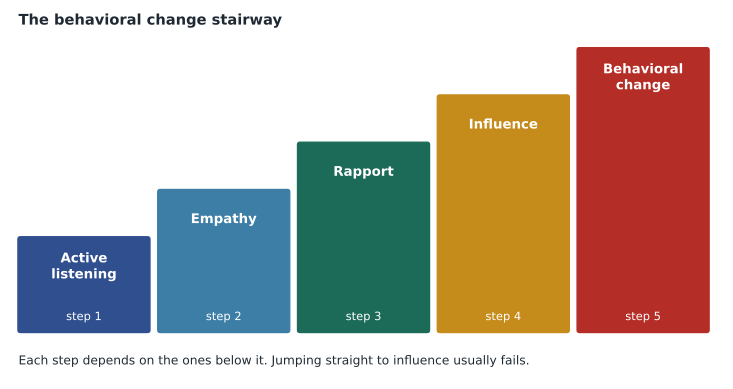
The key lesson, Kaplan says, is that the steps cannot be skipped. Officers are trained to solve problems, so their instinct is to jump straight to influence: 'Put that down and come with us.' Without rapport, that request usually fails, and the officer escalates to commands and then to force. On Calder Street, she spent nine minutes on the first three steps before asking Adam for anything.
Active listening skills
Morales lists the skills the class will practice in role-plays. Minimal encouragers are small sounds and words that show attention: 'Mm-hm', 'Okay', 'Go on'. Paraphrasing is repeating the content of what the person said in your own words: 'So you haven't slept since Monday because you're worried about the cameras.' Emotional labeling names the feeling you hear: 'You sound frightened.' 'It sounds like you're angry that nobody believes you.' Labels do not need to be perfect; if the person corrects you, they are engaging. Open-ended questions invite the person to talk: 'What's been happening tonight?' rather than 'Are you okay?' Summarizing pulls together what the person has said, which shows understanding and gives structure to a jumbled story. Effective pauses, staying quiet after the person speaks or before answering, give the person room to keep talking and often fill the silence with useful information.
Priya asks how emotional labeling differs from telling someone how they feel. Morales says the difference is tentativeness: 'It sounds like...' or 'I'm guessing you might be...' invites correction, while 'You're angry' can feel like an accusation. Linh, who has been taking crisis calls as a call-taker, adds that on the phone she relies on tone and pauses even more, because the caller cannot see her face.
Voice, body and space
Kaplan turns to what officers communicate without words. Speak slowly, quietly and in short sentences; a lower, slower voice tends to slow the other person down. Keep your hands visible and relaxed, not on your weapons. Stand at an angle rather than square on, which is less confrontational and also safer. Keep a distance that gives both you and the person room, often called a reactionary gap, and avoid towering over someone who is sitting. Avoid sudden movements. If several officers are present, only one should speak, and the others should stay back and out of the person's direct line of sight where possible.
She also describes what to avoid. Do not say 'calm down', which almost never works and often sounds dismissive. Do not argue with delusions or try to prove the person wrong. Do not threaten, lie or make promises you cannot keep, such as 'You won't go to hospital', because broken trust is very hard to rebuild. Do not shout multiple commands, especially from several officers at once; a person in crisis cannot follow them, and conflicting commands can be dangerous. Do not rush. Do not take insults personally; they are part of the crisis, not a judgment of you.
Choices and small agreements
People in crisis often feel powerless. Offering real choices, even small ones, gives back a sense of control and builds cooperation: 'Would you like to sit down or stand?' 'Do you want to call your sister, or should I?' 'Would you like to bring a jacket?' Each small agreement makes the next one easier. Kaplan warns that choices must be real: offering a choice and then taking it away destroys trust. When there is something that is not negotiable, such as a weapon being put down, it is better to say so plainly and explain why, and then offer choices about everything else.
Back on Calder Street, after the broom handle was against the wall, Kaplan asked whether Adam would mind stepping into the hallway, where the light was better, or whether he would prefer that she and Morales come in. He chose to let them in. Malhotra stayed at the door. Morales introduced herself and sat on a kitchen chair, lower than Adam, who was standing. Over the next half hour, she asked about his sleep, his medication, his sister and his treatment team. Adam said he had stopped his medication about a month earlier because it made him feel slowed down. He agreed that Morales could call Claire.
Communication also depends on culture, language and history. Morales reminds the class that eye contact, personal space, tone and the meaning of silence differ between cultures, and that a person who looks away may be showing respect, not hiding something. People who speak another language should be offered an interpreter, by phone if necessary, rather than a family member, and children should never interpret for their parents in a crisis. Jesse adds that for many Indigenous people, a police uniform carries a long and painful history, and that patience, honesty about why officers are there and, where possible, involving an Elder or a trusted community member can change the tone of a call. Trauma-informed communication follows the same principles throughout: explain what you are doing and why before you do it, ask before touching, offer choices, and do not take a person's fear or anger personally.
When de-escalation does not work
Marco asks what happens when talking does not work. Kaplan answers honestly that sometimes it does not: a person may be too ill, too intoxicated or too determined to harm someone. De-escalation is not a promise that force will never be needed. But even when force becomes necessary, the time spent communicating usually means officers have more information, more help on scene and a better plan, and that any force used is smaller and more controlled. In many departments, use of force reports now ask officers to describe the de-escalation they attempted and why it did or did not succeed.
What the evidence shows
Morales summarizes the research. The most rigorous study of de-escalation training in policing so far evaluated ICAT training in the Louisville Metro Police Department in Kentucky, comparing the period before and after training while accounting for other changes. Researchers found that use-of-force incidents fell by about 28 in every 100, injuries to community members by about 26 in 100 and injuries to officers by about 36 in 100. Other evaluations, including some of crisis intervention training, have found improvements in officers' knowledge, attitudes and confidence, though effects on outcomes such as injuries and arrests are less consistent. The evidence is still developing, she says, but it is moving in one direction.
Listening on the Calder Street recording
The class analyzes the first fifteen minutes of the Calder Street recording, in which Kaplan and Morales spoke with Adam. The program below uses a coded transcript, where each turn records who spoke and for how many seconds, to measure how much of the conversation was Adam talking.
# First 15 minutes at Calder Street: (speaker, seconds) for each turn, from a coded transcript
turns = [("Kaplan", 14), ("Adam", 9), ("Kaplan", 6), ("Adam", 32), ("Kaplan", 5),
         ("Adam", 41), ("Kaplan", 8), ("Adam", 55), ("Kaplan", 4), ("Adam", 38),
         ("Kaplan", 9), ("Adam", 62), ("Kaplan", 7), ("Adam", 47), ("Kaplan", 6),
         ("Morales", 12), ("Adam", 70), ("Morales", 10), ("Adam", 58), ("Morales", 8),
         ("Adam", 66), ("Kaplan", 5), ("Adam", 44)]
talk = {}
for who, s in turns:
    talk[who] = talk.get(who, 0) + s
total = sum(talk.values())
for who, s in sorted(talk.items(), key=lambda x: -x[1]):
    print(f"{who:8} {s:4} seconds  share {s / total:.2f}")
officer_turns = [s for who, s in turns if who != "Adam"]
print("average officer or clinician turn, seconds:", round(sum(officer_turns) / len(officer_turns), 1))Adam 522 seconds share 0.85 Kaplan 64 seconds share 0.10 Morales 30 seconds share 0.05 average officer or clinician turn, seconds: 7.8
Adam spoke for more than four fifths of the talking time, and the average turn by Kaplan or Morales lasted less than eight seconds. Desjardins says this is what good crisis communication usually looks like on paper: short questions, short reflections and a lot of listening. He compares it with a recording from 2019, before Port Ardent's de-escalation training, in which officers did most of the talking, mostly in commands.
Worked problem
Turning commands into conversation
An officer arrives at a convenience store where a man is pacing and shouting that the clerk stole his money. He is not holding anything. The officer's first words are, 'Hey! Calm down and sit on the curb, now!' The man shouts louder. How could the officer have opened differently?
Show solution
- Slow down and position: stop at a distance, at an angle, with hands visible.
- Introduce yourself: 'Hi, I'm Officer Patel. What's your name?'
- Listen and label: 'It sounds like you think you've been cheated. That would make anyone angry. Tell me what happened.'
- Paraphrase and summarize what he says, and use pauses to let him keep talking.
- Offer choices once he is calmer: 'Do you want to sit down while we sort this out, or would you rather stand?'
Answer: The officer should replace commands with an introduction, active listening and emotional labeling, and offer choices once the man feels heard.
Common mistakes
MistakeDe-escalation means doing nothing.
InsteadDe-escalation is active work: assessing, positioning, communicating and keeping options open.
MistakeTelling someone to calm down helps.
InsteadIt rarely works and can sound dismissive; listening and labeling emotions work better.
MistakeOfficers should go straight to asking the person to comply.
InsteadInfluence depends on listening, empathy and rapport first; skipping steps usually fails.
MistakeMore officers giving commands means more control.
InsteadOne voice should speak; multiple commands confuse and escalate.
Summary and key terms
- De-escalation uses communication, time, distance and positioning to lower intensity and risk.
- High arousal narrows thinking; calm, slow communication and being understood reduce it.
- The behavioral change stairway: active listening, empathy, rapport, influence, behavioral change.
- Active listening skills include minimal encouragers, paraphrasing, emotional labeling, open questions, summarizing and pauses.
- Voice, posture and space matter; avoid commands, arguing, threats, lies and broken promises.
- Real choices and small agreements build cooperation; research on de-escalation training shows reductions in force and injuries.
- De-escalation
- Using communication, time, distance and positioning to reduce the intensity of a situation.
- Active listening
- Paying full attention and showing a person that they are heard.
- Emotional labeling
- Naming the feeling a person seems to be experiencing, tentatively.
- Paraphrasing
- Restating what a person said in your own words.
- Rapport
- A sense of trust and connection between two people.
- Reactionary gap
- A distance that gives an officer time to react to a sudden movement.
Practice problems
Work each problem on paper first, then reveal the answer to check.
Name the five steps of the behavioral change stairway.
Show answer
Active listening, empathy, rapport, influence and behavioral change.
Give an example of emotional labeling.
Show answer
'It sounds like you're frightened that someone is watching you.'
In the code example, what share of the talking time was Adam's?
Show answer
About 0.85.
Why should choices offered to a person in crisis be real?
Show answer
Taking back a choice destroys trust, which is hard to rebuild.
Lesson quiz · 5 questions
Score 60% or more to complete this lesson.
Create a free account to save your progress, take quizzes and earn a certificate.