
LES-114 · Lesson 9 of 12 · 19 min
Mental illness in the justice system: diversion, competency and insanity
▶ Video coming soon A video version of this lesson is on the way.
Two days after the Calder Street call, the building's property manager phoned Kaplan. The broken light fixture had cost about 180 dollars to replace, and the manager wanted to know whether Adam would be charged with criminal mischief. Kaplan told the class that she had grounds for the charge: Adam had deliberately broken the fixture. The question was whether charging him was the right thing to do. 'This is where policing and mental health meet the courts,' Desjardins says. 'And the first decision in that system is usually made by a patrol officer.'
Criminalization of mental illness
Morales explains a pattern that researchers and courts have described for decades. People with serious mental illness are overrepresented at every stage of the criminal justice system: in arrests, in jails, in courts and in prisons. In the United States, studies have found that people with serious mental illness are several times more likely to be held in jails and prisons than in psychiatric hospitals, and large county jails have been described as the biggest mental health facilities in their states. Much of this involvement begins with minor offenses committed during a crisis or as a result of poverty and homelessness: trespassing, mischief, minor theft, causing a disturbance, breaching conditions. A criminal record then makes housing and work harder to obtain, which makes the next crisis more likely.
The term criminalization of mental illness describes this cycle. Morales is careful to say that it does not mean people with mental illness should never be charged. People with mental illness can and do commit serious crimes, and victims deserve justice. It means that the justice system should not be the main way society responds to illness, and that where an offense is minor and connected to illness, other responses are often fairer and more effective.
The sequential intercept model
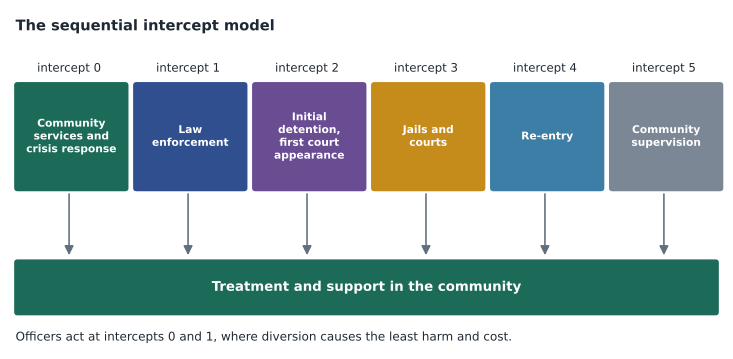
Desjardins introduces a model used by planners in many communities. It describes the points, called intercepts, at which a person with mental illness can be diverted from the justice system into care. Intercept 0 is community services: crisis lines, mobile crisis teams and walk-in services that can help before police are involved. Intercept 1 is law enforcement: the officer's decision on the street. Intercept 2 is initial detention and the first court appearance. Intercept 3 is jails and courts, including specialized courts. Intercept 4 is re-entry from custody. Intercept 5 is community supervision, such as probation. The earlier the intercept, the less harm and cost to everyone.
Diversion by the officer
Police officers in the United States have broad discretion whether to arrest and charge for minor offenses. Many departments, including Port Ardent, have policies encouraging officers to consider alternatives to arrest when an offense is minor and linked to mental illness, such as taking the person to a crisis center or connecting them with treatment. Some Ohio counties also run pre-arrest or pre-booking diversion programs with mental health agencies. Kaplan lists the questions she asks herself: How serious was the offense? Was anyone hurt or put at risk? Was the behavior a result of the illness? Is the person now connected to treatment? What does the victim want, and can their loss be repaired another way? Would a charge make the person or the community safer?
For Adam, the answers pointed one way. The offense was minor, no one was hurt, the damage happened because of his delusion, and he was now in hospital and reconnected with his treatment team. Mrs. Halverson told Kaplan she did not want Adam punished; she wanted to feel safe. Claire offered to pay for the fixture. Kaplan spoke with the property manager, who accepted payment and agreed not to pursue the matter. Kaplan recorded the incident, the grounds she had, the reasons she chose not to charge, and the restitution. 'Not charging is not doing nothing,' she says. 'It is a decision, and it has to be explained as carefully as a charge.'
Diversion by the courts
When a charge is filed, Ohio law offers several routes out of the usual path. Under section 2951.041 of the Revised Code, a court can grant intervention in lieu of conviction when mental illness or an intellectual disability was a factor in the offense; the person follows a treatment plan, and if they complete it, the charge is dismissed. The Supreme Court of Ohio certifies specialized dockets, including mental health courts, in many counties, which combine court supervision with treatment. Morales says research on mental health courts and diversion has generally found reductions in new arrests and time in custody, though results vary by program and by how well treatment services are funded.
Conditions that set people up to fail
Morales describes a pattern she sees often. A person with a serious mental illness is charged with a minor offense and released with conditions: a curfew, a requirement to live at a fixed address, a ban on drinking, a requirement to take medication as prescribed, or a no-go zone that covers the only shelter or clinic in the area. When the illness worsens, the person misses a curfew or goes to the clinic, and is arrested for breaching the condition. Soon they have more breach charges than original offenses. Ohio's bail rules require the least restrictive conditions that reasonably assure appearance and safety, and many courts now review conditions for people with mental illness so that they do not create violations the person cannot avoid. Kaplan says officers can help by recommending only conditions that a person can realistically follow, and by thinking carefully before arresting a person in crisis for a breach that caused no harm.
The victim's perspective
Diversion must also take victims seriously. Mrs. Halverson had been frightened, and her fear was real even though Adam had not meant to harm her. Kaplan visited her the day after the call, explained what had happened in general terms without sharing Adam's health information, told her he was receiving care, and gave her the co-response team's number if she was worried again. Mrs. Halverson said the visit mattered more to her than any charge would have. Morales notes that victims of offenses committed during a mental health crisis are often family members, who may want help for their relative far more than punishment, and that their views deserve weight. Where a victim does want a charge, especially after violence, officers and prosecutors must weigh that seriously too.
Competency to stand trial
A person can be tried only if they are competent to stand trial. Under Dusky v. United States, a defendant must have a sufficient present ability to consult with their lawyer with a reasonable degree of rational understanding, and a rational and factual understanding of the proceedings. Ohio's section 2945.37 presumes a defendant is competent unless, after a hearing, the court finds that because of their mental condition they cannot understand the nature and objective of the proceedings or assist in their defense. If a defendant is found incompetent, the court can order treatment to restore competency under section 2945.38, within time limits, because under Jackson v. Indiana a person cannot be held indefinitely solely because they are incompetent. Desjardins notes that officers' observations of a person's mental state at arrest are sometimes used in these hearings, which is another reason to record them accurately.
The insanity defense
Ohio's definition of not guilty by reason of insanity, in section 2901.01 of the Revised Code, requires the defendant to prove that, at the time of the offense, they did not know, as a result of a severe mental disease or defect, the wrongfulness of their acts. The defendant must prove this by a preponderance of the evidence. A person found not guilty by reason of insanity is not simply released; the court holds hearings under section 2945.40 to decide whether they must be committed to a hospital, and their release is supervised by the court. Such verdicts are rare, and are successful in only a small share of the cases where they are raised. Desjardins tells the class that officers sometimes resent these outcomes, but that the principle behind them is old and widely shared: punishment is meant for people who could understand and control what they did.
Statements from people in crisis
Desjardins connects this lesson with the class's work on interviews. A statement from a person in a mental health crisis may be unreliable. In the United States, under Colorado v. Connelly, a confession is involuntary under the Constitution only if police coercion caused it, so a statement by a person in psychosis is not automatically excluded. But courts look closely at waivers of Miranda rights by people who are ill, and a statement obtained by exploiting a person's confusion may be excluded or given little weight. Kaplan's rule is simpler: when a person is in acute crisis, she does not interview them about offenses. She records what they say spontaneously, and leaves questioning until they are well and have had legal advice.
Port Ardent diversion outcomes
In 2025, Port Ardent officers dealt with 310 people whose minor offense was linked to a mental health crisis. The program below compares people who were diverted, either by the officer or through a court diversion program, with people who were charged and went through the usual court process, looking at whether they had a new police contact for an offense within 12 months.
# Port Ardent 2025: minor crimes linked to a mental health crisis
# (group, people, new contact for a crime within 12 months)
groups = [("officer diversion, linked to treatment", 142, 28),
          ("court diversion completed", 61, 14),
          ("charged, usual court process", 107, 41)]
for g, n, new in groups:
    print(f"{g:40} people {n:3}  new contact {new:3}  rate {new / n:.2f}")
diverted = groups[0][1] + groups[1][1]
diverted_new = groups[0][2] + groups[1][2]
print("all diverted:", diverted, "rate", round(diverted_new / diverted, 2))officer diversion, linked to treatment people 142 new contact 28 rate 0.20 court diversion completed people 61 new contact 14 rate 0.23 charged, usual court process people 107 new contact 41 rate 0.38 all diverted: 203 rate 0.21
About one diverted person in five had a new offense contact within a year, compared with nearly two in five of those charged. Priya, as always, asks about selection: officers may have diverted people they thought were less likely to reoffend. Morales agrees that this comparison cannot prove that diversion caused the difference. But it is consistent with the research, it saved court time, and it kept 203 people out of the cycle of charges and breaches. The department now reviews diversion decisions every quarter with the prosecutor and the hospital.
Worked problem
A charge or diversion?
A woman with bipolar disorder, in a manic episode, takes a 40-dollar scarf from a store without paying and argues loudly with staff, who call police. She has no record, is now calmer, and her husband says she stopped her medication a week ago and has an appointment with her psychiatrist tomorrow. The store wants the scarf back and does not want her charged. What should the officer consider?
Show solution
- The offense is minor and the item can be returned; no one was hurt.
- The behavior appears linked to her illness, and she has treatment in place.
- The victim does not want a charge.
- Options include no charge with the scarf returned, a warning, a referral to the co-response team, or, if a charge is filed, a request for intervention in lieu of conviction.
- Whatever the decision, record the grounds, the reasons and the follow-up.
Answer: Diversion without a charge, with the scarf returned and a referral to her psychiatrist and the co-response team, is likely the best response, with the reasons recorded.
Common mistakes
MistakeDiversion means the person got away with it.
InsteadDiversion is a decision to respond through treatment and repair, recorded and explained.
MistakeA person found incompetent is found not guilty.
InsteadThe case is paused while the person receives treatment; it is not a verdict.
MistakeA person found not guilty by reason of insanity goes free.
InsteadThe court holds commitment hearings and supervises release.
MistakeOfficers should question a person in acute crisis while they are talking.
InsteadRecord spontaneous statements, but leave questioning until the person is well and has had legal advice.
Summary and key terms
- People with serious mental illness are overrepresented throughout the justice system, often starting with minor offenses.
- The sequential intercept model identifies points where people can be diverted into care; officers act at the earliest ones.
- Officers have discretion to divert minor offenses linked to illness, and must record the grounds and reasons.
- Intervention in lieu of conviction and certified mental health dockets offer routes out of the usual process after a charge.
- Competency under Dusky and section 2945.37 and insanity under section 2901.01 are separate questions, overseen by the courts.
- Statements from people in crisis may be unreliable and are closely examined by courts.
- Diversion
- Responding to an offense through treatment or repair instead of the usual court process.
- Intervention in lieu of conviction
- An Ohio program under section 2951.041 that dismisses charges after a completed treatment plan.
- Competency to stand trial
- The ability to understand the proceedings and assist in the defense (Dusky).
- NGRI
- Not guilty by reason of insanity.
- Specialized docket
- A court docket, such as a mental health court, certified by the Supreme Court of Ohio.
- Sequential intercept model
- A model of points at which people can be diverted from the justice system into care.
Practice problems
Work each problem on paper first, then reveal the answer to check.
Name intercepts 0 and 1 of the sequential intercept model.
Show answer
Intercept 0 is community services and crisis response; intercept 1 is law enforcement.
Why did Kaplan not charge Adam?
Show answer
The offense was minor, no one was hurt, it was caused by his delusion, he was in treatment, the neighbor did not want punishment and the damage was repaid.
In the code example, what was the new-contact rate for all diverted people?
Show answer
42 of 203, about 0.21.
What is the Dusky test?
Show answer
A sufficient present ability to consult with counsel with reasonable rational understanding, and a rational and factual understanding of the proceedings.
Lesson quiz · 5 questions
Score 60% or more to complete this lesson.
Create a free account to save your progress, take quizzes and earn a certificate.