
ITIL-130 · Lesson 3 of 12 · 29 min
The service value chain and its six activities
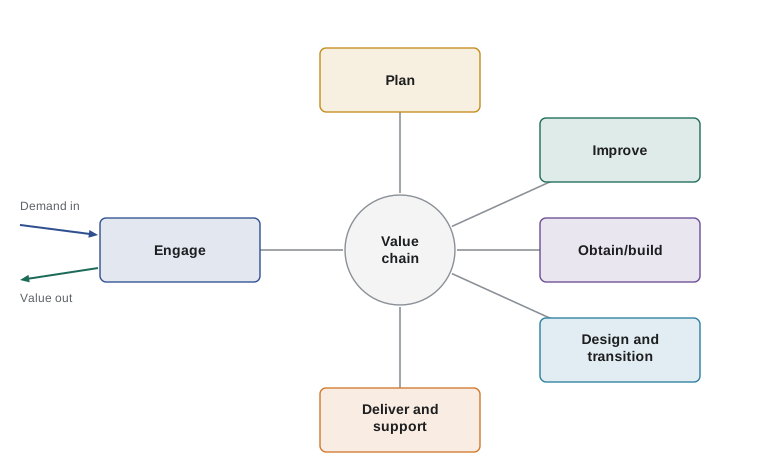
At the heart of the service value system sits the service value chain: an operating model that describes the key activities an organization needs to respond to demand and turn it into value. ITIL 4 names six activities: plan; improve; engage; design and transition; obtain/build; and deliver and support. This lesson introduces all six, explains how they connect through inputs and outputs, and shows why the chain is a network of activities rather than a production line. Lessons 4 to 7 then examine the activities in depth.
What an operating model is
An operating model describes how an organization does its work: which activities happen, how they connect and what flows between them. It sits between strategy (what the organization wants to achieve) and day-to-day execution (who does what, with which tools). The value chain is ITIL's generic operating model for creating, delivering and continually improving services. It is generic on purpose. Every service organization performs these activities in some form, but each configures them differently.
The word chain can mislead. In manufacturing, a value chain often implies a linear sequence: raw materials in, finished goods out. The ITIL service value chain is better pictured as a set of interconnected activities, each of which can trigger, feed or receive from any other. A piece of work might pass through engage, then design and transition, then back to engage, then obtain/build, then deliver and support, with improve touching all of them.
The six activities at a glance
The descriptions below are written in plain language. They capture the purpose of each activity without reproducing official wording.
| Activity | Purpose in plain terms | Typical outputs |
|---|---|---|
| Plan | Create a shared understanding of the vision, the current status and the direction of improvement across the organization | Strategic, tactical and operational plans; portfolio decisions; policies |
| Improve | Make sure products, services and practices keep getting better across every activity and dimension | Improvement initiatives and plans; value stream performance information; status reports |
| Engage | Understand stakeholder needs, keep communication open and transparent and maintain good relationships | Consolidated demand and opportunities; requirements; contract and agreement inputs; change requests |
| Design and transition | Make sure products and services keep meeting expectations for quality, cost and time to market | Requirements and specifications for components; new and changed services; contract requirements |
| Obtain/build | Make sure service components are available when and where needed and meet agreed specifications | Service components; contracts and agreements with suppliers; knowledge about new components |
| Deliver and support | Make sure services are delivered and supported according to agreed specifications and stakeholder expectations | Services delivered; information on performance; improvement opportunities; change requests |
Inputs and outputs
Each activity receives inputs and produces outputs. Some inputs come from outside the organization (demand from consumers, components from suppliers). Others come from other value chain activities. For example, deliver and support produces information about how services are performing; that information is an input to improve and to plan. Engage produces requirements; those are inputs to design and transition. Obtain/build produces service components; those are inputs to deliver and support.
Thinking in inputs and outputs makes dependencies visible. If design and transition is waiting for requirements, the problem may lie in engage, not in design. If deliver and support keeps receiving poorly tested components, the problem may lie in obtain/build or in design and transition. Mapping the flows lets the organization find the real constraint rather than blaming the team where the symptom appears.
Worked problem
Tracing a dependency through inputs and outputs
An operations team complains that new services keep arriving without support documentation, causing long incident resolution times. Which activities produce and consume the documentation, and where should the fix be made?
Show solution
- The consumer of the documentation is deliver and support, which needs knowledge to resolve incidents.
- The documentation should be produced during design and transition (service design packages, operating procedures) and obtain/build (component knowledge from suppliers or developers).
- The symptom appears in deliver and support, but the cause is missing outputs from earlier activities.
- The fix is to make support documentation a required output of design and transition, with acceptance criteria checked before services go live.
Answer: Fix the output of design and transition (and obtain/build), not the support team. Inputs and outputs reveal where the problem originates.
Engage as the interface
Engage has a special position. It is the main point at which the value chain interacts with stakeholders outside it: customers, users, suppliers, partners and other parts of the organization. Demand typically enters through engage, and the value created leaves through engage when products and services are handed to consumers and feedback is gathered. That does not mean every conversation with a stakeholder happens in one team; it means the activity of understanding and communicating with stakeholders is recognized as essential and deliberately managed.
Value streams use the chain
Because the activities are generic, they do not describe how a particular piece of work flows. That is the job of value streams: specific combinations of activities, in a specific order, used to handle a specific type of demand. Restoring a failed service follows one value stream; onboarding a new employee follows another; developing a new product follows a third. Each uses some or all of the six activities, possibly more than once. Lessons 8 and 9 cover value streams in detail.
| Value stream | Activities used, in order |
|---|---|
| Restore a failed service | Engage → deliver and support → (obtain/build if a component must be replaced) → deliver and support → engage → improve |
| Fulfill a standard laptop request | Engage → deliver and support → obtain/build → deliver and support → engage |
| Launch a new digital service | Engage → plan → design and transition → obtain/build → design and transition → deliver and support → engage → improve |
In tables and diagrams, arrows are used to show the order in which a particular value stream uses activities. The chain itself has no fixed order.
Practices support the activities
Activities describe what has to happen; practices supply the resources to make it happen. ITIL 4 describes 34 practices, grouped as general management, service management and technical management practices. Every activity draws on several practices, and every practice contributes to several activities. Incident management, for example, contributes most to deliver and support but also to engage (communicating with users) and improve (identifying improvement opportunities). ITIL-140 and ITIL-141 examine the practices; here the point is the many-to-many relationship.
Worked problem
Mapping practices to an activity
List four practices that contribute to the obtain/build activity when a team procures and configures a new software-as-a-service product.
Show solution
- Supplier management: selects the vendor and negotiates the contract.
- Information security management: checks the product's security controls and data handling.
- Service configuration management: records the new configuration items and their relationships.
- Software development and management or infrastructure and platform management: configure integrations and environments.
Answer: Supplier, information security, service configuration and development or platform practices all contribute. One activity draws on many practices.
The ITIL (Version 5) lifecycle view
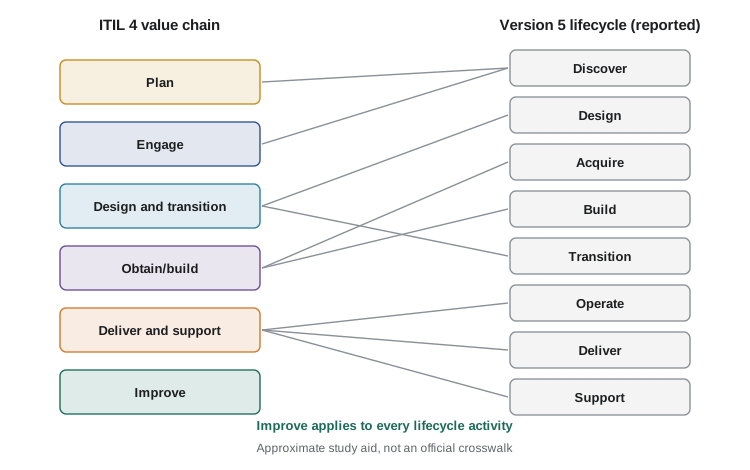
ITIL (Version 5), released in February 2026, keeps the value chain and adds a product and service lifecycle. Published Version 5 course outlines, checked in October 2026, list eight lifecycle activities: discover, design, acquire, build, transition, operate, deliver and support. They describe the activities as iterative and non-linear, much as the value chain activities are. The lifecycle gives a finer-grained view of how a product or service comes into being and is run, while the value chain remains the operating model at the center of the value system.
| ITIL 4 value chain activity | Closest Version 5 lifecycle activities (approximate) |
|---|---|
| Engage and plan | Discover |
| Design and transition | Design; transition |
| Obtain/build | Acquire; build |
| Deliver and support | Operate; deliver; support |
| Improve | Applies across all lifecycle activities |
Two cautions apply. First, this correspondence is our own study aid, not an official crosswalk, and some activities overlap. Second, exam questions should always be answered in the terms of the edition you are sitting. A Version 4 question about the six activities expects the six names exactly; a Version 5 question about the lifecycle expects the eight.
Activities versus departments
A frequent mistake is to map each activity to a department: a planning office, an engagement team, a design team, a build team, an operations team. That recreates the silos the system model was designed to remove. In practice, a single product team might perform engage, design and transition, obtain/build and deliver and support for its own product, while a central function performs plan and coordinates improve. Another organization might outsource obtain/build entirely to a partner. The value chain describes what must happen, not who must do it.
Worked problem
One team, many activities
A five-person product team runs an internal expense-claims application. In one week, they: meet finance to discuss a new approval rule; update the design and test it; buy an additional license for a reporting add-on; deploy the change; answer user questions about the new rule; and review last month's incident data for patterns. Map each task to a value chain activity.
Show solution
- Meeting finance about a new rule: engage.
- Updating and testing the design: design and transition.
- Buying an additional license: obtain/build.
- Deploying the change: design and transition (moving it into live use).
- Answering user questions: deliver and support, with engage where users give feedback.
- Reviewing incident data for patterns: improve.
Answer: One small team performed five of the six activities in a week. Activities are not departments.
Why six activities are enough
Six activities may seem too few to describe everything a service organization does. The answer is that they are deliberately broad. Within each, many practices, procedures and tasks operate. The benefit of keeping the list short is that it provides a common language across very different organizations and makes it easier to see the whole. When a conversation stalls on whose process is broken, asking which activity is failing to produce the output another activity needs often unlocks it.
Common mistakes
MistakeDrawing the value chain as a fixed sequence from plan to deliver and support.
InsteadTreat the activities as interconnected; value streams combine them in whatever order the work requires.
MistakeAssigning each activity to a single department.
InsteadRecognize that one team may perform several activities and one activity may span many teams or partners.
MistakeFixing problems where symptoms appear.
InsteadTrace inputs and outputs to find which activity is failing to produce what another needs.
MistakeTreating the Version 5 lifecycle as replacing the value chain.
InsteadVersion 5 adds the lifecycle view alongside the value chain; the value chain remains a component of the value system.
MistakeConfusing activities with practices.
InsteadActivities describe what happens; practices supply the resources to do it, in a many-to-many relationship.
Summary and key terms
- The service value chain is ITIL's generic operating model, with six interconnected activities.
- The activities are plan; improve; engage; design and transition; obtain/build; and deliver and support.
- Each activity takes inputs and produces outputs; tracing them reveals where problems originate.
- Engage is the main interface with stakeholders, where demand enters and value is handed over.
- Value streams combine activities in specific orders for specific types of demand.
- Practices supply resources to the activities in a many-to-many relationship.
- ITIL (Version 5) adds a product and service lifecycle of eight activities, reported as discover, design, acquire, build, transition, operate, deliver and support.
- Operating model
- A description of how an organization performs its work and how activities connect.
- Value chain activity
- One of the six generic steps an organization takes in creating value.
- Plan
- The activity that creates shared understanding of vision, status and direction.
- Improve
- The activity that ensures continual improvement across all activities and dimensions.
- Engage
- The activity that understands stakeholder needs and maintains communication and relationships.
- Design and transition
- The activity that ensures products and services meet quality, cost and time-to-market expectations.
- Obtain/build
- The activity that makes service components available and fit for specification.
- Deliver and support
- The activity that delivers and supports services to agreed specifications.
- Service component
- A part of a service, such as software, hardware, a supplier service or a team's capability.
- Product and service lifecycle
- The ITIL (Version 5) view of eight activities through which products and services are created and run.
Practice problems
Work each problem on paper first, then reveal the answer to check.
List the six ITIL 4 value chain activities.
Show answer
Plan; improve; engage; design and transition; obtain/build; deliver and support.
Which activity is the main interface with stakeholders?
Show answer
Engage.
What is the difference between an activity and a value stream?
Show answer
An activity is a generic step; a value stream is a specific combination of activities for a type of demand.
Deliver and support produces performance information. Name two activities that use it.
Show answer
Improve and plan.
Why can it be misleading to call it a chain?
Show answer
It suggests a fixed sequence, but the activities are interconnected and used in any order.
Name the eight lifecycle activities reported for ITIL (Version 5).
Show answer
Discover, design, acquire, build, transition, operate, deliver and support.
Which activity makes sure components meet agreed specifications?
Show answer
Obtain/build.
Give an example of one practice contributing to several activities.
Show answer
Incident management contributes to deliver and support, engage and improve.
A design team waits weeks for requirements. Which activity may be the constraint?
Show answer
Engage, which produces requirements.
Does each activity need its own department?
Show answer
No. Activities describe what happens, not who does it.
Lesson quiz · 5 questions
Score 60% or more to complete this lesson.
Create a free account to save your progress, take quizzes and earn a certificate.