
ITIL-130 · Lesson 11 of 12 · 31 min
Partners, suppliers and service integration
Very few organizations deliver services entirely on their own. Cloud platforms, software vendors, telecommunications carriers, outsourced support desks, consultants and specialist partners all contribute components and capabilities. Lesson 10 introduced partners and suppliers as one of the four dimensions. This lesson goes deeper: how organizations decide what to source and from whom, how they classify and manage suppliers according to risk and value, the main sourcing models, how service integration and management (SIAM) coordinates many suppliers, and how contracts and exit planning protect the value the system is meant to deliver.
Why partners and suppliers matter to the value system
Every value chain activity can involve partners and suppliers. Obtain/build often relies on them for components. Deliver and support may be partly outsourced. Engage may work through partners who face customers. Design and transition may use specialist consultants. Even plan and improve draw on supplier roadmaps and benchmarking. When a supplier fails, the effect flows through the value streams that depend on it, and the organization's customers experience the failure regardless of whose fault it was.
This creates a simple but important principle: an organization cannot outsource its accountability to customers. It can outsource work, but it remains responsible for the service it promises.
Partners versus suppliers
ITIL distinguishes relationships along a spectrum, as ITIL-110 described. At one end are basic supplier relationships, where a commodity is bought on standard terms. At the other are partnerships, where two organizations share goals, plan jointly and invest in each other's success. The terms partner and supplier are sometimes used loosely; what matters is the nature of the relationship, which should match the importance and risk of what is being sourced.
Factors in a sourcing strategy
Deciding what to source, and how, is a strategic choice. ITIL suggests several factors that influence an organization's supplier strategy, described here in plain language: its strategic focus (whether it prefers to concentrate on core competencies and source the rest), its corporate culture (some organizations prefer to keep work in-house), resource scarcity (skills that are hard to hire may be easier to source), cost (sourcing may be cheaper or more expensive than doing it internally), subject-matter expertise (a specialist may do the work better), external constraints (regulation and policy may restrict sourcing), and demand patterns (variable demand may favor flexible supplier capacity).
| Factor | Favors sourcing externally when… | Favors in-house when… |
|---|---|---|
| Strategic focus | The capability is not a source of differentiation | The capability is core to competitive advantage |
| Corporate culture | The organization is comfortable relying on partners | The culture values internal control |
| Resource scarcity | Skills are scarce or expensive to hire | Skills are readily available |
| Cost | A supplier's scale makes it cheaper | Volume makes internal delivery cheaper |
| Subject-matter expertise | Specialists deliver better quality | Internal experts already exist |
| External constraints | Regulation permits sourcing | Regulation restricts where work or data can go |
| Demand patterns | Demand is variable or seasonal | Demand is steady and predictable |
Sourcing models
Organizations use several sourcing models, often in combination. Insourcing keeps work inside the organization. Outsourcing transfers work to an external supplier. Single sourcing uses one supplier for a given type of service; multi-sourcing spreads work across several suppliers, often with one coordinating them. Partnership or joint ventures share investment and risk. Cloud services add consumption-based models where the organization pays for what it uses.
| Model | Benefits | Risks |
|---|---|---|
| Insourcing | Control, internal knowledge, cultural fit | Fixed cost, skill gaps, slower to scale |
| Outsourcing to a single supplier | Simplicity, one point of accountability | Dependence, lock-in, loss of internal knowledge |
| Multi-sourcing | Best-of-breed suppliers, competition, resilience | Integration effort, finger-pointing between suppliers |
| Partnership or joint venture | Shared investment and expertise, aligned goals | Complex governance, dependence on the partner's health |
| Consumption-based cloud | Flexibility, pay for use, rapid scaling | Cost growth if usage is unmanaged; data location questions |
Classifying suppliers by risk and value
Not all suppliers deserve the same attention. A widely used tool for classifying them is the purchasing portfolio matrix associated with Peter Kraljic, which places each supplier or category on two axes: the impact on the organization's results (profit or value impact) and the supply risk (how hard it would be to replace the supplier or how vulnerable supply is). The four quadrants suggest different management approaches.
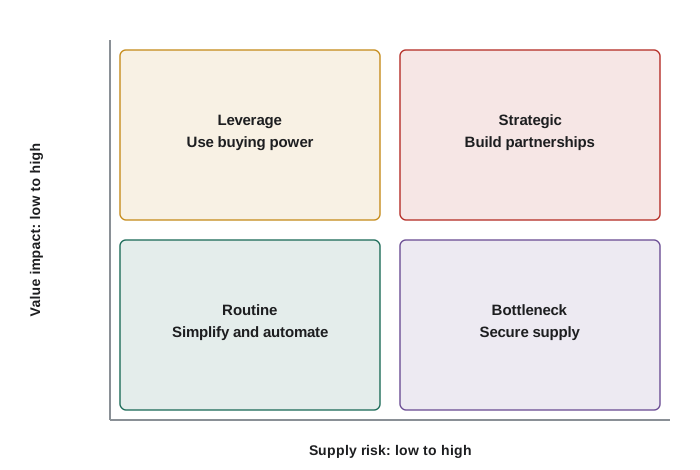
| Quadrant | Value impact | Supply risk | Approach | Example |
|---|---|---|---|---|
| Routine | Low | Low | Simplify and automate purchasing | Office supplies; standard accessories |
| Leverage | High | Low | Use competition and buying power | Commodity cloud storage; laptops |
| Bottleneck | Low | High | Secure supply; find alternatives | A niche license for a legacy system |
| Strategic | High | High | Build long-term partnerships; joint planning | Core cloud platform; outsourced service desk |
Worked problem
Classifying suppliers
An organization scores five suppliers from 1 to 10 for value impact (V) and supply risk (R), using 5 as the dividing line: A, laptop vendor (V7, R3); B, specialist software for an old payroll system (V3, R8); C, main cloud platform (V9, R8); D, printer toner (V2, R2); E, outsourced service desk (V8, R6). Classify each.
Show solution
- A (V7, R3): high value, low risk, so leverage. Use competition to get good prices.
- B (V3, R8): low value, high risk, so bottleneck. Secure supply and plan to replace the legacy system.
- C (V9, R8): high value, high risk, so strategic. Build a partnership with joint planning and an exit plan.
- D (V2, R2): low value, low risk, so routine. Automate purchasing.
- E (V8, R6): high value, high risk, so strategic.
Answer: Leverage: A. Bottleneck: B. Strategic: C and E. Routine: D. Management effort should focus on C and E.
Contracts and agreements
Contracts set out what suppliers commit to: services, service levels, prices, responsibilities, data handling, security, liability, termination and dispute resolution. A frequent failure is a mismatch between what the organization promises its customers and what its suppliers promise it. If a customer agreement commits to 99.9 % availability but the hosting contract commits only to 99.5 %, the organization carries the gap.
Worked problem
Checking supplier commitments against a customer promise
A provider promises customers 99.9 % monthly availability for an online service. The service depends on a hosting supplier committed to 99.95 % and a network carrier committed to 99.9 %, in series. Assuming independent failures, what availability do the supplier commitments support?
Show solution
- Components in series multiply: 0.9995 × 0.999 ≈ 0.9985, or about 99.85 %.
- That is below the 99.9 % promised to customers, before counting the provider's own software and operations.
- Options: negotiate better commitments, add redundancy (for example a second carrier in parallel), or revise the customer promise.
- With two carriers in parallel, each at 99.9 %, network availability becomes 1 − (0.001 × 0.001) = 99.9999 %, and the combined figure rises to about 99.95 %.
Answer: Supplier commitments support only about 99.85 %, below the 99.9 % promise. Adding a second carrier in parallel lifts the supported figure to about 99.95 %.
Service integration and management (SIAM)
When an organization uses many suppliers, someone must coordinate them so that end-to-end services work. Service integration and management (SIAM) is an approach in which a service integrator takes responsibility for coordinating multiple suppliers, managing the interfaces between them and providing a single point of accountability for end-to-end service performance. The integrator may be an internal team, an external provider or a hybrid. SIAM is described in its own body of knowledge, separate from ITIL, but fits naturally into the partners and suppliers dimension.
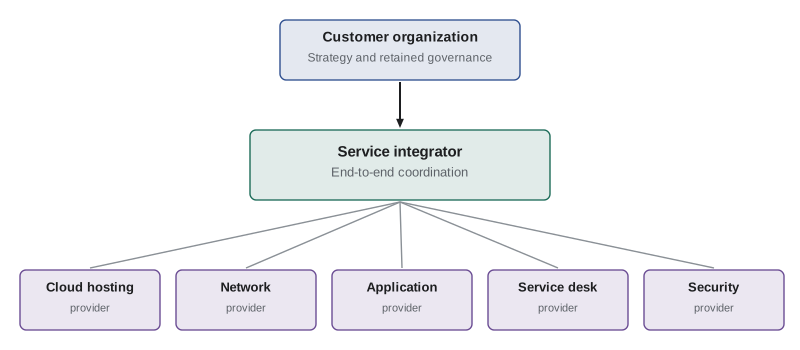
| SIAM layer | Responsibilities |
|---|---|
| Customer organization | Owns the strategy, retained governance and the commercial relationships |
| Service integrator | Coordinates providers, manages end-to-end performance, runs cross-provider processes such as major incident management |
| Service providers | Deliver their own services and cooperate through agreed processes and tools |
Worked problem
Reducing finger-pointing between suppliers
A major incident affects an online service hosted by one supplier, connected by a second and supported by a third. Without integration, each supplier spends time proving the fault lies elsewhere; on average, major incidents take 6 hours to restore, of which 3.5 hours are spent establishing ownership. A service integrator introduces shared monitoring and a joint major-incident process, cutting ownership time to 1 hour. If there are 10 major incidents a year, how many hours of disruption are avoided?
Show solution
- Time saved per incident: 3.5 − 1 = 2.5 hours.
- Restoration time falls from 6 to 3.5 hours per incident.
- Hours avoided per year: 10 × 2.5 = 25 hours of major-incident disruption.
Answer: About 25 hours of major-incident disruption are avoided each year, mainly by removing time spent arguing about ownership.
Managing supplier performance
Supplier management is an ongoing activity, not a one-time procurement event. It includes regular performance reviews, tracking service levels and satisfaction, managing risks, handling disputes and planning improvements together. The supplier management practice, covered in ITIL-141, supports this work. For strategic suppliers, reviews should cover not only past performance but future plans and how both organizations can improve value.
Exit planning
Every supplier relationship eventually ends, whether by choice, by contract expiry or because the supplier fails. Exit planning prepares for that moment: how data will be returned, how services will be transferred, what knowledge must be captured and how long the transition will take. Exit plans are particularly important for strategic and bottleneck suppliers, where replacement is hard.
In the United States, the General Services Administration provides shared acquisition vehicles and government-wide services, and the Technology Modernization Fund, created by the Modernizing Government Technology Act of 2017, funds agency modernization projects. Agencies therefore balance their own suppliers with shared federal services and contracts.
Supplier risk and concentration
Relying heavily on a single supplier creates concentration risk: if that supplier suffers an outage, a security breach or financial trouble, many services fail at once. Cloud platforms are a common example, since one provider may host email, collaboration, data storage and business applications. Organizations manage concentration risk by understanding which services depend on which suppliers, designing critical services to tolerate a supplier failure where the cost is justified, and keeping exit plans current.
Worked problem
Mapping concentration risk
An organization lists its 12 critical services and the main supplier for each. One cloud provider hosts 8 of them, a second hosts 2 and the organization runs 2 itself. What share of critical services depends on the largest supplier, and what questions should governance ask?
Show solution
- Share on the largest supplier: 8 ÷ 12 ≈ 67 %.
- Governance should ask: what happens if that provider has a regional outage? Which of the 8 services need multi-region or multi-provider resilience? Is the exit plan realistic?
- Not every service needs redundancy; the answer depends on the value at risk and the cost of protection.
Answer: About two-thirds of critical services depend on one supplier, so governance should review resilience and exit plans for those services.
Common mistakes
MistakeAssuming accountability can be outsourced along with the work.
InsteadRemain accountable to customers for services that depend on suppliers.
MistakeManaging every supplier with the same effort.
InsteadClassify suppliers by value impact and supply risk and focus effort on strategic ones.
MistakeSigning supplier contracts that do not support customer promises.
InsteadCheck that supplier commitments, combined, support what is promised to customers.
MistakeLeaving many suppliers to coordinate themselves.
InsteadUse service integration to manage interfaces and end-to-end accountability.
MistakePlanning an exit only when a relationship is ending.
InsteadPrepare exit plans in advance, especially for strategic and bottleneck suppliers.
Summary and key terms
- Partners and suppliers contribute to every value chain activity; accountability to customers stays with the organization.
- Sourcing strategy depends on strategic focus, culture, scarcity, cost, expertise, constraints and demand patterns.
- Sourcing models include insourcing, outsourcing, single sourcing, multi-sourcing, partnerships and consumption-based cloud.
- A purchasing portfolio matrix classifies suppliers as routine, leverage, bottleneck or strategic.
- Supplier commitments must combine to support customer promises; series components multiply availability.
- SIAM uses a service integrator to coordinate multiple providers and provide end-to-end accountability.
- Ongoing performance management and advance exit planning protect value.
- Supplier
- An organization that provides products or services to another organization.
- Partnership
- A relationship with shared goals, joint planning and mutual investment.
- Sourcing strategy
- An organization's approach to deciding what to provide internally and what to obtain externally.
- Insourcing
- Using internal resources to provide a product or service.
- Outsourcing
- Transferring the provision of a product or service to an external supplier.
- Multi-sourcing
- Using several suppliers for different parts of a service.
- Purchasing portfolio matrix
- A tool classifying suppliers by value impact and supply risk into four quadrants.
- Service integration and management (SIAM)
- An approach in which an integrator coordinates multiple service providers.
- Service integrator
- The role responsible for end-to-end coordination of multiple providers.
- Exit plan
- A plan for ending a supplier relationship and transferring services, data and knowledge.
Practice problems
Work each problem on paper first, then reveal the answer to check.
Can an organization outsource accountability for a service?
Show answer
No. It can outsource work but remains accountable to its customers.
Name four factors in a sourcing strategy.
Show answer
Strategic focus, corporate culture, resource scarcity and cost (also expertise, external constraints, demand patterns).
A supplier has high value impact and low supply risk. Which quadrant?
Show answer
Leverage.
A supplier has low value impact and high supply risk. Which quadrant and approach?
Show answer
Bottleneck; secure supply and find alternatives.
Two components in series have availability 99.9 % and 99.8 %. What is the combined availability?
Show answer
0.999 × 0.998 ≈ 99.7 %.
What does a service integrator do?
Show answer
Coordinates multiple providers, manages interfaces and provides end-to-end accountability.
Give one risk of multi-sourcing.
Show answer
Integration effort or finger-pointing between suppliers.
Why plan exits in advance?
Show answer
Replacement is hard and slow; plans protect data, knowledge and service continuity.
Which practice supports ongoing supplier performance management?
Show answer
Supplier management.
Give an example of a consumption-based sourcing model.
Show answer
Paying for cloud computing by usage.
Lesson quiz · 5 questions
Score 60% or more to complete this lesson.
Create a free account to save your progress, take quizzes and earn a certificate.