
HSE-407 · Lesson 7 of 12 · 20 min
Safety audits: internal, management system and certification audits
Inspections look at conditions and practices at a moment in time. They can show that a guard is missing today. They cannot easily show why guards keep going missing, whether the lockout program as a whole is designed and run properly, or whether the safety management system built in HSE-404 is doing what it claims. That is the job of audits. This lesson describes the kinds of audit Harrowgate Foods Inc. uses, the principles that make an audit trustworthy, and how the company built an audit program that put its effort where the risk was highest.
What an audit is
ISO 19011, the international guideline for auditing management systems, defines an audit as a systematic, independent and documented process for obtaining objective evidence and evaluating it objectively to determine the extent to which audit criteria are fulfilled. Each word matters. Systematic means the audit follows a plan. Independent means the auditor does not audit his or her own work. Documented means the plan, the evidence and the conclusions are written down. Objective evidence means records, observations and statements that can be verified. And audit criteria are the requirements the audit compares the evidence against, such as a law, a standard, a company procedure or a contract.
The difference from an inspection is mainly scope and depth. An inspection of the bread line asks whether its guards and lockout points are in good order today. An audit of the lockout program asks whether every machine has a correct procedure, whether workers are trained and competent, whether locks are applied and verified as the procedures require, whether periodic reviews happen, whether problems found are corrected, and whether all of this is working across the site and over time.
Three kinds of audit criteria
Audits at Harrowgate Foods Inc. use three kinds of criteria, and many audits combine them:
- Compliance audits compare practice with legal requirements, such as the federal Occupational Safety and Health Act (OSH Act) and OSHA's general industry standards in 29 CFR 1910. They answer the question: are we meeting the law?
- Management system audits compare the system with a standard such as ISO 45001 or ANSI/ASSP Z10.0, and with the company's own procedures. They answer: is the system designed properly and working?
- Topic or process audits look in depth at one program, such as lockout, contractor control or ammonia, against all the requirements that apply to it, whether legal, standard-based or internal. They answer: is this program effective? OSHA's lockout standard, for example, requires a periodic inspection of each energy control procedure at least once a year by an authorized employee other than those using it, which is itself a small, required audit.
First, second and third parties
Audits are also classed by who does them:
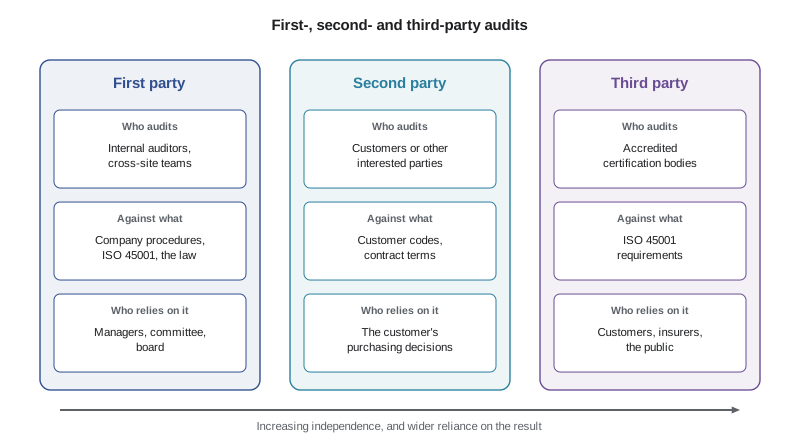
- First-party audits are internal audits done by or for the organization itself. ISO 45001 requires them at planned intervals, as part of the check step of the system.
- Second-party audits are done by an organization with an interest in the auditee, such as a customer auditing a supplier. Several of Harrowgate Foods Inc.'s retail customers audit its plants for food safety, and two now include worker safety questions.
- Third-party audits are done by independent bodies, such as certification bodies auditing against ISO 45001 or a regulator's or insurer's audit program. They give assurance that others can rely on.
Third-party certification to ISO 45001 follows a cycle. An accredited certification body carries out an initial audit in two stages, the first reviewing the system's design and readiness and the second assessing whether it is implemented and effective. If the body is satisfied, it issues a certificate valid for three years, with surveillance audits at least once a year and a recertification audit before the certificate expires. Certification does not mean that a company is safe. It means that an independent auditor found a management system that met the standard, based on a sample of evidence on the days of the audit.
The principles of auditing
ISO 19011 sets out seven principles that make an audit worth trusting. Elena printed them on the cover of the new audit procedure:
- Integrity: auditors work honestly, diligently and responsibly, and are not influenced by pressure to reach a particular result.
- Fair presentation: findings, conclusions and reports reflect the audit truthfully and accurately, including obstacles met and unresolved disagreements.
- Due professional care: auditors apply diligence and judgment appropriate to the importance of the task.
- Confidentiality: information obtained during the audit is protected and used appropriately.
- Independence: auditors are free from bias and conflicts of interest, and do not audit their own work.
- Evidence-based approach: conclusions rest on verifiable evidence, recognizing that audits rely on samples.
- Risk-based approach: audit effort is directed at matters that are significant to the client and the audit's objectives.
Independence was the hardest principle for a company of Harrowgate Foods Inc.'s size. It did not have a full-time internal audit team, and Elena could not audit the programs she had designed. The working group's answer was cross-site auditing. Trained auditors from one site audited another: supervisors and safety committee members from Athens audited McDonough, McDonough audited Gainesville, and Gainesville audited Athens. Elena led the audit program and trained the auditors, and Aisha Rahman's quality team, which already ran food safety internal audits, provided auditors with no stake in safety outcomes.
Building the audit program
An audit program is the set of audits planned for a period, usually a year or three years, with their scope, criteria, frequency and resources. ISO 45001 requires the program to take into account the importance of the processes concerned and the results of previous audits. Elena turned that into a simple scoring rule: a topic's audit frequency depended on the severity of its hazards, the result of its last audit and how much it had changed in the last year.
# Set audit frequency for each topic and site from a simple risk score
topics = [
    # (topic, site, severity 1-5, last audit result %, changes in last year 0-3)
    ("lockout",             "main plant",   5, 68, 2),
    ("lockout",             "sauces plant", 5, 88, 0),
    ("forklift traffic",    "distribution", 5, 61, 3),
    ("forklift traffic",    "main plant",   4, 82, 1),
    ("ammonia system",      "main plant",   5, 90, 1),
    ("ammonia system",      "distribution", 5, 79, 0),
    ("machine guarding",    "main plant",   4, 74, 2),
    ("contractor control",  "main plant",   4, 84, 1),
    ("chemical handling",   "sauces plant", 3, 93, 0),
    ("first aid and ERP",   "distribution", 2, 95, 0),
]
def score(sev, result, changes):
    weakness = (100 - result) / 10        # 0 for a perfect audit, 4 for 60 %
    return sev * (1 + weakness) + 2 * changes
def frequency(s, sev):
    months = 6 if s >= 25 else 12 if s >= 15 else 24   # months between audits
    if sev == 5:
        months = min(months, 12)   # floor: catastrophic hazards at least yearly
    return months
print(f"{'topic':<20}{'site':<14}{'score':>6}{'every':>7}")
for t, site, sev, res, ch in sorted(topics, key=lambda x: -score(*x[2:])):
    s = score(sev, res, ch)
print(f"{t:<20}{site:<14}{s:>6.1f}{frequency(s, sev):>4} mo")topic site score every forklift traffic distribution 30.5 6 mo lockout main plant 25.0 6 mo machine guarding main plant 18.4 12 mo ammonia system distribution 15.5 12 mo forklift traffic main plant 13.2 24 mo contractor control main plant 12.4 24 mo ammonia system main plant 12.0 12 mo lockout sauces plant 11.0 12 mo chemical handling sauces plant 5.1 24 mo first aid and ERP distribution 3.0 24 mo
The first version of the rule had no floor, and it scheduled the ammonia system at Gainesville for an audit only every two years because its last audit had gone well. Luis objected: a single failure in that system could kill people inside and outside the plant. The group added a floor so that any topic with catastrophic potential would be audited at least once a year, whatever its score. Elena noted that this was exactly the kind of judgment a formula should support, not replace.
Integrating safety and food safety audits
Harrowgate Foods Inc.'s plants were already audited each year against a food safety certification scheme, and Aisha's team ran internal food safety audits every quarter. Running separate safety audits on different days, with different auditors asking the same supervisors about training records, document control and corrective actions, would waste time and annoy everyone.
The working group combined the parts that overlapped. Document control, training records, management of change, corrective action and management review were audited once, with questions covering both food safety and worker safety. Sanitation audits checked both that equipment was clean and that it had been locked out for cleaning. Topic audits on hazards specific to safety, such as forklift traffic or ammonia, stayed separate. Aisha pointed out a benefit nobody had expected: the food safety auditors, trained to look for evidence rather than reassurance, were among the best safety auditors the company had.
Worked problem
Planning the first lockout audit at the main plant
Show solution
- Scope and criteria: the lockout program at Gainesville, audited against OSHA's lockout standard, 29 CFR 1910.147, which requires the host and outside employers to tell each other about their lockout procedures, the company's lockout procedure and the critical control definitions from Lesson 4.
- Team: an auditor from McDonough who had completed the company's auditor course, and one of Aisha Rahman's quality auditors, with Luis available to explain equipment but not part of the team.
- Plan: two days, including one night shift; a sample of machine procedures to check against the equipment; observation of lockouts in progress; interviews with sanitation workers, maintenance technicians and supervisors; and review of training, verification and periodic review records.
- Opening and closing meetings with the plant manager, Marcus Bell, and the safety committee co-chairs, so that the scope was agreed at the start and the findings heard together at the end.
Answer: The audit plan set criteria, an independent team, a sample that included the night shift, and meetings that involved both management and workers. Lesson 8 follows the audit through its evidence and findings.
Preparing auditors
Good auditors are made, not found. The company's auditor course ran over two days and covered the principles above, how to plan an audit, how to sample, how to interview without leading, how to tell an observation from an opinion, and how to write a finding. Each new auditor then did two audits as an observer and one under supervision before leading an audit. Dev Sandhu, the night sanitation supervisor at Gainesville, was one of the first to qualify, and his knowledge of night work made him one of the best interviewers in the program.
Outside reviews that are not audits
Some outside reviews look like audits but are not. A visit by an OSHA compliance safety and health officer is an inspection under the law, not an audit the company commissions, and it can lead to citations. The company's workers' compensation insurer may also send loss control consultants who make recommendations, and OSHA's free On-Site Consultation Program can review a site without issuing citations. These reviews give useful outside views, and the audit program treats their findings as inputs: every citation or recommendation is logged, assigned an owner and tracked in the same corrective action system as audit findings. But they do not replace the internal audits that ISO 45001 requires, because the company does not set their scope, timing or criteria.
Elena added one more source to the list: the audits of Harrowgate Foods Inc.'s own contractors described in HSE-406. Their results showed how well the contractor program was working, and the audit program treated them as part of the evidence for the contractor control topic.
Common mistakes
MistakeTreating an audit as a long inspection.
InsteadAudit whether a program or system is designed, implemented and effective, not just today's conditions.
MistakeLetting people audit programs they designed or run.
InsteadUse cross-site auditors or auditors from another function to keep audits independent.
MistakeAuditing every topic on the same fixed cycle.
InsteadSet frequency by risk, past results and change, with a floor for catastrophic hazards.
MistakeReading a certificate as proof that a company is safe.
InsteadRecognize that certification is based on a sample of evidence and confirms a system, not an outcome.
MistakeRunning food safety and worker safety audits separately on shared processes.
InsteadCombine audits of shared processes and keep separate audits for hazard-specific topics.
Summary and key terms
- An audit is a systematic, independent and documented process of collecting objective evidence and evaluating it against criteria.
- Audits may test compliance with law, conformity with a management system standard, or the effectiveness of a specific program.
- First-party audits are internal, second-party audits are by customers or other interested parties, and third-party audits are independent.
- ISO 45001 certificates run for three years with at least annual surveillance audits.
- ISO 19011's seven principles are integrity, fair presentation, due professional care, confidentiality, independence, an evidence-based approach and a risk-based approach.
- Audit programs should be risk-based, and shared processes can be audited together with food safety.
- Audit criteria
- The requirements, such as laws, standards or procedures, that audit evidence is compared against.
- Objective evidence
- Records, observations or statements that can be verified.
- Audit program
- The set of audits planned for a period, with their scope, criteria, frequency and resources.
- Surveillance audit
- A periodic audit between certification audits to confirm that a certified system is maintained.
- Cross-site auditing
- Using trained auditors from one site to audit another, to keep audits independent.
Practice problems
Work each problem on paper first, then reveal the answer to check.
What does it mean for an audit to be independent?
Show answer
The auditor is free from bias and conflicts of interest and does not audit his or her own work.
Give an example of a second-party audit at the company.
Show answer
A retail customer auditing a plant for food safety, including worker safety questions.
How long is an ISO 45001 certificate valid, and how often are surveillance audits done?
Show answer
Three years, with surveillance audits at least once a year.
Why was a floor added to the audit frequency rule?
Show answer
Because the formula scheduled the ammonia system only every two years, and catastrophic hazards need audits at least yearly.
Which processes did the company audit jointly for food safety and worker safety?
Show answer
Document control, training records, management of change, corrective action and management review, plus sanitation lockout checks.
Lesson quiz · 5 questions
Score 60% or more to complete this lesson.
Create a free account to save your progress, take quizzes and earn a certificate.