
HSE-407 · Lesson 6 of 12 · 20 min
Inspections that find hazards
When Elena collected the previous year's inspection records from the Gainesville plant, she found 52 monthly area checklists. All but three were marked 'satisfactory'. In the same months, the safety committee's own inspections, led by Tanya Morris, had recorded 23 hazards in the same areas, including two missing guards on the bread line and a lockout point that could not be reached without a ladder. The two sets of inspections were looking at the same plant and seeing different things.
The difference was not effort or honesty. The area checklist was four pages of yes-or-no questions, written years earlier, that asked mainly about housekeeping, fire extinguishers, exit signs and first aid kits. It said nothing about lockout points, guarding, forklift and pedestrian routes or ammonia. An inspector who completed it carefully would find the hazards it asked about and walk past the ones it did not. This lesson describes how Harrowgate Foods Inc. rebuilt its inspections so that they found the hazards that matter, and how it measured whether they did.
The kinds of inspection
A workplace has many inspections, done by different people for different purposes. The working group listed them all before changing any, because the gaps between them were as important as the inspections themselves:
- Pre-use checks: done by operators at the start of a shift, such as the forklift daily check or a check of a slicer's guard and interlock before use.
- Supervisor area inspections: weekly walks by the area supervisor looking at conditions and practices in the supervisor's own area.
- Planned general inspections: monthly or quarterly inspections of the whole site, including those done by the safety committee as HSE-405 described.
- Critical control verifications: short, focused field checks of the controls for serious hazards, from Lesson 4.
- Specialist inspections: done by qualified people at set intervals, such as pressure relief valves on the ammonia system, storage racking, electrical panels, fire protection systems and lifting equipment.
- Leadership walks: visits by managers to talk with workers about their work and its hazards, as HSE-401 described.
Each kind has its own strengths. Pre-use checks are frequent and done by the people closest to the equipment, but they are short and easily become routine. Specialist inspections are thorough but infrequent and narrow. General inspections cover the whole site but can only look at each area briefly. The gaps tend to fall between them: the rooftop condensers that nobody visits, the mezzanine with the spiral conveyor's disconnect, the pit under the dock levelers, and the night shift, when the people doing the work are not the people who usually inspect it.
Designing the route
Elena and Luis Ortega mapped the Gainesville plant and drew an inspection route for the monthly general inspection that covered every area at least once a quarter, including the roof, pits, mezzanines, the engine room and the outside tank farm. The route was split into four zones, each inspected in a different week, so that each inspection could spend real time in fewer places. One inspection each month was done on the night shift or a weekend.
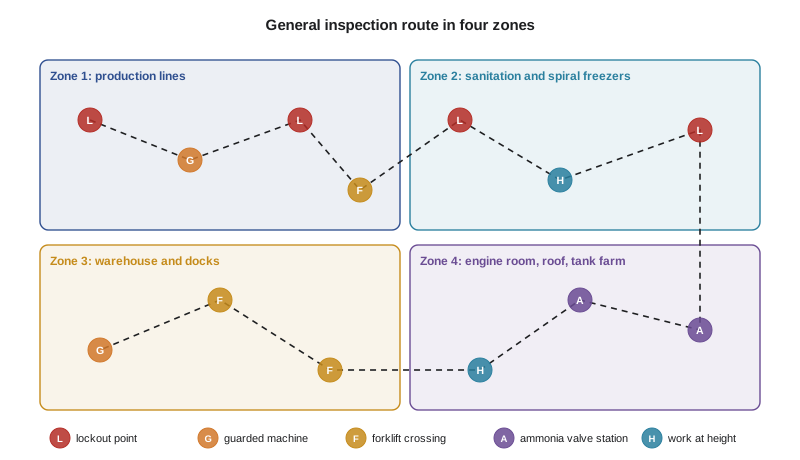
The route marked high-risk points in each zone: lockout isolation points, forklift and pedestrian crossings, guarded machines, ammonia valve stations and work at height. At each point the inspector was asked to look at a specific control, such as whether a disconnect was reachable and labeled, rather than to tick a general question.
From checklists to hazard hunting
Checklists are useful because they make sure important items are not forgotten. They are harmful when they become the whole inspection. The new inspection form had two parts. The first was a short list of the high-risk points on the route, each with the control to check. The second was an open section in which inspectors recorded anything else they saw, asked workers what worried them, and noted any task they watched being done.
Talking to workers changed the inspections more than anything else. On the first night inspection, a sanitation worker showed Tanya a hose reel mounted where workers had to lean over a conveyor to reach it. The checklist had never asked about it, because no one who wrote the checklist had cleaned that conveyor. Elena added a standard question to every inspection: 'What is the most dangerous thing you do here, and what would make it safer?'
Ranking findings
Every finding was ranked using the company's risk matrix from HSE-404, which combined the likely severity of harm with the likelihood. The ranking set the due date for correcting the finding. High-risk findings, such as a missing guard on a running machine, had to be made safe immediately, with a permanent fix within seven days. Medium-risk findings had 30 days, and low-risk findings 90 days. Anything that could cause a serious injury was also flagged as SIF potential and fed into the indicators from Lesson 4.
Ranking also helped with consistency between inspectors. Before the change, one inspector would write up a frayed cord as a serious hazard and another would ignore it. With a common matrix and a few worked examples, the safety committee members and supervisors began to rank similar findings in similar ways. Elena checked this twice a year by having two inspectors inspect the same zone separately and comparing their findings, a practice the group called a paired inspection.
Measuring inspections
An inspection program produces its own indicators. The old program had measured one thing: the share of scheduled inspections completed. That measure stayed, but the group added measures of quality and response:
- Completion: the share of scheduled inspections done on time, by type and site.
- Findings per inspection by risk: especially the number of high-risk findings, which shows whether inspections are finding the hazards that matter.
- Closure on time by risk class: the share of findings fixed within their due dates.
- Overdue high-risk findings: the number open past their due date, reported weekly.
- Repeat findings: the share of findings that repeat an earlier finding in the same place, which shows whether fixes last.
- Agreement in paired inspections: how closely two inspectors' findings match.
Nina pulled six months of findings from the new system and calculated the closure figures by risk class.
# Inspection findings: closure time and overdue items by risk class
import random, statistics
from datetime import date, timedelta
random.seed(406)
due_days = {"high": 7, "medium": 30, "low": 90}
today = date(2027, 3, 31)
findings = []
for i in range(180):
    risk = random.choices(["high", "medium", "low"], weights=[15, 45, 40])[0]
    opened = date(2026, 10, 1) + timedelta(days=random.randint(0, 175))
    typical = {"high": 9, "medium": 24, "low": 55}[risk]
    days = int(random.expovariate(1 / typical)) + 1
    closed = opened + timedelta(days=days)
    findings.append((risk, opened, closed if closed <= today else None))

print(f"{'risk':<8}{'found':>6}{'closed':>7}{'median days':>12}{'on time':>9}{'open overdue':>13}")
for risk in ("high", "medium", "low"):
    rows = [f for f in findings if f[0] == risk]
    done = [(c - o).days for _, o, c in rows if c]
    on_time = sum(1 for d in done if d <= due_days[risk])
    overdue = sum(1 for _, o, c in rows if c is None and (today - o).days > due_days[risk])
    print(f"{risk:<8}{len(rows):>6}{len(done):>7}{statistics.median(done):>12.0f}"
f"{on_time / len(done):>9.0%}{overdue:>13}")risk found closed median days on time open overdue high 20 20 11 30% 0 medium 85 75 14 84% 2 low 75 57 30 86% 2
The result was the opposite of what the system intended. High-risk findings were closed fastest in absolute terms, with a median of 11 days, but only 30 percent were closed within the seven-day deadline. Medium- and low-risk findings were mostly closed on time. Most high-risk findings had been made safe immediately, by stopping the machine or barricading the area, but the permanent fix waited for parts, contractors or a maintenance window. Luis pointed out that the deadline did not distinguish between making a hazard safe and fixing it permanently. The system was changed to record both: the date the hazard was made safe, with a 24-hour deadline, and the date of the permanent fix, with a deadline agreed with maintenance and approved by the site manager.
Worked problem
Re-inspecting the bread line
Show solution
- The old monthly checklist for the bread line had been marked satisfactory for eleven months in a row. Elena asked Tanya and Luis to inspect the line using the new route and form, on a production day and then on a sanitation night.
- On the production day they found a guard on the divider held on with cable ties instead of its fasteners, a lockout point for the proofer blocked by a pallet of trays, and a crossing where pedestrians stepped out from behind a rack into a forklift route.
- On the sanitation night they found that the lockout procedure for the rounder listed two isolation points, but the machine had a third, a pneumatic supply added during a change two years earlier.
- All four findings were ranked high risk. The guard and pallet were corrected the same day; the crossing got a barrier and mirror within a week; the lockout procedure was rewritten and the change was reported to the management of change process from HSE-404.
Answer: The same line that had passed eleven checklists had four high-risk hazards, including one that would only be visible during sanitation. Route design, worker input and timing found what the old checklist could not.
Inspections as a source of learning
Inspection findings are data about the safety management system, not just lists of things to fix. When Nina grouped six months of findings by cause, she found that a third of high-risk findings at Gainesville related to equipment changes that had not been reflected in procedures, guards or lockout points. That pattern pointed to a weakness in the management of change process, which the audits in Lesson 7 then examined. Repeat findings pointed to fixes that did not last, such as guards that were removed for cleaning and not replaced. A finding, in other words, is a symptom, and the inspection program is most useful when someone looks at the symptoms together.
Specialist inspections and their records
Specialist inspections need a different kind of oversight. Elena could not judge whether a pressure relief valve had been tested properly, but she could check that each one had been tested by a qualified person within its interval, that the results were recorded, and that any failures had been acted on. Luis built a register of every item that needed a specialist inspection at each site: relief valves, ammonia detectors, racking, overhead doors, dock levelers, lifting equipment, fire sprinklers and alarms, emergency lighting and eyewash stations. Each item had its interval, the last inspection date and the next due date.
The first run of the register found 14 items past their due dates across the three sites, including two ammonia detectors at McDonough that had not been calibrated for more than a year. None of them had shown up in any general inspection, because a detector that has not been calibrated looks exactly like one that has. The register became the source of a new indicator, specialist inspections overdue, which Luis reported monthly and which the board saw as part of the ammonia critical control indicator.
Common mistakes
MistakeUsing a fixed checklist that covers only easy items.
InsteadBuild the inspection around high-risk points and controls, with an open section for anything else.
MistakeInspecting only on day shift.
InsteadSchedule inspections across shifts, weekends and sanitation periods.
MistakeMeasuring only whether inspections were completed.
InsteadMeasure findings by risk, closure on time, repeats and agreement between inspectors.
MistakeTreating 'made safe' and 'fixed' as the same thing.
InsteadRecord the date a hazard was made safe and the date it was permanently fixed.
MistakeInspecting without talking to the workers in the area.
InsteadAsk workers what is most dangerous in their work and what would make it safer.
Summary and key terms
- Workplaces have pre-use checks, supervisor inspections, general inspections, critical control verifications, specialist inspections and leadership walks.
- Gaps between inspection types often hide rarely visited areas and night shift work.
- Inspection routes should cover every area on a rotation and mark high-risk points with specific controls to check.
- Findings should be ranked with a common risk matrix that sets due dates.
- Inspection quality is measured by high-risk findings, closure on time, repeats and agreement in paired inspections.
- Grouping findings by cause reveals system weaknesses such as poor management of change.
- Pre-use check
- A short inspection of equipment by its operator before use.
- Critical control verification
- A focused field check that a control for a serious hazard is in place and working.
- Paired inspection
- Two inspectors inspecting the same area separately so their findings can be compared.
- Repeat finding
- A finding that repeats an earlier finding in the same place, showing that a fix did not last.
- Made safe
- A temporary action that removes immediate danger, such as stopping a machine, pending a permanent fix.
Practice problems
Work each problem on paper first, then reveal the answer to check.
Why did the old area checklists at the main plant miss the hazards the committee found?
Show answer
They asked mainly about housekeeping, extinguishers, exits and first aid kits, and nothing about lockout, guarding, traffic or ammonia.
What question did Elena add to every inspection?
Show answer
What is the most dangerous thing you do here, and what would make it safer?
What are the due dates for high-, medium- and low-risk findings?
Show answer
Make high-risk findings safe immediately with a permanent fix in seven days, medium in 30 days and low in 90 days.
Why were only 30 percent of high-risk findings closed on time?
Show answer
The deadline did not separate making a hazard safe from fixing it permanently, and permanent fixes waited for parts or maintenance windows.
What did grouping findings by cause reveal at the main plant?
Show answer
A third of high-risk findings related to equipment changes not reflected in procedures, guards or lockout points, pointing to management of change.
Lesson quiz · 5 questions
Score 60% or more to complete this lesson.
Create a free account to save your progress, take quizzes and earn a certificate.