
HSE-405 · Lesson 5 of 12 · 21 min
Planning workplace inspections
For years the main plant committee at Harrowgate Foods Inc. had done the same inspection every month. Two members walked the same route on the same Tuesday morning with the same three-page checklist, ticked the same boxes and wrote 'housekeeping fair' at the bottom. In twelve months of reports, nobody had looked at the roof access, the ammonia machine room, the night sanitation crew or the outside yard where trucks backed up to the docks. Nobody had inspected anything after 3 p.m. The spiral conveyor where an operator was later injured was on the route, and had been ticked as acceptable eleven times.
Inspections are one of the most visible things a committee does, and one of the easiest to do badly. A good inspection finds hazards that people have stopped seeing, gives workers a chance to raise concerns where they work, and produces findings that lead to change. A poor one becomes a ritual. This lesson is about the planning that makes the difference; lesson 6 covers the inspection itself and ranking what it finds.
The committee's role in inspections
Federal OSHA does not require safety committees to inspect, but inspections are one of the main ways a committee finds and fixes hazards, and they support the hazard identification element of OSHA's Recommended Practices. Some states with committee rules require inspections. Oregon, for example, requires committees to conduct worksite inspections at least quarterly at most workplaces. Harrowgate Foods Inc.'s company standard is stricter than that: part of each site every month and all of it every year.
It helps to be clear about what committee inspections are and are not. They do not replace the employer's own inspections. Supervisors still check their areas daily, maintenance still inspects equipment, and specialists still test fire systems and pressure vessels. The committee's inspection is a second look, by people from different jobs, including workers who do the work. Its value is precisely that it is not done by the people responsible for the area.
Mapping the workplace
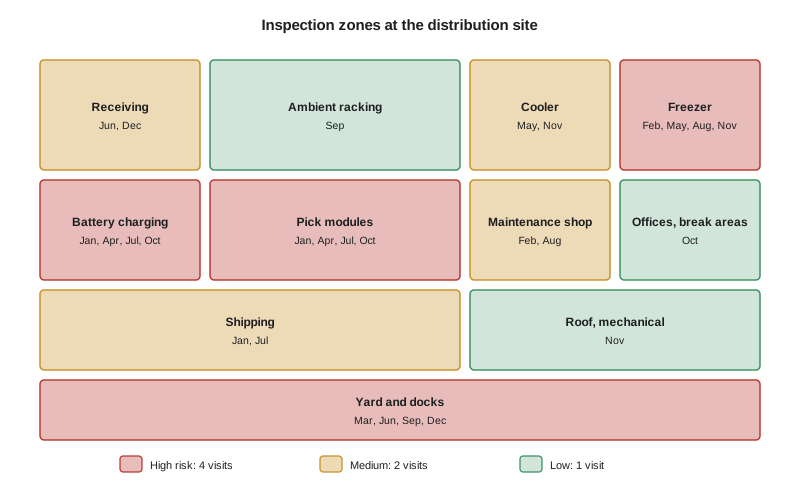
Planning starts with a map. Sam and Owen printed the distribution center's floor plan and divided it into zones that one pair of inspectors could cover well in about ninety minutes. They ended up with eleven zones: receiving, the ambient racking, the cooler, the freezer, the pick modules, shipping, the battery charging room, the maintenance shop, the yard and docks, the offices and break areas, and the roof and mechanical rooms. Some zones are small but high-risk, like battery charging. Others are large but lower risk, like the ambient racking.
For each zone they listed the main hazards, the activities that happen there and when they happen. That second list turned out to be important. The freezer is quiet at 10 a.m. but busy at 2 a.m., when night pickers are working against the dispatch deadline. The docks change completely when trucks are loading. The maintenance shop is empty on weekdays but busy on Sunday, when planned maintenance is done. An inspection that only sees a zone at its quietest misses most of its risk.
Building a schedule
With eleven zones and twelve months, the obvious answer is one zone a month. Sam and Owen rejected it. Some zones deserved more than one visit a year, and a single zone a month would take most of a year to come back to battery charging. Instead they gave each zone a risk rating and set the number of visits from it: four a year for high-risk zones, two for medium and one for low. They then spread the visits across the year so that each month had a similar workload.
# Build a year's inspection schedule from zone risk ratings.
zones = {
    "battery charging": "high", "freezer": "high", "yard and docks": "high",
    "pick modules": "high", "cooler": "medium", "receiving": "medium",
    "shipping": "medium", "maintenance shop": "medium",
    "ambient racking": "low", "offices and break areas": "low",
    "roof and mechanical": "low",
}
visits = {"high": 4, "medium": 2, "low": 1}
months = ["Jan", "Feb", "Mar", "Apr", "May", "Jun",
          "Jul", "Aug", "Sep", "Oct", "Nov", "Dec"]
plan = {m: [] for m in months}
slot = 0
for zone, risk in sorted(zones.items(), key=lambda z: -visits[z[1]]):
    n = visits[risk]
    step = 12 // n
    for k in range(n):
        plan[months[(slot + k * step) % 12]].append(zone)
    slot += 1
total = sum(len(v) for v in plan.values())
print(f"{total} zone visits in the year")
for m in months:
print(f"{m}: {', '.join(plan[m])}")27 zone visits in the year Jan: battery charging, pick modules, shipping Feb: freezer, maintenance shop Mar: yard and docks Apr: battery charging, pick modules May: freezer, cooler Jun: yard and docks, receiving Jul: battery charging, pick modules, shipping Aug: freezer, maintenance shop Sep: yard and docks, ambient racking Oct: battery charging, pick modules, offices and break areas Nov: freezer, cooler, roof and mechanical Dec: yard and docks, receiving
The schedule gives 27 zone visits a year, between one and three a month. March has only one, so the co-chairs later moved a low-risk visit into it to even out the workload. Every zone is covered at least once, and the four high-risk zones are visited every quarter. The co-chairs then adjusted it by hand: the yard and docks visit in January was moved to a night when snow clearing was under way, and the freezer visits were set for the busiest night of the week.
Timing and shifts
The main plant's old habit of inspecting on Tuesday mornings had a simple cause: that was when the two inspectors were both on day shift. It meant the plant was never inspected at night, on weekends or during sanitation, when the work and the workforce were completely different. Harrowgate Foods Inc.'s standard now requires that at least a quarter of each site's inspections happen outside the day shift, and that every shift is inspected at least twice a year.
Night members like Leila, Jasmine and Owen made this practical at the distribution center. They took the night and early-morning inspections, often pairing with a day member who came in early. The first night inspection of the freezer found three things no day inspection had seen: pickers wearing gloves too thin for the length of time they were spending inside, a door heater that had failed so ice was building on the threshold, and a pick path blocked by pallets waiting for putaway because the evening shift had fallen behind.
Choosing inspectors
Each inspection is done by at least two people: one worker member and one management member where possible, and always at least one person who does not normally work in the zone. The person who works there knows where the problems hide. The person who does not sees what the locals have stopped noticing. Harrowgate Foods Inc. also invites a worker from the zone to join each inspection for part of the route, which gives the committee another set of eyes and gives that worker a direct way to point out problems.
Inspectors rotate, so that every member inspects every kind of zone over their term. New members join experienced ones for their first three inspections, as lesson 4 described. Members do not inspect their own supervisor's area alone, which protects both the member and the integrity of the findings.
Checklists and what they miss
Checklists help. They remind inspectors of the things that are easy to forget, such as eyewash stations, extinguisher tags and exit signs, and they make results comparable from one visit to the next. They also have a well-known weakness: they focus attention on what is on the list, and inspectors stop looking for what is not. The main plant's three-page checklist had nothing about conveyors at all, which partly explains how the spiral conveyor was ticked eleven times.
Sam and Owen replaced the single site checklist with a short checklist for each zone, built from that zone's hazards and past incidents. Each checklist has three parts:
- Fixed items for that zone, no more than fifteen, covering the main hazards and controls, such as charger ventilation and eyewash in battery charging.
- A focus topic that changes each quarter across all zones, such as manual handling, slips and trips, or vehicle and pedestrian separation, so the committee looks deeply at one theme at a time.
- Open questions for workers in the zone: what has changed recently, what worries you, what nearly went wrong, and what would you fix first.
The open questions consistently produced the most useful findings. A forklift operator in receiving told inspectors that a new supplier's pallets were splintering on the forks, which was not on any checklist. A picker in the cooler said the floor was wet every morning near one evaporator. Both were fixed within a month.
Preparing for each inspection
Ten minutes of preparation makes an inspection far more useful. Before each visit, the inspectors look at:
- The last inspection report for the zone and the status of its findings, so they can check whether fixes were made and have lasted.
- Incidents, near misses and concerns reported in the zone since the last visit.
- Changes such as new equipment, new products, layout changes or new staff.
- Any focus topic material for the quarter, such as a short guide on manual handling risk factors.
They also tell the zone supervisor that they are coming. Some committees prefer unannounced inspections, believing that warning people allows them to tidy up. Harrowgate Foods Inc. chose to announce, for two reasons: supervisors who are told in advance can make sure workers are available to talk, and an area that is tidied for an inspection is still a tidier area. What the committee does not announce is which parts of the zone it will look at most closely.
Equipment and safety for inspectors
Inspectors need the same protection as anyone working in the zone, and sometimes more, because they go into corners others do not. They carry the PPE required for each zone, a flashlight, a camera or phone for photos, the zone checklist and a way to measure basic conditions where relevant, such as a thermometer for the freezer. They follow the site's rules: no touching equipment under lockout, no climbing racking, no entering confined spaces without a permit. If they need to see inside a guarded area, they ask the operator or maintenance to stop and lock out the machine.
Worked problem
Planning a battery charging room inspection
Show solution
- The zone is rated high-risk: hydrogen from charging, acid splashes, heavy batteries and forklift traffic. It is scheduled four times a year.
- The last report found the eyewash flow weak; the fix was marked complete. Since then there has been one near miss, when a battery was nearly dropped during a change.
- This quarter's focus topic is manual handling, which fits the near miss.
- Inspectors: Ravi, from maintenance, who knows the chargers, and Jasmine, who does not work in the zone. A forklift operator who changes batteries on nights will join for part of the route, so the inspection is set for 1 a.m.
Answer: The plan targets the zone's main hazards, checks the eyewash fix, follows up the near miss through the focus topic and puts inspectors there when batteries are actually being changed.
Involving the people who work in each zone
A plan written by two co-chairs in an office can still miss what matters. Before finalizing the schedule, Sam and Owen posted the draft zone map on the break room board and asked workers to mark anywhere they thought was missing or underrated. Twenty-three people added notes. Most agreed with the ratings, but three changed the plan. Drivers pointed out that the fuel island in the yard was not in any zone. Sanitation workers said the chemical dispensing room behind shipping was never inspected and was where they mixed concentrated cleaners. And several night pickers rated the pick modules higher than the co-chairs had, because of congestion during the last two hours before dispatch.
All three suggestions were adopted. The fuel island joined the yard and docks zone, the dispensing room became part of shipping with its own checklist items, and the pick module visits were set for the final hours before dispatch. Workers who had added notes were told what had changed, which did more to build trust in the committee than any poster.
Keeping the plan alive
An inspection schedule is not fixed for the year. The co-chairs review it at every meeting and change it when the workplace changes. When a new automated wrapping machine was installed in shipping in the spring, they added an extra visit two weeks after it started running, and another after three months. When a serious near miss occurred on the dock plates, the next yard and docks visit was brought forward. A plan that never changes is usually a plan nobody is reading.
Common mistakes
MistakeInspecting the same route at the same time every month.
InsteadDivide the workplace into zones and schedule visits by risk across every shift.
MistakeRelying on one long site checklist.
InsteadUse short zone checklists with a quarterly focus topic and open questions.
MistakeInspecting without reviewing past findings and incidents.
InsteadSpend ten minutes preparing with the last report, incidents and changes.
MistakeLetting only people who work in the area inspect it.
InsteadAlways include someone who does not normally work in the zone.
MistakeTreating committee inspections as a replacement for supervisor checks.
InsteadTreat them as a second look alongside the employer's own inspections.
Summary and key terms
- Federal OSHA does not require committee inspections; some states, such as Oregon, do.
- Divide the workplace into zones and schedule visits by risk, with high-risk zones visited more often.
- Inspect every shift, including nights, weekends and maintenance periods.
- Pair inspectors so at least one does not normally work in the zone, and invite a worker from the zone.
- Use short zone checklists, a quarterly focus topic and open questions for workers.
- Prepare with the last report, incidents and changes, and inspect safely.
- Inspection zone
- A part of the workplace one pair of inspectors can cover well in one visit.
- Risk-based schedule
- An inspection schedule in which higher-risk zones are visited more often.
- Focus topic
- A theme that all inspections look at in depth for a quarter.
- Open questions
- Questions inspectors ask workers about changes, worries and near misses.
- Zone checklist
- A short list of fixed items for a particular zone.
Practice problems
Work each problem on paper first, then reveal the answer to check.
Why did the main plant's inspections miss so much?
Show answer
Same route, same time, one checklist, no nights and no areas outside the route.
How many visits a year does a high-risk zone get under the schedule?
Show answer
Four.
Why include an inspector who does not normally work in the zone?
Show answer
They notice hazards that people in the area have stopped seeing.
What are the three parts of each zone checklist?
Show answer
Fixed items, a focus topic and open questions for workers.
Name two things to review before an inspection.
Show answer
The last report and the status of its findings, and incidents, concerns and changes since the last visit.
Lesson quiz · 5 questions
Score 60% or more to complete this lesson.
Create a free account to save your progress, take quizzes and earn a certificate.