
HSE-405 · Lesson 1 of 12 · 22 min
Why worker participation matters
On the second Tuesday of every month, the safety committee at the distribution center in McDonough was supposed to meet at 2:30 in the training room. In March the meeting was canceled because of a truck backlog. In April it went ahead with four of eight members, ran out of time before the inspection report and ended without a decision. In May the minutes from April still had not been typed. Sam Pellerin, the forklift operator who had co-chaired the committee for three years, said what several people were thinking: 'We meet, we talk, we write things down, and nothing changes. Why would anyone bring us a problem?'
Two weeks later a picker on the night shift caught her foot between a pallet jack and a dock leveler that had been sticking for months. She was lucky: bruising and a sprained ankle. The dock leveler was in the committee's minutes from January, with a recommendation to have it repaired. Nobody had answered the recommendation, and nobody on the committee had followed it up.
Elena Novak, the health and safety manager at Harrowgate Foods Inc., took the minutes to Rachel Okoye, the vice-president of operations. 'The committee saw this coming,' she said. 'The workers knew. The system didn't listen.' Rachel asked Elena to spend the next year rebuilding how Harrowgate Foods Inc. involves workers in safety, starting with the committees at all three sites. This course follows that work.
What worker participation means
Worker participation is the involvement of workers in identifying hazards, deciding how to control them, checking whether controls work and improving the system. It is more than being told about safety, and more than being asked for an opinion after decisions have been made. In a workplace with strong participation, the people who do the work help shape how it is done safely, and they can see their input change things.
It helps to think of participation as a ladder with four rungs.
- Informing. Management tells workers about hazards, rules and decisions. Necessary, but one-way.
- Consulting. Management asks workers for their views before deciding, and takes those views seriously. Two-way, but management still decides alone.
- Participating. Workers take an active part in the work of safety: inspecting, investigating, assessing risk, choosing controls and reviewing results alongside management.
- Co-deciding. Workers and management make certain decisions jointly, as a committee does when it agrees on a recommendation or decides whether a refused job is safe.
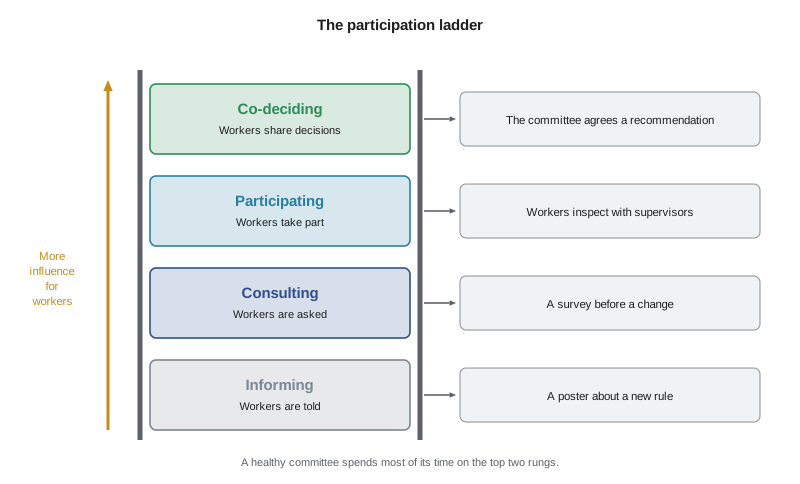
Most workplaces do plenty of informing and some consulting. The committee is the main structure through which workers move up to participating and, for some matters, co-deciding. When a committee stalls, as the one at the distribution center had, the workplace slides back down the ladder, usually without anyone deciding that it should.
The internal responsibility system
American law does not use the phrase internal responsibility system, but the idea behind it runs through good safety practice in the United States too. The OSH Act puts the duty to provide a safe workplace on the employer and requires workers to follow the rules that apply to their own conduct. OSHA's Recommended Practices for Safety and Health Programs, published in 2016, make worker participation one of seven core elements and say that workers should be involved in every part of the program, from finding hazards to evaluating whether it works.
Where a safety committee exists, it sits inside the employer's program. It does not take responsibility away from managers or supervisors. A supervisor who sees a hazard must deal with it, whether or not the committee has noticed it. What the committee adds is a second line of sight. Workers and managers looking together catch things that either group might miss alone, and the committee checks that the program is actually working.
Why participation improves safety
There are practical reasons, not just principled ones, for involving workers in safety.
- Workers know the work. They know which tasks are awkward, which machines misbehave, which shortcuts are tempting and why. A procedure written without them often describes work as imagined, not work as done.
- Workers see hazards first. They are on the floor every shift. A worker who can raise a concern easily and see it acted on becomes an early warning system.
- Controls work better when people help choose them. A guard or procedure that workers helped design is more likely to fit the job and to be used.
- Participation builds trust. When workers see their concerns lead to action, they report more. When they see concerns ignored, they stop.
- It spreads knowledge. Committee members learn about hazards and controls across the workplace and carry that knowledge back to their crews.
Research on joint committees broadly supports these reasons. Studies in several countries have found that workplaces with active joint committees and worker representatives tend to have better safety practices and, in many cases, lower injury rates than similar workplaces without them. The size of the effect varies, and the research consistently finds that what matters is how the committee works, not whether it exists. A committee that meets, inspects, investigates and gets answers is associated with better outcomes. A committee that exists on paper is not.
Committees that work and committees that stall
Elena had seen both kinds. At a previous employer, she had sat on a committee that met every month in a room with a clock that ran ten minutes fast so the meeting would end sooner. The management members did most of the talking, the minutes were written by the human resources office and posted weeks later, and recommendations disappeared into an email inbox. Workers called it the complaints committee, and not as a compliment.
She had also seen the opposite: a committee at a dairy that inspected every area of the plant on a rotating schedule, investigated every injury with the supervisor, tracked every recommendation on a board in the lunchroom, and had a plant manager who answered in writing within days. Workers there knew the co-chairs by name and brought them problems because they knew something would happen.
The difference was not the law, which was the same for both. It was a handful of practical things that this course covers one by one:
- clear terms of reference and membership that represents the workplace (lesson 3)
- trained members who know what they are allowed and expected to do (lesson 4)
- inspections that are planned, thorough and followed up (lessons 5 and 6)
- a real role in investigating incidents and handling refusals or complaints (lessons 7 and 8)
- recommendations that are written well and answered on time (lesson 9)
- meetings that are run well and produce decisions (lesson 10)
- a way of checking whether the committee is making a difference (lesson 11)
Participation beyond the committee
The committee is the formal structure, but participation should not stop at its door. Many of the best ideas at Harrowgate Foods Inc. came from crews that were not on any committee: the night sanitation crew that redesigned the lockout board, the drivers who mapped where pedestrians and forklifts crossed. Participation also happens in pre-job talks, in risk assessments for new equipment, in investigations, in procedure reviews and in the everyday conversations between a supervisor and a crew.
One way to think about it is that the committee is the place where participation is guaranteed and recorded. Everything else the company does to involve workers should feed into it and draw on it. A committee that is the only channel becomes a bottleneck. A committee that ignores other channels misses most of what workers know.
Federal law gives workers rights that make participation possible: the right to information and training about hazards, the right to report hazards and injuries without retaliation, the right to request an OSHA inspection and to talk to the inspector, and, in narrow circumstances, the right to refuse work that poses an imminent danger. A safety committee is one practical way to make those rights real inside the company. Lesson 8 covers complaints and refusals.
The committee at each site
Harrowgate Foods Inc. has three sites in Georgia. The main plant in Gainesville has about 420 workers and a safety committee of twelve members. The distribution center in McDonough has about 110 workers and a committee of eight. The sauces plant in Athens has about 60 workers and a committee of six. Georgia does not require private employers to have safety committees, and neither does federal OSHA. Harrowgate Foods Inc. runs them by choice, because the company believes they improve safety and because a major customer asks about worker involvement in its supplier audits. A small satellite warehouse near Athens with 12 workers has an elected safety representative instead of a committee.
Elena began with a simple question for each committee: how well does it actually work? She asked every member at the three sites to rate six aspects of their committee on a scale of 1 to 5, and compared the averages.
# Members' ratings of their own committee (1 = poor, 5 = excellent).
ratings = {
    "main plant":   {"meets as planned": 4.1, "inspections": 3.8, "investigations": 3.2,
                     "recommendations answered": 3.6, "workers know the members": 3.0, "makes a difference": 3.4},
    "distribution": {"meets as planned": 1.9, "inspections": 2.4, "investigations": 1.8,
                     "recommendations answered": 1.5, "workers know the members": 2.2, "makes a difference": 1.7},
    "sauces plant": {"meets as planned": 3.5, "inspections": 3.0, "investigations": 2.6,
                     "recommendations answered": 3.1, "workers know the members": 3.9, "makes a difference": 3.0},
}
for site, r in ratings.items():
    avg = sum(r.values()) / len(r)
    low = min(r, key=r.get)
print(f"{site:<13} average {avg:.1f} weakest: {low} ({r[low]})")main plant average 3.5 weakest: workers know the members (3.0) distribution average 1.9 weakest: recommendations answered (1.5) sauces plant average 3.2 weakest: investigations (2.6)
The distribution site's committee was clearly in trouble, with every score below 2.5 and recommendations scoring lowest of all. The main plant's committee was functioning but weak on investigations and on visibility: many workers did not know who their committee members were. The sauces plant, the smallest site, had the best visibility because everyone knew everyone, but less experience with investigations. These results set the agenda for the rest of the year.
Listening before fixing
Before changing anything, Elena spent a week at the distribution center talking to workers who were not on the committee. She asked three questions on every shift: do you know who is on the safety committee, have you ever brought them a problem, and what happened when you did? Of the 41 workers she spoke to, 17 could name at least one member. Nine had raised a concern with a member at some point. Only two could say what had happened to it.
The answers to the third question were the most revealing. A loader said he had mentioned a broken dock light to Sam and assumed it had gone nowhere, although it had in fact been fixed three weeks later; nobody had told him. A picker said she had stopped raising things because the last time, her supervisor had asked why she had gone to the committee instead of to him. A night driver said he did not know the committee met at all, because every meeting was in the afternoon.
Each answer pointed to something the committee could change: closing the loop with the person who raised a concern, making clear that going to the committee is a right and not a complaint about a supervisor, and finding ways to include night workers. Elena wrote the three questions on the first page of her plan and decided to ask them again at the end of the year.
What a committee can and cannot do
Committees work best when everyone understands their role. A committee identifies hazards, inspects, takes part in investigations, receives concerns, makes recommendations and checks that recommendations are acted on. It advises; it does not manage. The employer remains responsible for deciding what to do and for doing it. A committee cannot order a manager to spend money or stop production, although in some circumstances its members have specific legal roles, such as investigating a work refusal.
Equally, the committee is not a place to settle labor relations disputes. Where workers are unionized, wages, hours and discipline belong to collective bargaining and the grievance process. Even where workers are not unionized, a committee that becomes a forum for every workplace complaint loses its focus on safety. Elena put it simply in her first presentation to the committees: 'If it can hurt someone, it belongs here. If it is about pay or schedules, it belongs somewhere else, and we will help you find where.'
Worked problem
Informing, consulting or participating?
Show solution
- The main plant is replacing the shrink-wrap machine on line 3. Three possible approaches are on the table.
- Approach A: the engineering team chooses the machine and installs it, then posts a notice about new guarding and trains operators. This is informing.
- Approach B: engineering shows operators two candidate machines and asks which they prefer, then decides. This is consulting.
- Approach C: two line 3 operators and a committee member join the project team, visit a plant using the leading candidate, help write the risk assessment and sign off the guarding before start-up. This is participating.
- Which approach is most likely to catch the jam-clearing hazard that operators know about but engineers do not?
Answer: Approach C. Operators involved in the risk assessment are far more likely to raise how jams are actually cleared, and the guarding can be designed around it before installation.
Common mistakes
MistakeTreating the committee as a place to tell workers about decisions already made.
InsteadUse the committee to involve workers before decisions, in inspections, risk assessments and investigations.
MistakeAssuming the committee is responsible for safety.
InsteadManagers and supervisors remain responsible; the committee advises, checks and recommends.
MistakeMeasuring the committee by whether it meets.
InsteadMeasure whether it finds hazards and gets them fixed.
MistakeLetting the committee become the only channel for safety concerns.
InsteadEncourage concerns through supervisors, crews and other routes, and feed them into the committee.
MistakeUsing the committee for pay or scheduling disputes.
InsteadKeep the committee focused on health and safety.
Summary and key terms
- Worker participation means involving workers in finding hazards, choosing controls and checking results, not just informing them.
- The participation ladder runs from informing to consulting, participating and co-deciding.
- OSHA's Recommended Practices make worker participation a core element; a committee adds a second line of sight.
- Workers know the work, see hazards first and help design controls that fit.
- Research links active committees with better safety; committees that exist only on paper do not help.
- A committee advises and checks; the employer decides and acts.
- Worker participation
- Active involvement of workers in identifying hazards, choosing controls, checking results and improving safety.
- Shared responsibility
- The principle, central to good practice, that employers, supervisors and workers all have a part in safety, in proportion to their authority.
- Safety committee
- A group of worker and management members that meets regularly to identify hazards and recommend improvements.
- Participation ladder
- A way of describing levels of involvement: informing, consulting, participating and co-deciding.
- Co-chair
- One of two people who lead the committee, one chosen by worker members and one by management members.
Practice problems
Work each problem on paper first, then reveal the answer to check.
Name the four rungs of the participation ladder.
Show answer
Informing, consulting, participating and co-deciding.
What is the difference between consulting and participating?
Show answer
Consulting asks for views before management decides; participating involves workers in doing the work of safety, such as inspecting and assessing risk.
Give three reasons worker participation improves safety.
Show answer
Workers know the work, see hazards first, and controls they help choose work better; participation also builds trust and spreads knowledge.
Who remains responsible for acting on hazards when a committee exists?
Show answer
The employer, through its managers and supervisors.
Which committee at Harrowgate Foods Inc. scored lowest in the members' self-assessment?
Show answer
The distribution site committee, with recommendations answered scoring lowest.
Lesson quiz · 5 questions
Score 60% or more to complete this lesson.
Create a free account to save your progress, take quizzes and earn a certificate.