
HSE-382 · Lesson 9 of 12 · 18 min
Electrical hazards in wet kitchens
▶ Video coming soon A video version of this lesson is on the way.
Late one night in March, Kofi Mensah was hosing down the floor of the dish pit when he reached behind the prep sink to unplug the floor-standing food processor so he could move it. His hand was wet, the plug had a crack along one side that nobody had reported, and the receptacle behind the sink was one of the last in the kitchen without ground fault protection. He felt a hard jolt up his arm and let go. He was shaken but unhurt, and he did exactly the right thing afterwards: he left the processor where it was, reported it, and went to the hospital to be checked, because an electric shock can disturb the heart's rhythm hours later. The electrician who came the next day replaced the receptacle with a ground fault protected one, found two others without protection, and took the processor's cord out of service.
Kitchens combine water, steam, grease, heat and a lot of electrical equipment in a small space, often with people who are wet, rushed and standing on wet floors. This lesson covers how electric shock happens, how ground fault protection works, what kitchen staff check every day, how electrical fires start and what to do if someone is shocked.
How electric shock happens
Electricity flows when there is a path for it. In a working appliance, current flows out along the hot wire, through the appliance and back along the neutral wire. A shock happens when a person becomes part of another path: for example, between a damaged cord or a faulty appliance casing and the floor, a sink, a steel table or a water pipe. Water makes this far more likely. Wet skin conducts electricity much better than dry skin, a wet floor connects a person's feet to ground, and water in an appliance or on a plug can carry current to places it should never reach.
The harm depends on how much current flows through the body, along what path and for how long. A current of about one thousandth of an ampere, a milliampere, can just be felt. At around ten milliamperes the muscles of the hand can clamp onto the source so that the person cannot let go. A current of a few tens of milliamperes passing through the chest can disturb the heart's rhythm into ventricular fibrillation, which is fatal without quick treatment. An ordinary kitchen circuit can deliver hundreds of times that much. Burns, falls from the jolt, and injuries from being thrown against equipment add to the danger.
Ground fault protection
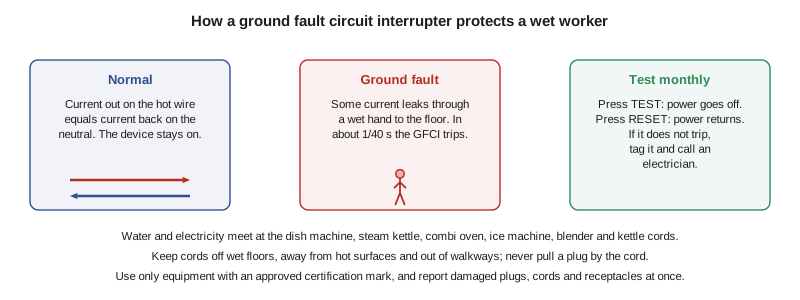
A ground fault circuit interrupter, often called a GFCI, is the single most important electrical safety device in a wet kitchen. It continuously compares the current flowing out on the hot wire with the current returning on the neutral. In a healthy circuit they are equal. If some current is leaking away, through a person or through water to ground, the two no longer match. When the difference reaches a few milliamperes, the GFCI cuts the power in a fraction of a second, fast enough to prevent a dangerous shock in most cases. A GFCI does not prevent the jolt entirely, and it does not protect against a shock between the hot and neutral wires, but it turns many potentially fatal shocks into a startling tingle.
The National Electrical Code requires GFCI protection for receptacles in commercial kitchens, including the higher-voltage receptacles that many kitchen appliances use, and for receptacles near sinks and in other wet locations. Older kitchens like Juniper's, which were renovated in stages, can have a mix of protected and unprotected receptacles, as Kofi found, because existing wiring is generally only brought up to the current code when it is altered. GFCI protection can be built into the receptacle, which has TEST and RESET buttons on its face, or into the breaker in the electrical panel.
A GFCI is an electronic device and can fail. It should be tested monthly by pressing the TEST button: the power should go off, and pressing RESET should bring it back. A GFCI that does not trip is tagged out of service and reported to the electrician. A GFCI that trips repeatedly is also telling you something: usually that an appliance or cord on that circuit has a fault or has water in it. Resetting it again and again without finding the cause defeats its purpose.
Where water and electricity meet
At Juniper the places that need the most attention are easy to list:
- The dish pit, where the dish machine and its booster heater, the pre-rinse sprayer, the floor hose and the receptacles behind the sinks share a small, permanently wet area.
- The combi oven, which makes steam and is wired for high power, and is cleaned with water and chemicals.
- The ice machine in the back corridor, with its drain line and its receptacle near the floor.
- The prep area, where blenders, the immersion blender, the food processor and the vacuum sealer are used beside sinks and are washed often.
- The bar, with its blender, coffee machine, glass washer and ice bins.
- The patio in summer, where extension cords for lights and heaters can end up running across wet ground.
Simple layout choices reduce the risk. Receptacles are mounted above countertop height where possible and away from sink splash. Appliances are unplugged before cleaning, and the plug is pulled by gripping it, never the cord. Small appliances are never immersed unless the manufacturer says they can be. Floor hoses are not aimed at receptacles, panels or the backs of appliances. And staff stand on dry mats and keep their hands dry when plugging in or unplugging equipment.
Cords, plugs and receptacles
Damaged cords and plugs cause many kitchen shocks and electrical fires. Cords in kitchens are pinched by carts, cut by knives, melted by hot pans, soaked by mopping and pulled by people moving equipment. Every user of a corded appliance should look at the cord and plug before using it. Signs that the appliance must be taken out of service include:
- Cracked, cut or melted insulation, or bare wire showing.
- A cracked plug, bent or loose prongs, or a missing grounding pin.
- Scorch marks or discoloration on the plug or the receptacle, or a smell of hot plastic.
- A plug that is warm to the touch after use.
- Tape wrapped around a cord as a repair.
OSHA's electrical standards require equipment to be approved and free of recognized hazards, flexible cords to be visually inspected before use for external defects and damage, and damaged cords to be removed from service. Equipment should carry the mark of a nationally recognized testing laboratory, such as UL, CSA or ETL. Cords are repaired or replaced by a qualified person, not taped.
Extension cords and power bars deserve their own rule, because kitchens use them constantly and often badly. At Juniper, extension cords are for temporary use only, such as an event on the patio, and are taken up afterwards. They are never run under floor mats or through doorways where they can be pinched, never plugged into each other in a chain, and never used for heaters, toasters, kettles or other high-power appliances. A piece of equipment that needs a cord to reach a receptacle permanently needs a new receptacle, installed by an electrician.
The electrical panel
The panel that feeds the kitchen is in the corridor beside the walk-in. It must be accessible at all times, with a clear working space in front of it, typically at least 3 ft (1 m) deep, so that breakers can be reached quickly in an emergency and an electrician can work on it safely. Panels in kitchens tend to become storage spots for mop buckets, cases of paper towels and spare chairs; at Juniper, the floor in front of the panel is painted with yellow stripes and nothing is allowed in the striped area. The breakers are labeled so that staff can identify which one feeds each appliance.
Kitchen staff may switch a breaker off in an emergency or to isolate a faulty appliance. They do not open the panel cover, replace breakers or fuses, or work on wiring. A breaker that trips repeatedly is a sign of a fault or an overloaded circuit and must be reported, not just reset.
Electrical fires
Electrical faults are a common source of kitchen fires that do not involve the cooking line. Overloaded cords and receptacles overheat; loose connections in a plug or receptacle arc and scorch; motors packed with grease or flour overheat; heat lamps and toasters ignite paper and food debris near them. The warning signs often appear well before a fire: a burning smell, flickering lights, a receptacle that is warm or discolored, a breaker that trips again and again, or a motor that hums and does not start.
If an appliance smokes or catches fire, the first step is to cut the power: switch it off at its own switch if that is safe, or at the breaker. Once the power is off, a small fire can be treated as an ordinary fire. If the power cannot be cut, only an extinguisher rated for electrical fires, such as ABC dry chemical or carbon dioxide, may be used, and water must never be used on equipment that may still be energized. If the fire is not small and easily controlled, follow the evacuation plan.
If someone is shocked
The instinct to grab a person who is being shocked is strong and dangerous, because the rescuer can become part of the same circuit. Juniper's first aid procedure is:
- Do not touch the person while they may still be in contact with the source.
- Cut the power at the switch, by unplugging the cord by its plug if that is safe, or at the breaker. If that is not possible, use a dry, non-conducting object, such as a wooden broom handle, to push the source away, standing on something dry.
- Call 911 and the first aid attendant. If the person is not breathing normally, start CPR and send someone for the AED.
- Anyone who has had a significant shock, even if they feel fine, is checked by a doctor the same day, as Kofi was.
- Report the incident, take the equipment out of service and keep it for the electrician and any investigation.
Monthly checks
Juniper's monthly safety check includes testing every GFCI in the kitchen and bar and looking at the cords and plugs of every portable appliance. The program below summarizes one month's results. The data contain no units or local rules, so the same program serves both countries.
# Summarize the monthly GFCI tests and cord inspections.
gfci_tests = [
    # (location, tripped on TEST, reset OK)
    ("dish pit left", True, True), ("dish pit right", True, True),
    ("prep sink", True, True), ("prep counter", False, False),
    ("bar back", True, True), ("ice machine", True, True),
    ("patio wall", True, False),
]
cords = [
    # (appliance, condition)
    ("food processor", "replaced cord, good"), ("immersion blender", "good"),
    ("bar blender", "plug warm after use"), ("vacuum sealer", "good"),
    ("coffee machine", "insulation nicked near base"), ("heat lamp", "good"),
]

print("GFCI tests:")
for place, tripped, reset in gfci_tests:
    if tripped and reset:
        result = "pass"
    elif not tripped:
        result = "FAIL: did not trip, tag out and call electrician"
    else:
        result = "FAIL: will not reset, check for a fault on the circuit"
    print(f"  {place:15s} {result}")
print("Cords and plugs:")
for name, condition in cords:
    action = "ok" if condition.endswith("good") else "TAKE OUT OF SERVICE"
print(f" {name:18s} {condition:30s} {action}")GFCI tests: dish pit left pass dish pit right pass prep sink pass prep counter FAIL: did not trip, tag out and call electrician bar back pass ice machine pass patio wall FAIL: will not reset, check for a fault on the circuit Cords and plugs: food processor replaced cord, good ok immersion blender good ok bar blender plug warm after use TAKE OUT OF SERVICE vacuum sealer good ok coffee machine insulation nicked near base TAKE OUT OF SERVICE heat lamp good ok
Two GFCIs and two cords need attention. The receptacle at the prep counter did not trip at all, so it gave no protection and was tagged out immediately. The patio GFCI tripped but would not reset, which pointed to water in the outdoor receptacle box after a rainy week. The warm bar blender plug and the nicked coffee machine cord were both taken out of service until they were repaired. Each of these findings is the kind of small problem that, left alone, becomes the next Kofi story.
Summary and key terms
- A shock happens when a person becomes part of a path for current, and water, wet skin and wet floors make that far more likely.
- A few tens of milliamperes through the chest can stop the heart; a GFCI cuts the power when it detects a few milliamperes leaking to ground.
- Receptacles in kitchens and near sinks need ground fault protection; test each GFCI monthly and never keep resetting one that trips.
- Inspect cords and plugs before use, take damaged equipment out of service, use extension cords only temporarily, and keep the space in front of the panel clear.
- For an electrical fire, cut the power first; for a person being shocked, never touch them until the power is off, then call 911 and give first aid.
- Ground fault
- An unintended path for current to ground, such as through a person or water.
- GFCI
- A ground fault circuit interrupter, which cuts power when the current going out and coming back differ by a few milliamperes.
- Milliampere (mA)
- One thousandth of an ampere; the unit used to describe the currents that harm people.
- Ventricular fibrillation
- A chaotic heart rhythm, which electric shock can cause, that is fatal without quick treatment.
- Working space
- The clear area in front of an electrical panel that must be kept free so it can be reached and serviced safely.
Common mistakes
MistakeIf the GFCI keeps tripping, plug the appliance into a different receptacle.
InsteadRepeated tripping signals a fault or water in the equipment; take it out of service and report it.
MistakeA cut in a cord can be fixed with electrical tape until the end of the week.
InsteadTaped cords are not a repair; take the appliance out of service until a qualified person replaces the cord.
MistakePull the person off the equipment as fast as you can.
InsteadCut the power first, or you may become part of the circuit; then call 911 and give first aid.
Practice problems
Work each problem on paper first, then reveal the answer to check.
Why is a wet dish pit floor so important to electrical safety?
Show answer
A wet floor connects a person's feet to ground, so a fault in an appliance or cord can send current through their body to the floor.
The TEST button on a GFCI is pressed and the power stays on. What does this mean and what should happen?
Show answer
The GFCI is not working and gives no protection; tag the receptacle out of service and call the electrician.
A toaster at the prep station starts smoking and a small flame appears. What are the first two steps?
Show answer
Cut the power by switching it off or turning off its breaker, then treat the small fire with an appropriate extinguisher if it is safe, or evacuate if it is not.
Lesson quiz · 5 questions
Score 60% or more to complete this lesson.
Create a free account to save your progress, take quizzes and earn a certificate.