
HSE-382 · Lesson 7 of 12 · 17 min
Gas appliances: safe use and inspection
▶ Video coming soon A video version of this lesson is on the way.
A week after Juniper Street reopened, Ben Carter lit the range at 10:30 in the morning and noticed that two of the front burners were burning with tall, lazy yellow flames instead of the usual crisp blue. Pans were blackening on the bottom and the line smelled faintly sharp. He turned the burners off, told Aisha, and taped a note on the knobs. The gas technician who came that afternoon found burner ports clogged with dried agent residue from the February discharge and an air shutter that had been knocked out of adjustment during the cleanup. Twenty minutes of cleaning and adjusting and the flames were blue again. Ben's call was exactly right, and it is the kind of judgment this lesson aims to build.
Most of the heat on Juniper's cooking line comes from natural gas: the two floor fryers, the six-burner range and oven, the griddle, the charbroiler and the tilting kettle, along with the water heater in the basement. Gas is efficient and responsive, which is why cooks like it. It is also a fuel that can leak, burn badly and produce carbon monoxide, so the equipment that uses it has to be installed, used and maintained properly. This lesson covers how gas reaches the line, how gas appliances work safely, what kitchen staff check every day and what must be left to licensed technicians. Lesson 8 covers leaks and carbon monoxide.
How gas reaches the line
Natural gas arrives from the utility's main under the street at a pressure higher than appliances can use. At the meter on Juniper's outside wall, a regulator reduces it to a low pressure for the building, typically around 7 in. w.c. (1.7 kPa), and each appliance has its own regulator or valve train that sets the exact pressure its burners need. Inside, steel piping runs along the wall behind the line, with a branch down to each appliance.
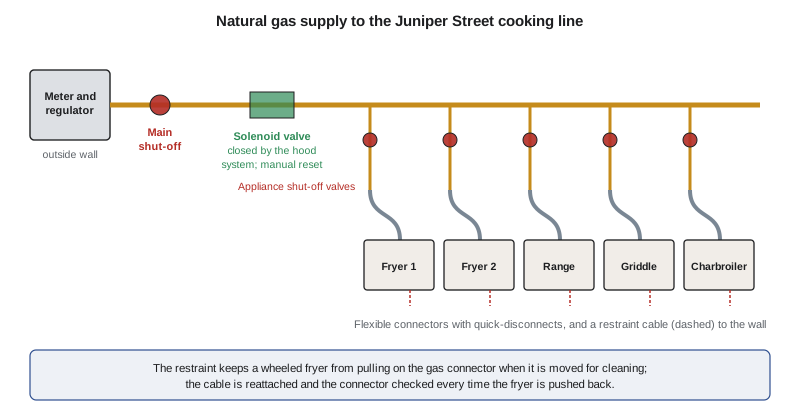
Three kinds of valve on that piping matter to kitchen staff:
- The main shut-off at or near the meter stops gas to the whole building. Its location is marked on the fire safety plan, and the managers know how to close it.
- The solenoid valve on the line serving the hood is closed automatically when the suppression system fires, as Lesson 5 described, and must be reset by hand after the system has been serviced. It also closes if the power fails, on some systems.
- Each appliance has its own manual shut-off valve on its branch, within reach, so that one appliance can be isolated for service or in an emergency without shutting down the whole line.
Every cook on the line should know where each appliance shut-off is and which way the handle turns. On the quarter-turn ball valves at Juniper, the handle is open when it lines up with the pipe and closed when it crosses the pipe.
Connectors for moving appliances
Fryers, ranges and griddles on casters are connected with a flexible gas connector so that they can be pulled out for cleaning. Commercial connectors are certified for this use under ANSI Z21.69/CSA 6.16, and the fuel gas codes require three things with them: a quick-disconnect fitting that shuts off the gas automatically when it is uncoupled, a manual shut-off valve upstream of the connector, and a restraining device, usually a steel cable, fastened to the wall and to the appliance. The cable is shorter than the connector, so that if the appliance is pulled too far the cable takes the strain instead of the gas line.
Staff at Juniper are trained to move an appliance in a fixed order. Turn the appliance off and let it cool, close its shut-off valve, uncouple the quick-disconnect, unclip the restraint, pull the appliance out and clean. To put it back: push it to its painted floor marks, clip on the restraint, couple the quick-disconnect until it clicks, open the valve, and relight following the manufacturer's instructions. Then check the connector for kinks or twists and make sure it is not resting against a hot surface.
When the old fryer 2 was taken out in May, the gas technician found its connector kinked tightly behind the fryer and its restraint cable missing entirely. Someone had removed the cable months earlier because it was a nuisance during cleaning, and the fryer had been pulled out every Sunday night with the full weight of the move on the connector. The new fryer went in with a new connector and restraint, and the move routine was added to the closing checklist.
How a gas burner works
A gas burner mixes gas with the right amount of air before it burns. Gas leaves a small fixed opening called the orifice at speed and draws in primary air through an adjustable opening called the air shutter. The mixture burns at the burner ports, drawing in more air from around the flame. When the mixture is right, the flame is blue with a sharp, inner cone and makes a soft, steady sound. When something is wrong, the flame shows it:
- Yellow, lazy or smoky flames mean incomplete combustion: not enough air, dirty ports, or the wrong gas. They produce soot and carbon monoxide.
- Flames that lift off the ports, or blow out easily, mean too much air or too much pressure.
- Flames that are uneven around a burner mean some ports are clogged.
- A flame that pops or flashes back into the burner when it is turned off needs adjustment.
Any of these is a reason to turn the burner off and report it, as Ben did. Ports are cleaned as the manufacturer describes, usually with a stiff brush or a wire, never with a toothpick that can break off inside. Air shutters and gas pressure are adjusted only by a licensed technician.
Ignition and flame safety
Older appliances use a standing pilot, a small flame that burns all the time and lights the main burner. Newer appliances use electronic ignition, which lights the burner with a spark or a hot surface only when it is called for. Either way, a modern appliance has a flame safety device that shuts off the gas if the flame goes out or fails to light. On a pilot appliance this is often a thermocouple, a sensor that sits in the pilot flame and holds the gas valve open only while it is hot.
Flame safety devices are the reason it is safe to leave an oven on: if the flame goes out, the gas stops. They are also a reason never to defeat a control that keeps shutting an appliance off. A burner that keeps going out is telling you something is wrong with the gas supply, the flame or the safety device itself.
Lighting is always done following the instructions on the appliance's lighting plate. If a burner or pilot does not light within a few seconds, the cook turns the gas off and waits several minutes for any unburned gas to clear before trying again. Repeated attempts in quick succession let gas build up inside the appliance, and the next spark can ignite it with a bang that can burn hands and faces. Nobody leans into an oven to light it, and nobody uses paper spills or lighters on appliances designed for electronic ignition.
Rating plates
Every gas appliance has a rating plate, usually inside a door or on the back, that lists the manufacturer, the model, the type of gas it is set up for, the heat input, the clearances it needs from combustible surfaces, and the certification mark. Two items on the plate matter most to kitchen staff. First, the gas type: an appliance set up for natural gas has orifices sized for it, and connecting it to propane, or the reverse, makes dangerously large or tiny flames. Conversion between gases is done only by a licensed technician with the manufacturer's kit. Second, the clearances: the space the appliance needs from walls and other combustible materials is part of its certification, and pushing it tight against a wall, or stacking supplies against it, can overheat the wall behind it.
Daily checks
The opening cook checks each gas appliance before service, and anyone using an appliance during the shift watches for the same things:
- No smell of gas around the appliance or the line.
- Each appliance in its marked position, with its restraint attached, its connector free of kinks and not touching a hot surface, and its shut-off valve open.
- Burners light promptly and burn blue and steady; pilots are steady.
- Fryer oil at the correct level before the fryer is lit, and the fryer reaching temperature normally and holding it.
- Nothing combustible stored on, against or under the appliance.
If anything is wrong, the appliance is turned off at its valve, tagged out of service with a note saying what is wrong, and reported to the kitchen manager. It stays off until a technician has looked at it.
Regular service
Juniper has every gas appliance serviced once a year by a licensed gas technician, under a service contract, and more often for the fryers. A service visit checks the gas pressure, the combustion and flame, the ignition and flame safety controls, the fryer thermostats and high-limit controls, the connectors and restraints, and tests the connections for leaks with an approved leak detection solution or an electronic detector. Gas work in Georgia, including any repair, replacement or alteration, is done by a licensed contractor and usually needs a permit from the local building department.
Leak testing is never done with a flame. A lighter held to a fitting to look for a leak can ignite the gas, and a leak that is big enough to show as a flame is big enough to burn someone badly.
Planning a new appliance
Every gas appliance on the line draws on the same supply, and the meter and piping are sized for a certain total load. When Tomás proposed adding a two-burner wok range for a new menu, Daniel asked the gas contractor whether the supply could carry it. The program below shows the kind of calculation the contractor did, using the heat input from each appliance's rating plate and the capacity of the meter. Real sizing also depends on pipe lengths and diameters; this check only looks at the meter.
# Compare the connected gas load with the meter capacity before adding an appliance.
appliances_btuh = {
    "fryer 1": 110_000, "fryer 2": 110_000, "range and oven": 215_000, "griddle": 90_000,
    "charbroiler": 102_000, "tilting kettle": 80_000, "water heater": 199_000,
}
meter_capacity_btuh = 1_100_000
planning_limit = 0.85       # keep the connected load below this share of capacity

def report(loads, label):
    total = sum(loads.values())
    share = total / meter_capacity_btuh
    status = "within limit" if share <= planning_limit else "OVER planning limit"
    print(f"{label}: {total:,} Btu/h of {meter_capacity_btuh:,} Btu/h, {round(share * 100)} out of 100 used, {status}")

report(appliances_btuh, "Now")
with_wok = dict(appliances_btuh, **{"wok range (2 burners)": 250_000})
report(with_wok, "With wok range")Now: 906,000 Btu/h of 1,100,000 Btu/h, 82 out of 100 used, within limit With wok range: 1,156,000 Btu/h of 1,100,000 Btu/h, 105 out of 100 used, OVER planning limit
The existing line already uses most of the meter's capacity, and the wok range would take it well past the limit. Adding it would mean a larger meter from the utility, new piping, changes to the hood and suppression system for a high-volume wok station, and a shorter hood cleaning interval. The wok dishes went on the menu cooked on the existing range instead.
Summary and key terms
- Gas reaches the line through a meter and regulator, a main shut-off, a hood-controlled solenoid valve and a manual shut-off for each appliance; staff should know where each one is.
- Appliances on casters use certified flexible connectors with a quick-disconnect, an upstream shut-off valve and a restraint cable that must always be reattached.
- A healthy flame is blue with a sharp inner cone; yellow, lifting or uneven flames mean trouble and the burner should be turned off and reported.
- Flame safety devices shut off the gas if the flame fails; never defeat them, and wait for gas to clear before relighting.
- Staff check appliances daily and tag faulty ones out of service; only licensed technicians adjust, repair, convert or install gas equipment, and leaks are never tested with a flame.
- Regulator
- A device that reduces gas pressure to the level a building or appliance needs.
- Quick-disconnect
- A fitting on a flexible gas connector that shuts off the gas automatically when uncoupled.
- Restraining device
- A cable fastened to the wall and the appliance, shorter than the gas connector, so the connector is never strained.
- Flame safety device
- A control, such as a thermocouple, that shuts off the gas if the flame goes out or fails to light.
- Rating plate
- The label on an appliance showing its gas type, heat input, clearances and certification.
When to call the technician
Kitchen staff should call for service, rather than keep cooking, whenever an appliance shows any of these signs: a gas smell that does not clear when a burner is turned off, a pilot or burner that keeps going out, flames that are yellow, lifting or uneven, a fryer that overheats or will not hold temperature, a connector that is kinked, cracked or stiff, a restraint that will not attach, or soot appearing on walls or pans. The cost of a service call is small next to the cost of a fire or a carbon monoxide incident.
Common mistakes
MistakeThe restraint cable gets in the way during cleaning, so it is fine to leave it off.
InsteadWithout the restraint, moving the appliance strains the gas connector; always reattach it.
MistakeIf a burner will not light, keep pressing the igniter until it catches.
InsteadTurn the gas off and wait several minutes for unburned gas to clear before trying again.
MistakeHold a lighter near a fitting to see if it is leaking.
InsteadNever use a flame; leaks are found with an approved leak detection solution or a detector, by a technician.
Practice problems
Work each problem on paper first, then reveal the answer to check.
Two burners on the range are burning yellow and leaving soot on pans. What should the cook do?
Show answer
Turn those burners off, tag them, and report it; the cause may be clogged ports or a misadjusted air shutter, and incomplete combustion produces carbon monoxide.
List the steps for putting a fryer back after cleaning.
Show answer
Push it to its floor marks, attach the restraint, couple the quick-disconnect, open the shut-off valve, relight following the instructions, and check the connector for kinks and contact with hot surfaces.
Why must a natural gas fryer never be connected to a propane cylinder?
Show answer
Its orifices are sized for natural gas; on propane the flames would be dangerously large. Conversion needs a licensed technician and the manufacturer's kit.
Lesson quiz · 5 questions
Score 60% or more to complete this lesson.
Create a free account to save your progress, take quizzes and earn a certificate.