
HSE-382 · Lesson 12 of 12 · 17 min
Capstone: a restaurant fire safety walk
▶ Video coming soon A video version of this lesson is on the way.
Seven months after the fire, on a quiet Wednesday afternoon in September, Juniper Street's safety committee did its first full fire safety walk. Kofi Mensah, the worker member, carried the checklist. Aisha Rahman, the safety lead, carried a flashlight and a phone for photographs. Nadia Haddad represented the front of house, and Daniel Okafor came for the employer. They started at the back door at 2:30, after the lunch rush, and finished on the patio at 4:15. This capstone lesson follows their walk, room by room, and uses it to pull together everything in the course.
A fire safety walk is different from the monthly extinguisher check or the daily opening checklist. It looks at the whole restaurant at once, with fresh eyes, and asks not only whether each item passes but why problems keep appearing. It is also a chance for workers, who see the kitchen every day, to point out what managers miss.
Planning the walk
Aisha built the checklist from the lessons in this course, organized by area rather than by topic so that the group could walk the building in one loop. Before the walk, she printed the latest records from the fire safety binder: the hood cleaning report, the suppression service report, the extinguisher log, the gas appliance service report, the GFCI and cord check, the emergency lighting log and the last drill report. Walking with the records in hand lets the group check that what the paper says matches what they see.
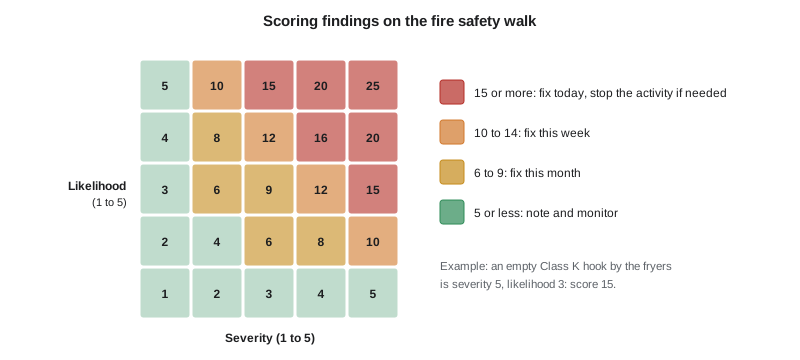
The group agreed on how to score findings before they started, using the same severity and likelihood matrix the committee uses for every inspection. Severity runs from 1, a minor problem, to 5, one that could cause death or the loss of the building. Likelihood runs from 1, very unlikely, to 5, expected to happen soon if nothing changes. The product decides how fast the fix must happen.
The back door and the corridor
The walk started where an evacuation would end for the kitchen staff. The back door opened easily from inside with its panic bar, and the exit sign above it was lit. Outside, the dumpster enclosure was tidy, but a stack of broken-down cardboard leaned against the building wall beside the door, waiting for recycling pickup. Combustible storage against an exterior wall, beside an exit, is exactly the kind of fuel a dropped cigarette or an arsonist finds. Severity 4, likelihood 2: score 8, fix this month. Daniel arranged for an extra recycling pickup and a caged cardboard area away from the wall.
In the corridor, the electrical panel's yellow-striped working space was clear, and the breaker labels were readable. The ice machine's receptacle was a GFCI type and passed its test. The fire alarm pull station by the back door was visible and unobstructed.
The cooking line
The line is where most kitchen fires start, so the group spent the longest here.
- Hood and filters: all eight filters were in place and seated, with no gaps. The filter washing log showed every nightly entry since February except two nights in August. The cleaning certificate on the hood was from late August, within its three-month interval, and the report listed no areas left uncleaned, thanks to the access panels added in the spring.
- Suppression system: the service tag was current, every nozzle had its blow-off cap, and the appliances were all on their painted floor marks. The pull station by the back door was clear.
- Class K extinguisher: the hook beside the fryers was empty. The extinguisher had been taken down to the dish pit a week earlier during a deep clean of the wall and never put back. It was found under the dish table.
- Fryers: oil levels were correct, the high-limit controls had been tested at the last gas service, and both restraint cables were attached. One fryer's flexible gas connector rested against the side of the hot fryer when it was pushed back.
- Range and charbroiler: burners lit promptly with clean blue flames. A sheet pan was sitting on top of the salamander.
- Storage near heat: a box of takeout containers had crept back onto the shelf above the range.
The empty Class K hook was the most serious finding of the walk: severity 5, because without it a fire the hood system did not fully put out would have no backup, and likelihood 3, because the extinguisher was missing and nobody had noticed for a week. Score 15, fix today. The extinguisher was returned to its hook immediately, checked, and the monthly check was changed so that Kofi also confirms every extinguisher is on its hook during the weekly closing walk.
The connector touching the fryer scored 4 and 3, a 12: fix this week. The gas technician rerouted it with a longer bend the next morning. The sheet pan on the salamander and the takeout box above the range were both easy fixes on the spot, each scoring 6 for this month, and both had the same root cause: there was nowhere convenient to put things down. Tomás added a small stainless shelf at the end of the line, away from the heat, for exactly those items.
The prep area and dish pit
In the prep area, the GFCI at the prep counter that had failed its test in the spring had been replaced and tripped properly. The bar blender and coffee machine cords had been replaced. The food processor sat away from the sink. But the extension cord the pastry cook used for a stand mixer at the far end of the counter was back, running behind the sink, because there was no receptacle at that end. Severity 4, likelihood 3: score 12, this week. Daniel booked the electrician to add a GFCI receptacle at the end of the counter.
In the dish pit, the soiled-towel bin was the lidded metal can introduced after Lesson 1's log review, and the towels were collected by the laundry service twice a week. The chemical storage was in order. The dish pit receptacles passed their GFCI tests.
The basement
The basement storeroom had the combustible gas detector added after the June leak and a CO alarm near the water heater, both tested within the month. The water heater's flue connector was intact. The shelving that had once been installed tight against the gas line had been moved back. The ABC extinguisher in the office, previously hidden by chair cushions, was visible and mounted. The light switch at the top of the stairs carried a small sign: smell gas, do not switch.
The dining room and bar
In the dining room, Nadia checked the front-of-house items. Exit signs were lit, the side door opened from inside and was clear, and the emergency lighting log showed the August test. The maximum occupant load sign was posted at the entrance. The candles on the tables were in enclosed glass holders. The chafing fuel for the weekend brunch buffet was stored in its original box in a cabinet away from heat, with the snuffer caps and the long lighter beside it.
At the bar, the ABC extinguisher was mounted and tagged. The CO2 cylinders for the beer system were chained upright in the walk-in. The bar blender's new cord was in good condition, and the glass washer's receptacle passed its GFCI test.
The patio
On the patio, the propane cylinder cage was locked, outside, away from the doors, and held only the cylinders for the four patio heaters and the event barbecue. The heaters were on level ground with clearance from the umbrellas. The group also looked at the place where the wood-fired oven will go next year and confirmed that the planned woodpile location at the back of the lot was still clear. The one finding here was an outdoor extension cord left from a private party the weekend before, running across the patio to a string of lights, with its plug sitting in a puddle beside the patio receptacle. Severity 4, likelihood 2: score 8, this month; in practice it was unplugged and taken in on the spot.
Scoring and sorting the findings
Back in the office, Aisha entered the findings into the committee's tracking sheet. The program below shows how the sheet scores and sorts them so that the most urgent items come first, with a deadline for each. The scores and categories are the same in both countries, so one program serves both.
# Score fire safety walk findings and sort them by urgency.
findings = [
    # (finding, severity 1-5, likelihood 1-5)
    ("Class K extinguisher missing from its hook", 5, 3),
    ("Gas connector touching hot fryer", 4, 3),
    ("Extension cord behind prep sink for stand mixer", 4, 3),
    ("Cardboard stacked against wall by back door", 4, 2),
    ("Patio extension cord plug in a puddle", 4, 2),
    ("Sheet pan on top of salamander", 3, 2),
    ("Takeout containers on shelf above range", 3, 2),
    ("Two nights missing from filter washing log", 3, 2),
]

def deadline(score):
    if score >= 15:
        return "today"
    if score >= 10:
        return "this week"
    if score >= 6:
        return "this month"
    return "monitor"

scored = sorted(((s * l, s, l, f) for f, s, l in findings), reverse=True)
for score, s, l, f in scored:
    print(f"{score:2d} ({s}x{l})  {deadline(score):10s}  {f}")
print(f"{len(findings)} findings; {sum(1 for x in scored if x[0] >= 10)} need action within a week")15 (5x3) today Class K extinguisher missing from its hook 12 (4x3) this week Gas connector touching hot fryer 12 (4x3) this week Extension cord behind prep sink for stand mixer 8 (4x2) this month Patio extension cord plug in a puddle 8 (4x2) this month Cardboard stacked against wall by back door 6 (3x2) this month Two nights missing from filter washing log 6 (3x2) this month Takeout containers on shelf above range 6 (3x2) this month Sheet pan on top of salamander 8 findings; 3 need action within a week
Eight findings, three of them needing action within a week, and one the same day. None of them was dramatic, and all of them were the kind of slow drift that led to the February fire: a routine that slips, a convenience that becomes a habit, an item put down in the wrong place because there is no right place.
Looking for patterns
The most useful part of the walk came at the end, when the group asked what the findings had in common. Three patterns stood out.
- Missing places to put things. The sheet pan, the takeout box and the stand mixer cord all came from equipment or supplies with no proper home. The fix was physical: a shelf and a receptacle.
- Checks that look at paper, not at the kitchen. The Class K extinguisher had a current tag and a monthly check, but nobody had looked at the hook for a week. The fix was to add a quick visual check to an existing routine.
- Temporary arrangements that stay. The patio extension cord and the cardboard by the door were meant to be temporary. The fix was a rule that whoever sets up something temporary takes it down by the end of their shift.
A culture of fire safety
Juniper's year since the fire shows what a working fire safety culture looks like in a restaurant. The systems matter: a clean hood, a serviced suppression system, the right extinguishers, maintained gas and electrical equipment, clear exits and a practiced plan. But the systems depend on people who use them every day: the cook who washes the filters at midnight when everyone else has gone home, the dishwasher who reports a cracked plug, the prep cook who walks back up the stairs instead of turning on the light, and the line cook who pulls the station without waiting for permission.
Elena made a point of recognizing Hana at the staff meeting after the fire, and of recognizing Luis after the gas leak, because the right action in the first seconds is what made both events minor. New hires at Juniper now hear both stories on their first day, walk to every pull station, extinguisher and exit with Aisha or Kofi, and are told plainly that nobody will ever be blamed for pulling the hood system or the fire alarm in good faith.
The September walk will be repeated every quarter. The next one is in December, before the holiday party season, when the dining room is busiest and the kitchen most rushed.
Summary and key terms
- A fire safety walk looks at the whole restaurant at once, with the records in hand, to check that the paper matches what is really there.
- Organize the walk by area, score each finding by severity and likelihood, and set a deadline from the score.
- Most findings are small drifts: routines that slip, conveniences that become habits and temporary arrangements that stay.
- Look for patterns behind the findings and fix the causes, such as adding a shelf or a receptacle, rather than only the symptoms.
- Fire safety depends on people who know the systems and are trusted to act in the first seconds of an emergency.
- Fire safety walk
- A planned inspection of the whole restaurant for fire hazards, done with the records in hand.
- Severity
- How bad the outcome of a hazard could be, scored from 1 to 5.
- Likelihood
- How likely the hazard is to cause harm if nothing changes, scored from 1 to 5.
- Risk score
- Severity multiplied by likelihood, used to rank findings and set deadlines.
- Root cause
- The underlying reason a problem keeps appearing, which a lasting fix addresses.
Common mistakes
MistakeIf every tag and log is current, the walk can be done from the office.
InsteadWalk the building with the records; the Class K extinguisher had a current tag but was not on its hook.
MistakeFix each finding and move on.
InsteadAsk why it happened; fixing the cause, such as adding a shelf or a receptacle, stops it from coming back.
MistakeOnly managers need to take part in fire safety walks.
InsteadWorkers see the kitchen every day and often spot what managers miss; walks include workers and front-of-house staff.
Practice problems
Work each problem on paper first, then reveal the answer to check.
During a walk you find a fire alarm pull station blocked by a high chair storage rack. Score it and set a deadline.
Show answer
Something like severity 4 or 5 and likelihood 2 or 3 gives a score of 8 to 15; at the high end it is fixed today, and moving the rack takes a minute, so fix it on the spot.
The walk finds a box of paper towels stored on the shelf above the charbroiler for the third month running. What is the likely root cause and fix?
Show answer
There is no convenient storage for paper towels near the line; provide a proper place away from the heat and remove the shelf or mark it for nothing combustible.
Name four records worth printing before a fire safety walk.
Show answer
Any four of: hood cleaning report, suppression service report, extinguisher log, gas appliance service report, GFCI and cord check, emergency lighting log, drill report, filter washing log.
Lesson quiz · 5 questions
Score 60% or more to complete this lesson.
Create a free account to save your progress, take quizzes and earn a certificate.