
HSE-382 · Lesson 8 of 12 · 17 min
Gas leaks and carbon monoxide
▶ Video coming soon A video version of this lesson is on the way.
At 9:15 on a Tuesday morning in June, Luis Moreno went down to the basement storeroom for a case of tomatoes and smelled rotten eggs at the bottom of the stairs. He did not turn on the light, did not take out his phone, and did not go looking for the source. He went back up, told Aisha, who was the only other person in the building, and the two of them left by the back door. From the lane, Aisha called the gas utility's emergency line and then 911. The utility crew found a leaking union on the gas line to the water heater, shut off the gas at the meter, and had the fitting replaced by noon. Juniper opened for dinner an hour late. Luis did everything right, and this lesson explains why each of his choices mattered.
Gas leaks and carbon monoxide are the two invisible hazards of a gas kitchen. A leak can lead to a fire or an explosion. Carbon monoxide, produced when gas burns badly, can poison people without any warning they can see or smell. Both are rare when appliances are maintained and the exhaust system works, and both are far more dangerous when people do not know the signs.
How natural gas and propane behave
Natural gas is mostly methane. It is lighter than air, about half as heavy, so when it leaks it rises and collects near ceilings and in the upper parts of rooms, then escapes through any opening above. Propane is heavier than air, about one and a half times as heavy, so a propane leak sinks and pools in low places: basements, floor drains, pits and the bottom of cabinets. Juniper's kitchen runs on natural gas, but the patio heaters and the barbecue that the bar uses for summer events run on propane cylinders, so staff need to know both.
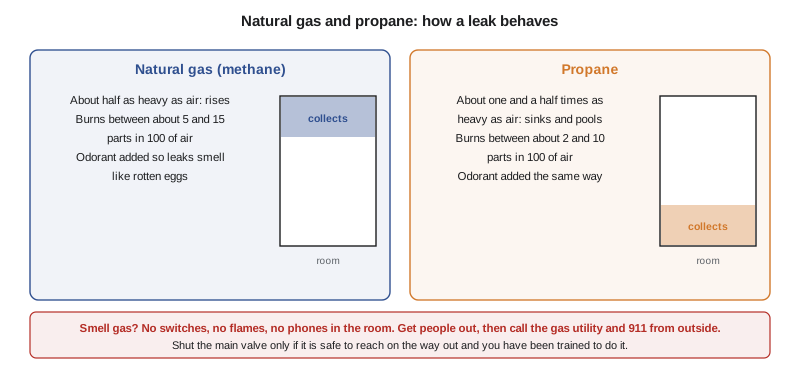
Both gases burn only when they are mixed with air within a certain range. Natural gas burns when it makes up roughly 5 to 15 parts in 100 of the air; propane roughly 2 to 10 parts in 100. Below the lower limit the mixture is too lean to burn, and above the upper limit too rich, but a leak that is building up will pass through the flammable range on the way, and a spark at that moment can cause an explosion. That is why the first rule is to avoid anything that can make a spark.
The smell
Natural gas and propane have no smell of their own. The utility adds a small amount of an odorant, a sulfur compound called mercaptan, which gives the gas its rotten egg or cabbage smell so that a leak can be noticed long before it reaches a flammable concentration. The smell is the main warning, and it should always be taken seriously. Some people have a weaker sense of smell, from age, illness or simply working in a kitchen full of strong smells, and odorant can fade in some circumstances, so no smell does not prove there is no leak.
Other signs of a leak include a hissing or whistling sound near a gas line or appliance, a burner that will not stay lit, dead plants near an outdoor line, or bubbles in standing water over a buried line.
What to do if you smell gas
The response to a gas smell is the same in both countries, and it is designed to avoid any spark while getting people away from the gas. Juniper posts it at the back door and in the basement:
- Do not turn any switches on or off, including lights, appliance controls and the exhaust fan switch. Do not unplug anything. Do not use a phone, a lighter or a match in the area.
- If the smell is strong, or you can hear gas, leave immediately and tell others to leave. If the smell is faint and the source is obvious, such as a burner knob left on without a flame, the cook may turn that knob off and open a door on the way out, but should not search for leaks.
- Get everyone out of the building, including guests if they are present, using the evacuation plan. Leave doors open behind you if you can do so without delay.
- From a safe distance outside, call the gas utility's emergency number and 911.
- Close the main gas valve at the meter only if you are trained to do it, it is on your way out, and you can do it without staying near the leak.
- Do not go back in until the utility or the fire department says it is safe.
Luis followed these steps without having to think about them, because the basement leak drill was part of his orientation and had been practiced at the spring fire drill. Turning on the basement light would have been the most natural thing in the world, and it is exactly what the drill trains people not to do.
Leaks the kitchen can prevent
Most gas leaks in restaurants come from a few predictable places: flexible connectors that have been kinked, stretched or worn, quick-disconnect fittings that are damaged or not fully coupled, burner valves left on without a flame, pilot lights that have gone out on old appliances without flame safety devices, and fittings disturbed by other work, as happened with the water heater union, which had been bumped when shelving was installed beside it. The daily checks in Lesson 7 and the annual service by a licensed technician catch most of them. A restraint cable on every wheeled appliance prevents the most serious kind, a connector torn from the wall.
Some kitchens also install combustible gas detectors near appliances and in basements, which sound an alarm when gas reaches a fraction of its lower flammable limit. Juniper added one in the basement after the June leak.
Carbon monoxide
Carbon monoxide, CO, is a colorless, odorless gas produced when any fuel burns without enough oxygen. Gas appliances that are working properly in a well-ventilated kitchen produce very little. They produce much more when the flame is starved of air or cooled by a dirty or misadjusted burner, when the exhaust fan is off or too weak, when make-up air is missing so that flue gases are drawn back into the room, or when a vent or flue from a water heater or oven is blocked. Charcoal and wood fires produce large amounts of CO, which is why they must never be used indoors without an exhaust system designed for them.
CO is dangerous because the body absorbs it in place of oxygen. It binds to the hemoglobin in red blood cells far more tightly than oxygen does, so even a modest concentration in the air builds up in the blood over time and starves the heart and brain of oxygen. Early symptoms are easily mistaken for something else: headache, dizziness, tiredness, nausea and confusion. A clue is that several people feel the same symptoms in the same place, and feel better when they leave. Higher exposures cause collapse, loss of consciousness and death. People with heart disease, pregnant workers and their unborn children are especially vulnerable.
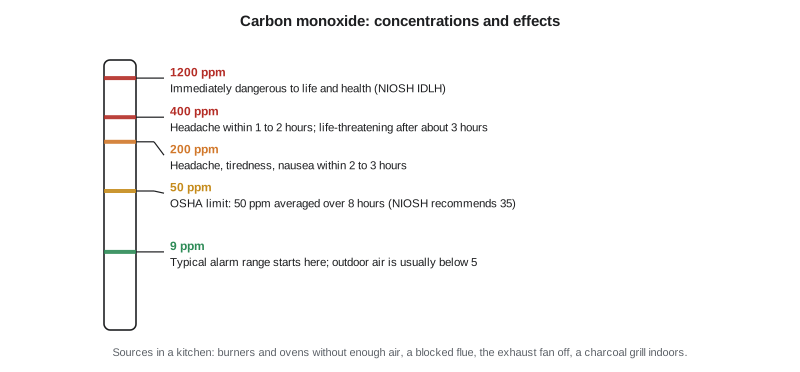
Exposure limits for workers are set in parts per million, ppm, averaged over a shift. OSHA's permissible exposure limit for carbon monoxide is 50 ppm averaged over an 8-hour shift. NIOSH recommends a lower limit of 35 ppm over a 10-hour shift with a ceiling of 200 ppm that should never be exceeded, and the American Conference of Governmental Industrial Hygienists recommends 25 ppm. In a kitchen with a working exhaust system, CO levels should stay in the low single digits.
CO at Juniper
Juniper had its own CO scare the winter before the fire. On a cold Sunday night, the closing crew turned off the exhaust fan to keep the kitchen warm while they cleaned, but left the ovens on low to dry out sheet pans and the kettle simmering stock for Monday. After about an hour, two of them had headaches and Noah Fischer, the 17-year-old line trainee, felt sick and dizzy. Kofi noticed that all three had the same symptoms and sent everyone outside into the lane, where they felt better within half an hour. Nobody needed hospital treatment, but it was a warning.
The changes afterwards were simple. The exhaust fan stays on whenever any gas appliance is lit, with a sign on the switch. Appliances are turned off before cleaning starts, and nothing simmers overnight without the fan running. And Juniper installed two carbon monoxide alarms, one on the kitchen side of the pass and one in the basement near the water heater, with digital displays so that low readings can be seen before the alarm sounds.
CO alarms and detectors
Building codes in both countries require CO alarms in homes and in some other buildings with fuel-burning appliances, but the rules for restaurants vary from place to place and many kitchens have none. A CO alarm costs little compared with what it prevents. Kitchen alarms should be the commercial type designed for the space, placed where the manufacturer recommends, away from the direct blast of appliances, and tested monthly. A display that shows the current level is useful, because it lets the kitchen see a slow rise before the alarm threshold.
If a CO alarm sounds, the response is to get everyone out into fresh air, call 911 if anyone has symptoms, and call the gas utility or a technician to find the source. The fire department will measure the levels before people go back in. Anyone with symptoms should be checked by a doctor, because the effects of CO can be delayed and the treatment is oxygen, sometimes under pressure.
Averaging an exposure
When a workplace takes CO readings during a shift, the readings are averaged over time to compare with the limit. The program below uses readings from a portable meter clipped to Noah's apron during a test shift after the alarms were installed: each entry gives the concentration and the number of minutes it lasted. The limit depends on the country, so the program is shown in two versions.
# Time-weighted average CO exposure over an 8-hour shift (480 minutes).
readings = [   # (ppm, minutes)
    (3, 120), (6, 90), (14, 45), (9, 60), (4, 120), (2, 45),
]
limit_ppm = 50          # OSHA 8-hour permissible exposure limit
niosh_rel_ppm = 35      # NIOSH recommended limit
shift_minutes = 480

dose = sum(ppm * minutes for ppm, minutes in readings)
covered = sum(minutes for _, minutes in readings)
twa = dose / shift_minutes
print(f"Minutes recorded: {covered} of {shift_minutes}")
print(f"8-hour time-weighted average: {twa:.1f} ppm (OSHA {limit_ppm} ppm, NIOSH {niosh_rel_ppm} ppm)")
print("Highest reading:", max(ppm for ppm, _ in readings), "ppm")
print("Below the limits" if twa < niosh_rel_ppm else "AT OR ABOVE A LIMIT: find the source")Minutes recorded: 480 of 480 8-hour time-weighted average: 5.5 ppm (OSHA 50 ppm, NIOSH 35 ppm) Highest reading: 14 ppm Below the limits
The average is low, as it should be with the fan running and the burners clean. The highest reading, 14 ppm, came during the 45 minutes when the kettle and all six burners were on high at the start of dinner, and it fell as soon as the rush eased. If the same meter had been worn on the cold Sunday night with the fan off, the numbers would have told a very different story.
Summary and key terms
- Natural gas rises and collects high; propane sinks and pools low; both burn only within a range of concentrations in air, which a building leak can pass through.
- An odorant gives gas its rotten egg smell; treat any gas smell seriously, and remember that no smell does not prove there is no leak.
- If you smell gas: no switches, flames or phones; get everyone out; call the gas utility and 911 from outside; close the main valve only if trained and it is safe.
- Carbon monoxide is colorless and odorless and comes from fuel burning without enough air; headache, dizziness and nausea in several people at once are warning signs.
- Keep the exhaust fan on whenever gas appliances are lit, maintain burners, install and test CO alarms, and get everyone into fresh air if an alarm sounds.
- Methane
- The main component of natural gas; lighter than air.
- Propane
- A fuel gas stored as a liquid under pressure in cylinders and tanks; heavier than air.
- Flammable range
- The range of gas concentrations in air within which a mixture can ignite.
- Mercaptan
- The odorant added to natural gas and propane so that leaks can be smelled.
- Carbon monoxide (CO)
- A colorless, odorless, poisonous gas produced by incomplete burning of fuel.
- Time-weighted average
- An exposure averaged over a shift, used to compare with exposure limits.
Training everyone, not just the cooks
Gas leaks and carbon monoxide do not only affect the line. Servers, dishwashers and the bar staff work in the same building, often arrive first or leave last, and may be the only people present when a smell or an alarm appears. Juniper's orientation covers the gas smell response and the CO alarm response for every new hire, and the posted cards are in the staff room as well as the kitchen.
Common mistakes
MistakeTurn on the lights so you can find the leak.
InsteadSwitches can spark; leave the area without touching anything electrical and call from outside.
MistakeTurning the exhaust fan off at closing saves energy and keeps the kitchen warm.
InsteadWith gas appliances lit, the fan must run; without it carbon monoxide builds up.
MistakeIf nobody can smell gas, there is no leak.
InsteadSome people cannot smell the odorant well and it can fade; a detector or the utility confirms it.
Practice problems
Work each problem on paper first, then reveal the answer to check.
Where would you expect leaked propane from a patio heater cylinder stored indoors to collect?
Show answer
Near the floor and in low places such as basements and floor drains, because propane is heavier than air; that is one reason propane cylinders are stored outside.
Three cooks on the closing shift all have headaches and feel dizzy. What should the supervisor suspect and do?
Show answer
Suspect carbon monoxide; get everyone outside into fresh air, call 911 if symptoms are serious, turn nothing on, and have the fire department or gas utility check the kitchen.
A meter shows readings of 10 ppm for 240 minutes and 4 ppm for 240 minutes. What is the 8-hour time-weighted average?
Show answer
(10 x 240 + 4 x 240) / 480 = 7 ppm.
Lesson quiz · 5 questions
Score 60% or more to complete this lesson.
Create a free account to save your progress, take quizzes and earn a certificate.