
HSE-371 · Lesson 8 of 12 · 21 min
Finishing, curing, cutting and coring concrete
Once the concrete is in the forms, a different crew takes over. Finishers screed, float and trowel the surface, often working late into the evening as the concrete sets, with power trowels spinning at their feet. Over the next days the concrete is cured under blankets, sprays or heat. Weeks later, other trades come back to saw-cut joints, core holes for pipes and ducts, and grind high spots. Each of these jobs has its own hazards, and two of them, silica dust from cutting and hidden services in the slab, can cause harm that does not show up until much later. This lesson covers finishing, curing, and cutting, coring and grinding concrete safely.
Finishing
Hand finishing
Hand finishing means long hours kneeling on boards over fresh concrete, reaching with floats and trowels, often in wet concrete over the boots. Knees, backs and shoulders take the strain, and skin in contact with wet concrete is at risk of the chemical burns covered in lesson 12. Finishers use knee pads designed for concrete work, waterproof gloves and boots high enough that concrete cannot get in, and they rotate between tasks during long pours. Bull floats on long handles can reach overhead power lines and must have non-conductive or insulated handles where contact is possible.
Power trowels
Walk-behind power trowels have rotating blades under a guard ring, driven by a gasoline, propane or electric motor. Ride-on trowels are larger machines with two or more rotors, driven from a seat. Both can cause serious injuries.
- Dead-man controls. Manually guided power trowels must have a control that shuts off the power automatically when the operator's hands leave the handles. Never tie down or bypass it.
- Guards and blades. Guard rings stay on, and blades are changed only with the engine off and, on electric machines, the cord unplugged.
- Edges and openings. Ride-on trowels have fallen through openings and off slab edges. Openings are covered with secured covers strong enough for the machine, edges are protected, and the operator knows where every opening is before starting.
- Carbon monoxide. Gasoline and propane trowels used inside enclosed or partly enclosed areas, such as the underground parking level or a tarped and heated floor, can build up dangerous levels of carbon monoxide quickly. Tallgrass uses electric or battery trowels indoors where possible, and otherwise requires ventilation and carbon monoxide monitoring, as HSE-370 lesson 10 describes.
- Noise and vibration. Trowels are loud and transmit vibration through the handles. Hearing protection is worn, and operators rotate.
- Lifting. Walk-behind trowels are heavy and awkward. Two workers or the crane lift them onto decks, never one worker alone.
Laser screeds and other equipment
Ride-on laser screeds level large slabs. They have moving booms, hydraulic parts and engines, and the operator's view is limited. Workers stay out of the machine's travel path and the reach of its boom, and the same carbon monoxide rules apply indoors.
Curing
Concrete needs moisture and warmth for days after placement to gain strength. Curing methods bring their own hazards.
- Curing compounds sprayed on the surface may contain solvents or resins that irritate skin, eyes and lungs, and some are flammable. The safety data sheet sets the protective equipment and ventilation. Freshly sprayed surfaces are very slippery and are barricaded until dry.
- Wet curing with water, burlap or plastic sheeting creates slip hazards and, where electrical cords cross wet slabs, shock hazards. Cords are kept off wet surfaces and protected by ground-fault circuit interrupters.
- Blankets and heat in cold weather mean tarped enclosures, fuel-fired heaters and long hours in enclosed spaces, with the carbon monoxide and fire risks covered in lesson 3.
Cutting, coring and grinding
Weeks after a pour, the concrete is cut and drilled for many reasons: control joints in slabs on grade, openings for pipes, ducts and conduit, anchors for equipment and railings, and grinding to level high spots or remove fins. The tools include walk-behind saws, handheld cut-off saws, core drills, rotary hammers and grinders. Two hazards dominate: silica dust and what is hidden inside the concrete.
Silica dust
Concrete, block, brick, mortar and the aggregate in them contain crystalline silica. Cutting, grinding, drilling and chipping these materials produces respirable crystalline silica, dust fine enough to reach deep into the lungs, where it causes silicosis, an incurable scarring of the lungs, as well as lung cancer and kidney disease. OSHA's construction silica standard, 1926.1153, sets a permissible exposure limit of 50 µg/m³ as an 8-hour average and an action level of 25 µg/m³. HSE-370 lesson 10 introduced silica; this lesson applies it to concrete work, and lesson 12 adds medical surveillance and the bigger picture.
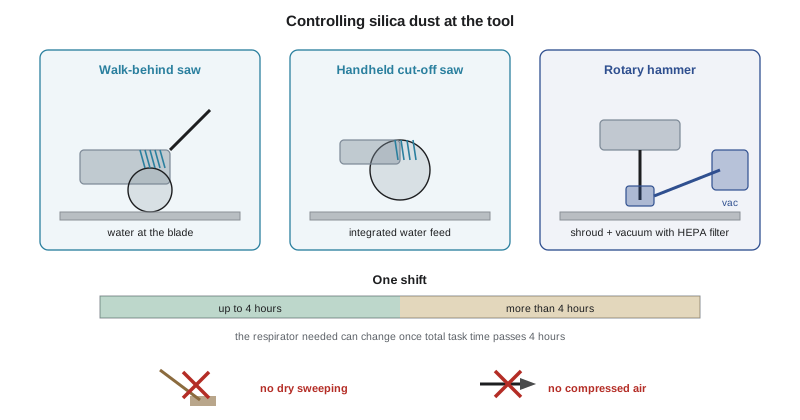
The main controls for cutting and drilling concrete are:
- Water. Saws and core drills with an integrated water delivery system keep dust wet at the blade or bit. Water must flow continuously, at the rate the manufacturer recommends, while the tool is cutting.
- Shrouds and dust collectors. Grinders, rotary hammers and some saws use a shroud around the blade or bit connected to a vacuum dust collector with a high-efficiency filter, with the airflow the tool manufacturer recommends.
- Planning. Cast-in sleeves and openings, placed before the pour, avoid much of the coring and cutting later.
- Respirators. Where water or dust collection is not enough, such as for long tasks or work indoors, workers wear respirators selected for silica and fit tested, as part of a written respiratory protection program.
- No dry sweeping or compressed air. Dust and dried slurry are cleaned up with wet methods or a vacuum with a high-efficiency filter, never by dry sweeping or blowing.
OSHA's silica standard gives employers two ways to comply. They can measure exposures and keep them below the limit, or they can fully follow Table 1 in the standard, which lists common tasks and tools, the engineering control required for each, and the respirator required, if any, depending on whether the task is done outdoors or indoors and whether it lasts more or less than four hours in a shift. For example, a handheld power saw with integrated water delivery used outdoors needs no respirator for four hours or less in a shift, and a respirator with an assigned protection factor (APF) of at least 10 for more than four hours. Employers following Table 1 still need a written exposure control plan and a competent person to put it into effect. At Cottonwood Place, Tallgrass follows Table 1, as the program below shows.
# Respirator check for today's cutting tasks (summarized site rules; check the current standard or plan).
# Each rule: tool -> (setting, minutes up to the limit, respirator APF needed up to and over 4 hours)
rules = {
    "handheld saw, water":    {"outdoors": (0, 10), "indoors": (10, 10)},
    "walk-behind saw, water": {"outdoors": (0, 0),  "indoors": (10, 10)},
    "core drill, water":      {"outdoors": (0, 0),  "indoors": (0, 0)},
}
tasks = [  # worker, tool, setting, minutes planned in the shift
    ("Dev",   "handheld saw, water",    "outdoors", 150),
    ("Dev",   "handheld saw, water",    "outdoors", 120),
    ("Marco", "walk-behind saw, water", "indoors", 90),
    ("Ana",   "core drill, water",      "indoors", 240),
]
totals = {}
for who, tool, where, mins in tasks:
    totals[(who, tool, where)] = totals.get((who, tool, where), 0) + mins
for (who, tool, where), mins in totals.items():
    upto, over = rules[tool][where]
    apf = over if mins > 240 else upto
    need = f"respirator APF {apf}" if apf else "no respirator"
print(f"{who:6} {tool:23} {where:9} {mins:4} min -> {need}")Dev handheld saw, water outdoors 270 min -> respirator APF 10 Marco walk-behind saw, water indoors 90 min -> respirator APF 10 Ana core drill, water indoors 240 min -> no respirator
Dev's two outdoor cutting tasks add up to more than four hours, so he needs a respirator for the shift, even though neither task alone is that long. Marco's indoor saw work needs a respirator whatever its length. Ana, the coring contractor's technician, needs none for core drilling with water. The table in the program is a short summary for this example, not a complete copy of any standard; the site's exposure control plan and the current regulations set the actual rules.
Water, slurry and electricity
Wet cutting solves the dust problem and creates others. Slurry is slippery, alkaline like wet cement, and must not go down drains. Water and electric tools are a dangerous mix: wet-cutting tools are plugged into circuits with ground-fault protection, cords are kept out of standing water, and only tools designed for wet use are used with water. Slurry is vacuumed or contained and disposed of according to the environmental plan.
Grinding, chipping and breaking
Grinding concrete to remove fins and high spots, chipping with a rotary hammer to expose bars or roughen a joint, and breaking out concrete with a demolition hammer produce some of the highest silica exposures on a site, and they are loud and heavy on the hands and arms. Grinders are used with a shroud and vacuum dust collector, and for long or indoor grinding, with respirators as well. Rotary and demolition hammers are matched to the job so that a worker is not using a heavy breaker overhead, and the work is shared and broken up with other tasks to limit vibration exposure. Hearing protection is needed for all of these tools; many produce noise well above 100 dBA at the operator's ear. Flying chips and grinding particles need safety glasses at minimum, and a face shield for grinding and breaking. Workers nearby who are not doing the cutting are exposed too, so dusty and noisy work is scheduled, screened or moved away from other crews where possible.
What is inside the concrete
A finished slab or wall may contain electrical conduit with live conductors, plumbing, post-tensioning tendons and heavy reinforcing. Cutting into a live conduit can electrocute the operator. Cutting a post-tensioning tendon, which is under very high tension, can release it violently, damaging the structure and injuring anyone nearby, and it weakens the slab. Lesson 9 explains why. Cutting reinforcing that the structure needs weakens it too.
At Cottonwood Place, no one cuts, cores or drills into any structural concrete without a permit from Tallgrass. The permit requires the location to be checked against the drawings and scanned, usually with ground-penetrating radar, and the services and tendons found to be marked on the surface. Structural engineering approval is needed for any core or opening not shown on the drawings. Electrical circuits that could be in the area are de-energized and locked out by the electrical contractor, following OSHA's electrical and lockout requirements.
Saw and drill hazards
Cut-off saws can kick back violently if the blade binds, and diamond blades that are damaged, the wrong type or run above their rated speed can break apart. Core drills can twist suddenly when the bit binds, injuring wrists and arms, so they are anchored to the concrete with a vacuum base or anchor bolt. Cores and cut-outs are heavy and can drop through to the floor below, so the area below is barricaded, and cut sections are supported before the last cut. Hearing and eye protection are needed for all of these tools.
Worked problem
The core through the conduit
Show solution
- An electrician on level 3 needs a 4 in (100 mm) hole for a new conduit run. The hole is not on the drawings, and a coring contractor is booked.
- Before coring, Tallgrass issues a permit. The scan shows a group of conduits and two post-tensioning tendons within 6 in (150 mm) of the planned location.
- The structural engineer moves the core 16 in (400 mm) to a spot clear of tendons, and the electrical foreman confirms the conduits nearby are not energized.
- The coring contractor anchors the drill, uses water feed, barricades the area below, and vacuums the slurry.
- The core comes out cleanly and nothing is hit. The scan and approval are filed with the permit.
Answer: Scanning and engineering approval before cutting stop electrocution, tendon release and structural damage. Water feed, anchoring and barricades handle the rest.
Common mistakes
MistakeTying back the dead-man handle on a power trowel to rest the hands.
InsteadNever bypass the dead-man control; rotate operators instead.
MistakeRunning a gasoline trowel in the tarped parking level.
InsteadUse electric or battery equipment indoors, or ventilate and monitor carbon monoxide.
MistakeCutting concrete dry because the water hose is in the way.
InsteadUse the water feed or shroud and vacuum every time.
MistakeCoring a slab where the hole is convenient.
InsteadGet a permit, scan the slab and get engineering approval for any opening not shown on the drawings.
MistakeSweeping up dried slurry and dust with a broom.
InsteadUse wet methods or a vacuum with a high-efficiency filter.
Summary and key terms
- Finishing strains knees, backs and shoulders and exposes skin to wet concrete; knee pads, waterproof gloves and boots, and rotation help.
- Power trowels need working dead-man controls and guards, covered openings, and carbon monoxide control indoors.
- Curing compounds, wet curing and heated enclosures bring chemical, slip, shock, carbon monoxide and fire hazards.
- Cutting, grinding and drilling concrete releases respirable crystalline silica; OSHA allows employers to follow Table 1 or keep exposures below 50 µg/m³.
- Water or shrouds with vacuums control dust at the tool, respirators cover what remains, and dust is never dry swept or blown.
- No cutting or coring of structural concrete without a permit, scanning and engineering approval, because of live conduits, tendons and reinforcing.
- Power trowel
- A machine with rotating blades used to finish concrete surfaces, walk-behind or ride-on.
- Dead-man control
- A control that stops a machine automatically when the operator lets go.
- Curing
- Keeping concrete moist and warm after placement so it gains strength.
- Respirable crystalline silica
- Silica dust fine enough to reach deep into the lungs, produced by cutting and grinding concrete, block and stone.
- Ground-penetrating radar
- A scanning method used to find reinforcing, conduits and tendons inside concrete before cutting or coring.
- Slurry
- The mix of water and concrete dust produced by wet cutting and coring.
Practice problems
Work each problem on paper first, then reveal the answer to check.
What does a dead-man control on a power trowel do?
Show answer
It shuts off power automatically when the operator's hands leave the handles.
Why is a gasoline trowel dangerous in the underground parking level?
Show answer
Exhaust can build up dangerous levels of carbon monoxide in an enclosed space.
Name two engineering controls for silica when cutting concrete.
Show answer
Integrated water delivery at the blade, and a shroud with a vacuum dust collector with a high-efficiency filter.
Dev cuts outdoors with a wet handheld saw for 2.5 hours in the morning and 2 hours in the afternoon. Why does the total matter?
Show answer
The respirator requirement depends on total time in the shift; 4.5 hours is over the four-hour threshold.
Why must slabs be scanned before coring?
Show answer
To find live conduits, post-tensioning tendons and reinforcing that could electrocute the operator, release violently or weaken the structure.
Lesson quiz · 5 questions
Score 60% or more to complete this lesson.
Create a free account to save your progress, take quizzes and earn a certificate.