
HSE-371 · Lesson 3 of 12 · 21 min
Shoring, reshoring and stripping forms
A concrete floor is not finished when the concrete is placed. For days afterward, it is too weak to carry itself, let alone the next floor being built on top of it. In a multi-story building, the load of each fresh slab is passed down through shores and reshores to several floors below, so that no single young slab carries more than it can. Get the sequence wrong, by stripping too early, removing reshores too soon or loading a floor that is not ready, and the failure can travel down through several levels at once. This lesson covers how shoring and reshoring work, the checks made before, during and after a pour, and the rules for stripping forms safely.
How the load travels down
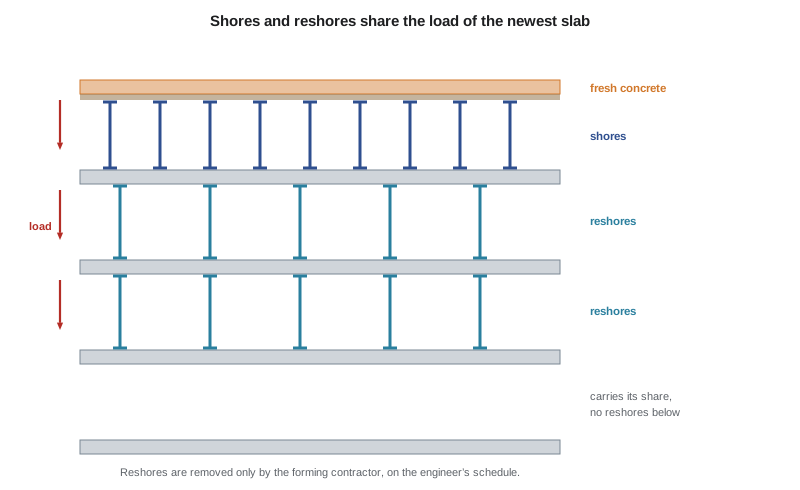
When the level 5 slab at Cottonwood Place is poured, its weight goes into the forms, through the shores and onto the level 4 slab below. Level 4 was poured about a week earlier and has gained some strength, but not its full design strength, and it is designed for apartment loads, not for the weight of a wet slab plus formwork. So the load does not stop at level 4. Reshores under level 4 pass part of the load to level 3, and reshores under level 3 pass part of it to level 2. Several floors share the load of the newest slab, each according to its stiffness and strength.
The number of floors of shores and reshores, and the time each stays in place, are set by the formwork engineer based on the concrete strength gain, the slab design loads and the construction cycle. On Cottonwood Place, the drawings call for one level of shores and two levels of reshores below the slab being poured. That pattern repeats up the building: as each new deck is built, the lowest level of reshores is removed, but only once the engineer's conditions for its removal are met.
Inspecting shoring before, during and after a pour
OSHA's rule at 1926.703(b) requires shoring equipment to be inspected before erection to confirm it is as specified in the shoring drawings, and the erected shoring to be inspected immediately before, during and after concrete placement. Shoring equipment found damaged so that its strength is reduced below what the design requires must not be used, and shoring that is damaged or weakened after it is erected must be reinforced at once. Single-post shores in more than one tier need a design by a qualified designer and inspection by an engineer qualified in structural design. Tallgrass does not allow a pour to start until the signed inspection is in the site office.
Before the pour
The pre-pour inspection compares what is built with the current drawings. Lena Petrov's crew uses a checklist that covers:
- every shore present, at the spacing shown, plumb and fully seated, with pins in place and adjustment screws within the manufacturer's limits;
- base plates in firm contact with the slab below or with sills on firm, level ground;
- shore heads snug against the beams, with no gaps or wedges that were not designed;
- all bracing installed and connected;
- beams and joists at the spacing shown, with no damaged members;
- edge forms, bulkheads and openings tied and braced against the push of concrete;
- reshores below in place as drawn, snug and not loosened by other trades;
- no shores or reshores removed for access by electricians, plumbers or drywall crews.
During the pour
During placement, two carpenters named on the pour plan watch the shoring from below. They stay out of the area directly under the concrete being placed, look along the lines of shores and beams for movement, listen for creaking or popping, and check that wedges and screw jacks have not shifted. Shores sometimes settle slightly as load comes on, and the formwork plan says how much adjustment is allowed and when. The watchers have radios and the authority to call an immediate stop. If a shore is buckling, a beam is sagging badly or concrete is pouring through an opening joint, the pump stops, workers on the deck move back over the completed part of the slab or off it, and the formwork foreman decides what to do. Re-tightening a shore under a full load of wet concrete is dangerous and is done only on the foreman's instructions, never by reaching under a moving form.
After the pour
After placement, the shoring is checked again for settlement, deflection and damage, and the edges and openings are checked for movement. Anything found is recorded and reported to the formwork engineer before the next stage of work.
The inspection records matter as much as the inspections. Each record names the deck, the drawing revision checked, the person who inspected it, the time and anything found and fixed. If something goes wrong later, the record shows what was checked and when. If an inspector from OSHA visits, it is the first thing they ask to see. And when a crew changes partway through a job, the record tells the new crew what state the shoring was left in. A pour without a signed inspection is a pour that should not have started.
Stripping: when concrete is strong enough
Forms are expensive and the schedule depends on reusing them, so there is always pressure to strip early. But concrete gains strength over days and weeks, more slowly in cold weather, and a slab stripped before it is strong enough can crack, sag or collapse, especially once construction loads are put on it.
OSHA's rule at 1926.703(e) requires forms and shores, except those for slabs on grade and slip forms, to stay in place until the employer determines that the concrete has gained enough strength to support its weight and superimposed loads. That determination must be based on compliance with conditions in the plans and specifications that say when forms and shores can be removed, or on the results of tests that show the concrete has gained sufficient strength, such as compressive strength tests of field-cured cylinders to recognized ASTM methods. A calendar date alone is not enough, because cold weather can slow strength gain for days.
Strength requirements are often expressed as a percentage of the specified 28-day strength. On Cottonwood Place, the formwork drawings call for the slab concrete to reach 75 percent of its specified strength before the shores come out and the reshores go in, and the post-tensioning tendons must be stressed before stripping, because the tendons carry much of the slab's own weight once stressed. Lesson 9 covers post-tensioning.
Stripping and reshoring safely
Stripping is not just a matter of removing forms. It is a planned sequence, shown on the drawings, that transfers load from the shores to the reshores without leaving any part of the slab unsupported for longer than the design allows.
- Strip in bays. Remove shores and forms from one bay at a time and install reshores in that bay before moving to the next, so that only a limited area is unsupported at once.
- Install reshores snug, not jacked. Reshores should be brought into firm contact with the slab without jacking it up, which would put load where the design does not expect it.
- Control falling material. Panels, beams and plywood can drop as they are released. Keep workers out of the area under material being stripped, use the equipment the forming system provides for lowering panels, and do not drop forms to the floor.
- Stack and remove. Stripped material is a trip hazard and a load. Stack it in the places shown on the plan, away from edges, and remove it promptly.
- Protect the edges. Stripping can remove guardrails attached to the forms. Replace edge protection before the area is opened to other trades.
- Never remove reshores without approval. Reshores look like spare shores to other trades, who sometimes borrow them or knock them out for access. The site rule is that reshores are removed only by the forming contractor, on the formwork engineer's schedule.
Loading a young slab
A stripped slab is still young, and the next trades are eager to use it. Pallets of drywall, stacks of block, a scissor lift or a load of reshores for the next floor can all put more load on a young slab than it was designed to carry at that age. OSHA's rule at 1926.701(a) says no construction loads may be placed on a concrete structure or part of one unless the employer determines, based on information from a person qualified in structural design, that the structure or part can support them. The formwork drawings at Cottonwood Place state the maximum construction load on each reshored floor. Before any heavy material is landed, the material handler checks the drawings or asks the field engineer.
Cold weather
San Antonio winters are long, and concrete placed in cold weather gains strength slowly and can be damaged if it freezes before it reaches a minimum strength. Cold-weather concreting adds heated enclosures, insulated blankets and propane or electric heaters to the work. That brings its own hazards: carbon monoxide from fuel-fired heaters inside tarped enclosures, fire from heaters near tarps and form oil, and workers spending long hours in poorly ventilated spaces. Tallgrass uses indirect-fired heaters that vent outside the enclosure, puts carbon monoxide monitors in every enclosure, and keeps heaters well clear of tarps. The cold also changes the stripping schedule: field-cured cylinders and maturity sensors show the concrete's real strength, which may be days behind what the schedule assumed.
Checking the strength before stripping
Tallgrass's field engineer tracks the cylinder results for each pour. The program below checks whether the level 4 slab has reached the 75 percent stripping strength using invented test results, and shows why the date alone is not enough.
# Stripping check for the level 4 slab (invented results).
specified = 5000                 # psi, specified 28-day strength
required = 0.75 * specified      # psi needed before stripping, per formwork drawings
tests = {                        # age in days: field-cured cylinder results (psi)
    3: [2480, 2380],
    5: [3570, 3670],
    7: [3970, 3900],
}
print(f"Required before stripping: {required:,.0f} psi")
for age, results in tests.items():
    avg = sum(results) / len(results)
    low = min(results)
    ready = avg >= required and low >= 0.9 * required
print(f"Day {age}: average {avg:,.0f} psi, lowest {low:,.0f} -> {'strip' if ready else 'wait'}")Required before stripping: 3,750 psi Day 3: average 2,430 psi, lowest 2,380 -> wait Day 5: average 3,620 psi, lowest 3,570 -> wait Day 7: average 3,935 psi, lowest 3,900 -> strip
The slab is ready on day 7, not day 5, even though the schedule assumed five days. A cold snap the week of the pour slowed strength gain. The rule in the program that the lowest result must also be close to the requirement is an invented site rule, added so that one strong cylinder cannot hide a weak one. The engineer's specification sets the real acceptance rule.
Worked problem
The borrowed reshores
Show solution
- Drywall crews on level 2 find reshores in their way while framing walls. Two workers remove eight reshores to fit a wall track and lean them against a column.
- Owen Hartley spots the stacked reshores during his afternoon walk. Level 2 is still carrying part of the load of levels 3 and 4, which were poured in the last ten days.
- He stops the work on level 2 and calls the formwork foreman, who reinstalls the reshores and checks the slab above for cracking and deflection.
- The formwork engineer confirms no damage, and the drywall contractor's foreman is told reshores can only be removed by the forming contractor on the engineer's schedule.
- Tallgrass adds bright tags to every reshore reading "Structural support. Do not remove. Ask Redline Forming", and adds the rule to the orientation for every trade.
Answer: Reshores carry real load from floors above. Only the forming contractor removes them, when the engineer allows.
Common mistakes
MistakeStripping on the day the schedule says, regardless of weather.
InsteadStrip only when tests or the engineer confirm the required strength.
MistakeTreating reshores as spare shores anyone can borrow.
InsteadReshores carry load from floors above and are removed only by the forming contractor.
MistakeJacking reshores tight to lift the slab.
InsteadBring reshores snug against the slab without lifting it.
MistakeStanding under a deck during a pour to watch.
InsteadOnly named shore watchers go below, and they stay out from under the area being placed.
MistakeDropping stripped panels and beams to the floor.
InsteadLower them with the system's equipment and keep people out of the area below.
Summary and key terms
- In a multi-story building, shores and reshores spread the weight of the newest slab over several floors below.
- Shoring is inspected against the drawings before the pour, watched during it and checked again after.
- Named shore watchers have the authority to stop the pour if the shoring moves or deforms.
- Forms stay in place until the concrete has the strength the engineer requires, confirmed by tests, not by a calendar date.
- Stripping follows a planned sequence: bay by bay, with reshores installed snug and edges protected.
- Reshores are removed only by the forming contractor on the formwork engineer's schedule.
- Reshore
- A shore installed under a stripped slab so that it shares the load of floors built above it.
- Stripping
- Removing formwork and shores from concrete once it has enough strength.
- Field-cured cylinder
- A concrete test cylinder cured on site beside the structure so that its strength reflects the strength of the concrete in place.
- Specified strength
- The compressive strength the engineer requires the concrete to reach, usually at 28 days.
- Maturity method
- A way of estimating concrete strength from its temperature history, using sensors cast into the concrete.
- Shore watcher
- A worker named to watch the shoring from below during a pour and call a stop if it moves or deforms.
Practice problems
Work each problem on paper first, then reveal the answer to check.
Why does the load of a fresh slab need to reach several floors below?
Show answer
The slab directly below is young and designed for building loads, not the weight of a wet slab plus formwork, so shores and reshores spread the load over several floors.
When must shoring be inspected?
Show answer
Before the pour against the drawings, during placement and after placement.
What should shore watchers do if a shore starts to buckle?
Show answer
Call an immediate stop by radio, stay clear of the area under the load, and let the formwork foreman decide on the fix.
Why is a calendar date not enough to decide when to strip?
Show answer
Cold weather and mix changes can slow strength gain; strength must be confirmed by tests or another method the engineer accepts.
A drywall crew wants to remove reshores to fit a wall. What is the rule?
Show answer
No; only the forming contractor removes reshores, on the formwork engineer's schedule.
Lesson quiz · 5 questions
Score 60% or more to complete this lesson.
Create a free account to save your progress, take quizzes and earn a certificate.