
HSE-371 · Lesson 12 of 12 · 20 min
Cement burns, silica and manual handling
The hazards in the earlier lessons tend to cause sudden injuries: a collapse, a fall, a whip. The hazards in this lesson work more slowly. A finisher kneels in wet concrete all afternoon and does not notice the burn until that night. A mason cuts block for years and is diagnosed with silicosis in middle age. A mason tender's back gives out after a decade of lifting block. These injuries are common in concrete and masonry work, often permanent, and almost entirely preventable. This lesson covers cement burns and dermatitis, the long-term effects of silica and how exposure is monitored, and manual handling. It ends by bringing the course together.
Cement burns
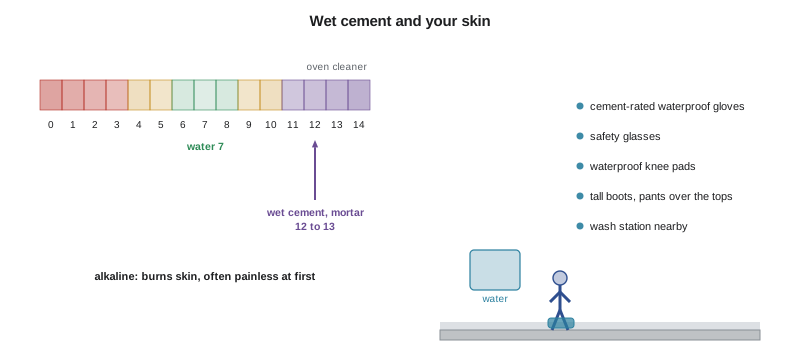
Portland cement reacts with water to form calcium hydroxide, a strong alkali. Wet concrete, mortar and grout typically have a pH of about 12 to 13, similar to oven cleaner or drain cleaner. Alkalis burn skin by breaking down its fats and proteins, and they keep working as long as they are in contact with the skin.
What makes cement burns so damaging is that they often do not hurt at first. A worker kneeling in wet concrete, or with concrete inside a boot or soaked into a glove, may feel nothing for hours. By the time the skin reddens, blisters or turns gray, a deep chemical burn may have formed, sometimes needing skin grafts. Cement burns are especially common on knees, shins and ankles, where concrete gets into boots and soaks through work pants.
Preventing cement burns
- Keep it off the skin. Waterproof gloves, such as nitrile- or butyl-coated gloves rated for cement, not cotton or leather gloves that soak it up. Rubber boots tall enough that concrete cannot get in, with pants worn over the boot tops, not tucked in. Waterproof knee pads or kneeling boards for finishers.
- Eye protection. Safety glasses with side protection, or goggles when splashing is likely, such as during pumping, placing and mixing.
- Wash it off quickly. If wet concrete or mortar gets on the skin, wash it off with clean water as soon as possible, and use a pH-neutral or slightly acidic soap. Remove clothing, gloves or boots that are soaked, and wash the skin under them.
- Do not use hand cleaners that dry the skin or wash with abrasive materials such as sand, which damage the skin and let cement in.
- Wash facilities. Clean water, soap and eyewash are available near the work, not only in the site trailer.
First aid
If wet concrete gets in the eyes, flush them immediately with clean water or eyewash for at least 15 minutes, holding the eyelids open, and get medical attention. If skin has been in contact for a long time, or shows redness, blistering or pain, remove contaminated clothing, rinse the area with plenty of clean, lukewarm water for an extended time, and get medical attention, telling the provider that the burn is from wet cement. Burns that look minor at first can turn out to be deep.
Cement dermatitis
Repeated contact with cement also causes dermatitis, inflamed, dry, cracked and itchy skin, usually on the hands and forearms. There are two kinds:
- Irritant dermatitis is caused by the alkalinity and abrasiveness of cement drying out and damaging the skin over time.
- Allergic dermatitis is caused by an allergy, most often to hexavalent chromium, a trace substance found in cement. Once a worker becomes sensitized, even small exposures cause a reaction, and the allergy is usually permanent. Some workers have had to leave the trade because of it.
Gloves, washing and moisturizing after work prevent most dermatitis. Workers who notice persistent rashes, cracks or itching on their hands tell their supervisor and see a doctor early, before the condition becomes chronic. Some cement products have reduced levels of hexavalent chromium, and the safety data sheet for each cement, mortar or grout product shows its hazards and the protective equipment needed.
Silica: the long-term picture
Lesson 8 covered the controls for silica when cutting, grinding and drilling. This section covers what silica does and how exposure is tracked over time.
Health effects
Respirable crystalline silica particles that reach the deep lung cause inflammation and scarring. The diseases include:
- Silicosis, scarring of the lungs that makes breathing harder over time. Chronic silicosis usually appears after ten or more years of exposure; accelerated and acute forms can appear after much shorter, heavier exposures. There is no cure, and the disease can keep progressing after exposure stops.
- Lung cancer. Crystalline silica is classified as a cause of lung cancer in humans.
- Chronic obstructive pulmonary disease and other lung diseases.
- Kidney disease and an increased risk of tuberculosis in people with silicosis.
Because these diseases appear years after exposure, they are easy to ignore on the day. A cloud of dust from a dry cut feels like nothing more than an irritation. That is why silica control depends on rules followed every time, not on how the dust feels.
Exposure control plans and monitoring
OSHA's silica standard requires each employer to have a written exposure control plan that describes the tasks involving silica exposure, the engineering controls, work practices and respirators used for each, the housekeeping methods, and how access to high-exposure areas is restricted. A competent person must make frequent and regular inspections to put the plan into effect. Employers must offer medical exams, including a chest X-ray and lung function test, to workers who will be required to wear a respirator under the standard for 30 or more days a year, with exams repeated at least every three years. At Cottonwood Place, Tallgrass and each concrete and masonry contractor have written exposure control plans and name a competent person for silica.
Manual handling
Concrete and masonry work is some of the heaviest manual work on any site. Rebar, block, bags of cement and grout, buckets of mortar, form panels and hoses are lifted and carried all day. Strains and sprains to the back, shoulders, wrists and knees are the most common lost-time injuries in these trades, and many workers leave the trades early because of them.
What makes a lift risky
Weight is only one factor. A load becomes riskier when it is:
- far from the body, such as reaching across a pallet or into a form;
- lifted from near the floor or above the shoulders;
- lifted with a twist of the back;
- lifted often, or for long periods without a break;
- hard to grip, such as a rough block or a slippery form panel;
- carried over uneven ground, such as a rebar mat or a muddy site.
Researchers at the US National Institute for Occupational Safety and Health (NIOSH) developed a lifting equation that starts from a maximum recommended load of 51 lb (23 kg) under ideal conditions and reduces it for each of these factors. The result is a recommended weight limit for that particular lift. Dividing the actual load by the recommended limit gives a lifting index; an index above 1 means the lift puts many workers at increased risk of injury.
The program below uses a simplified form of the NIOSH lifting equation to compare a mason tender lifting block from the ground with lifting the same block from a stack at waist height, for an eight-hour shift at four lifts a minute.
# Simplified NIOSH lifting equation (US units); for comparing lifts, not for detailed job design.
def rwl(h, v, d, a, fm, cm=1.0):
    lc = 51.0                              # lb, load constant
    hm = min(1.0, 10 / h)                  # horizontal distance from the ankles, in
    vm = 1 - 0.0075 * abs(v - 30)          # height of the hands at the start, in
    dm = min(1.0, 0.82 + 1.8 / d)          # vertical travel, in
    am = 1 - 0.0032 * a                    # twist, degrees
    return lc * hm * vm * dm * am * fm * cm

block = 40.0     # lb
FM = 0.45        # frequency factor for 4 lifts a minute over a full shift (from the NIOSH table)
for label, h, v, d, a in [("block from the ground, twisting", 18, 4, 32, 45),
                          ("block from a waist-high stack", 12, 30, 8, 0)]:
    limit = rwl(h, v, d, a, FM)
print(f"{label:33} limit {limit:4.1f} lb, lifting index {block / limit:3.1f}")block from the ground, twisting limit 7.7 lb, lifting index 5.2 block from a waist-high stack limit 19.1 lb, lifting index 2.1
Lifting from the ground with a twist gives a lifting index of about 5, far into the high-risk range. Raising the stack to waist height and turning the feet instead of the back brings the index down to about 2. That is still above 1, which is why mason tenders also rotate tasks and take micro-breaks. The calculation is simplified, but the lesson holds: where the material sits matters as much as how heavy it is.
Controls for manual handling
- Eliminate or mechanize. Use cranes, telehandlers, pallet jacks, hoists and vacuum lifters to move heavy items. Order materials delivered close to where they are used.
- Reduce the load. Use lighter block where the design allows, smaller cement bags, and two-person lifts for heavy or awkward items.
- Set the height. Keep stacks, mortar boards and work at about waist height.
- Reduce reach and twist. Stand close to the load, and turn with the feet.
- Pace and rotate. Break up repetitive lifting with other tasks, and take short breaks.
- Prepare the route. Clear walkways across rebar mats and muddy ground before carrying loads.
Bringing the course together
Every concrete and masonry operation at Cottonwood Place, from the first footing to the last block, uses the same approach. Hazards are identified before the work, in the drawings, the lift plans, the pour plan and the masonry work plan. Controls are chosen from the top of the hierarchy where possible: a guardrail rather than a harness, a designed shoring system rather than improvised posts, a wet saw rather than a respirator alone. Each employer controls its own part and the controlling contractor coordinates the parts that overlap. And on the day, workers check, watch and speak up: the shore watcher who calls a stop, the spotter who stops a truck, the mason tender who refuses to land a pallet on an overloaded bay.
Worked problem
The burn that showed up at night
Show solution
- A new finisher on the level 7 pour kneels on the slab for most of the afternoon without knee pads. Concrete soaks through his work pants at the knees, but he feels nothing.
- That night his knees are red and painful, and by morning both have blisters. He goes to a clinic, where he is treated for chemical burns from wet cement.
- He reports the injury to his foreman, who reports it to Owen Hartley. The finisher loses three days of work.
- The investigation finds the finishing crew had knee pads in the gang box, but nobody had told the new worker about cement burns or where the pads were.
- The fixes: cement burn awareness added to the pour-day briefing and the finishing contractor's orientation, waterproof knee pads and cement-rated gloves issued to every finisher, and a wash station with clean water set up on each deck during pours.
Answer: Cement burns are painless at first and serious later. New workers need to know the hazard, and protective equipment and wash water need to be at the work, not just on site.
Common mistakes
MistakeWearing cotton or leather gloves for concrete work.
InsteadWear waterproof gloves rated for cement.
MistakeTucking pants into rubber boots.
InsteadWear pants over the boot tops so concrete cannot run in.
MistakeWaiting until the end of the shift to wash off wet concrete.
InsteadWash it off with clean water at once and remove soaked clothing.
MistakeIgnoring a hand rash because it comes and goes.
InsteadReport it and see a doctor early; allergic dermatitis can become permanent.
MistakeLifting block from the ground all day because the pallet is already there.
InsteadRaise stacks to waist height and use mechanical handling.
Summary and key terms
- Wet cement, mortar and grout have a pH of about 12 to 13 and cause chemical burns that often do not hurt at first.
- Waterproof gloves, tall boots with pants over them, knee pads, eye protection and quick washing prevent burns.
- Repeated contact causes irritant and allergic dermatitis; allergy to hexavalent chromium is usually permanent.
- Silica causes silicosis, lung cancer, lung disease and kidney disease, appearing years after exposure.
- OSHA requires a written exposure control plan, a competent person, and medical exams for workers who wear respirators 30 or more days a year.
- Manual handling risk depends on weight, reach, height, twist, frequency and grip; mechanical handling and waist-height stacks reduce it most.
- Cement burn
- A chemical burn caused by prolonged skin contact with wet cement, concrete, mortar or grout.
- pH
- A scale from 0 to 14 that measures how acidic or alkaline a substance is; 7 is neutral.
- Allergic dermatitis
- Skin inflammation caused by an allergy, such as to hexavalent chromium in cement.
- Silicosis
- An incurable scarring of the lungs caused by breathing respirable crystalline silica.
- Exposure control plan
- A written plan describing tasks that expose workers to a hazard such as silica, and the controls for each.
- Lifting index
- The ratio of a load to the recommended weight limit for that lift; above 1 means increased risk.
Practice problems
Work each problem on paper first, then reveal the answer to check.
Why are cement burns often worse than they first appear?
Show answer
Alkaline burns often do not hurt at first and keep working while cement stays on the skin, so deep burns can develop over hours.
What should be done if wet concrete gets in the eyes?
Show answer
Flush with clean water or eyewash for at least 15 minutes, holding the eyelids open, and get medical attention.
What causes allergic cement dermatitis?
Show answer
An allergy, most often to hexavalent chromium in cement; once sensitized, a worker reacts to small exposures.
Why do silica diseases need strict rules rather than judgment on the day?
Show answer
They appear years after exposure, so the dust does not seem harmful when it is breathed.
What two changes most reduced the lifting index for block in the example?
Show answer
Raising the stack to waist height and turning with the feet instead of twisting.
Lesson quiz · 5 questions
Score 60% or more to complete this lesson.
Create a free account to save your progress, take quizzes and earn a certificate.