
HSE-371 · Lesson 11 of 12 · 20 min
Masonry work: scaffolds, saws, mortar and handling block
Lesson 10 dealt with the wall as a structure. This lesson deals with the people building it. A masonry crew works on scaffolds raised a level at a time, surrounded by pallets of block, tubs of mortar and a mixer that never stops. Masons and mason tenders lift tens of metric tons of block and mortar by hand over the course of a job, and cut block with saws that throw silica dust. They work outside in all weather. The common injuries are falls from scaffolds, scaffold overloading, back and shoulder strains, hand injuries from saws and mixers, and lung damage from silica. This lesson covers each one, using the Reyes Masonry LLC crew at Cottonwood Place.
Mason scaffolds
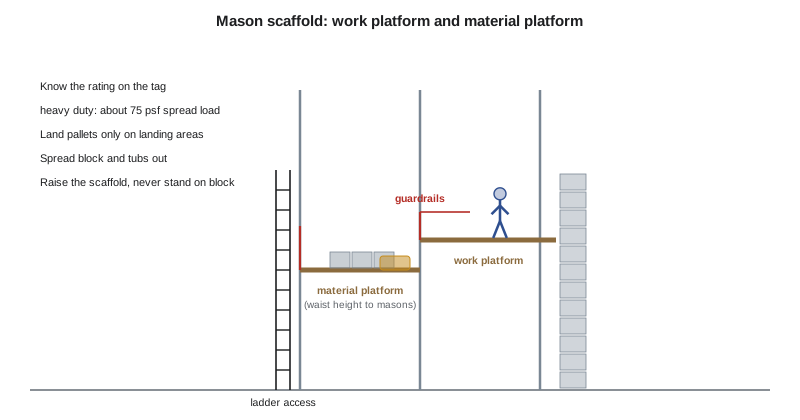
Masons work from scaffolds that are raised as the wall goes up, so the work is always at a comfortable height. At Cottonwood Place, Reyes Masonry LLC uses frame scaffolds along the west wall, with a work platform for the masons next to the wall and a lower or separate platform for block and mortar, so the masons can reach materials without bending to the planks.
Scaffolds are covered in detail in TRD-105 and HSE-370. OSHA's scaffold standard, Subpart L, requires scaffolds to be designed by a qualified person and erected, moved, altered and dismantled under the supervision of a competent person, to support their own weight and at least four times the maximum intended load, to be fully planked, and to have guardrails or fall arrest where workers could fall more than 10 feet. Mason scaffolds need extra care because they carry some of the heaviest loads of any scaffold on site.
Loading the scaffold
A pallet of concrete block can weigh over a metric ton, and a mortar tub full of mortar is heavy and dense. Scaffolds have a rated load, often described as light, medium or heavy duty, and mason scaffolds are typically rated heavy duty. The rating is for a load spread over the platform, and it is easy to exceed it by landing a full pallet on one bay, by stacking block several courses high on the planks, or by leaving several tubs of mortar in one place. Overloaded scaffold planks crack, and overloaded scaffold frames buckle or settle into soft ground.
- Know the rating. The scaffold tag shows the rated load. The competent person explains it to the crew.
- Land loads only where planned. Forklift or telehandler operators land pallets only on the platforms or loading areas designed for them, and only one at a time.
- Spread material out. Block is stacked on the material platform no higher than the plan allows, and tubs are spaced along the scaffold.
- Keep the masons' platform clear. The platform next to the wall carries the masons and the block they are about to lay, not reserve stock.
# Scaffold bay load check for the west wall (invented values; use the scaffold design and tag).
rating = 75                      # psf, heavy-duty mason scaffold, uniformly spread (typical value)
bay_area = 7 * 5                 # ft2, one bay of material platform
block_lb = 40                    # lb, one 8 in hollow concrete block (typical)
tub_lb = 240                     # lb, mortar tub when full (invented)
for label, blocks, tubs in [("planned load", 50, 1), ("full pallet landed", 90, 1), ("pallet plus two tubs", 90, 3)]:
    lb = blocks * block_lb + tubs * tub_lb
    psf = lb / bay_area
    verdict = "OK" if psf <= rating else "OVERLOADED"
print(f"{label:22} {lb:5,} lb = {psf:3.0f} psf vs {rating} psf -> {verdict}")planned load 2,240 lb = 64 psf vs 75 psf -> OK full pallet landed 3,840 lb = 110 psf vs 75 psf -> OVERLOADED pallet plus two tubs 4,320 lb = 123 psf vs 75 psf -> OVERLOADED
The planned load is within the rating, but landing a full pallet on one bay already exceeds it, and adding tubs makes it worse. The block and tub weights are typical figures and the rating is a typical heavy-duty value; the scaffold's design and tag set the real limits. The crew's rule is to break pallets down onto the platform rather than land them whole on a bay that is not designed for a pallet.
Raising the scaffold and working at the edge
Each time the wall rises a level, the scaffold is raised: frames added, planks moved up, guardrails reinstalled and ties checked. Raising the scaffold is when falls happen, because guardrails are off and planks are being moved. Only the trained scaffold crew raises it, with fall protection during the change, and nobody works on a level until the competent person has inspected it and the tag is updated. Masons do not stand on block stacks, mortar tubs or the wall itself to reach higher; when the work outgrows the platform, the scaffold is raised.
Gaps between the scaffold platform and the wall are kept small enough that a worker cannot fall through. If the gap is too large, the guardrail on the wall side stays on.
Access and housekeeping on the scaffold
Masons reach each scaffold level by a ladder or stair tower built into the scaffold, never by climbing the frames or cross braces. Planks stay clean and free of mortar droppings, broken block and offcuts, which are slippery and a trip hazard on a narrow platform. Dropped mortar and broken pieces fall onto anyone below, so toe boards stay on, and the area under the scaffold is kept clear or protected while masons are working above. At the end of each day the crew clears the platforms, covers mortar boards, and stacks block so it cannot blow or fall off overnight.
Mast climbers
On taller buildings, many masonry contractors use mast-climbing work platforms, powered platforms that climb a mast tied to the building. They raise and lower the whole crew and its materials, so masons always work at the right height. They have their own rated loads, inspection requirements and operator training, and the manufacturer's instructions control their erection, tying, use and dismantling.
Handling block and mortar
A standard 8 in (190 mm) hollow concrete block weighs 40 lb (about 18 kg), and larger or solid units weigh much more. A mason may lay several hundred block a day, and a mason tender carries and stocks them, as well as mixing and carrying mortar. Over a career, these loads injure backs, shoulders, wrists and knees. Lesson 12 covers the general principles of manual handling. For masonry work, the main controls are:
- Mechanical handling. Forklifts, telehandlers and pallet jacks move pallets close to the work, so workers carry block only a short distance. Block grabs and clamps let one worker carry a block without pinching fingers.
- Material at the right height. The material platform, block stacks and mortar boards are set at about waist height, so masons and tenders do not lift from the planks.
- Lighter units and two-person lifts. Lightweight block, where the design allows, and two-person handling for heavy units.
- Rotation. Mason tenders rotate between stocking, mixing and other tasks.
- Gloves. Block is rough and abrasive, and mortar is caustic. Gloves that resist cement and abrasion protect hands.
Mortar mixers
Mortar and grout are mixed on site in drum or paddle mixers, usually powered by gasoline engines or electric motors. A paddle mixer has blades that rotate inside the drum and can catch a hand, a shovel or a sleeve.
- Guards and grates. The grate over the mixing drum stays in place, and nobody reaches through it or puts a shovel into a running mixer.
- Lockout. Before cleaning or reaching into the drum, the mixer is shut off and locked out so it cannot be started by someone else.
- Cement and sand dust. Opening and emptying bags of dry cement and sand into the mixer raises dust that contains silica and alkaline cement. The mixer is placed so the wind carries dust away from workers, bags are emptied gently, and workers wear eye protection and, where dust cannot be controlled, a respirator.
- Bag weights. Cement bags are heavy. Bags are stored at a height that avoids lifting from the ground, and lighter bag sizes are used where available.
- Exhaust. Gasoline mixers are never run inside enclosures without ventilation and carbon monoxide monitoring.
Masonry saws
Block that must be cut to fit, at corners, openings and the tops of walls, is cut on a stationary masonry saw or with a handheld cut-off saw.
OSHA's rule at 1926.702(i) requires masonry saws to be guarded with a semicircular enclosure over the blade, with a method for retaining blade fragments built into the design of the enclosure. Diamond blades are matched to the saw and the material and are never run above their rated speed. Cutting block releases large amounts of silica dust, so saws are used with water delivery at the blade, as Table 1 of the silica standard requires for stationary masonry saws, and the respirator rules from lesson 8 apply. At Cottonwood Place, the masonry saw is set up outdoors, downwind of the crew, with water flowing whenever the blade is cutting.
Other saw hazards are kickback with handheld saws, cuts from contact with the blade, noise and electrical shock where water meets electric tools. Masons feed block steadily, keep hands clear of the blade path, wear eye and hearing protection, and use ground-fault protected power for electric wet saws.
Grouting and reinforcing
The west wall has reinforcing bars grouted into some cores. Grout is pumped or poured from buckets into the cores. Grout pump hoses carry the same whip hazards as concrete pump hoses, described in lesson 7, and the cleanouts at the base of tall grout lifts can blow out if grout is placed too fast. Vertical reinforcing projecting from the top of a partly built wall is an impalement hazard for masons working above it on the scaffold, so it is capped as lesson 5 describes.
Weather
Masons work outdoors through San Antonio summers and winters. Heat brings the heat stress hazards covered in HSE-370 lesson 10: water, rest and shade, and acclimatization for new workers. In cold weather, mortar must be kept from freezing, so walls are enclosed in tarps and heated. The enclosures bring wind loads on the scaffold, fire risk from heaters near tarps, and carbon monoxide from fuel-fired heaters. Tarped scaffolds catch wind like a wall and must be designed and tied for it, which is why tarps are added only with the scaffold designer's approval.
Worked problem
The pallet on the top lift
Show solution
- Late in the day, the masons on the west wall run low on block. The telehandler operator offers to land a full pallet on the masons' platform to save time.
- The mason tender, who did the scaffold load briefing that morning, points out that the platform is not designed for a full pallet and that two tubs of mortar are already on that bay.
- The foreman agrees. The pallet is landed on the ground-level loading area, and the tender breaks it down onto the material platform in smaller stacks along several bays.
- Next morning, the competent person adds a sign to each bay showing the maximum number of block and tubs it can carry.
- At the weekly coordination meeting, Tallgrass reminds telehandler operators that loads go only where the scaffold plan shows a landing area.
Answer: Scaffolds are overloaded by convenience. Clear limits, posted at the bay, and a crew willing to say no keep loads within the rating.
Common mistakes
MistakeLanding a full pallet of block on any scaffold bay.
InsteadLand loads only on designed landing areas and spread material out.
MistakeStanding on block or a mortar tub to reach the top course.
InsteadRaise the scaffold when the work outgrows the platform.
MistakeScraping the inside of a running mortar mixer with a shovel.
InsteadShut off and lock out the mixer before reaching or scraping inside.
MistakeCutting block dry on the masonry saw because the water line froze.
InsteadStop cutting until water delivery works, or use another approved control.
MistakeAdding tarps to a scaffold for winter without checking with the designer.
InsteadTarps add wind load; add them only with the scaffold designer's approval.
Summary and key terms
- Mason scaffolds carry heavy loads; know the rating, land loads only where planned and spread material out.
- Scaffolds are raised by the trained crew and inspected before use; masons never stand on block or tubs to reach higher.
- Mechanical handling, materials at waist height, lighter units and rotation reduce strains from block and mortar.
- Mortar mixers keep their grates in place and are locked out before anyone reaches inside; bag dust is controlled.
- Masonry saws have blade enclosures and water delivery to control silica dust.
- Grout hoses can whip, projecting wall reinforcing is capped, and heat, cold and tarps bring their own hazards.
- Mason tender
- A worker who supplies masons with block, mortar and materials and keeps the work area stocked.
- Material platform
- A scaffold platform, often lower than the work platform, where block and mortar are stocked within reach of the masons.
- Heavy-duty scaffold
- A scaffold rated for the heavy spread loads typical of masonry work.
- Mast climber
- A powered work platform that climbs a mast tied to the building.
- Mortar mixer
- A machine with rotating paddles or a drum for mixing mortar or grout on site.
- Block grab
- A hand tool that clamps a concrete block so it can be carried without pinching fingers.
Practice problems
Work each problem on paper first, then reveal the answer to check.
Why is landing a full pallet of block on one scaffold bay a problem?
Show answer
It concentrates more load on that bay than the scaffold's spread-load rating allows.
What should a mason do when the work is above comfortable reach from the platform?
Show answer
Have the scaffold crew raise the scaffold; never stand on block, tubs or the wall.
Name three ways to reduce strains from handling block.
Show answer
Mechanical handling close to the work, materials at waist height, lighter units or two-person lifts, block grabs and task rotation.
What must happen before someone reaches into a mortar mixer?
Show answer
It is shut off and locked out so no one can start it.
What two features protect workers using a stationary masonry saw?
Show answer
A blade enclosure that retains fragments, and water delivery at the blade to control silica dust.
Lesson quiz · 5 questions
Score 60% or more to complete this lesson.
Create a free account to save your progress, take quizzes and earn a certificate.