
HSE-363 · Lesson 8 of 12 · 20 min
Permission slips, waivers and informing families
Before almost any trip or special activity, a form goes home. Families sign it, students bring it back (sometimes crumpled at the bottom of a backpack), and staff file it in the trip binder. Forms are so routine that it is easy to forget what they are for, and to overestimate what they can do. This lesson explains what a permission slip does and does not accomplish, why waivers are treated with caution, what families need to know to give real consent, and how to keep the paperwork accurate.
What a permission slip does
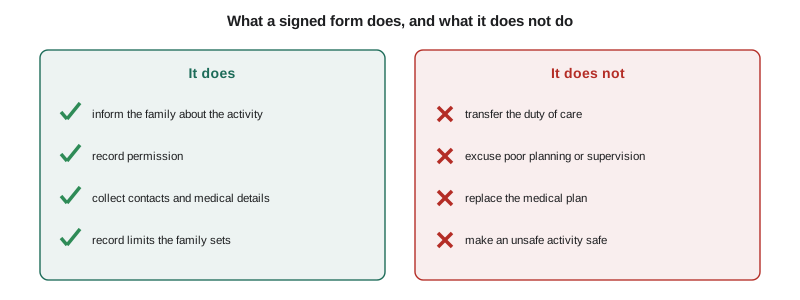
A good permission slip does four jobs:
- It informs the family about the activity, with enough detail to understand what their child will do, where, with whom, and what the main risks and safety arrangements are.
- It records the family's permission for their child to take part.
- It collects up-to-date information the school needs, such as emergency contacts for the day, medical conditions, medications and dietary needs.
- It records any conditions the family sets, such as 'may take part in the hike but not the pond study'.
The word that matters most is informed. Permission given without understanding is not worth much. A form that says only 'Your child will be going on a field trip to Riverbend Park on Thursday' does not tell a family that the trip includes a pond study, that students will be in small groups led by parent volunteers, or that the bus returns after the end of the school day. Families cannot make a sensible decision, or prepare their child, without those details.
What a permission slip does not do
Staff sometimes think of a signed form as protection: if the family agreed, the school is covered. That is not how the law sees it. A family's permission is not permission to be careless. The school keeps its full duty of care during the activity, and if a student is hurt because of poor planning or supervision, the signed form does not excuse it. The form is still important evidence: it shows that the family was told about the activity and its risks, and it shows that the school collected and acted on medical and contact information. But it cannot make an unsafe activity safe.
Waivers and releases
A waiver, or release, is different from a permission slip. It is a document in which a person gives up the right to sue for injuries, often including injuries caused by the other party's negligence. Adults sign waivers all the time, at gyms, climbing walls and ski hills. Schools and their providers sometimes want families to sign them for students.
In the United States, the rules on waivers vary by state. Some states enforce a parent's pre-injury waiver for a child in some situations; many courts refuse to enforce them, especially for school activities and for injuries caused by negligence, and courts in many states treat waivers for public school programs as against public policy. Minnesota courts apply a strict test to any waiver, and its enforceability for minors is uncertain. The district does not ask families to sign waivers for school activities. Instead, its forms are acknowledgments of risk: they describe the activity and its risks and ask the family to confirm they understand. When an outside provider, such as a climbing gym, insists on its own waiver, the leader sends it to the principal, who checks it with the district before it goes home and may choose another provider if the waiver is unacceptable.
Students who are 18 or older sign their own forms. For those students, the school still informs families where the student agrees or where the district's policy calls for it, but the legal permission is the student's.
What families need to know
The district's template for a trip permission slip and information letter includes:
- The purpose of the trip and how it fits the curriculum.
- The date, departure and return times, and where students will be picked up.
- The destination, with an address and a website or phone number for the site.
- Transport: bus operator, walking route or other arrangements.
- The activities, in plain language, with any higher-risk ones named specifically, such as swimming, climbing, canoeing or skiing.
- Supervision: the number of staff and volunteers, and how students will be grouped.
- The main safety arrangements for the riskier activities, such as swim tests, life jackets, helmets or instructors.
- What to bring and wear, including clothing for the weather, lunch, water and any required equipment.
- Cost and the confidential way to ask for help with it.
- A request to update medical information, medications and emergency contacts for the day.
- How to reach the school and the trip leader during the trip.
The letter is written in plain language, avoids jargon and acronyms, and is translated for families who need it. Willow Park sends trip letters both on paper and through the school's messaging app, and its office staff call families who have not responded a few days before the deadline, because a missing form is often a sign that the letter did not reach home.
Yearly and one-time permissions
Not every outing needs its own form. Many schools use a yearly permission, signed at the start of the year, for routine walks in the local area, such as to the park or library, with notice to families before each walk. Day trips beyond walking distance, any trip with higher-risk activities, any trip that returns after the school day and all overnight trips need their own permission slip. A yearly permission does not cover a different kind of activity just because it is convenient.
Emergency medical treatment
Forms often ask families to authorize emergency medical treatment if they cannot be reached. Health care providers can give emergency treatment to a minor without parental consent when waiting would put the child at serious risk, so a signed authorization is not what makes emergency care possible. The value of the section is practical: it gives the trip leader the family's insurance information, allergies, medications and doctor, and it tells families that the school will call 911 and go with their child to hospital if needed.
Tracking forms
Missing and incomplete forms are a common cause of last-minute problems. Priya Nair tracks every form for every trip, and nothing leaves the office on the day without a complete list. The program below shows her daily check a week before a trip.
# Form tracker: who has returned a complete form for the trip?
students = {
    "Ava":   {"signed": True,  "medical_updated": True,  "contact_day": True},
    "Ben":   {"signed": True,  "medical_updated": False, "contact_day": True},
    "Chloe": {"signed": False, "medical_updated": False, "contact_day": False},
    "Dev":   {"signed": True,  "medical_updated": True,  "contact_day": True},
    "Ella":  {"signed": True,  "medical_updated": True,  "contact_day": False},
}
complete = [n for n, f in students.items() if all(f.values())]
print(f"complete: {len(complete)}/{len(students)} -> {', '.join(complete)}")
for n, f in students.items():
    gaps = [k for k, ok in f.items() if not ok]
    if gaps:
print(f" follow up {n}: missing {', '.join(gaps)}")complete: 2/5 -> Ava, Dev follow up Ben: missing medical_updated follow up Chloe: missing signed, medical_updated, contact_day follow up Ella: missing contact_day
Ben's family signed but did not update his medical information, and Ella's family left out a contact for the day. Both are followed up by phone. Chloe's form is missing entirely. If it does not arrive, Chloe stays at school with a planned activity in another class, and the office lets her family know the day before. Staff do not accept verbal permission over the phone for a trip that needs a permission slip, except where the district's policy allows a recorded phone consent in unusual circumstances, with the principal's approval.
Changes after the forms are signed
If the plan changes in a meaningful way after families have signed, such as a new activity, a different site, a later return, or a different form of transport, families must be told and, for any added higher-risk activity, must give new permission. Changes made on the day, such as dropping an activity because of weather, are fine when they reduce risk. Adding a riskier activity on the day, like a swim that was not on the form, is not.
Worked problem
The climbing wall waiver
Show solution
- Sam Whitford books a climbing gym for his tenth-grade physical education class. The gym sends a three-page waiver for parents to sign, releasing the gym from all claims, including for its own negligence.
- Sam sends the waiver to Marion Clarke before sending anything home, as the district requires.
- Marion checks with Daniel Lefebvre, who advises that the district will not ask families to sign that waiver. He suggests asking the gym whether it will accept the district's own acknowledgment of risk form and its certificate of insurance instead.
- The gym agrees. Sam's information letter describes the climbing, the gym's certified instructors, the auto-belay and top-rope systems, and the helmet and harness checks, and asks families to sign the district's form.
- Two families ask questions about the auto-belays. Sam answers them by phone and adds a short explanation to next year's letter.
Answer: The district reviews outside waivers before they go home, uses its own acknowledgment of risk form, and gives families enough detail to make an informed decision.
When a family says no
Sometimes a family declines permission, or agrees to part of a trip but not all of it. The reasons vary: worries about safety, cost, religious or cultural concerns about an activity, a child's anxiety, or a past bad experience. Staff respect the decision and, where it helps, talk with the family about their concerns. A conversation often resolves the worry: a parent who is anxious about a canoe trip may feel very differently after hearing about the swim test, the certified leaders and the satellite messenger. But the decision belongs to the family, and staff do not pressure students or treat them differently because their family said no. A student who does not go is given a meaningful activity at school, not a day of busywork in the office.
Photos, social media and privacy
Trips produce many photos, and families love to see them. They also create privacy risks: a photo posted publicly can show where a student is and who they are with, and some students have custody arrangements, safety concerns or family wishes that mean their image must not be shared. The district collects a yearly media consent for each student, and trip leaders check it before any photo is used. Under FERPA and Minnesota's Government Data Practices Act, student records, including photos kept by the school and medical details, are protected and shared only as allowed. Staff use district devices or accounts for trip photos where possible, do not post students' photos on personal social media, and ask students not to post photos of classmates without permission.
Medical information on permission slips is sensitive too. The trip binder stays with the leader, not on a bus seat or in an open bag. Group lists given to volunteers include only what each volunteer needs: names, photos and, for students in their group, a short note such as 'severe peanut allergy, auto-injector in waist pouch, plan in leader's binder', not the student's full medical history.
Common mistakes
MistakeBelieving a signed form protects the school from any claim.
InsteadThe duty of care continues; a form shows informed permission, not a license to be careless.
MistakeSending home a provider's waiver without checking it.
InsteadSend outside waivers to the principal for review first.
MistakeWriting a vague form that does not name the riskier activities.
InsteadDescribe the activities, risks and safety arrangements in plain language.
MistakeAdding a swim on the day that was not on the form.
InsteadOnly reduce risk on the day; new higher-risk activities need new permission.
MistakeAccepting a quick phone call instead of a missing form.
InsteadFollow the district rule; a student without the form stays at school with a planned activity.
Summary and key terms
- A permission slip informs the family, records permission, collects information and records any limits.
- Consent must be informed: families need the activities, risks, supervision and safety arrangements.
- A signed form does not transfer the duty of care or excuse negligence.
- Parent waivers for minors are unlikely to stop a claim, so the district uses acknowledgment of risk forms instead.
- Yearly permissions cover routine local walks; other trips need their own form.
- Forms are tracked to completion, and meaningful changes need families to be told and, for added risk, to give new permission.
- Informed consent
- Permission given with a real understanding of what the activity involves and its risks.
- Waiver
- A document in which a person gives up the right to sue for injuries.
- Acknowledgment of risk
- A form confirming that the family understands the activity and its risks, without giving up legal rights.
- Yearly permission
- A form signed once a year that covers routine, low-risk local outings.
- Emergency treatment authorization
- The part of a form that gives health information and tells families how emergencies will be handled.
Practice problems
Work each problem on paper first, then reveal the answer to check.
What four jobs does a good permission slip do?
Show answer
Informs the family, records permission, collects up-to-date information and records any conditions set by the family.
Does a signed form protect the school if a student is hurt because of poor supervision?
Show answer
No. The duty of care continues and the form does not excuse negligence.
Why does the district not ask families to sign waivers?
Show answer
Parent waivers for minors are unlikely to stop a claim, and the district prefers acknowledgment of risk forms.
A trip adds a swim the day before departure. What is needed?
Show answer
Families must be told and must give new permission for the added higher-risk activity.
What happens to Chloe if her form does not arrive?
Show answer
She stays at school with a planned activity, and her family is told the day before.
Lesson quiz · 5 questions
Score 60% or more to complete this lesson.
Create a free account to save your progress, take quizzes and earn a certificate.