
HSE-363 · Lesson 11 of 12 · 20 min
Concussions and other injuries: recognize, remove, respond
Injuries are the most common reason a school calls a family during the day. Most are minor: scrapes, bumps, a jammed finger in basketball. A smaller number need more: a broken wrist from the monkey bars, a knocked-out tooth, a cut that needs stitches, a sprained ankle on a hike. And some injuries, especially head injuries, can look minor at first and turn out to be serious. This lesson covers concussions in detail, because the rules for them are specific and well established, and then the response to other common injuries at school and on trips.
What a concussion is
A concussion is a brain injury caused by a blow to the head, face or neck, or by a blow elsewhere on the body that jolts the head, such as a hard fall on the back or a body check. The force makes the brain move inside the skull, which disrupts how it works. Most people with a concussion do not lose consciousness, and many have no visible mark. Symptoms can appear right away or develop over hours, which is why a student who 'seems fine' after a collision still needs to be watched.
Signs and symptoms fall into a few groups:
- Physical: headache, pressure in the head, dizziness, nausea or vomiting, blurred vision, sensitivity to light or noise, balance problems, feeling tired.
- Thinking: feeling foggy or slowed down, trouble concentrating or remembering, confusion about the game or the day.
- Emotional: irritability, sadness, nervousness, being more emotional than usual.
- Sleep: sleeping more or less than usual, trouble falling asleep.
- What others see: a blank or vacant look, lying still after the hit, slow to get up, clutching the head, stumbling, not knowing the score or the opponent.
Recognize and remove
The single most important rule is simple: if a concussion is suspected, the student is removed from activity right away and does not return that day, even if they say they feel fine. Minnesota's Minn. Stat. 121A.38 and the Minnesota State High School League rules require this for school sports: a coach or official must remove a youth athlete who shows signs or symptoms of a concussion or is suspected of having one, and the athlete may not return until symptoms are gone and a trained health care provider gives written clearance. Coaches and officials must complete concussion training, with a refresher at least every three school years, and families receive concussion information at the start of each season. The district applies the same rule to physical education and recess, and every coach carries a concussion recognition tool on the bench.
A student who is removed is not left alone. An adult stays with them, watches for worsening, and contacts the family, who are told the student needs to be assessed by a physician or nurse practitioner. The student does not drive home. Some signs mean the student needs emergency care right away, and the adult calls 911:
- Neck pain or tenderness, or weakness, tingling or burning in the arms or legs.
- Loss of consciousness, even briefly, or increasing drowsiness.
- Severe or worsening headache.
- Repeated vomiting.
- Seizure or convulsions.
- Double vision.
- Increasing confusion, restlessness, agitation or combative behavior.
- Slurred speech or not recognizing people or places.
If a neck injury is possible, the student is not moved unless they are in danger, and nobody removes a helmet unless they are trained to do it.
Return to school and return to sport
After a diagnosed concussion, the student follows a gradual return plan in two tracks. Return to school comes first, because thinking, reading and screen time also strain an injured brain. A student usually starts with a short period of relative rest at home, then shorter days or reduced work at school, then full days with accommodations, such as extra time, breaks and fewer tests, then full return. Return to sport runs alongside but cannot finish before the student has fully returned to school.
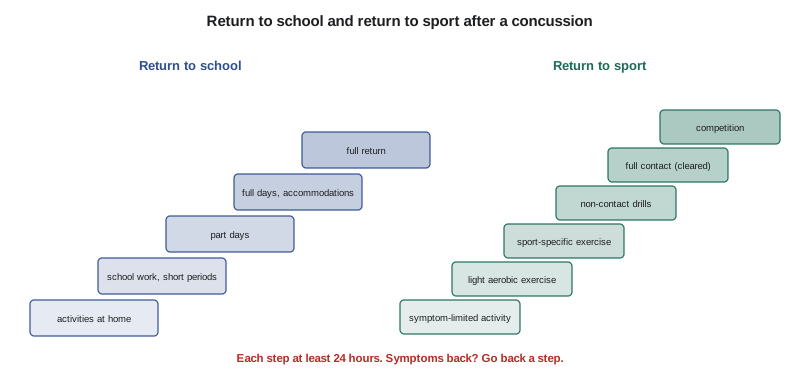
The return-to-sport steps follow international consensus guidance and Minnesota State High School League practice: symptom-limited activity, light aerobic exercise, sport-specific exercise, non-contact training drills, full contact practice, and return to competition. Each step lasts at least 24 hours. If symptoms return, the student goes back to the previous step. Under state law and district policy, the student needs written clearance from a trained health care provider before returning, and the return-to-learn and return-to-play plan is coordinated by the school nurse or a designated staff member, who shares it with the student's teachers and coach.
The program below shows how the district's tracking sheet checks that a student's return to sport has followed the rules: at least a day at each step, no advancing while symptoms are present, return to school complete before full contact, and medical clearance on file.
# Return-to-sport tracking check (invented data). Each entry: step, hours at step, symptoms?
STEPS = ["symptom-limited activity", "light aerobic", "sport-specific", "non-contact drills",
         "full contact practice", "competition"]
log = [(0, 48, False), (1, 24, False), (2, 24, True), (2, 30, False), (3, 24, False), (4, 24, False)]
school_done, clearance = True, True

problems = []
for i, (step, hours, symptoms) in enumerate(log):
    if hours < 24:
        problems.append(f"{STEPS[step]}: only {hours} h")
    if symptoms and i + 1 < len(log) and log[i + 1][0] > step:
        problems.append(f"advanced from {STEPS[step]} with symptoms")
if any(s >= 4 for s, _, _ in log) and not (school_done and clearance):
    problems.append("full contact before return to school and clearance")
print("return plan OK" if not problems else "\n".join(problems))
print("current step:", STEPS[log[-1][0]])return plan OK current step: full contact practice
This student had symptoms at the sport-specific step, stayed at that step until they cleared, then moved on, so the plan is in order. If the log had shown a move to non-contact drills straight after a day with symptoms, the check would flag it.
Other common injuries
Most injuries at school call for first aid, a call to the family and a report. Staff give first aid within their training and follow the district's guidance on when a student needs more:
- Bleeding: firm, direct pressure with a clean dressing, wearing gloves. A cut that gapes, will not stop bleeding, or is on the face may need stitches, so the family is asked to take the student for care.
- Suspected fractures and dislocations: keep the limb still and supported in the position found, apply ice wrapped in cloth, and call the family to take the student for an X-ray. Call 911 for an obvious deformity of a large bone, bone through the skin, or a limb that is cold, pale or numb below the injury.
- Sprains: rest, ice, gentle compression and elevation, and no return to activity that day if the student cannot bear weight normally.
- Dental injuries: a knocked-out permanent tooth is an emergency. Pick it up by the crown, not the root, rinse briefly if dirty, and put it back in the socket if possible, or keep it in milk or the student's saliva, and get the student to a dentist within the hour. Baby teeth are not put back.
- Eye injuries: do not rub; flush chemicals with lots of water for at least 15 minutes; cover an eye with an object in it without pressing and call 911.
- Head injuries in young children: a first-grade student who falls from the climbing structure and hits their head is watched closely for any concussion signs, and the family is always called, even if the child seems fine.
Getting a student to care
When a student needs emergency care, the district's rule is to call an ambulance, not to drive them in a staff member's car. Staff are not equipped to care for a seriously injured student while driving, and an ambulance brings care to the student immediately. For injuries that need care but are not emergencies, the family takes the student. If the family cannot be reached and the student needs care that cannot wait, the principal decides, usually by calling an ambulance. A staff member goes with the student to hospital and stays until the family arrives, taking the student's emergency information and medical plan.
Worked problem
The collision at the soccer game
Show solution
- In the second half of a senior girls' soccer game, a Pinecrest High School player collides head-to-head with an opponent going for a header. She gets up slowly and says she is fine.
- Sam Whitford sees her hold her head and looking dazed. He takes her off and checks her using the recognition tool. She has a headache and cannot remember the score.
- Her teammates ask him to let her back on for the last ten minutes of a close game. He says no: a suspected concussion means no return that day.
- He keeps her on the bench with an assistant coach, watches for red flags, calls her parents to pick her up and take her to a doctor, and gives them the district's concussion information sheet.
- She is diagnosed with a concussion. Over the next two weeks, she returns to full days of school with accommodations, then works through the return-to-sport steps, with written clearance before full contact.
Answer: Recognize, remove and do not return that day, then a gradual, tracked return to school and sport with medical clearance.
Heat, cold and sun on trips and at games
Environmental injuries are among the most preventable on trips and at outdoor sports. Heat illness ranges from cramps and heat exhaustion, with heavy sweating, weakness, headache and nausea, to heat stroke, a medical emergency in which the body's cooling fails and the person becomes confused, collapses or has a seizure. Heat stroke needs 911 and rapid cooling, ideally by immersing the person in cold water, while waiting for help. Prevention is simpler: schedule hard activity for cooler parts of the day, give water and shade breaks, let students adjust gradually to hot weather at the start of a season, and watch students who are less fit, unwell or wearing heavy equipment.
Cold injuries are the winter mirror image. Frostbite usually starts with numb, white or waxy-looking skin on fingers, toes, ears and cheeks; hypothermia shows as shivering, clumsiness and confusion. Students on winter trips are checked for proper clothing before leaving, wet clothing is changed promptly, and adults watch for students who stop shivering but become quiet and slow, which can mean worsening hypothermia. Sunburn and dehydration affect students in every season on snow and water, so sunscreen and water bottles are on every outdoor trip list.
Preventing injuries in physical activity
Most physical activity injuries can be reduced by the same few habits. Sam Whitford's department checks equipment and playing surfaces before each class, removes damaged equipment and reports hazards; teaches skills in progression; matches students by size and skill for contact activities; requires the protective equipment the activity calls for, such as helmets, mouth guards and shin pads; enforces rules on safe play, including no hits to the head; and builds in proper warm-ups and cool-downs. These are the same points courts look at after an injury, and they are what the district activity safety guidelines set out activity by activity.
Common mistakes
MistakeLetting a player back in because they say they feel fine.
InsteadA suspected concussion means removal and no return that day.
MistakeAssuming no loss of consciousness means no concussion.
InsteadMost concussions happen without loss of consciousness; watch for all symptoms.
MistakeSending a student with a head injury home alone or letting them drive.
InsteadAn adult stays with them until a family member takes over.
MistakeReturning to full contact before the student is back at school full time.
InsteadReturn to school comes before return to sport, with medical clearance.
MistakeDriving a seriously injured student to hospital in a staff car.
InsteadCall an ambulance; a staff member goes with the student.
Summary and key terms
- A concussion is a brain injury that often happens without loss of consciousness or visible marks.
- A suspected concussion means immediate removal and no return that day.
- Red flags such as neck pain, worsening headache, repeated vomiting or seizures need 911.
- Return to school comes first; return to sport follows step by step, at least 24 hours per step, with medical clearance before full contact.
- First aid for other injuries follows clear steps, and the family is always told.
- Students who need emergency care go by ambulance, with a staff member, not in a staff car.
- Concussion
- A brain injury caused by a force to the head or body that jolts the head, disrupting how the brain works.
- Red flags
- Signs of a possibly more serious injury, such as neck pain, worsening headache or seizures, needing emergency care.
- Return to school
- The gradual return to learning after a concussion, with accommodations, before full return to sport.
- Return to sport
- The stepwise return to physical activity after a concussion, ending with medical clearance and competition.
- Medical clearance
- Written permission from a qualified health care provider to return to full activity.
Practice problems
Work each problem on paper first, then reveal the answer to check.
Does a concussion require loss of consciousness?
Show answer
No. Most concussions happen without loss of consciousness.
A player with a suspected concussion says she feels fine ten minutes later. Can she return to the game?
Show answer
No. A suspected concussion means no return that day and an assessment by a physician or nurse practitioner.
Name four red flags that need 911.
Show answer
Any four of: neck pain or tingling in the limbs, loss of consciousness or increasing drowsiness, severe or worsening headache, repeated vomiting, seizure, double vision, increasing confusion or agitation, slurred speech.
How should a knocked-out permanent tooth be handled?
Show answer
Hold it by the crown, rinse briefly if dirty, put it back or keep it in milk or saliva, and get to a dentist within the hour.
Why does return to school come before return to sport?
Show answer
Thinking and screen work also strain the injured brain, and full recovery means coping with school before contact sport.
Lesson quiz · 5 questions
Score 60% or more to complete this lesson.
Create a free account to save your progress, take quizzes and earn a certificate.