
HSE-363 · Lesson 6 of 12 · 20 min
Field trip planning and risk assessment
Field trips are some of the most memorable parts of school. A day at a conservation area, a visit to a science center, a play, a farm, a factory tour, a week at an outdoor education center: these experiences reach students in ways a classroom cannot. They also take students out of a controlled environment into places with traffic, water, crowds, strangers, weather and unfamiliar hazards. The difference between a trip that goes well and one that goes badly is usually decided weeks before the day, in the planning. This lesson walks through the district's planning process and the risk assessment at its center.
Why trips need approval
Every trip needs approval before it is announced to students or families. Approval is not a formality. It is a second set of eyes on the plan, it makes sure the trip matches the district's rules, and it means the principal and, for higher-risk trips, the district know where students are and have agreed that the plan is reasonable. The level of approval rises with the risk and distance:
| Type of trip | Who approves | Submit at least |
|---|---|---|
| Walking trip in the local area | Principal (a yearly walking permission covers routine walks) | 1 week |
| Day trip, low or moderate risk | Principal | 4 weeks |
| Day trip with higher-risk activities (water, climbing, skiing) | Principal and the district safety coordinator | 8 weeks |
| Overnight trip in Minnesota | Principal and assistant superintendent | 12 weeks |
| Trip outside Minnesota or outside the United States | Superintendent and the school board | 6 months |
The lead times are not arbitrary. They allow time to book transport and sites, arrange extra adults, gather medical information, collect permission slips, hold family information meetings for overnight trips, and fix problems the approver finds. A rushed trip is a trip with gaps.
The planning steps
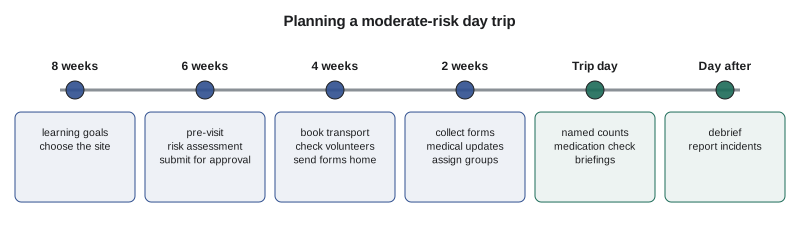
Aaron Fisk's planning for the conservation area trip followed the district's steps:
- Purpose: what students will learn, linked to the curriculum. A clear purpose helps decide which activities are worth their risks.
- Site: he chose a conservation area the district has used before, with a staffed education center, restrooms, marked trails and a pond study area.
- Pre-visit: he walked the trail and the pond area on a weekend, noting the steep bank on one side of the pond, the parking lot where buses and cars mix, and the spots with no cell signal.
- Risk assessment: he listed the hazards and the controls for each, which we look at below.
- Staffing: he calculated adults using the district ratio, as in lesson 4, and assigned each adult a group and a role.
- Medical and individual needs: he checked every student's medical plan and IEP and planned for each.
- Transport: he booked an approved bus operator.
- Emergency plan: he identified the nearest hospital, the site's first aid post and staff, the meeting point if anyone is lost, and how to call for help where there is no signal.
- Communication: he sent home the information letter and permission slip, and planned a short phone message to families when the bus left the site.
- Approval: he submitted everything to Ruth Bellamy six weeks before the trip.
The risk assessment
A risk assessment is a structured way of answering three questions: what could go wrong, how likely and how serious is it, and what will we do about it? The district uses the same likelihood and severity matrix introduced in HSE-360, with each hazard scored from 1 to 5 for likelihood and for severity before and after controls. Hazards that score high after controls either need more controls or are removed from the trip.
Controls follow the same order of preference used everywhere in safety work. Removing the hazard comes first: skip the activity or change the site. Next come physical separations, such as fences, ropes and designated areas. Then come procedures: rules, briefings, buddy systems and head counts. Last is personal protective equipment, such as life jackets, helmets and sunscreen. A good trip plan usually combines several.
The program below is Aaron's risk register for the conservation area. It scores each hazard before and after the planned controls and flags any that still score high.
# Trip risk register: likelihood x severity (1-5 each), before and after controls.
register = [
    # hazard,                         L0, S0, controls,                                                L1, S1
    ("Student falls into pond",        3,  4, "rope line at bank, adult at water's edge, no wading",       1,  4),
    ("Student separated on trail",     3,  3, "buddy pairs, adult front and back, counts at junctions",    1,  3),
    ("Bus/car traffic in parking lot", 3,  5, "students stay on bus until adults are posted, walk in line", 1,  5),
    ("Bee sting, allergic student",    2,  5, "auto-injectors with student and leader, plan briefed",       2,  3),
    ("Heat or sun exposure",           3,  2, "shade at lunch, water bottles, hats, check forecast",         1,  2),
    ("Ticks on long grass",            3,  2, "stay on trails, long pants, tick check letter to families",   2,  1),
]
for hz, l0, s0, ctl, l1, s1 in register:
    before, after = l0 * s0, l1 * s1
    flag = "  <-- still high, review" if after >= 10 else ""
print(f"{hz:31} {before:2} -> {after:2}{flag}")Student falls into pond 12 -> 4 Student separated on trail 9 -> 3 Bus/car traffic in parking lot 15 -> 5 Bee sting, allergic student 10 -> 6 Heat or sun exposure 6 -> 2 Ticks on long grass 6 -> 2
Every hazard drops to a low score after controls, which is what Ruth Bellamy looks for. Two details are worth noticing. The parking lot keeps a severity of 5 even after controls, because being struck by a vehicle is always serious; what the controls change is the likelihood. And the bee sting for the student with a severe allergy keeps a likelihood of 2, because the controls cannot stop a sting, but the severity falls because epinephrine is immediately at hand and the adults know the plan.
Groups, buddies and meeting points
On any trip outside the school, students are organized so that no one can quietly disappear. Each adult has a named group, usually small enough to count at a glance, with a list that includes photos for younger students. Within groups, students have a buddy whom they stay with and check on. Everyone knows the meeting point and the time to be there, and younger students wear something that makes the group easy to spot, such as matching shirts or vests. Students are told exactly what to do if they become separated: stay where they are, look for a staff member of the site or a parent with children, and never leave the site with anyone.
Inclusion and accessibility
A trip should be planned so that every student in the class can take part. When Aaron checked the site, he confirmed that the main trail and the education center were accessible for a student who uses a walker, and arranged for her to use the boardwalk route to the pond. When a site cannot be made accessible, the district expects staff to look for another site rather than leave a student behind, and any plan that excludes a student needs the principal's approval and a conversation with the family well in advance.
Cost is also an inclusion issue. The district expects schools to make sure no student misses a curriculum trip because their family cannot pay, using school funds, parent-teacher organization support or community donations, handled discreetly.
The trip binder and the day itself
Everything comes together in the trip binder, which goes with the leader, and a copy, which stays in the school office. It holds the approved plan and risk assessment, the itinerary, the group lists with photos and emergency contacts, the medical plans and medication list, the transport booking, the site contacts, the emergency plan and the incident report forms.
On the day, the leader runs through a short checklist before leaving: every student on the list is present or marked absent; every medication and auto-injector named in the plans is packed, with the student or the assigned adult; every adult has their group list and the leader's phone number; the bus is the one booked; the weather is within the plan's limits; and the office has the final list of who went.
For trips outside the United States, the district also checks the U.S. Department of State's travel advisories for the destination, makes sure every student has the right travel documents and health insurance, and has a plan for contacting families and the district across time zones.
Worked problem
The pond bank
Show solution
- On his pre-visit, Aaron notices that the pond study area has a gentle shore on one side and a steep, muddy bank about a meter high on the other.
- His first plan had groups rotating around the pond. He realizes that a student slipping down the steep bank would land in water about waist deep on an adult and over the head of a sixth-grade student.
- He talks with the site's education staff, who suggest using only the gentle shore, where they have a dipping platform with a rail.
- His revised plan uses the platform only, with a rope line marking the edge of the study area and one adult stationed at the water at all times. No student wades.
- He adds the change to the risk register and briefs the volunteers on it.
Answer: The pre-visit found a hazard that no brochure would show, and the plan removed the riskier area entirely before adding procedures.
Working with outside providers
Many trips involve another organization: a science center's education staff, a farm, a climbing gym, a ski hill, a theater, an outdoor education center or a tour company. Their staff may run the activity, but the school does not hand over its duty of care. Students are still the school's responsibility, and the leader needs to know exactly who is doing what. Before booking, the district asks the leader to confirm with the provider:
- What the provider's staff will supervise, and what school adults must supervise, at each part of the day.
- The qualifications of the provider's instructors for the activity, such as lifeguard, climbing or first aid certifications.
- The provider's own safety procedures, emergency plan and first aid arrangements.
- That the provider carries liability insurance at the level the district requires, with a certificate on file.
- Any waiver or release the provider wants families to sign, which the leader sends to the principal before it goes home, because the district reviews these forms (lesson 8 covers why).
A provider's staff are experts in their activity, but they do not know the students. The leader shares what they need to know, such as a student who is anxious about heights or a student with a seizure plan, and stays close by. School adults do not wander off for coffee while an instructor runs the climbing session; they supervise their groups and support the instructor.
Keeping families informed
Families are more comfortable with trips when they know what will happen and hear from the school at key moments. Willow Park's practice for day trips is a letter with the permission slip that explains the purpose, the schedule, the site, the activities and their main safety arrangements, what students should bring and wear, and how to reach the school during the day. For trips that return after the end of the school day, the office sends a short message when the bus leaves the site, so families know when to arrive for pickup.
If something goes wrong, the plan is equally clear. The leader calls the principal, who decides with the leader what to tell families and when. Families of an injured student hear directly from the school, not from another child's social media post. Staff do not post photos of students during the trip, and the district's rules on photos and consent apply on trips just as they do at school.
Common mistakes
MistakeAnnouncing a trip to students before it is approved.
InsteadGet approval first; the approver may find gaps that need fixing.
MistakePlanning from the site's website alone.
InsteadPre-visit, or at least call the site, to see the real hazards.
MistakeRelying only on rules and briefings to control a hazard.
InsteadRemove or separate hazards first, then add procedures and equipment.
MistakeLeaving the trip binder at school.
InsteadCarry the binder; leave a copy in the office.
MistakePlanning a site some students cannot access.
InsteadChoose an accessible site or make arrangements so everyone can take part.
Summary and key terms
- Every trip needs approval, with higher levels and longer lead times for riskier and longer trips.
- Planning covers purpose, site, pre-visit, risk assessment, staffing, medical needs, transport, emergencies and communication.
- A risk assessment scores hazards before and after controls, using the hierarchy of controls.
- Named groups, buddies and meeting points keep track of every student.
- Trips are planned so every student can take part, including on access and cost.
- The trip binder holds the plan, lists, medical information and emergency contacts.
- Risk assessment
- A structured review of what could go wrong, how likely and serious it is, and what will be done about it.
- Pre-visit
- A visit to a trip site by the leader before the trip to see its real hazards.
- Hierarchy of controls
- The order of preference for controls: remove, separate, procedures, protective equipment.
- Buddy system
- Pairing students to stay together and check on each other.
- Trip binder
- The folder the leader carries with the approved plan, lists, medical information and emergency contacts.
Practice problems
Work each problem on paper first, then reveal the answer to check.
Why are longer lead times required for overnight and out-of-region trips?
Show answer
To allow time for bookings, extra adults, medical information, forms, family meetings and fixing problems the approver finds.
What are the three questions a risk assessment answers?
Show answer
What could go wrong, how likely and serious is it, and what will we do about it.
Why does the parking lot hazard keep a severity of 5 after controls?
Show answer
Being struck by a vehicle is always serious; controls reduce the likelihood, not the severity.
What should a student who becomes separated from the group do?
Show answer
Stay where they are, look for site staff or a parent with children, and never leave with anyone.
What did Aaron change after his pre-visit to the pond?
Show answer
He used only the gentle shore and dipping platform with a rope line and an adult at the water, and no wading.
Lesson quiz · 5 questions
Score 60% or more to complete this lesson.
Create a free account to save your progress, take quizzes and earn a certificate.