
HSE-363 · Lesson 7 of 12 · 21 min
Higher-risk trips: overnight stays, water and outdoor education
Some trips carry more risk than a day at a museum: anything involving water, overnight stays, wilderness travel, winter sports, climbing or travel far from help. These are also some of the most valuable experiences schools offer, and the district supports them, with extra planning, qualified leaders and tighter rules. This lesson covers the three areas where the most serious trip tragedies have happened: water, wilderness travel and overnight supervision.
Why water is different
Drowning is one of the leading causes of accidental death for children and teenagers, and it does not look the way people expect. A person who is drowning usually cannot shout or wave; they slip under quietly, often within a minute or two, and often within a short distance of other people. Many school-related drownings have happened during supposedly casual swims at a lake or a pool on a trip, not during planned water lessons. For that reason, the district treats any water activity, including wading, as a higher-risk activity that needs specific approval and controls.
School groups in the United States have had their own drowning tragedies on trips to lakes, rivers, beaches and hotel pools, and reviews afterward keep finding the same gaps: students who could not swim well allowed into deep or open water, no swim check before the trip, no lifeguard, too few adults watching the water, and adults who were present but distracted. Northern states such as Minnesota, with thousands of lakes and cold water for much of the year, also see cold water immersion deaths among canoeists and boaters. Today's practice reflects these lessons: leaders with real qualifications, students tested and trained before they go, proper equipment, respect for cold water and weather, and the authority to stay off the water.
Layers of protection for water
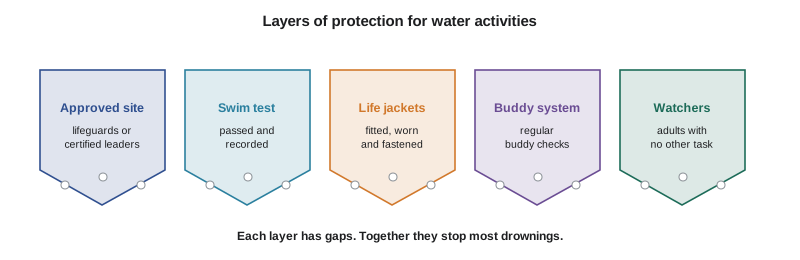
The district requires every one of these layers for any swimming or boating activity:
- An approved site: a supervised pool or a beach with lifeguards on duty for swimming, or an outdoor education provider or district program with certified leaders for paddling. Unsupervised open water swimming is not allowed.
- A swim test: every student taking part in swimming in deep water or in any paddling activity must have passed the district's swim test before the trip, with the result recorded and checked by the trip leader against the group list. Students who have not passed may take part only in shallow-water activities with constant visual supervision, or not at all for paddling.
- Life jackets: for all boating and paddling, and for weaker swimmers in any water, a U.S. Coast Guard-approved life jacket that fits, worn and buckled at all times on the water.
- Buddies: every student has a buddy, and buddy checks are called at regular intervals; students who do not find their buddy at once signal an adult.
- Watchers: adults are assigned to watch the water, not to do anything else. Lifeguards do not replace school supervision.
Hotel and cabin pools deserve a special mention, because they are where many trip drownings have happened. The district's rule is simple: students do not use a hotel or cabin pool unless a lifeguard is on duty and the trip plan includes it, with the same ratios and buddy rules as any other swim.
Cold water and weather
In much of Canada and the northern United States, lakes and rivers stay cold well into the summer. Cold water is dangerous long before hypothermia sets in. A sudden plunge causes a gasp reflex and rapid breathing that can make a person inhale water in the first minute; within about ten minutes, the muscles in the arms and legs stop working well enough to swim or hold on; unconsciousness from hypothermia can follow within about an hour. This is sometimes taught as the 1-10-1 principle, and it explains why life jackets must be worn, not just carried in the canoe: a life jacket keeps a person's head above water through the cold shock and the loss of muscle control.
Wind, waves and lightning end more paddling days than any other factor. Trip leaders check the forecast each morning, stay close to shore on large lakes, cross open water only in the calmest part of the day, and get off the water at the first sign of thunder. The district gives leaders clear authority to change the route or stay on shore, and expects them to use it without pressure from the schedule.
Wilderness and outdoor education trips
Leah Tremblay's eleventh-grade canoe trip spends four days on a lake chain two hours from the nearest town. Trips like this need everything a day trip needs, plus:
- Leaders with recognized paddling, wilderness first aid and trip leadership certifications, and at least one leader who has traveled the route before.
- A training program before the trip, including a swim test, paddling skills, capsize and rescue practice in a pool, and camping skills.
- A route plan and a schedule filed with the school and the district, with planned campsites, check-in times and escape routes to roads.
- Communication that works where cell phones do not, such as a satellite messenger or satellite phone, with a set time each day to check in with the school contact.
- An emergency plan for evacuating an injured or ill student, including how long it would take to reach a road and the nearest hospital, and who would meet the group there.
- Equipment checked before departure: life jackets fitted for each student, spare paddles, throw bags, first aid kits, water treatment and shelter.
Before the trip, Leah checks every student against the requirements. The program below shows how her readiness check works.
# Canoe trip readiness: every student needs each item before departure.
REQUIRED = ["swim test passed", "medical form returned", "life jacket fitted",
            "capsize practice done", "consent signed"]
roster = {
    "Amara":  {"swim test passed", "medical form returned", "life jacket fitted", "capsize practice done", "consent signed"},
    "Ben":    {"swim test passed", "medical form returned", "life jacket fitted", "consent signed"},
    "Chen":   {"medical form returned", "life jacket fitted", "capsize practice done", "consent signed"},
    "Dana":   {"swim test passed", "medical form returned", "life jacket fitted", "capsize practice done", "consent signed"},
}
for name, done in roster.items():
    missing = [r for r in REQUIRED if r not in done]
print(f"{name:6} {'ready' if not missing else 'NOT READY: ' + ', '.join(missing)}")Amara ready Ben NOT READY: capsize practice done Chen NOT READY: swim test passed Dana ready
Ben still needs his capsize practice, which he can do at the next pool session. Chen has not passed the swim test. Leah's rule, which follows the district's, is that a student who has not passed the swim test does not go on a paddling trip, no matter how close the departure date. She arranges extra pool time for Chen with a swim instructor and a retest; if he passes, he goes.
Overnight trips
Overnight trips add a different kind of risk: supervision at night, when adults are tired and students are excited, and all the ordinary health, safety and behavior issues of students living away from home. The district's requirements for overnight trips include:
- Sleeping arrangements planned in advance, with students grouped by grade and, generally, by gender, and with adults' rooms near students' rooms. Students are never in an adult's room, and adults never share a room or tent with a student.
- Arrangements that respect students' gender identity and privacy, worked out in advance with the student and, where appropriate, the family, so that every student has a safe and comfortable place to sleep and change.
- A lights-out time, room or tent checks by two adults, and an adult awake or on call through the night with a clear way for students to reach them.
- Rules on staying in assigned areas, with no students leaving the site, entering other rooms or tents after lights-out, or using alcohol, cannabis, vaping products or other drugs. Families agree in advance that a student who breaks serious rules may be sent home at the family's expense.
- Medications stored and given as planned, including morning and evening doses that students usually take at home.
- A plan for homesickness, illness and injury, including who stays with a student who goes to hospital while the group continues.
- A family information meeting before the trip, so families understand the program, the rules and how to reach the group.
Worked problem
The hotel pool
Show solution
- On the first evening of a eighth-grade overnight trip to the capital, a group of students asks the adults if they can use the hotel pool before bed. The itinerary does not include swimming.
- One volunteer says it seems harmless, since there are six adults and the pool is small.
- The trip leader checks with the front desk: there is no lifeguard on duty. The swim tests of the group have not been collected, because no swimming was planned.
- She says no, and explains to the students that the pool is not part of the plan and has no lifeguard. She suggests the hotel's games room with two adults supervising instead.
- She notes the request in the trip report and suggests that the next year's trip either books a supervised pool session with swim tests collected in advance or makes clear in the family letter that hotel pools will not be used.
Answer: Water activities happen only when planned and approved with all the layers in place, not as a last-minute extra.
Winter trips: skiing, snowboarding and skating
Ski and snowboard days are popular winter trips, and the injuries they bring are mostly predictable: wrist fractures for snowboarders, knee injuries for skiers, head injuries for both, collisions on crowded runs, and cold injuries on long chairlift rides. The district's rules for ski trips are:
- Helmets are required for every student on skis or a snowboard, and are fitted before students go on the hill.
- Students take a lesson matched to their level, and beginners stay on beginner terrain until an instructor says they are ready.
- Students ski or ride in groups of at least three, so one can stay with an injured student while another gets help, and check in with an adult at a set place and time every hour.
- Terrain parks, trees and closed runs are off limits unless the plan says otherwise and an instructor is with the group.
- Adults are on the hill, not all in the lodge, and one adult stays at the meeting point with the trip binder and a phone.
- The hill's ski patrol handles injuries on the hill; the trip leader goes with an injured student or sends an adult.
Outdoor skating on ponds and lakes adds the risk of breaking through ice. The district allows skating only on maintained rinks or on ice that a local authority or the site has measured and declared safe, never on ice the group has not checked. Clear ice at least 10 centimeters (4 in) thick is a common minimum for walking and skating, but ice thickness varies across a lake, and moving water, snow cover and thaws all weaken it.
Using an outdoor education center
Many schools take classes to residential outdoor education centers for two to five days. The center usually provides instructors for activities such as canoeing, orienteering and the high ropes course, while the school provides supervision the rest of the time. Before booking, Leah Tremblay confirms that the center holds the accreditations and insurance the district requires, gets the center's written safety procedures, and agrees in writing which adults supervise each part of the day and night. School staff stay with their groups during instructor-led activities, help with student behavior and know their students' medical plans, which the center's staff may not.
Common mistakes
MistakeAllowing a quick, unplanned swim at a lake or hotel pool.
InsteadSwim only as planned, at supervised sites, with swim tests and watchers.
MistakeKeeping life jackets in the bottom of the canoe.
InsteadWear a fitted, approved life jacket, done up, at all times on the water.
MistakeLetting a student who has not passed the swim test paddle "just this once".
InsteadNo pass, no paddling trip; arrange a retest instead.
MistakePushing on across open water to keep to the schedule.
InsteadChange the route or stay on shore when wind, waves or lightning threaten.
MistakeSharing a tent or room with a student on an overnight trip.
InsteadAdults sleep near students, never with them, and do checks in pairs.
Summary and key terms
- Drowning is fast and quiet, and many trip drownings happen during unplanned swims.
- Water activities need an approved site, a recorded swim test, worn life jackets, buddies and dedicated watchers.
- Cold water causes cold shock and loss of muscle control long before hypothermia; life jackets must be worn.
- Wilderness trips need certified leaders, training, filed route plans, satellite communication and an evacuation plan.
- Overnight trips need planned sleeping arrangements, night supervision, clear rules and medication plans.
- Leaders have the authority, and the duty, to change plans when conditions are unsafe.
- Swim test
- A test set by the district that students must pass, and have recorded, before deep-water swimming or paddling.
- Life jacket
- An approved flotation device that keeps a person afloat; it works only when worn and fastened.
- Cold shock
- The gasp reflex and rapid breathing caused by sudden immersion in cold water.
- 1-10-1 principle
- About one minute of cold shock, ten minutes of useful movement and an hour before unconsciousness in cold water.
- Satellite messenger
- A device that sends check-ins and emergency alerts where there is no cell coverage.
Practice problems
Work each problem on paper first, then reveal the answer to check.
Why are unplanned swims on trips so dangerous?
Show answer
They often lack swim tests, lifeguards and dedicated watchers, and drowning is fast and quiet.
Name the five layers of protection for water activities.
Show answer
Approved site with lifeguards or certified leaders, recorded swim test, fitted life jackets worn, buddy system and dedicated adult watchers.
What does the 1-10-1 principle describe?
Show answer
One minute of cold shock, about ten minutes of useful movement and about an hour before unconsciousness in cold water.
What did Leah do about Chen, who had not passed the swim test?
Show answer
He could not go unless he passed; she arranged extra pool time and a retest.
Why did the trip leader refuse the hotel pool?
Show answer
It was not in the plan, had no lifeguard and the group's swim tests had not been collected.
Lesson quiz · 5 questions
Score 60% or more to complete this lesson.
Create a free account to save your progress, take quizzes and earn a certificate.