
HSE-363 · Lesson 2 of 12 · 21 min
Negligence in schools: what the cases teach
Most school injuries never reach a lawyer. A scraped knee is cleaned, a parent is called, and the day goes on. But some injuries are serious enough that families look for compensation, and when they do, the question becomes whether the school was negligent. Staff do not need to become lawyers, but knowing how negligence works, and what courts have said in school cases, makes it much easier to understand why policies ask for what they do. This lesson walks through the elements of negligence, the defenses, who actually pays, and the cases that shaped supervision practice.
The four elements
To succeed in a negligence claim, the injured person has to prove four things:
- Duty: the defendant owed them a duty of care. In schools, this is rarely in dispute, because the relationship between staff and students creates the duty.
- Breach: the defendant failed to meet the standard of care, meaning they did not act as a careful parent or reasonable adult in the same role would have acted.
- Causation: the breach actually caused the harm. If the injury would have happened anyway, even with perfect supervision, the claim fails on causation.
- Damage: the person suffered real harm, such as an injury, financial loss or a recognized psychological injury.
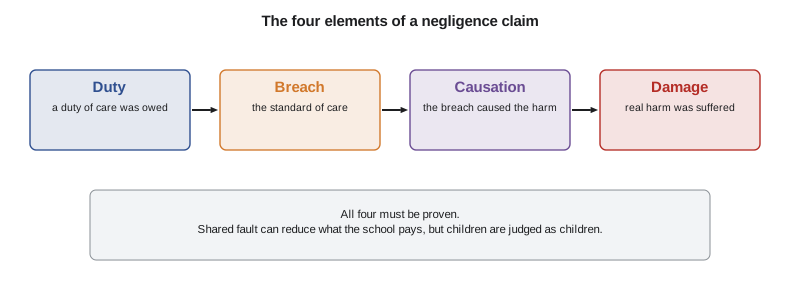
Almost every school case turns on breach and causation. Was the supervision reasonable for those students and that activity? And if it was not, would better supervision have prevented the injury? A supervisor who was chatting at the far end of a yard when a fall happened may have breached the standard, but if the child slipped on a dry, level surface while walking, a court may conclude that no reasonable supervision would have stopped it.
Defenses and shared fault
Several defenses can reduce or defeat a claim. In Minnesota, as in most states, comparative fault lets a court or jury divide responsibility between the parties and reduce the damages by the student's share; under Minnesota's rule, a plaintiff whose fault is greater than the defendant's recovers nothing. Courts are careful with children: a child is judged against what a child of similar age, intelligence and experience would have done, and very young children are rarely found at fault at all. Assumption of risk rarely succeeds against a school for required activities, because students are expected to be taught and protected. Time limits to start a claim vary, and for minors the clock generally does not start until they reach adulthood, so a claim for a childhood injury can arrive years later.
The long time limits are one reason the district insists that incident reports be written promptly and kept. A report written the same day, describing where the supervisor was standing, what instructions had been given and what the student did, is far more useful years later than anyone's memory.
Who pays
When a staff member is negligent while doing their job, the district is normally responsible as their employer. This is called vicarious liability, and the claim is usually brought against the district, which is insured. Minnesota law also gives public employees official immunity for genuinely discretionary decisions, those that involve weighing policy considerations, and the district can share that immunity. Routine duties set by policy, such as following a required supervision ratio, are usually treated as ministerial and are not protected. The Minnesota Tort Claims Act also caps the amount a school district can be ordered to pay. Individual staff are rarely asked to pay damages personally, but they can be named in a claim, may have to give evidence, and can face discipline or licensing consequences if they ignored policies. The point of good supervision is not to protect the district's insurance; it is to prevent the injury in the first place.
What the cases teach
School negligence cases are useful because they show, in concrete detail, where courts drew the line. The facts below are summarized, and the lessons are the ones courts and safety organizations have drawn from them.
Gymnastics and specialized activities
In Larson v. Independent School District No. 314, decided by the Minnesota Supreme Court in 1980, an eighth-grade student was paralyzed attempting a gymnastics move in a physical education class taught by a teacher in his first year. The student had not been taken through the proper steps or given adequate spotting. The court upheld findings that both the teacher and the principal were negligent: the teacher for how he taught and supervised the move, and the principal for failing to supervise the planning of the physical education program. The court also held that the teacher's day-to-day decisions about spotting and progression were not the kind of policy-level choices protected by official immunity. The case is still cited for the points that dangerous activities need progression, spotting and competent supervision, and that administrators are responsible for how programs are planned.
Unstructured time
Many claims come from recess, lunch and class changes rather than lessons. In Dailey v. Los Angeles Unified School District (1970), the California Supreme Court allowed a claim to proceed after a student died from a fall during 'slap-boxing' in a school gym at lunch, where the supervising teacher was in an office and no clear supervision plan existed. Courts in many states have since held that schools do not have to watch every child every second, but they must have a reasonable number of supervisors, placed and moving where trouble is likely, with rules that are enforced. Schools have been found liable where supervisors were missing from an assigned area, where a known dangerous game was allowed to continue, or where a hazard was left in use, and not liable where reasonable supervision was in place and an injury happened suddenly in ordinary play.
Trips and outdoor programs
Courts across the United States have heard many claims from field trips and outdoor programs: drownings at lakes and pools, falls on hikes, injuries on rides and in vehicle crashes. A common thread is that 'free time' on a trip is still supervised time. Schools have been found liable where students were allowed into water without a swim check, lifeguards or a buddy system, where boundaries were not set or checked in risky terrain, and where planning ignored known hazards at the site. They have generally not been found liable where planning, supervision and instruction were reasonable and an accident happened anyway.
Known individual needs
Claims also arise when staff knew about a particular student's needs and did not plan for them: a student with a known severe allergy who was given food at a class party without checking, a student with a history of running away who was not assigned an adult on a trip, a student with epilepsy allowed to swim without one-to-one supervision. These are among the hardest claims to defend, because the risk was not just foreseeable in general; it was written in the student's file.
Putting numbers on shared fault
When a court finds both the school and the student at fault, it divides the damages. The program below shows how the division works with a few made-up examples. The fault shares are decided by the court based on the evidence; the arithmetic is then simple.
# How shared fault reduces damages (invented examples).
cases = [
    ("Grade 10 rings dismount, no spotter", 400_000, 0.20),
    ("Grade 12 off-trail scramble on a trip", 250_000, 0.35),
    ("Grade 3 trip on broken playground step", 18_000, 0.00),
]
for name, damages, student_share in cases:
    paid = damages * (1 - student_share)
print(f"{name:40} assessed {damages:>9,} student share {student_share:4.0%} school pays {paid:>9,.0f}")Grade 10 rings dismount, no spotter assessed 400,000 student share 20% school pays 320,000 Grade 12 off-trail scramble on a trip assessed 250,000 student share 35% school pays 162,500 Grade 3 trip on broken playground step assessed 18,000 student share 0% school pays 18,000
In the first two examples, the older students' own decisions reduce what the school pays but do not eliminate the school's responsibility, because the supervision and planning fell short. In the third, a young child is not expected to watch for a broken step, so the school carries the full share. The examples show why staff should never rely on students, especially younger ones, to protect themselves.
What reasonable supervision looks like to a court
Across all these cases, courts look for the same practical evidence. When the district reviews an incident, it asks these questions, because they are the ones a court would ask:
- Was there a plan for this activity or this period, and did it match the students and the risk?
- Were enough adults present, and were they where they were supposed to be?
- Had students been taught the rules and the skills, and were the rules enforced?
- Were equipment and the site checked and suitable?
- Did staff know about individual students' needs and plan for them?
- Did staff respond promptly and properly when the injury happened?
- Was everything written down at the time?
Worked problem
The gym class without a spotter
Show solution
- During a ninth-grade gymnastics unit at Pinecrest High School, Sam Whitford sets up four stations. He spots at the vault station and asks students at the low beam, floor and rings stations to practice only the skills already taught.
- A student at the rings, who has been told not to attempt a dismount without a spotter, tries one anyway and lands on his shoulder.
- Sam reaches him within seconds, gives first aid, sends a student to the office and keeps the rest of the class seated.
- The incident report records the station layout, the instructions given, the student's attempt and the response. The review asks whether the rings station should have been open at all without a spotter.
- The department changes its practice: stations that involve inversion or dismounts from height run only when an adult is spotting at that station, and the others are limited to skills that do not need spotting.
Answer: The review asks the questions a court would ask: plan, adults, instruction, equipment, individual needs, response and records. It then changes practice to close the gap.
Other kinds of claims
Negligence is the most common claim after an injury, but it is not the only way a school's care of students is tested. Staff should know about a few others, because the same good practice protects against all of them.
- Disability discrimination complaints under Section 504, the ADA and the Minnesota Human Rights Act can follow when a student with a disability is excluded from a trip or activity, or included without the accommodation they need.
- Bullying and harassment that staff knew about and did not address can lead to claims and to complaints under district policy and Minnesota's Safe and Supportive Schools Act.
- Failing to report suspected maltreatment breaks Minnesota's mandated reporter law, which requires school staff to report to the local welfare agency or police.
- Privacy complaints under FERPA can arise when education and health records are shared more widely than needed, or not shared with the people who need them to keep a student safe.
After an injury: talking with families
The way a school communicates after an injury affects both the family's trust and, sometimes, whether a claim is made at all. Families who feel informed and respected are far less likely to assume the worst. The district's guidance for staff is practical:
- Call the family promptly, before the student gets home or posts about it, and describe what happened factually: where, when, what the injury appears to be and what first aid was given.
- Express care and concern. Saying 'I'm sorry this happened to Maya' is a normal human response and is encouraged.
- Do not guess about causes or fault, and do not promise outcomes. Say that the school will look into what happened and follow up.
- Tell the family what the school is doing next: an incident report, a review, any change to the activity.
- Pass any questions about compensation or insurance to the principal, who will involve the district.
Staff sometimes worry that any expression of sympathy will be treated as an admission of fault. A plain expression of sympathy for what the family is going through is not the same as admitting negligence, and families notice when staff are cold or evasive. Courts look at the facts of the supervision, not at whether a teacher said they were sorry.
Common mistakes
MistakeThinking that if a student broke a rule, the school cannot be responsible.
InsteadCourts often share fault; the school is still judged on its planning and supervision.
MistakeAssuming young children can protect themselves from obvious hazards.
InsteadChildren are judged as children, and very young ones are rarely found at fault.
MistakeTreating free time on a trip as unsupervised time.
InsteadSet boundaries, check them and keep adults with students in unfamiliar places.
MistakeWriting the incident report days later from memory.
InsteadWrite it the same day; claims can arrive years later.
MistakeIgnoring what the student file says about individual needs.
InsteadPlan for every known medical, behavior and supervision need.
Summary and key terms
- Negligence requires duty, breach, causation and damage.
- Most school cases turn on whether supervision was reasonable and whether it would have prevented the harm.
- A student's own carelessness can reduce damages, but children are judged by their age and experience.
- The employer is usually responsible for staff negligence, but staff can still face discipline.
- Cases on gymnastics, recess and trips stress progression, adequate adults, enforced rules and boundaries.
- Known individual needs that are not planned for lead to the hardest claims to defend.
- Negligence
- Failing to take reasonable care, causing harm to someone owed a duty of care.
- Breach
- Falling below the standard of care expected in the circumstances.
- Causation
- The link showing the breach actually caused the harm.
- Contributory negligence or comparative fault
- A finding that the injured person's own carelessness contributed to the harm, reducing damages.
- Vicarious liability
- Responsibility of an employer for negligence by employees acting in the course of their work.
Practice problems
Work each problem on paper first, then reveal the answer to check.
What are the four elements of negligence?
Show answer
Duty, breach of the standard of care, causation and damage.
Why can a claim for a childhood injury arrive years after the event?
Show answer
Because the time limit generally does not run while the injured person is a minor.
What did the gymnastics cases establish about specialized activities?
Show answer
That they need progression, proper equipment and close, competent supervision, judged against a trained instructor.
A student is assessed $250,000 in damages and found 35% at fault. How much does the school pay?
Show answer
$162,500, which is 65% of the damages.
What did the gym department change after the rings incident?
Show answer
Stations involving inversion or dismounts from height run only with an adult spotting there.
Lesson quiz · 5 questions
Score 60% or more to complete this lesson.
Create a free account to save your progress, take quizzes and earn a certificate.