
HSE-363 · Lesson 12 of 12 · 20 min
When something goes wrong: response, reporting and review
Even with good supervision, careful plans and well-trained staff, things go wrong. A student breaks an arm on the play structure, a third-grade student wanders away from the group at a museum, a student has a severe allergic reaction on a bus, or a canoe capsizes. What staff do in the first minutes, how they communicate and record what happened, and how the school learns from it afterward all matter, for the student, for the family, for the other students, and for the staff involved. This final lesson brings the course together around the response to an incident, and ends with a capstone review of a full trip plan.
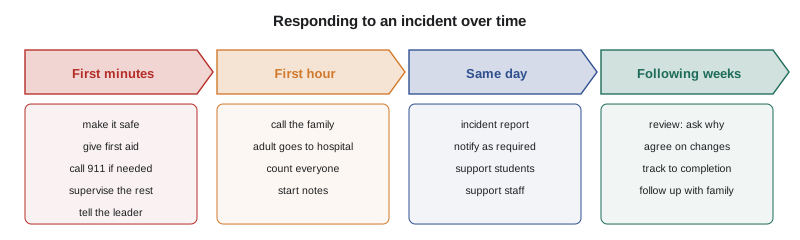
The first minutes
Whatever has happened, the first minutes follow the same order:
- Make it safe. Stop the activity, move other students away from the hazard and make sure nobody else is hurt. On the water, that means rescuing people before equipment.
- Care for the injured student. Give first aid within your training, use the medical plan if the student has one, and give emergency medication such as epinephrine without delay.
- Call for help. Send a specific adult or student to call 911 if needed, and to get the AED, first aid kit or the student's medication.
- Keep everyone else supervised. One adult cares for the injured student; others take charge of the rest of the group, move them away, count them and keep them calm. This is why every outing has at least two adults.
- Tell the person in charge. The trip leader or principal takes over the overall response, which frees the first adult to focus on the student.
A missing student
A student who cannot be found is one of the most frightening incidents for any school, and one where speed matters most. The district's missing student procedure applies at school and on trips:
- As soon as a student is noticed missing, the adult tells the person in charge and does a quick named count of the rest of the group, to be sure only one student is missing.
- Adults search the immediate area and the places the student is most likely to be, such as the restrooms, the last place they were seen, the bus, the exit and the gift shop, while one adult stays with the group.
- At a site such as a museum, park or ski hill, the leader tells site staff at once; most sites have their own lost child procedures, including watching exits.
- If the student is not found within about ten minutes, or at once for a young child, a student with a disability or medical condition, or anywhere near water or traffic, the leader calls law enforcement and the principal. Calling early is never a mistake.
- The principal contacts the family, and the group continues to be supervised and counted.
Afterward, the review asks how the student became separated and how it was noticed. In many cases, the answer is a missed count at a transition, a group that was too large for one adult, or a student who needed closer supervision than the plan provided.
Informing families
The family of a student who is hurt, ill or missing hears from the school as soon as possible, by phone, from the principal or the person in charge, with the facts known so far and where their child is or is being taken. For serious incidents, the principal decides with the district what to tell other families and when, so that they hear accurate information from the school rather than rumors. Staff do not post about incidents on social media and refer media questions to the principal or the district's communications staff.
Writing the incident report
The incident report is written the same day by the staff member most directly involved, with help from others who saw what happened. A good report is factual, specific and complete:
- Who was involved, including the student, the staff on duty and witnesses.
- When and where it happened, as precisely as possible.
- What the activity was, how it was being supervised and what instructions had been given.
- What happened, in plain, factual language: what was seen and heard, not guesses about causes or blame.
- The injury or illness, and the first aid or treatment given, with times.
- Who was called and when: 911, the family, the principal.
- What happened afterward: the student went home, to hospital, or back to class.
Reports go to the principal and, through the district's system, to the people who need them, including the district's insurer for any injury that might lead to a claim. Staff injuries also go to the workers' compensation insurer, and serious staff injuries must be reported to MNOSHA within the required hours. Some incidents trigger other duties: suspected maltreatment is reported to the local welfare agency or police, and serious incidents are reported to the superintendent the same day.
Supporting people afterward
Serious incidents affect more than the injured student. Classmates who saw a friend collapse, a teacher who gave CPR, a volunteer who could not find a student for twenty minutes, all may be shaken. The district follows the psychological first aid approach from HSE-362: check on people, listen, give practical help and information, and connect them to support, such as guidance staff, the employee assistance program or community services. Staff involved in a serious incident are not expected to finish the day as if nothing happened.
Reviewing and improving
Every serious incident and near miss is reviewed. The purpose is to find what can be changed so it does not happen again, not to find someone to blame. A useful technique is to keep asking 'why?' until the answer points to something the school can fix: a student was missing at the museum; why? Because the count at the cafeteria was missed; why? Because the group leader was buying lunch and the count was nobody else's job; why? Because the plan did not name who counts at each transition. The fix is a plan that names a counter for every transition.
Patterns matter as much as individual incidents. Willow Park reviews its injury reports each semester to see where and when injuries happen. The program below shows the kind of summary the principal looks at.
from collections import Counter
# One term of student injury reports at an elementary school (invented data): (place, time, type)
reports = [
    ("play structure", "lunch recess", "fall"), ("play structure", "lunch recess", "fall"),
    ("paved area", "morning recess", "collision"), ("field", "lunch recess", "collision"),
    ("play structure", "lunch recess", "fall"), ("hallway", "class change", "trip"),
    ("gym", "phys ed", "sprain"), ("play structure", "morning recess", "fall"),
    ("paved area", "lunch recess", "collision"), ("field", "lunch recess", "fall"),
    ("play structure", "lunch recess", "fall"), ("bus loop", "dismissal", "trip"),
]
print("by place:", Counter(p for p, _, _ in reports).most_common(3))
print("by time: ", Counter(t for _, t, _ in reports).most_common(2))
ps_lunch = sum(1 for p, t, _ in reports if p == "play structure" and t == "lunch recess")
print(f"play structure at lunch recess: {ps_lunch} of {len(reports)} reports")by place: [('play structure', 5), ('paved area', 2), ('field', 2)]
by time: [('lunch recess', 7), ('morning recess', 2)]
play structure at lunch recess: 4 of 12 reportsFive of the twelve reports come from falls on the play structure at lunch recess. The school checks the surfacing under the structure, which turns out to be compacted and worn thin under the slide and the overhead ladder, has it topped up to the required depth, and adds a second supervisor in zone B at lunch. The next term's reports show whether the changes worked.
Capstone: reviewing a trip plan
To bring the course together, consider the plan Leah Tremblay submits for next spring's four-day eleventh-grade canoe trip, and the review Daniel Lefebvre carries out using everything in this course.
| Area | What the plan shows | Review finding |
|---|---|---|
| Duty of care and approval | Submitted six months ahead to the principal and superintendent, with learning goals | Meets the lead time and approval levels |
| Staffing and ratios | 14 students, 3 adults: Leah, a certified guide from an outdoor education provider and a second teacher | Meets 1 per 6; both teachers hold wilderness first aid; guide holds paddling instructor and lifeguard certifications |
| Water safety | Swim tests recorded for 13 of 14 students; life jackets fitted; capsize practice scheduled | One student must pass the swim test or not paddle; plan says this clearly |
| Route and weather | Route plan with campsites, escape routes to roads, daily check-ins by satellite messenger | Add a rule for waiting out wind on the large lake crossing on day 2 |
| Medical and medication | Two students with plans (asthma, anaphylaxis); one with evening medication | Two auto-injectors for the student at risk; evening medication logged by one named adult |
| Forms and families | Information meeting, acknowledgment of risk form, emergency contacts, photo consent | Good; translate the letter for two families |
| Emergency plan | Evacuation times from each campsite, nearest hospitals, school contact on call 24 hours | Add who meets the group at the road if a student is evacuated |
| Overnight supervision | Tent groups by gender with student input; adults' tents nearby; night checks in pairs | Meets policy |
Daniel approves the trip with three conditions: the large-lake rule for wind, the named contact to meet any evacuation at the road, and the translated letters. None of the findings are dramatic. That is the point. A well-planned trip is one where the review finds small things to tighten, because the large things, ratios, swim tests, life jackets, medical plans and emergency communication, are already in place.
Worked problem
Lost at the science center
Show solution
- During a third-grade trip to a science center, a parent volunteer's group of five returns from the planetarium with four students. Eli is missing.
- The volunteer tells Aaron immediately. Aaron does a named count of the other groups: everyone else is present. He keeps the class together with the other adults and sends the volunteer back to the planetarium entrance.
- He tells the front desk, which alerts its staff and watches the exits. Eight minutes later, Eli has not been found. Because he is seven, Aaron calls law enforcement and Ruth Bellamy, who calls Eli's family.
- Two minutes later, a center staff member finds Eli at the dinosaur exhibit, upset but unhurt. Aaron lets law enforcement and the family know at once.
- The review finds that the group was counted on leaving the planetarium only by number, while a different school's child had joined the line. The school adds named counts at every exhibit change and smaller groups for younger students.
Answer: Tell the leader, count the rest, search likely places, alert the site, call law enforcement early for a young child, and fix the system gap the review finds.
Following up with the family
The response does not end when the incident report is filed. The principal or the staff member who knows the student best calls the family a day or two later to ask how the student is doing, to answer questions and to explain what the school is doing as a result. If the student needs a return plan, such as after a concussion or a fracture, the school sets it up with the family. If the review leads to changes, families are told about them in general terms. Families who see that the school took the incident seriously and acted on it are far more likely to keep trusting the school with their child.
Common mistakes
MistakeEvery adult rushing to the injured student and leaving the group.
InsteadOne adult cares for the student; others supervise and count the rest.
MistakeSearching for a missing young child for half an hour before calling law enforcement.
InsteadCall early, at once for young or vulnerable students or near water or traffic.
MistakeWriting an incident report full of guesses and blame.
InsteadRecord facts: who, when, where, what was seen, what was done and who was called.
MistakeTreating a review as a search for someone to blame.
InsteadAsk why until the answer points to a system the school can fix.
MistakeLooking at each incident on its own.
InsteadReview reports for patterns by place, time and type each semester.
Summary and key terms
- In the first minutes: make it safe, give care, call for help, keep everyone else supervised and tell the person in charge.
- For a missing student, count the rest, search likely places, alert the site and call law enforcement early.
- Families hear from the school promptly, with facts; staff do not post about incidents.
- Incident reports are factual and written the same day, and some incidents trigger reporting duties.
- People affected by serious incidents get support, including staff.
- Reviews look for system fixes and patterns, and a well-reviewed plan finds only small things to tighten.
- Incident report
- A same-day, factual record of what happened, the response and who was notified.
- Missing student procedure
- The steps for finding a student who cannot be located, including when to call law enforcement.
- Near miss
- An event that could have caused harm but did not, reported so the cause can be fixed.
- Five whys
- Asking why repeatedly until the answer points to a cause that can be fixed.
- Corrective action
- A change made after a review, with an owner and a date, to prevent a repeat.
Practice problems
Work each problem on paper first, then reveal the answer to check.
What five things happen in the first minutes of an incident?
Show answer
Make it safe, care for the injured student, call for help, keep everyone else supervised and tell the person in charge.
When should law enforcement be called for a missing student?
Show answer
If the student is not found within about ten minutes, or at once for a young child, a student with a disability or medical condition, or near water or traffic.
What should an incident report avoid?
Show answer
Guesses about causes and blame; it records facts.
What pattern did Willow Park find in its injury reports, and what did it change?
Show answer
Falls on the play structure at lunch; it topped up the worn surfacing and added a lunch supervisor.
What conditions did Daniel set for the canoe trip?
Show answer
A rule for waiting out wind on the large lake, a named contact to meet any evacuation at the road, and translated letters.
Lesson quiz · 5 questions
Score 60% or more to complete this lesson.
Create a free account to save your progress, take quizzes and earn a certificate.