
HSE-353 · Lesson 9 of 12 · 22 min
Fires and other emergencies involving cylinders
Fires involving propane cylinders are rare at stations, but they are the worst thing that can happen at an exchange cage, and the right response is very different from what people's instincts tell them. The instinct is to put the fire out, rescue the cylinders or stay to watch. The right response is almost always to get everyone away, keep them away and let the fire department deal with it. This lesson explains why, and covers the related emergencies: a cylinder burning at the relief valve, a fire near the cage, a vehicle fire beside it, burns and cold injuries, and what happens afterwards.
What happens to a cylinder in a fire
When a cylinder is heated by a fire, three things happen in sequence.
- The pressure rises. As Lesson 3 showed, the pressure climbs steeply with temperature. Within a short time in a fire, it reaches the setting of the relief valve.
- The relief valve opens. It releases propane gas, which usually catches fire as it leaves the valve, making a loud, roaring jet of flame that can reach a few meters. The release lowers the pressure, the valve may close, and then the cycle repeats as the cylinder heats again. This is the relief valve doing its job, protecting the cylinder from bursting, but the jet of flame can set fire to anything nearby, including other cylinders.
- The steel may weaken. The liquid inside keeps the steel it touches relatively cool by boiling. But the steel above the liquid level, in contact only with gas, can heat quickly if flame plays on it. Hot steel loses strength. If the shell weakens enough while the pressure is high, it can split open.
When a cylinder or tank holding liquefied gas fails in a fire, the liquid inside, suddenly at atmospheric pressure, boils almost instantly and the propane ignites in a fireball. This event is called a BLEVE, short for boiling liquid expanding vapor explosion. Pieces of the cylinder can be thrown a long way, and an exchange cage full of cylinders can produce a series of failures. Small cylinders can also be propelled like rockets if a valve breaks off. This is why the fire department, not station staff, deals with cylinders in a fire.
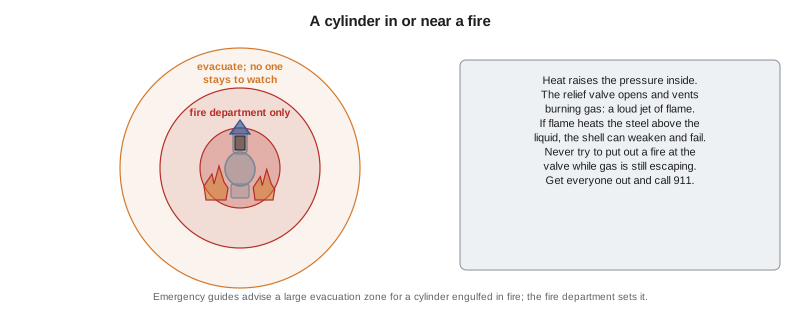
A fire at the cage or involving a cylinder
If a cylinder or the cage is on fire, or a fire is close enough to heat the cylinders, Northfield's procedure is:
- Raise the alarm and get people away. Shout, use the store's alarm if it has one, and move customers and staff away from the cage, out of the store if the store is close, and well back from the forecourt.
- Stop the fuel. Use the emergency shut-off to stop the fuel dispensers, from the store or a remote post, if you can do so without going near the fire.
- Call 911 from a safe place. Tell the dispatcher that propane cylinders are involved and roughly how many are in the cage. That information changes how the fire department responds.
- Keep everyone back, and keep new arrivals from driving onto the lot. Do not let anyone go back for their car, the till or their phone.
- Meet the fire department at a safe distance and give them the facts: what is burning, how many cylinders, whether anyone is missing or hurt, and where the emergency shut-offs and the supplier's number are.
The distance people should be kept back is for the fire department to decide. Emergency response guides, such as the Emergency Response Guidebook, call for large isolation zones around liquefied gas containers in a fire, as much as 1 mile (1,600 m) for a tank truck or rail car. A cage of barbecue cylinders is much smaller, but cylinders can fail or fly, so the safe default for staff is to move people well back, out of sight of the cage if possible, and wait for instructions.
Why not put it out?
Station staff are trained to use portable fire extinguishers on small fires, as HSE-350 covered, and the urge to grab one is strong. For a fire at a propane cylinder, it is usually the wrong choice, for two reasons.
First, a burning jet of propane from a valve or a leak is a gas-fed fire. If the flame is put out but the gas keeps flowing, the result is an unburned cloud of propane drifting along the ground, looking for an ignition source. It can then reignite with a flash or an explosion, which is often worse than the original flame. Firefighters generally let a gas-fed fire burn while they cool the cylinder with water, until the gas can be shut off at its source.
Second, getting close enough to use an extinguisher on a cylinder fire puts the worker inside the zone where a cylinder could fail. A portable extinguisher lasts for seconds, and it will not cool the steel of a cylinder that has been heated.
So the rule for Northfield's cashiers is: do not try to put out a fire at a cylinder valve or a fire involving cylinders. An extinguisher may be used on a small fire that is not yet touching any cylinder, such as a burning cardboard box beside the cage or a small grass fire, if the worker is trained, the fire is small, they have a clear way out behind them and they can do it in seconds. If the fire is not out within a few seconds, or it reaches the cage, they leave.
A vehicle fire near the cage
A car that catches fire at the forecourt or in a parking space beside the cage is a fire close to propane. Treat it as a fire involving cylinders: get people away, use the emergency shut-off, call 911 and say that a propane cage is nearby. Do not try to move the cylinders out of the cage away from the fire; there is no time, and carrying cylinders near a fire is exactly the position the procedure is designed to avoid.
Burns and cold injuries
People can be hurt by propane in two opposite ways: by heat from a fire and by cold from liquid propane.
- Heat burns: cool the burn with cool running water for at least 20 minutes, remove rings and watches before swelling starts, cover loosely with a clean, non-stick dressing or plastic wrap, and get medical help for anything more than a small, shallow burn. Do not use ice, butter or creams. For burns to the face or airway, or large burns, call 911.
- Cold burns: as Lesson 2 explained, liquid propane can freeze skin and eyes in seconds. Warm the area gently with lukewarm, not hot, water, do not rub it, and get medical help. Eyes splashed with liquid propane need gentle flushing with lukewarm water and urgent medical attention.
- Breathing problems: anyone who feels dizzy, has a headache or is confused after being near a leak is moved to fresh air and watched; call 911 if symptoms are serious or do not clear.
Northfield keeps a first aid kit and has trained first aiders on site, and the first aider takes charge of injured people while others manage the area.
After the emergency
When the fire department has dealt with the emergency and says the site is safe, the work is not quite over:
- Nobody touches cylinders that were in or near a fire. They may look fine and still be weakened. The supplier collects them all and inspects or scraps them.
- The cage, the bollards and the signs are checked and repaired before the cage is restocked, and the fire department may want to inspect the site.
- The manager reports the incident as the company, the insurer, the supplier and the regulator require, and, where a worker was hurt, as the workplace safety rules require.
- Staff who were involved are offered support. A fire is frightening, and HSE-352 covered why support after an incident matters.
- The incident is reviewed: what started it, what went well, what did not, and what should change.
Timing a response
Emergencies happen fast, and it helps to know how the minutes add up. The program below lays out a realistic timeline for Northfield's response to a fire beside the cage and checks it against two targets Leah set in the site's emergency plan: everyone moved away within three minutes of the alarm, and 911 called within one minute.
# Check an emergency response timeline against the site's targets (illustrative).
events = [
    (0.0, "smoke and flames seen at a cardboard pile beside the cage"),
    (0.3, "cashier shouts 'fire, everyone out', hits store alarm"),
    (0.6, "second worker presses emergency shut-off for the dispensers"),
    (0.9, "cashier calls 911 from the store's far door, says 'propane cage involved'"),
    (1.5, "customers at the pumps and in the store directed to the far edge of the lot"),
    (2.6, "last customer clear; workers count staff and customers"),
    (3.2, "workers stop a car turning onto the lot"),
    (7.5, "fire department arrives; cashier briefs the officer"),
]
targets = {"911 called": (1.0, "calls 911"), "everyone clear": (3.0, "last customer clear")}

for t, what in events:
    print(f"{int(t):02}:{int(round((t % 1) * 60)):02}  {what}")
for name, (limit, key) in targets.items():
    t = next(t for t, w in events if key in w)
print(f"{name:15} at {t:.1f} min (target {limit:.1f}) -> {'met' if t <= limit else 'MISSED'}")00:00 smoke and flames seen at a cardboard pile beside the cage 00:18 cashier shouts 'fire, everyone out', hits store alarm 00:36 second worker presses emergency shut-off for the dispensers 00:54 cashier calls 911 from the store's far door, says 'propane cage involved' 01:30 customers at the pumps and in the store directed to the far edge of the lot 02:36 last customer clear; workers count staff and customers 03:12 workers stop a car turning onto the lot 07:30 fire department arrives; cashier briefs the officer 911 called at 0.9 min (target 1.0) -> met everyone clear at 2.6 min (target 3.0) -> met
In this timeline, both targets are met, but only just: 911 was called at 54 seconds and the area cleared at about two and a half minutes. The fire department took seven and a half minutes to arrive, which is normal for many places and is the reason the first three minutes matter so much. Running the same exercise as a drill, with a stopwatch, quickly shows where time is lost, for example a cashier who cannot find the emergency shut-off or who goes looking for the phone number of the supplier before calling 911.
For supervisors: briefing the fire department
Prepare a one-page site card for the fire department, kept by the door and in the emergency binder: a site plan showing the cage, the dispensers, the emergency shut-offs, the tanks and the drains, the number of cylinders the cage holds, the supplier's emergency number, and the manager's number. At the new site, add the propane dispenser and its storage tank. Firefighters will thank you for it.
Worked problem
Flames at the relief valve
On a very hot afternoon, a cylinder that a customer left standing in full sun on the pavement beside the cage, after being refused an exchange, starts venting from its relief valve. The gas catches fire from a cigarette dropped nearby, and a jet of flame about a meter long roars from the valve. Ben has an extinguisher in his hand. What should he do?
Show solution
- This is a gas-fed fire at a cylinder valve. If he puts out the flame, gas will keep escaping and could reignite with a flash, and he would have to stand close to a heated cylinder to try.
- He puts the extinguisher down and shouts a warning, moves customers away from the cage and the forecourt, and has the second worker use the emergency shut-off.
- He calls 911 from a safe distance and says a burning propane cylinder is beside an exchange cage holding about 14 cylinders.
- He keeps everyone back, stops cars entering the lot, meets the fire department and hands over the site card.
Answer: Do not fight the fire; clear the area, shut off the fuel, call 911 and keep everyone back until the fire department takes over.
Common mistakes
MistakePutting out a flame at a leaking cylinder valve.
InsteadLet the fire department handle gas-fed fires; an unburned gas cloud can be worse.
MistakeTrying to carry cylinders away from a fire.
InsteadGet people away; never go near cylinders being heated.
MistakeStaying close to watch.
InsteadMove well back and keep others back until the fire department says otherwise.
MistakeCalling the supplier before 911.
InsteadCall 911 first and say that propane cylinders are involved.
MistakeRestocking with cylinders that were near the fire.
InsteadThe supplier collects, inspects or scraps every cylinder exposed to the fire.
Summary and key terms
- In a fire, a cylinder's pressure rises, the relief valve vents burning gas, and the steel above the liquid can weaken and fail.
- A cylinder failure in a fire, a BLEVE, can throw fragments and create a fireball.
- Get people away, use the emergency shut-off, call 911 and say propane is involved.
- Do not try to put out a fire at a cylinder or carry cylinders away from a fire.
- An extinguisher is only for a small fire not yet touching any cylinder, by a trained worker with a way out.
- Treat heat burns with cool water and cold burns with lukewarm water, and get medical help.
- After a fire, the supplier deals with every exposed cylinder, and the incident is reported and reviewed.
- BLEVE
- Boiling liquid expanding vapor explosion: a container of liquefied gas failing in a fire.
- Gas-fed fire
- A fire fed by gas escaping from a leak or valve.
- Isolation zone
- The area emergency responders keep people out of during a hazardous materials emergency.
- Emergency shut-off
- A button that stops fuel or propane dispensers in an emergency.
- Site card
- A one-page summary of the site's hazards and controls for the fire department.
Practice problems
Work each problem on paper first, then reveal the answer to check.
What happens to the pressure in a cylinder heated by a fire?
Show answer
It rises steeply until the relief valve opens.
Why can the steel above the liquid level fail in a fire?
Show answer
It is not cooled by boiling liquid, so it heats quickly and loses strength.
Why should staff not put out a flame at a leaking valve?
Show answer
Gas would keep escaping as an unburned cloud that could reignite more violently, and they would have to be close to a heated cylinder.
What should you tell the 911 dispatcher about a fire near the cage?
Show answer
That propane cylinders are involved, roughly how many, where, and whether anyone is hurt.
How should a heat burn be treated?
Show answer
Cool running water for at least 20 minutes, remove rings, cover loosely, and get medical help if needed.
What happens to cylinders that were near a fire?
Show answer
Nobody touches them; the supplier collects and inspects or scraps them.
Lesson quiz · 5 questions
Score 60% or more to complete this lesson.
Create a free account to save your progress, take quizzes and earn a certificate.