
HSE-353 · Lesson 7 of 12 · 21 min
Deliveries, stock counts and records
An exchange cage is a small warehouse that empties and refills all week. Full cylinders go out with customers, empties come back, and twice a week Dale from Aspen Propane arrives to swap a load of empties for a load of fulls. Each of those movements is a chance for something to go wrong: a damaged cylinder slipping through, a cage left unlocked, extra cylinders left on the ground, or a count that does not add up because a cylinder was stolen. This lesson covers the delivery routine, stock counts, the records Northfield keeps, and what to do about recalls and paperwork.
Delivery day
Deliveries at the original store happen on Tuesday and Friday mornings, after the second worker arrives and before the lunch rush, so that one cashier can stay at the till while the other deals with the driver. Northfield and Aspen agreed the routine in writing:
- Dale parks his truck where it does not block the dispensers, the store door or the fire lane, sets the parking brake, turns off the engine and chocks the wheels as his company requires.
- The cashier unlocks the cage and stays with the driver for the whole delivery. The cage is never left open and unattended.
- Empties come out first. Dale loads all the empties, and any tagged cylinders, onto the truck before he unloads any fulls. This keeps the total on site from rising above the cage's capacity, as Lesson 6 showed.
- Fulls go in next. Dale unloads full cylinders straight into the cage, upright on the shelves, up to the cage's capacity and no more.
- The cashier counts what went out and what came in, checks the numbers against the delivery slip and signs it.
- The cage is locked, and the cashier writes the delivery in the cage log.
The driver is responsible for the truck, for handling the cylinders and for the shipping paperwork. The cashier is responsible for the cage, the count and the signature. If something looks wrong, such as a full cylinder with a dent, a hissing valve or a cylinder with an old round handwheel among the fulls, the cashier points it out and the driver takes it back. A cashier never signs for cylinders they have not counted.
Dale's truck carries hazardous materials, so it displays the required placards or markings and carries shipping papers under DOT's hazardous materials regulations, and Dale has hazmat training from his employer. The station does not need hazmat training to receive an exchange delivery, but cashiers should know that the delivery slip and the driver's shipping papers are not just invoices: they describe what is on the truck for emergency responders.
Counting stock
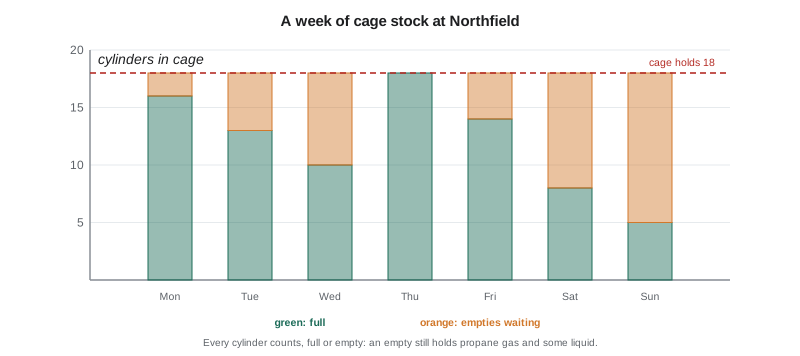
A stock count is simple: count the full cylinders and the empties in the cage, and compare the total with what the records say should be there. Northfield counts the cage at every shift change and on every delivery. The count catches three different problems:
- Theft: if a full cylinder is missing and there is no sale for it, someone may have taken it, which can point to a lock or key problem.
- Unchecked swaps: if there are more empties than exchanges, a customer may have swapped a cylinder without the cashier, which means the cage was left unlocked.
- Overfilling the cage: if the total is above capacity, cylinders are probably standing outside the cage.
Counting also keeps cashiers looking at the cylinders regularly. A count is the natural moment to notice a cylinder lying on its side, a new dent, a smell or a tag that has fallen off.
Reconciling the count
The count only helps if someone compares it with what should be there. The program below reconciles a week of shift counts at the original store against the delivery slips and the till's record of exchange sales, and flags any shift where the numbers do not match.
# Reconcile cage counts with deliveries and till sales (illustrative week).
# Each shift: (label, full_counted, empty_counted, exchanges_sold, new_sold, delivery_in, empties_out)
shifts = [
    ("Mon AM", 16, 2, 0, 0, 0, 0),
    ("Mon PM", 13, 5, 3, 0, 0, 0),
    ("Tue AM", 18, 0, 1, 0, 6, 6),   # delivery: 6 fulls in, 6 empties out
    ("Tue PM", 15, 2, 2, 1, 0, 0),
    ("Wed AM", 13, 4, 1, 0, 0, 0),
    ("Wed PM", 10, 6, 1, 2, 0, 0),
]
prev_full, prev_empty = None, None
for label, full, empty, exch, new, d_in, e_out in shifts:
    if prev_full is not None:
        exp_full = prev_full - exch - new + d_in
        exp_empty = prev_empty + exch - e_out
        ok = (full, empty) == (exp_full, exp_empty)
        note = "ok" if ok else f"CHECK: expected {exp_full} full / {exp_empty} empty"
        print(f"{label}: counted {full:2} full, {empty:2} empty  {note}")
    else:
        print(f"{label}: opening count {full} full, {empty} empty")
prev_full, prev_empty = full, emptyMon AM: opening count 16 full, 2 empty Mon PM: counted 13 full, 5 empty ok Tue AM: counted 18 full, 0 empty ok Tue PM: counted 15 full, 2 empty ok Wed AM: counted 13 full, 4 empty CHECK: expected 14 full / 3 empty Wed PM: counted 10 full, 6 empty CHECK: expected 10 full / 5 empty
Most shifts reconcile. Wednesday morning does not: the count shows one full cylinder fewer and one empty more than expected, which is the signature of an unchecked swap, a customer taking a full cylinder from an unlocked cage and leaving an empty without paying. Wednesday evening is off too, with one more empty than the till explains, which usually means an exchange was rung up as a new-cylinder sale. Neither problem is serious on its own, but both show that the cage routine slipped, and the log tells Leah which shifts to talk to. Real records are rarely this tidy, which is exactly why counting at every shift change matters: small differences are easy to explain the same day and impossible a week later.
When a delivery does not go to plan
Most deliveries are routine, but a few situations come up often enough to plan for:
- The driver arrives during a rush or when only one cashier is on. The delivery waits, or the driver comes back later. The cage is not opened for a driver to help himself while the cashier serves customers.
- The truck is short of fulls. The driver still takes all the empties, and the cashier records the shortfall so that Leah can raise it with the supplier if it keeps happening.
- A full cylinder on the truck is damaged or leaking. It stays on the truck, or, if it is leaking, the driver deals with it under his company's procedure and the cashier keeps customers away.
- The driver wants to leave fulls on the ground because the cage is full of empties he has no room for. The answer is no. Fulls that do not fit in the cage go back on the truck.
- The weather is bad. In ice or heavy snow, the driver and the cashier take extra care with footing and with keeping the cage door clear, and the delivery can be moved if the lot is unsafe.
In every case, the rule is the same: the cage is never left open and unattended, nothing is left outside the cage, and anything unusual goes in the log.
The cage log
Northfield keeps a simple cage log in a binder at the till, with one line per entry. It records:
- Shift counts: date, time, number of full and empty cylinders, initials.
- Deliveries: date, driver, fulls in, empties and tagged cylinders out, slip number.
- Refused and tagged cylinders: date, reason and what happened, as in Lesson 4.
- Daily cage checks: the opener's initials and any problems found.
- Incidents: leaks, damage to the cage or bollards, theft, customers bringing cylinders inside, anything unusual.
- Lost keys and lock changes.
The log is short and boring, which is how it should be. Its value shows when something goes wrong: if a fire inspector, an insurer or the supplier asks what happened to a damaged cylinder or when the bollard was hit, the log answers the question. It also gives Leah the pattern information she uses in Lesson 12 to review the program.
Northfield keeps the log for at least the period its insurer and the supplier ask for, and incident records for longer, alongside its training records and any records its fire permit requires.
Training records
A cashier who works the exchange cage needs to have been trained in this material: the hazards of propane, the return check, handling, the cage, leaks and fires. Northfield records each worker's propane training in the same file as their other safety training, with the date, the content and who delivered it. At the new site, certified fillers' certificates are copied into the file with their expiry dates, and Lesson 10 shows how to track them.
Training also needs to reach the people who only work the cage now and then, such as a weekend relief cashier or a manager from another store covering a shift. Northfield's rule is that nobody runs the exchange on their own until they have done the return check with a trained worker at least a few times and had the cage routine, the key rule and the leak procedure explained. A short sign-off sheet in the training file records it, so that Leah can see at a glance who is ready to work the cage alone.
Recalls and supplier notices
Occasionally a manufacturer or regulator recalls a batch of cylinders or valves, for example because a type of valve has been found to leak or a relief valve may not open properly. For exchange cylinders, the supplier handles recalls: it identifies affected cylinders in its pool and pulls them at the plant or on delivery. The station's part is to read any notice the supplier sends, check the cage if asked, set aside any affected cylinders and make sure they go back on the truck.
Customers sometimes ask about recalls they have read about. The cashier can say that exchange cylinders are checked by the supplier, and for a customer's own cylinder, point them to the manufacturer's or the regulator's recall page.
For supervisors: when the numbers keep drifting
If counts regularly fail to reconcile, look at the routine rather than the people first. Is the key leaving the till? Is the cage being left open during busy periods? Are exchanges being rung up as new cylinder sales or vice versa? Is the shift change count actually being done or just copied from the last line? A short observation of a busy Saturday often answers the question.
Worked problem
A short delivery
On Friday, Dale arrives with eight full cylinders. The cage holds 18; Sofia's count shows 6 full and 9 empty, plus one tagged cylinder with a deep dent. Dale is in a hurry and starts unloading fulls before loading empties. What should Sofia do?
Show solution
- Before the delivery there are 6 + 9 + 1 = 16 cylinders on site. Unloading eight fulls first would make 24, six more than the cage holds, so some would end up on the ground.
- She asks Dale politely to load the nine empties and the tagged cylinder first, as the agreed routine says.
- After the empties and the tagged cylinder go out, the cage holds 6 fulls, so there is room for the 8 new fulls, giving 14 full and none empty.
- She counts what went out and what came in, checks the slip, signs only for what she counted, locks the cage and writes the delivery and the tagged cylinder's return in the log.
Answer: Insist on empties out first, then fulls in, count and sign only for what was counted, lock the cage and log the delivery.
Common mistakes
MistakeLeaving the cage open while the driver unloads alone.
InsteadStay with the driver for the whole delivery.
MistakeUnloading fulls before loading empties.
InsteadEmpties out first, so the total on site never exceeds the cage capacity.
MistakeSigning the delivery slip without counting.
InsteadCount what goes out and comes in, then sign.
MistakeCopying the last count into the log.
InsteadCount the cage at every shift change.
MistakeIgnoring a supplier recall notice.
InsteadCheck the cage, set aside affected cylinders and send them back.
Summary and key terms
- Deliveries follow a written routine: empties out first, fulls in, count, sign, lock and log.
- The driver handles the truck, the cylinders and the transport paperwork; the cashier handles the cage and the count.
- Counting at every shift change catches theft, unchecked swaps and an overfilled cage.
- Counts are reconciled with deliveries and sales to find problems while they are easy to explain.
- The cage log records counts, deliveries, refusals, checks, incidents and keys.
- Training records and supplier recall notices are part of the paperwork.
- Delivery slip
- The supplier's record of cylinders delivered and collected, signed by the station.
- Reconcile
- Compare a count with what the records say should be there.
- Unchecked swap
- An exchange made without a cashier checking the returned cylinder.
- Recall
- A notice that a batch of cylinders or valves must be taken out of service.
- Shipping papers
- Documents carried by the driver that describe the hazardous products on the truck for emergency responders.
Practice problems
Work each problem on paper first, then reveal the answer to check.
Why do empties go onto the truck before fulls come off?
Show answer
To keep the number of cylinders on site within the cage capacity.
Who is responsible for the shipping paperwork on a delivery?
Show answer
The driver and the supplier.
Name three problems that regular stock counts can reveal.
Show answer
Theft, unchecked swaps from an unlocked cage, and too many cylinders on site.
List four kinds of entry in Northfield's cage log.
Show answer
For example shift counts, deliveries, refused cylinders, daily checks, incidents and lost keys.
What should a cashier do if they find a damaged full cylinder during a delivery?
Show answer
Point it out and have the driver take it back; do not put it in the cage.
Who handles recalls of exchange cylinders?
Show answer
The supplier, with the station checking the cage and setting aside affected cylinders.
Lesson quiz · 5 questions
Score 60% or more to complete this lesson.
Create a free account to save your progress, take quizzes and earn a certificate.