
HSE-353 · Lesson 6 of 12 · 22 min
The exchange cage: location, distances and security
The exchange cage is the station's propane storage. It holds anywhere from a handful to a few dozen cylinders, full and empty, every hour of every day, often a few steps from the store's main door. Where it sits, how it is built, how it is protected and how it is locked decide how bad things could get if one of those cylinders leaked, if a car hit the cage or if someone tried to steal from it. Most of these decisions are made once, when the cage is installed, but the cashier sees the cage many times a day and is the person most likely to notice when something about it has changed.
What the codes aim for
NFPA 58 sets the rules for storing cylinders that are waiting to be sold or exchanged, and the International Fire Code, as adopted by the state or city, repeats and adds to them. The detailed clearances depend on how much propane is stored and what is nearby, and they are applied by the authority having jurisdiction, usually the local fire department or fire marshal, which may also require a permit. The supplier usually prepares the layout and installs the cage to meet them. The aims behind the numbers are the same everywhere:
- Keep cylinders outdoors, where any leaked gas can disperse, and never inside the building.
- Keep them away from places where gas could get into a building: doors, exits, windows, air intakes and vents.
- Keep them away from places where gas could collect: drains, pits, ditches and basement openings.
- Keep them away from ignition sources: fuel dispensers, vehicle traffic, electrical equipment, smoking areas and heaters.
- Keep them from being hit by vehicles or tampered with, and keep the cylinders upright and secure.
- Make sure there is a clear way out of the building even if the cage is involved in a fire.
Typical distances
For the amount of propane in a typical station cage, the International Fire Code's table for cylinders awaiting use or resale, which follows NFPA 58, sets clearances for up to 720 lb (327 kg) of propane, the amount in about 36 barbecue cylinders. In the edition many jurisdictions use, the cage must be at least 5 ft (1.5 m) from a doorway or opening in a building with two or more exits, 10 ft (3 m) where the building has only one exit, 10 ft (3 m) from combustible materials and 20 ft (6 m) from a motor fuel dispenser. Larger quantities need larger distances. Northfield's cage was placed by Aspen Propane and checked by the fire department when the store opened.
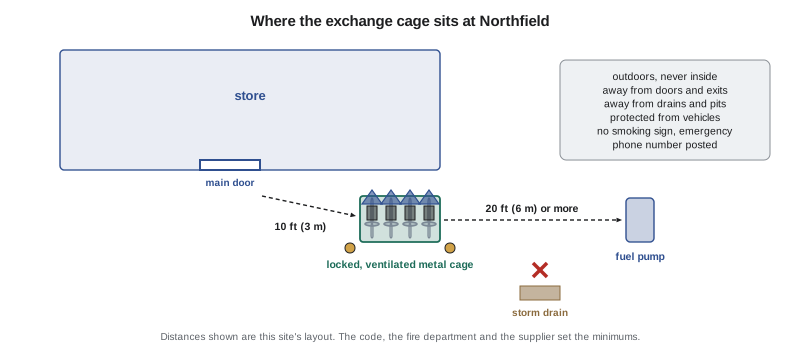
The cashier does not need to memorize the tables. What matters is that the cage stays where it was approved, that nothing is put next to it that would break the clearances, and that changes are checked with the supplier and the fire department first. Common ways a compliant cage becomes non-compliant include:
- Moving the cage closer to the door 'so it can be watched', or to make room for a seasonal display.
- Stacking firewood, charcoal, pallets or cardboard against or beside the cage.
- Putting a vending machine, an ice chest with a compressor, or a new electrical outlet right beside it.
- Adding a second store door, a patio or a smoking bench near the cage.
- Letting the cage overflow, with extra cylinders standing outside it on busy weekends.
How the cage is built
Exchange cages are usually made of steel mesh or perforated steel panels on a steel frame, with a lockable door and shelves. The design matters:
- Ventilated: the mesh or perforations let any leaked gas escape and disperse rather than building up inside. A solid box with no vents would trap gas.
- Metal and non-combustible: the cage itself will not burn.
- Lockable: only staff can take cylinders out, which prevents theft and stops customers from swapping damaged cylinders without a check.
- Shelved so cylinders stand upright: each cylinder stands on its foot ring, with the valve at the top.
- Sized for the stock: the number of cylinders the cage holds is set by the design, and that number, counting empties, is the limit.
Some stations now use automated exchange machines that dispense a cylinder after card payment. These have their own requirements, such as dispensing one cylinder per transaction and electrical equipment rated for flammable atmospheres, and they still need daily checks by staff. Northfield does not have one.
Protection from vehicles
Cages sit beside parking spaces and driveways, and cars do occasionally drive into store fronts. A car striking a cage full of cylinders could knock cylinders over, crush valves and start a leak beside a running engine. The codes and fire departments usually require some protection where vehicles could reach the cage, such as bollards set in concrete, a curb or a barrier, unless the cage itself is a strong enough enclosure. Northfield has two steel bollards in front of its cage. Cashiers should report any bollard that has been bent or loosened by a vehicle, because it may not stop the next one.
Locks, keys and signs
The cage stays locked at all times except when a cashier is taking out or putting in a cylinder. Northfield keeps two keys: one on a colored lanyard at the till, which never leaves the store, and one in the manager's safe. A lost key is reported to the manager the same day, and the lock is changed if the key is not found. During an exchange, the cashier unlocks the cage, takes out the full cylinder, puts the checked empty in, and locks the cage again before walking back to the store. On busy days it is tempting to leave the cage unlocked; this is exactly when a customer may help themselves, swap a damaged cylinder or leave the door open for the next person.
The signs on and near the cage usually include a no smoking sign, a sign identifying the contents as propane or flammable gas, and the supplier's emergency phone number. Some fire departments also require a sign at the store's entry door saying not to bring LP-gas cylinders into the building, and an emergency contact sign near the cage, and many require a portable fire extinguisher, often a 40-B:C unit, within a short walk of the cage but not right beside it. Signs fade, get covered by posters or get torn off, and the cashier's daily check includes seeing that they are still there and readable.
Snow, ice and summer sun
The weather changes what the cage needs. In winter, snow banks pushed up by the plow can bury the bollards, block the cage door or pile against the mesh so that it is no longer ventilated, and ice on the shelves can make cylinders slip. The snow contractor should know to keep the cage area and its approach clear, and the cashier should report a cage that has been buried. In summer, a cage in full afternoon sun gets hot, which raises the pressure in every cylinder in it. A light-colored cage, shade from the building, or a location on the north or east side helps, and it is one more reason never to let the cage overflow onto the hot pavement.
Theft and tampering
Full cylinders are worth stealing, and an unlocked or damaged cage invites it. Thieves sometimes cut the mesh or break the lock at night, and some take only the propane, by venting or transferring it, which is dangerous for everyone nearby. Signs of tampering include a cut or bent panel, a lock that does not close properly, cylinders that are lighter than they should be, and valves that have been removed or damaged. A cashier who finds any of these keeps people away, does not try to fix anything, and calls the manager and the supplier. If there is any smell of gas, the leak procedure comes first.
The daily cage check
Northfield's opening checklist, which the opener does on the first walk-round after the second worker arrives, includes the cage:
- Cage locked, door closed, lock working.
- No smell of gas, no hissing, no frost on any cylinder.
- All cylinders upright on the shelves, none on the ground outside the cage, none lying down.
- Cage not overfilled, counting empties.
- Damaged or tagged cylinders in their marked place.
- Bollards undamaged, nothing stacked against or near the cage.
- Signs present and readable.
- No new ignition sources nearby, such as a heater, a vending machine or a smoker's bench.
Is the cage over its limit?
Because clearances depend on the quantity stored, it matters how much propane is in the cage, and empties count. An empty that comes back usually still has some propane in it, and the codes generally treat empty cylinders that have not been purged as if they were full for the purposes of quantity limits. The program below checks a week of stock at Northfield against the cage capacity and against the 720 lb (327 kg) tier from the fire code table mentioned earlier.
# Check cage stock against capacity and a quantity tier. Empties count as full.
full_lb_each = 20            # nominal propane per barbecue cylinder
tier_lb = 720                # first quantity tier in the fire code table for cylinder storage
capacity = 18                # cylinders the cage is designed to hold

week = {"Mon": (16, 2), "Tue": (13, 5), "Wed": (10, 8), "Thu": (18, 0),
        "Fri": (14, 4), "Sat": (8, 10), "Sun": (5, 13), "Sun + extra delivery": (18, 6)}

for day, (full, empty) in week.items():
    total = full + empty
    counted_lb = total * full_lb_each          # empties counted as full
    flags = []
    if total > capacity:
        flags.append(f"OVER CAGE CAPACITY by {total - capacity}")
    if counted_lb > tier_lb:
        flags.append("over the 720 lb tier")
    print(f"{day:22} {full:2} full + {empty:2} empty = {total:2} cylinders, "
f"{counted_lb:4} lb ({counted_lb * 0.4536:3.0f} kg) {'; '.join(flags) or 'ok'}")Mon 16 full + 2 empty = 18 cylinders, 360 lb (163 kg) ok Tue 13 full + 5 empty = 18 cylinders, 360 lb (163 kg) ok Wed 10 full + 8 empty = 18 cylinders, 360 lb (163 kg) ok Thu 18 full + 0 empty = 18 cylinders, 360 lb (163 kg) ok Fri 14 full + 4 empty = 18 cylinders, 360 lb (163 kg) ok Sat 8 full + 10 empty = 18 cylinders, 360 lb (163 kg) ok Sun 5 full + 13 empty = 18 cylinders, 360 lb (163 kg) ok Sun + extra delivery 18 full + 6 empty = 24 cylinders, 480 lb (218 kg) OVER CAGE CAPACITY by 6
On ordinary days the cage is within its 18-cylinder design, which is well under the first quantity tier. The problem is the last line: a driver who drops off a full load before collecting a big pile of empties leaves 24 cylinders on site, six more than the cage holds. The extra cylinders end up standing outside the cage, unlocked and unprotected. The fix is not a bigger pile but a delivery routine: empties go onto the truck before fulls come off, which Lesson 7 covers.
For supervisors: before you move anything
Any change near the cage, such as a new door, a patio, an electrical outlet, a display, a smoking area or moving the cage itself, should be checked with the supplier and, where needed, the fire department before it happens. The original layout was approved for a reason, and small changes can quietly break a clearance.
Worked problem
The spring display
In April, the head office sends Northfield a large display of charcoal, firewood bundles and barbecue tools, with a suggestion to set it up 'beside the propane cage for a summer-ready look'. Raj starts to unpack it. What should he do?
Show solution
- Firewood, charcoal and the cardboard display are combustible materials. Placing them against the cage would add fuel right beside the cylinders and could break the clearance from combustibles.
- A display beside the cage may also block the view of the cage from the till and make the daily check harder.
- Raj sets the display up inside the store or elsewhere on the forecourt, well away from the cage, the door and the dispensers, keeping the walkways clear.
- He tells Leah, who lets head office know so that the suggestion is not sent to other stores.
Answer: Keep the combustible display well away from the cage; do not change what is around the cage without checking.
Common mistakes
MistakeMoving the cage closer to the door so it is easier to watch.
InsteadKeep it where it was approved; use cameras or windows to watch it.
MistakeLeaving the cage unlocked on busy days.
InsteadLock it after every exchange.
MistakeStanding extra cylinders outside the cage.
InsteadKeep stock within the cage's capacity, counting empties.
MistakeStacking firewood or cardboard against the cage.
InsteadKeep combustibles and new equipment away from it.
MistakeIgnoring a bent bollard.
InsteadReport it; damaged protection may not stop the next vehicle.
Summary and key terms
- Cylinders are stored outdoors in a locked, ventilated, metal cage.
- Codes set clearances from doors, openings, drains, combustibles and fuel dispensers, growing with the amount stored.
- The supplier and the fire department set the location; the station keeps it that way.
- Bollards or barriers protect the cage from vehicles.
- The cage stays locked except during an exchange, and keys are controlled.
- Signs, a daily check and a stock limit that counts empties keep the cage safe.
- Clearance
- The minimum distance between the cage and something such as a door, a drain or a dispenser.
- Authority having jurisdiction
- The body that enforces the code locally, such as the fire department.
- Bollard
- A short, strong post that stops vehicles from hitting the cage.
- Ventilated enclosure
- A cage with mesh or vents so leaked gas can escape.
- Quantity tier
- A band of stored quantity in a code table that sets the required clearances.
- Automated exchange
- A machine that dispenses a cylinder after payment without a cashier.
Practice problems
Work each problem on paper first, then reveal the answer to check.
Give four places a cage should be kept away from.
Show answer
For example doors and exits, windows and vents, drains and pits, fuel dispensers, combustible materials and ignition sources.
Why is the cage made of mesh or perforated steel?
Show answer
So leaked gas can escape and disperse instead of building up inside.
Why do empty cylinders count toward the cage limit?
Show answer
Returned empties still contain propane and are generally treated as full for quantity limits.
What protects the cage from vehicles at Northfield?
Show answer
Two steel bollards set in front of it.
When should the cage be unlocked?
Show answer
Only while a cashier is taking out or putting in a cylinder.
List four items on the daily cage check.
Show answer
For example locked, no smell or hiss, cylinders upright, not overfilled, tagged cylinders in place, bollards undamaged, signs readable, no new ignition sources.
Lesson quiz · 5 questions
Score 60% or more to complete this lesson.
Create a free account to save your progress, take quizzes and earn a certificate.