
HSE-353 · Lesson 2 of 12 · 23 min
Properties of propane
Every rule in this course comes back to a few physical facts about propane. It is a gas at normal temperatures but is stored as a liquid under pressure. It boils at a very low temperature. The liquid turns into a large volume of gas when it escapes. The gas is heavier than air, it burns only in a narrow range of mixtures with air, and it has no smell of its own. Once these facts are clear, the reasons for keeping cylinders outdoors, upright, away from drains and never overfilled become obvious rather than arbitrary.
Propane is one of the liquefied petroleum gases, often shortened to LPG or LP-gas. It is made from natural gas processing and oil refining, and in the United States it is widely used for heating rural homes, for barbecues and patio heaters, for construction heaters and forklifts, and as a vehicle fuel. Its safety data sheet, which Northfield must keep available under OSHA's Hazard Communication Standard, classifies it as an extremely flammable gas and a gas under pressure.
A liquid under pressure
At atmospheric pressure, propane boils at −44 °F (about −42 °C). On almost any day of the year in Red Deer or Billings, the outside air is warmer than that, so propane left open to the air boils away into gas. To store it as a liquid, it is kept in a closed, strong container. Inside the cylinder, some of the liquid boils until the pressure of the gas above it stops further boiling. The cylinder then holds liquid in the bottom and gas, called vapor, in the space above it.
The pressure inside depends on the temperature, not on how full the cylinder is. A cylinder that is nearly empty and one that is nearly full have the same pressure at the same temperature, as long as there is some liquid left. On a cool spring day the pressure might be around 75 psi (500 kPa); on a hot summer day in the sun it can be well over 150 psi (1,000 kPa). Lesson 3 shows how steeply the pressure rises with temperature and why that matters for cylinders left in cars.
When gas is drawn off the top of the cylinder to run a barbecue, the liquid boils to replace it, and boiling takes heat. That is why a cylinder feeding a big burner gets cold, and why on a humid day a line of frost or condensation forms on the outside at the level of the liquid. It is also why a cylinder can struggle to supply a heater on a very cold day: at −22 °F (−30 °C) there is little pressure to push the gas out.
A small amount of liquid makes a lot of gas
One liter of liquid propane becomes about 270 liters of gas at normal temperature and pressure. Put another way, the 20 lb (9 kg) in a barbecue cylinder becomes 170 ft³ (roughly 4.8 m³) of pure propane gas. That gas does not stay pure; it mixes with air, and a mixture is flammable over a wide volume. The program later in this lesson works out how big that flammable volume can be.
This expansion is why a liquid leak is much more serious than a gas leak. If a cylinder leaks from the gas space, say from a loose valve with the cylinder upright, gas escapes at a rate limited by the size of the hole. If a cylinder is lying on its side or upside down and the leak is in the liquid, liquid sprays out and immediately boils, producing about 270 times as much gas. A cylinder that is hissing and has frost forming around the leak is losing liquid. It is also why cylinders must be stored and carried upright, so that the relief valve sits in the gas space.
Heavier than air
Propane gas is about one and a half times as heavy as air. When it leaks, it does not rise and blow away the way natural gas tends to. It sinks and flows along the ground like an invisible liquid, collecting in low places: drains, ditches, pits, basements, stairwells, the floor of a car or the bottom of a tent. In still air it can travel a long way from the leak and stay there for a long time. If it reaches a pilot light, a car's ignition, a cigarette or a spark from a light switch, it can ignite and the flame can flash back to the leak.
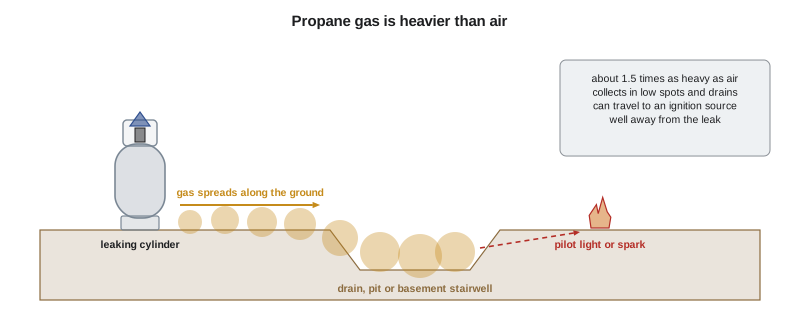
This one property explains several of the rules in later lessons. The exchange cage must not sit beside a storm drain, a basement window or a pit. A leaking cylinder should be moved, if it is safe to do so, to open ground and not into a ditch. Cylinders must never be stored indoors, where gas would collect on the floor, or in a vehicle's passenger area. And during a leak, the safest place for people is uphill and upwind.
Flammable, but only in a narrow range
Propane burns only when it is mixed with air in the right proportions. Below about 2.1 % propane in air the mixture is too lean to burn; above about 9.5 % it is too rich, with not enough oxygen. These limits are called the lower and upper flammable limits, or the lower and upper explosive limits (LEL and UEL). Published values vary a little from source to source, but these are the figures most safety data sheets give.
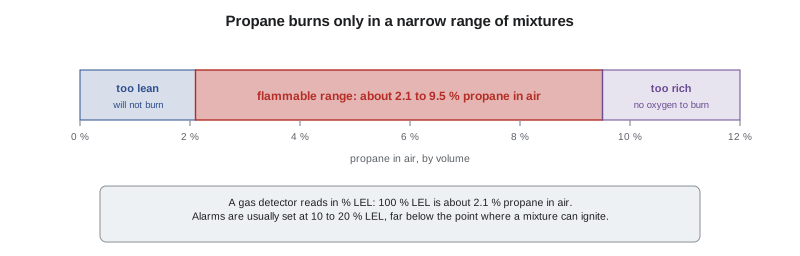
The lower limit is the number that matters most for safety. It means that even a small amount of propane, about one part in fifty, is enough to burn. A gas that is 'too rich' is no comfort either: a rich cloud always has a lean, flammable edge where it mixes with the surrounding air, and as it spreads and dilutes, more of it passes through the flammable range.
Gas detectors and the meters firefighters carry usually read in percent of the LEL rather than percent of gas. A reading of 100 % LEL means the mixture has reached the lower flammable limit, about 2.1 % propane. Alarms are typically set at 10 % or 20 % LEL, so that people get out long before the air becomes flammable. Northfield does not need fixed detectors for an outdoor cage, but the new site's dispenser area is designed around the same idea: keep any leak small, outdoors and well away from ignition sources.
Ignition sources
Propane needs very little energy to ignite once it is in the flammable range. Common ignition sources around a station include:
- Open flames: cigarettes, lighters, pilot lights, barbecues being tested, a customer's patio heater.
- Hot surfaces: vehicle exhausts and catalytic converters, engine blocks, space heaters.
- Electrical sparks: light switches, phone chargers, ordinary electric motors, a car's starter and ignition.
- Static electricity and friction sparks: a dragged steel cylinder on concrete, tools striking metal.
This is why a leak response begins by stopping anything that could ignite the gas and moving people away, as Lesson 8 explains, and why the exchange cage must be well away from fuel dispensers and building openings.
A smell added on purpose
Pure propane has no smell. To make leaks noticeable, suppliers add an odorant, usually ethyl mercaptan, which smells like rotten eggs, cabbage or a skunk. Most people can smell it at concentrations far below the lower flammable limit, which gives an early warning. Anyone who smells it should treat it as a leak until proven otherwise.
Smell is a good warning but not a perfect one. Some people have a poor sense of smell, because of age, a cold, smoking or medication. People get used to a smell after a few minutes and stop noticing it. And in some situations the odorant can fade, for example in a new cylinder or tank where it reacts with rust on the inside wall, or when gas passes through soil. A cylinder can therefore leak without much smell, which is why hissing, frost and the other signs in Lesson 8 matter too.
Health hazards
Propane is not toxic in the way that carbon monoxide is, but it still harms people in three ways:
- Cold burns: liquid propane boils at −44 °F (−42 °C) and, as it boils off skin, it causes frostbite in seconds. A spray of liquid from a fitting can freeze skin and eyes. Workers who fill cylinders wear gloves and eye protection for this reason.
- Asphyxiation: in a confined space, a large amount of propane can push out the oxygen. Long before that happens, though, the mixture would be flammable, which is the bigger danger.
- Carbon monoxide: propane appliances used indoors or in poorly ventilated spaces, such as a patio heater in a garage or a camp stove in a tent, produce carbon monoxide if combustion is poor. Customers sometimes do not realize this, and it is worth mentioning when someone buys a cylinder for a heater.
For cold burns, the first aid is to warm the area gently with lukewarm water, not hot water, not to rub it, and to get medical help for anything more than a small patch. Northfield's first aiders cover this in their training.
How big can the cloud get?
The program below estimates the volume of gas and of flammable mixture that could come from propane leaking out of a cylinder. It uses the ideal gas law to turn the mass of propane into a volume of gas, then divides by the lower and upper flammable limits to find the range of mixture volumes that could burn. Real clouds are uneven, so this is an order-of-magnitude estimate, but it shows why even a partly empty cylinder deserves respect.
# Volume of gas and flammable mixture from leaked propane (ideal gas estimate).
M = 44.1            # g/mol, molar mass of propane
R = 8.314           # J/(mol K)
T = 273.15 + 15     # 15 C
P = 101_325         # Pa, sea-level atmospheric pressure (Red Deer and Billings are higher, so a bit more)
LEL, UEL = 0.021, 0.095

for kg in (0.5, 2, 9):
    mol = kg * 1000 / M
    gas_m3 = mol * R * T / P
    most = gas_m3 / LEL          # all of it mixed at the lean limit
    least = gas_m3 / UEL         # all of it mixed at the rich limit
    print(f"{kg:>4} kg -> {gas_m3:4.1f} m3 of propane gas; flammable mixture "
          f"between {least:5.1f} and {most:6.1f} m3")

room = 6 * 3 * 2.4               # a small store room, m3
gas_needed = room * LEL
kg_needed = gas_needed * P / (R * T) * M / 1000
print(f"propane to bring a {room:.0f} m3 room to the LEL: about {kg_needed:.2f} kg")0.5 kg -> 0.3 m3 of propane gas; flammable mixture between 2.8 and 12.8 m3 2 kg -> 1.1 m3 of propane gas; flammable mixture between 11.3 and 51.1 m3 9 kg -> 4.8 m3 of propane gas; flammable mixture between 50.8 and 229.8 m3 propane to bring a 43 m3 room to the LEL: about 1.69 kg
The numbers are striking. A full cylinder could, in principle, make a flammable mixture of a couple of hundred cubic meters, larger than a small house. And under 4.4 lb (2 kg) of propane, about a fifth of one cylinder, is enough to bring a small store room to the lower flammable limit if it collects there. That is the real reason for the rule that cylinders never come inside.
For supervisors: using the safety data sheet
The safety data sheet for propane is a good training tool. Section 2 lists the hazards, section 5 covers firefighting, section 6 covers leaks and section 9 lists the physical properties discussed here. Walking a new worker through those sections, with the cage in view, takes ten minutes and turns abstract numbers into something they will remember.
Worked problem
The smell by the drain
On a still evening, Tyler notices a faint rotten-egg smell near the storm drain at the edge of the lot, 33 ft (about 10 m) from the exchange cage. Nothing seems to be leaking at the cage itself. What could be happening, and what should he do?
Show solution
- Propane is heavier than air, so gas from a slow leak at the cage could flow along the ground and collect in the drain, where the smell is strongest.
- The smell is a warning that propane may be present at a level he can detect, which is usually well below the flammable limit, but he cannot know the concentration.
- He keeps people and vehicles away from the drain and the cage, does not operate switches or start engines there, and does not open the cage to search with a lighter or a phone light near the drain.
- He calls the manager and the supplier's emergency number, and 911 if the smell is strong or spreading, and records what he found.
Answer: Treat it as a possible propane leak that has flowed into the drain; keep people and ignition sources away and call for help.
Common mistakes
MistakeThinking an empty-feeling cylinder has no pressure.
InsteadPressure depends on temperature; any cylinder with liquid in it has full pressure.
MistakeExpecting leaked propane to rise and disperse.
InsteadIt sinks and flows into low places such as drains, pits and car floors.
MistakeRelying only on smell.
InsteadOdorant can fade and people get used to it; watch for hissing and frost too.
MistakeLaying a cylinder on its side.
InsteadKeep it upright so any leak or relief valve release is gas, not liquid.
MistakeTouching a frosted fitting or spray of liquid.
InsteadLiquid propane causes frostbite; wear gloves and eye protection or keep away.
Summary and key terms
- Propane is stored as a liquid under pressure and boils at −44 °F (about −42 °C).
- Pressure depends on temperature, not on how full the cylinder is.
- One volume of liquid makes about 270 volumes of gas, so liquid leaks are far worse than gas leaks.
- Propane gas is about 1.5 times as heavy as air and collects in low places.
- It burns between about 2.1 % and 9.5 % in air; detectors read in % of the lower limit.
- An odorant gives it a rotten-egg smell, but the smell can fade or go unnoticed.
- Hazards to people include cold burns, asphyxiation in confined spaces and carbon monoxide from appliances.
- LPG
- Liquefied petroleum gas, the family of fuels that includes propane and butane.
- Vapor
- The gas in the space above the liquid in a cylinder.
- Expansion ratio
- The volume of gas made by one volume of liquid, about 270 for propane.
- Lower flammable limit (LEL)
- The lowest concentration in air that can burn, about 2.1 % for propane.
- Upper flammable limit (UEL)
- The highest concentration in air that can burn, about 9.5 % for propane.
- Odorant
- A strong-smelling chemical, usually ethyl mercaptan, added so that leaks can be smelled.
- Cold burn
- Frostbite caused by liquid propane boiling off the skin.
Practice problems
Work each problem on paper first, then reveal the answer to check.
At about what temperature does propane boil at atmospheric pressure?
Show answer
About −44 °F (−42 °C).
Why is a leak from the liquid part of a cylinder worse than a leak from the gas space?
Show answer
The liquid turns into about 270 times its volume of gas as it escapes.
Where does leaked propane gas tend to collect?
Show answer
In low places such as drains, pits, basements, stairwells and vehicle floors, because it is heavier than air.
What is the flammable range of propane in air?
Show answer
About 2.1 % to 9.5 %.
Give two reasons why smell alone is not a reliable leak detector.
Show answer
Odorant can fade, some people have a poor sense of smell, and people stop noticing a smell after a while.
What is the first aid for a small cold burn from liquid propane?
Show answer
Warm the area gently with lukewarm water, do not rub it, and get medical help if it is more than a small patch.
Lesson quiz · 5 questions
Score 60% or more to complete this lesson.
Create a free account to save your progress, take quizzes and earn a certificate.