
HSE-350 · Lesson 7 of 12 · 24 min
Emergency shut-off, breakaways and fire response
When something goes wrong on the forecourt, the most important single action is usually to stop the fuel. A fire at a fill neck stays small if no more fuel reaches it; a spill stops growing when the pump stops; a damaged dispenser stops leaking when its supply is cut. Fuel stations are built with several devices that stop fuel automatically or at the press of a button. This lesson explains what they are, how they work, where they are, and how the cashier uses them as part of the response to a fire, a spill, a drive-off or a vehicle hitting a dispenser.
HSE-105 covers fire extinguishers, fire behavior, alarms and evacuation in general. This lesson applies those skills to the forecourt.
The devices that stop fuel
- Emergency shut-off (ESO): a clearly marked switch, often a large red mushroom button, that cuts power to every dispenser at once. It stops all fuel flow from the forecourt. Fire codes require one at every station, placed where the attendant can reach it.
- Pump controls at the till: the cashier's console can stop an individual pump. Useful for a single problem, but the ESO is faster and certain in an emergency.
- Automatic nozzle shut-off: stops flow when the tank is full (Lesson 6).
- Breakaway coupling: a device in the hose, usually near the dispenser, that separates cleanly if a vehicle drives off with the nozzle still in the tank, and seals both halves so fuel does not spray out. The hose and nozzle stay with the car; the dispenser is protected.
- Shear (impact) valve: a valve in the fuel supply line under each dispenser, at the level of the island. If a vehicle knocks the dispenser over, the valve snaps at a weak point and closes, cutting off fuel from the tank. Many shear valves also close automatically in a fire, using a fusible link that melts.
- Submersible pump shut-off: the pumps in the tanks stop when the ESO is pressed, so no fuel is pushed to the dispensers.
- Bollards and island curbs: posts and raised islands that keep vehicles from striking the dispensers.
Where the emergency shut-off must be
The fire code sets the location. Under the International Fire Code and NFPA 30A, the emergency disconnect switch for exterior dispensers must be outside, within 100 ft (30 m) of the dispensers but not less than 20 ft (6 m) from them, clearly identified with a sign, and readily accessible. At attended self-serve stations there must also be a control the attendant can reach, usually inside at the till, and stations commonly have both. The minimum distance keeps the switch out of a fire or vapor cloud at the pumps; the maximum keeps it close enough to reach quickly.
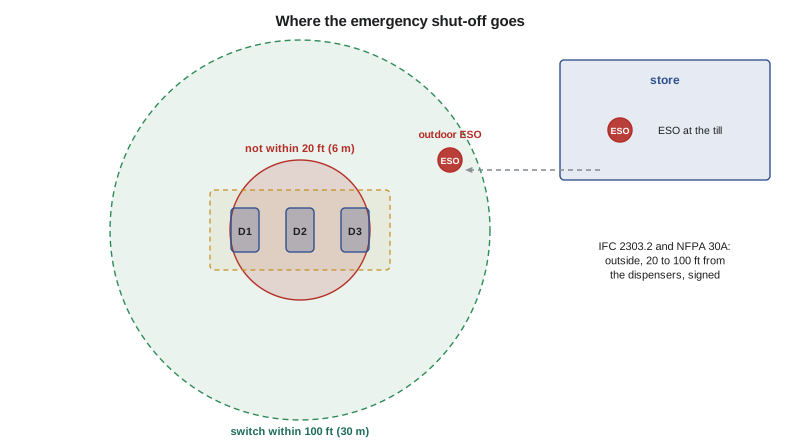
Checking the shut-off distances
When Leah's company renovated the forecourt in 2025 to add the electric vehicle chargers, the contractor moved the outdoor shut-off post. Marco checked the new position against the distances from each dispenser. The program below does the check using coordinates from the site plan in meters. The distances shown on the US site are the IFC limits; on the Canadian site the limits are placeholders the station must confirm against its fire code, which is why the program prints them as values to check.
# Distance from the outdoor emergency shut-off to each dispenser (site plan coordinates, ft).
import math
eso = (69.0, 13.0)                      # post between store and canopy
dispensers = {"D1": (26, 39), "D2": (46, 39), "D3": (66, 39), "D4": (26, 66), "D5": (46, 66), "D6": (66, 66)}
MIN_FT, MAX_FT = 20.0, 100.0            # IFC 2303.2 and NFPA 30A limits for exterior dispensers
for name, (x, y) in dispensers.items():
    d = math.dist(eso, (x, y))
    flag = "too close" if d < MIN_FT else ("too far" if d > MAX_FT else "within range")
    print(f"{name}: {d:5.1f} ft  {flag}")
till_to_eso = math.dist((69.0, -20.0), eso)
print(f"Walk from till to outdoor switch: {till_to_eso:.1f} ft, about {till_to_eso / 4.6:.0f} s at a brisk walk")D1: 50.2 ft within range D2: 34.7 ft within range D3: 26.2 ft within range D4: 68.2 ft within range D5: 57.8 ft within range D6: 53.1 ft within range Walk from till to outdoor switch: 33.0 ft, about 7 s at a brisk walk
All six dispensers are within range of the new switch, the nearest just far enough away and the farthest comfortably close. The walk from the till to the outdoor switch takes about 20 to 25 seconds, which is why the switch at the till matters: in an emergency the cashier presses the inside switch first, without leaving the store, and the outside switch is there for anyone outside, including customers and the tanker driver.
Testing and maintaining the shut-off
An emergency shut-off that has never been pressed may not work when it is needed. Stations test the system on a schedule set by the fire code, the equipment maker and the company, commonly monthly or quarterly, and record the test. A test means pressing each switch and confirming that every dispenser stops and the tank pumps shut down, then resetting the system. The test also checks that the sign is visible and that nothing blocks the path to the switch: a stack of windshield washer fluid in front of the inside switch, or a display, a parked car or a snowbank by the outside post, makes it useless.
After the ESO is pressed, the system stays off until someone resets it. Reset only after the cause has been dealt with and the fire department, if called, has said it is safe. Know how your station resets: some use a key, some a reset button at the panel, and some need the service contractor. Write it on the emergency card at the till.
Drive-offs with the nozzle
A customer who drives away with the nozzle still in the tank is surprisingly common; Northfield had three last year. The breakaway coupling separates and seals, the hose and nozzle are dragged behind the car or fall onto the forecourt, and a small amount of fuel may spill from the separated ends. The response is simple and the most important point is not to chase the vehicle.
- Stop the pump at the till or with the ESO if fuel is spilling.
- Do not run after the vehicle or step in front of it.
- Keep other customers away from the dispenser until it is checked.
- Pick up the hose and nozzle if they are on the forecourt and contain any spill (Lesson 11 and HSE-351).
- Take the dispenser out of service and call the service contractor to inspect and reconnect the breakaway. Most breakaways can be reconnected, but only by someone trained, and some must be replaced after separating.
- Record the event, including the time and the vehicle description if seen, for the manager and the insurer.
Vehicles hitting dispensers
A vehicle striking a dispenser is rarer but more serious. The shear valve should close and stop the fuel supply, but the hoses and the fuel already in the dispenser can still leak, and electrical parts may be damaged and sparking. Press the ESO at once, keep people away, call 911 if fuel is leaking or anyone is hurt, and do not let anyone restart or touch the damaged dispenser. Fuel and electrical faults together are a fire risk until the fire department and service contractor have made it safe.
Fire response on the forecourt
Fires at stations are rare, and most are small: a flash at a fill neck from static, a fire in a car's engine compartment, a burning garbage can, a small spill ignited by a cigarette. The cashier's first actions decide whether a small fire stays small.
| Situation | First actions |
|---|---|
| Fire at a vehicle fill neck during fueling | Tell the customer to leave the nozzle in and back away; press ESO; call 911; clear the area; extinguish only if trained, small and safe |
| Fire in a vehicle engine or under a car at the pump | Press ESO; get people out of and away from the vehicle; call 911; do not open the hood; clear the canopy area |
| Burning spill on the forecourt | Press ESO; call 911; move everyone upwind and away; small fire: extinguisher if trained and safe; keep fire away from drains |
| Fire in a garbage can or the store | Follow the store's fire plan (HSE-105); press ESO if the fire is near the forecourt |
| Fire during a fuel delivery | Driver uses the truck's emergency stop; press ESO; evacuate; call 911; do not attempt to fight a fire involving the tanker |
Station extinguishers are usually dry chemical units rated for Class B fires (flammable liquids), placed near the dispensers and in the store, as the fire code requires. A trained person can put out a small fire with one, but only if the fire is small and not spreading, the person has a clear way out behind them, and the right extinguisher is to hand. Use the PASS method from HSE-105: pull the pin, aim at the base of the fire, squeeze the handle, sweep side to side. Never fight a fire that is growing, that involves a tanker or a large spill, or that is between you and the exit. Get out, keep others out, and wait for the fire department. Some larger stations have fixed fire suppression systems in the canopy over the dispensers; if yours does, know how it is activated and that it does not replace the ESO.
For supervisors: practice the first thirty seconds
In a real emergency, people do what they have practiced. Walk each new cashier through the steps at the till: where the ESO is, how hard you press it, how the console shows the pumps are off, what to say over the intercom, how to call 911 and what to tell them, and where the extinguishers are. Then have them do it. Repeat it every few months with the whole team. Thirty seconds of practice is worth more than an hour of reading.
Worked problem
Fire under a car at pump 4
At 8 p.m., Tyler sees smoke and then flames under the front of a car at pump 4. The driver is still inside and another customer is fueling at pump 5. What should Tyler do, in order?
Show solution
- Press the emergency shut-off at the till to stop all the pumps.
- Use the intercom to tell the driver to get out and move away from the car, and the customer at pump 5 to leave the nozzle and move away.
- Call 911: give the address, say a vehicle is on fire at a fuel pump, and whether anyone is hurt.
- Keep other vehicles from pulling in, and keep people away and upwind; if it is safe, put the store's emergency sign in the window.
- Use an extinguisher only if the fire is still small, he is trained, and he has a clear way back; do not open the car's hood.
- When firefighters arrive, tell them which pumps are affected, that the ESO is pressed, and where the tank fill ports are.
Answer: Press the ESO, get the driver and nearby customers away, call 911, keep the area clear, fight the fire only if small and safe, and brief the fire department when it arrives.
Common mistakes
MistakeStopping only the one pump on the console during a fire.
InsteadPress the emergency shut-off, which stops every dispenser and the tank pumps.
MistakeChasing a car that drove off with the nozzle.
InsteadLet it go, stop the pump, contain any spill and take the dispenser out of service.
MistakeLetting stock or snow block the emergency shut-off.
InsteadKeep the path and sign clear and check them on every forecourt check.
MistakeResetting the ESO as soon as the fire is out.
InsteadReset only after the cause is dealt with and the fire department says it is safe.
MistakeFighting a growing fire or one between you and the exit.
InsteadGet out, keep others away and wait for the fire department.
Summary and key terms
- Stopping the fuel is usually the most important first action in a forecourt emergency.
- The emergency shut-off stops every dispenser and the tank pumps; breakaways, shear valves and nozzle shut-offs stop fuel automatically.
- The IFC and NFPA 30A put the outdoor switch 20 to 100 ft from the dispensers, with a control at the till.
- Test the shut-off on schedule, keep it clear, and reset only when it is safe.
- Do not chase drive-offs; stop the pump, contain spills and have the breakaway checked.
- In a fire: shut off, get people away, call 911, and fight only small fires if trained and safe.
- Emergency shut-off (ESO)
- A switch that cuts power to all dispensers and tank pumps at once.
- Breakaway coupling
- A hose fitting that separates and seals if a vehicle drives off with the nozzle in.
- Shear valve
- A valve under a dispenser that closes if the dispenser is knocked over or exposed to fire.
- Bollard
- A sturdy post that protects equipment from vehicle impact.
- Class B fire
- A fire involving flammable liquids such as gasoline.
- PASS
- Pull, aim, squeeze, sweep: the steps for using a fire extinguisher.
Practice problems
Work each problem on paper first, then reveal the answer to check.
What does the emergency shut-off do?
Show answer
Cuts power to every dispenser and stops the tank pumps.
How does a breakaway coupling protect the station?
Show answer
It separates and seals both ends if a car drives off with the nozzle, preventing a large spill and dispenser damage.
What is a shear valve for?
Show answer
It closes the fuel supply under a dispenser if the dispenser is knocked over or exposed to fire.
Where must the outdoor emergency switch be under the IFC?
Show answer
Outside, at least 20 ft and no more than 100 ft from the dispensers, clearly marked.
What should a cashier do after a drive-off with the nozzle?
Show answer
Not chase; stop the pump; keep people away; contain spills; take the dispenser out of service; record it.
When can the ESO be reset after a fire?
Show answer
Only after the cause is dealt with and the fire department says it is safe.
When should a worker not fight a fire?
Show answer
If it is growing, involves a tanker or large spill, is between them and the exit, or they are not trained.
What does PASS stand for?
Show answer
Pull, aim, squeeze, sweep.
Lesson quiz · 5 questions
Score 60% or more to complete this lesson.
Create a free account to save your progress, take quizzes and earn a certificate.