
HSE-350 · Lesson 4 of 12 · 23 min
Health hazards: benzene and fuel exposure
Fire is the hazard everyone thinks of at a fuel station, but fuel also affects health more quietly. The smell of gasoline at the pump is vapor entering your nose and lungs. Fuel splashed on hands soaks into the skin. A mouthful of gasoline while siphoning, a common mistake, can be deadly. For most self-serve cashiers the exposure is small and brief. For full-serve attendants who fuel vehicles all day, for workers who clean up spills, and for anyone who handles fuel often, it is worth understanding what the hazards are and how to keep exposure low.
This lesson covers how fuel enters the body, the specific concern of benzene, exposure limits and how they apply at a station, skin contact, swallowing and aspiration, carbon monoxide, and practical ways to reduce exposure. HSE-103 covers hazard recognition generally and HSE-106 covers first aid response in more depth.
How fuel gets into the body
- Breathing vapor: the main route. Vapor rises from the fill neck of a vehicle during fueling, from spills and from open containers. The concentration is highest right at the opening and falls quickly with distance and with wind.
- Skin contact: gasoline and diesel remove the skin's natural oils, causing dryness, cracking and dermatitis with repeated contact, and some components are absorbed through the skin. Fuel trapped against the skin in a soaked glove or sleeve can cause chemical burns.
- Swallowing: usually from siphoning or from drinking from a mislabeled bottle. The big danger is aspiration: fuel is thin and slippery, and if it gets into the lungs, even a small amount, it causes a severe chemical pneumonia.
- Eyes: splashes sting and can injure the eye surface.
Benzene
Gasoline contains a small amount of benzene, a hydrocarbon that is a known human carcinogen. Long-term exposure to benzene at high levels causes leukemia and other blood disorders; this is well established from studies of workers in industries where exposure was much higher than at a modern fuel station. Benzene is the reason gasoline's safety data sheet lists cancer hazards, and the reason governments limit how much benzene gasoline may contain.
In the United States, EPA rules limit benzene in gasoline to an annual average of 0.62% by volume, with a cap on any batch. Typical retail gasoline contains well under 1% benzene, so the benzene in the vapor at the pump is a small fraction of a small fraction.
Studies of fuel station attendants who fuel vehicles all day have measured benzene exposures that are usually far below the limits that applied when the studies were done, but not zero, and higher for attendants in hot weather, at busy stations, and where vapor recovery is not used. Self-serve cashiers inside the store have much lower exposure still. The aim is to keep exposure as low as reasonably achievable, because there is no clearly safe level for a carcinogen.
Exposure limits
Occupational exposure limits set the maximum average concentration of a substance a worker may breathe, usually over an eight-hour shift (a time-weighted average, TWA), and sometimes over a short period such as 15 minutes (a short-term exposure limit, STEL).
OSHA's benzene standard (1910.1028) sets a permissible exposure limit of 1 ppm as an eight-hour average, 5 ppm over 15 minutes, and an action level of 0.5 ppm that triggers monitoring and medical surveillance. However, that standard does not apply to the dispensing and sale of gasoline after it leaves bulk storage, except where fuel is dispensed indoors for more than four hours a day, so a typical outdoor station is outside it. The American Conference of Governmental Industrial Hygienists (ACGIH) lowered its recommended benzene limit to 0.02 ppm as an eight-hour average in December 2023, fifty times lower than OSHA's limit. Under the General Duty Clause, employers are still expected to control serious recognized hazards, and good practice is to keep exposure as low as reasonably achievable.
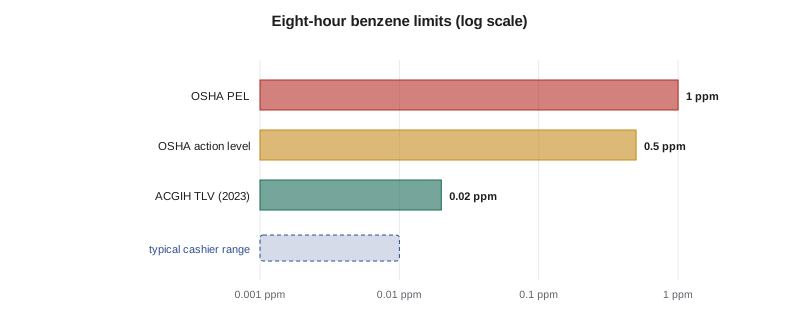
Working out a time-weighted average
An eight-hour time-weighted average is worked out by multiplying each measured concentration by the time spent at it, adding them up and dividing by eight hours. Short, high exposures, such as cleaning up a spill, add to the average even if most of the shift is spent inside. The program below uses invented air sampling results for a full-serve attendant at a busy station on a hot day, a situation Northfield does not have but which some stations do, and compares the result with the limits.
# Eight-hour time-weighted average benzene exposure (invented sampling results).
periods = [  # (activity, hours, benzene ppm during that time)
    ("fuelling vehicles, morning", 3.0, 0.030),
    ("inside store", 1.5, 0.002),
    ("fuelling vehicles, afternoon heat", 2.5, 0.050),
    ("cleaning up a small spill", 0.25, 0.400),
    ("break, upwind", 0.75, 0.001),
]
total = sum(h for _, h, _ in periods)
twa = sum(h * c for _, h, c in periods) / 8
print(f"Hours sampled: {total}")
print(f"8-hour TWA: {twa:.3f} ppm")
for name, limit in (("ACGIH TLV (2023)", 0.02), ("OSHA action level", 0.5), ("OSHA PEL", 1.0)):
    print(f"{name:20} {limit:>5} ppm -> {twa / limit:5.1%} of limit")
spill = 0.25 * 0.400 / 8
print(f"Share of TWA from the 15-minute spill clean-up: {spill / twa:.0%}")Hours sampled: 8.0 8-hour TWA: 0.040 ppm ACGIH TLV (2023) 0.02 ppm -> 199.2% of limit OSHA action level 0.5 ppm -> 8.0% of limit OSHA PEL 1.0 ppm -> 4.0% of limit Share of TWA from the 15-minute spill clean-up: 31%
The attendant's eight-hour average of about 0.04 ppm is less than a tenth of the older limits, but about twice the ACGIH value adopted in 2023. Fifteen minutes of spill clean-up contributes almost a third of the day's exposure, which shows why spill response deserves care: work from upwind, use absorbent rather than leaning over the pool, and do not linger. The numbers are invented for teaching, but the pattern, that short close-up tasks dominate, matches what real sampling usually finds.
Who is most exposed at Northfield
At Northfield, which is self-serve, nobody fuels vehicles all day, so routine benzene exposure is low. The tasks that bring staff closest to fuel are occasional: cleaning up spills at the pumps, helping a customer whose nozzle will not shut off, watching a delivery at the fill ports, changing a damaged nozzle or hose with the service contractor, and handling leaking containers that customers bring back. Leah's hazard assessment lists each of these, with the controls for each: nitrile gloves and safety glasses in the spill kit, standing upwind, using the absorbent sock and pads rather than rags, bagging soaked absorbent promptly, and washing hands before eating or smoking. The assessment also notes that pregnant workers or workers with health concerns can ask to be kept away from spill clean-up, which is easy to arrange on a shift with two people.
Carbon monoxide and exhaust
Vehicle exhaust contains carbon monoxide, a colorless, odorless gas that prevents the blood from carrying oxygen. On an open forecourt, it disperses quickly. It becomes a hazard in enclosed spaces: a car wash bay with the doors closed in winter, a service bay, a delivery bay or a kiosk where idling vehicles line up close to an air intake. Symptoms are headache, dizziness, nausea and confusion. If workers in an enclosed car wash or a small kiosk report these symptoms, get them into fresh air, ventilate, and have the space checked. Lesson 10 covers car washes.
Skin protection
Gasoline on the skin evaporates quickly, so brief splashes do little harm beyond drying, but repeated contact causes dermatitis, and fuel trapped against the skin can burn. Workers who handle fuel nozzles all day, clean up spills or service equipment should wear chemical-resistant gloves. Nitrile gloves resist gasoline and diesel for short contact and are the usual choice; thin latex or vinyl gloves do not protect well. Change gloves that become soaked, wash skin that gets fuel on it with soap and water rather than rubbing it with more fuel or solvent, and remove fuel-soaked clothing promptly, away from ignition sources, because soaked clothing is both a skin hazard and a fire hazard.
Swallowing and siphoning
Customers sometimes ask for help siphoning fuel from a tank, or try it themselves on the forecourt. Never siphon fuel by mouth, and never help a customer do so. Swallowed gasoline can enter the lungs as the person coughs or vomits, and causes a serious chemical pneumonia that can kill. If someone swallows fuel, do not make them vomit; call 911 or the poison center and follow their advice. Keep fuel only in approved, labeled containers (Lesson 6), never in drink bottles, which is how many accidental poisonings of children happen.
First aid for fuel exposure
| Exposure | First aid |
|---|---|
| Breathing vapor, feeling dizzy or sick | Move to fresh air, sit down, get medical help if symptoms continue |
| Fuel on skin | Remove soaked clothing away from ignition sources, wash with soap and water for several minutes |
| Fuel in eyes | Flush with clean water for at least 15 minutes, remove contact lenses if easy, get medical help |
| Fuel swallowed | Do not induce vomiting; call 911 or the poison center; keep the person calm and upright if conscious |
| Clothing on fire | Stop, drop and roll, or smother with a blanket; cool burns with water; call 911 |
For supervisors: reduce exposure without fuss
Most exposure reduction at a station is simple. Keep vapor recovery equipment in good repair, where it is required. Make sure staff fuel from upwind when they have to fuel a vehicle and do not lean over the fill neck. Provide nitrile gloves and make sure they are used for spills. Train staff to clean up spills with absorbent and long-handled tools, not by leaning over the pool. Keep the store door closed when a large spill is being cleaned up outside so vapor does not drift in. And keep an eye on staff who regularly complain of headaches or nausea; it may be exposure, or it may be something else, but it is worth checking.
Worked problem
A customer asks for help siphoning
A customer whose truck has run out of diesel on the forecourt asks Tyler for a length of hose so he can siphon fuel from his other vehicle into a pop bottle. What should Tyler do?
Show solution
- Refuse to help with siphoning by mouth and explain briefly why: swallowing or breathing in fuel can cause a serious lung injury.
- Explain that fuel must go into an approved container, never a drink bottle, and offer to sell an approved diesel container.
- Suggest the customer fill the approved container at a pump, with the container on the ground, and pour it into the truck.
- If the truck is blocking a lane, help the customer arrange to move it safely or call roadside assistance.
Answer: Tyler should refuse to help with mouth siphoning or a drink bottle, explain the risk, and offer an approved container filled at the pump instead.
Pregnancy, young workers and sensitive workers
Some workers may want or need extra care with fuel exposure: people who are pregnant or planning a pregnancy, young workers, and people with asthma or skin conditions. The exposures at a self-serve station are low, but it is reasonable to arrange work so that these workers are not the ones cleaning up spills or standing at the fill ports during deliveries, especially on hot days. Workers do not have to explain their reasons in detail; the manager should simply make the change where it can be made, as Northfield does.
Common mistakes
MistakeThinking the smell of gasoline is harmless.
InsteadThe smell is vapor entering your body; keep exposure low, especially to benzene.
MistakeLeaning over a spill to wipe it up by hand.
InsteadWork from upwind with absorbent and long-handled tools, wearing nitrile gloves.
MistakeWashing fuel off hands with more fuel or solvent.
InsteadWash with soap and water.
MistakeMaking someone vomit after swallowing gasoline.
InsteadDo not induce vomiting; call 911 or the poison center.
MistakeIgnoring headaches in workers at an enclosed car wash or kiosk.
InsteadSuspect carbon monoxide, move to fresh air and have the space checked.
Summary and key terms
- Fuel enters the body by breathing vapor, skin contact, swallowing and splashes to the eyes.
- Gasoline contains a small amount of benzene, a known carcinogen; keep exposure as low as reasonably achievable.
- OSHA's benzene standard (1 ppm) does not cover most outdoor retail dispensing; ACGIH lowered its recommendation to 0.02 ppm in 2023.
- Short close-up tasks such as spill clean-up can dominate a worker's daily exposure.
- Use nitrile gloves, wash skin with soap and water, and never siphon fuel by mouth.
- Carbon monoxide is a risk in enclosed car washes, kiosks and bays.
- Benzene
- A hydrocarbon present in small amounts in gasoline; a known human carcinogen.
- Time-weighted average (TWA)
- The average concentration a worker breathes over a period, usually eight hours.
- Short-term exposure limit (STEL)
- The maximum average concentration over a short period, usually 15 minutes.
- Aspiration
- Liquid entering the lungs, for example after swallowing fuel; it can cause severe lung damage.
- Dermatitis
- Skin inflammation, for example from repeated contact with fuel.
- Carbon monoxide
- A colorless, odorless gas in vehicle exhaust that prevents blood carrying oxygen.
Practice problems
Work each problem on paper first, then reveal the answer to check.
Name the four routes by which fuel can enter or affect the body.
Show answer
Breathing vapor, skin contact, swallowing, and splashes to the eyes.
Why is benzene a concern in gasoline?
Show answer
It is a known human carcinogen that can cause leukemia with long-term high exposure.
What is a time-weighted average?
Show answer
The average concentration breathed over a period, weighted by time at each level.
In the example, which task contributed most for its length?
Show answer
The 15-minute spill clean-up, which gave almost a third of the day's exposure.
Which gloves are suitable for short contact with gasoline?
Show answer
Nitrile gloves.
What should you do if someone swallows gasoline?
Show answer
Do not induce vomiting; call 911 or the poison center.
Where is carbon monoxide most likely to build up at a station?
Show answer
In enclosed spaces such as a car wash bay with doors closed, a service bay or a kiosk near idling vehicles.
Give two simple ways a supervisor can reduce fuel exposure.
Show answer
Any two of: maintain vapor recovery, fuel from upwind, provide nitrile gloves, use absorbent and long tools for spills, keep the door closed during clean-up.
Lesson quiz · 5 questions
Score 60% or more to complete this lesson.
Create a free account to save your progress, take quizzes and earn a certificate.