
HSE-350 · Lesson 12 of 12 · 24 min
Capstone: a forecourt safety walk and orientation for a new attendant
Sofia starts at Northfield Fuel and Market next week. She is 22, has worked in a coffee shop but never at a fuel station, and will soon be working evening shifts, sometimes as the only person in the building after 10 p.m. Leah has asked Raj to plan and deliver her orientation, using everything in this course, and to do a full forecourt safety walk with her on her second day, so she learns to see the station the way an experienced attendant does. This capstone follows Raj as he plans both.
The capstone brings together the course: the station and its hazards (Lesson 1), the rules (Lesson 2), the fuels and their health effects (Lessons 3 and 4), ignition and containers (Lessons 5 and 6), the emergency shut-off and fire response (Lesson 7), deliveries and tanks (Lessons 8 and 9), the forecourt (Lesson 10) and emergency planning (Lesson 11). It finishes with how the station knows the orientation and the walk have worked.
Planning the orientation
A good orientation is planned, written down and signed off, not left to whoever is on shift. It covers what a new worker needs before they work, what they need before they work alone, and what can follow in the first months. Raj divides it into three stages.
OSHA requires training on hazard communication, emergency action and fire prevention, and portable fire extinguishers where workers are expected to use them, and tank rules require Class C operator training before an employee is left in charge of the site. The station's orientation record is the evidence that this has happened.
| Stage | When | What Sofia learns and does |
|---|---|---|
| 1. Before the first shift | Day 1, with Raj | Rights and duties; hazard assessment for the job; the station layout; fuels and their SDS; emergency shut-off: where, how, practice; 911 script and emergency card; extinguishers and spill kit locations; robbery basics; first aid kit and AED |
| 2. Before working alone | First 2 to 3 weeks, shadowing | Forecourt checks; container and customer rules with the intercom script; a full delivery watched and the ullage worked out; tank gauge alarms; spill clean-up practiced with absorbent; drills: pump fire, delivery spill, medical, power failure; working-alone check-ins (HSE-352) |
| 3. First three months | Ongoing | EV charger and car wash checks; propane cage (HSE-353); incident reporting; first aid course if not already certified; a second full forecourt walk on her own, reviewed by Raj |
The first stage happens before she touches the till. The most important single item is the emergency shut-off: where both switches are, how hard to press, what the console shows when the pumps are off, and how it is reset. Raj has her press the inside switch during a quiet moment, with customers warned, so she knows what it feels like.
The orientation checklist
Raj keeps the orientation on a checklist so nothing is missed and so Leah can see Sofia's progress. Each item is signed off by Raj and by Sofia when it has been explained and, where it is a skill, demonstrated. The program below checks Sofia's record after her second week against the items that must be complete before she can work alone.
# Orientation progress: which items must be done before working alone? (example record)
items = {  # item: (required before working alone, done)
    "rights, duties and hazard assessment": (True, True),
    "fuels, SDS and health hazards": (True, True),
    "emergency shut-off located and pressed": (True, True),
    "911 script and emergency card": (True, True),
    "extinguishers and PASS": (True, True),
    "spill kit and drain protection practised": (True, False),
    "container and customer rules, intercom script": (True, True),
    "delivery watched and ullage checked": (True, False),
    "tank gauge alarms": (True, True),
    "drill: pump fire": (True, True),
    "drill: delivery spill": (True, False),
    "robbery and working-alone check-in": (True, True),
    "EV charger and car wash checks": (False, False),
    "propane cage": (False, True),
}
required = {k: v for k, v in items.items() if v[0]}
missing = [k for k, (req, done) in required.items() if not done]
print(f"Required items done: {len(required) - len(missing)}/{len(required)}")
for k in missing:
    print("  still to do:", k)
print("Ready to work alone:", "yes" if not missing else "NO")Required items done: 9/12 still to do: spill kit and drain protection practiced still to do: delivery watched and ullage checked still to do: drill: delivery spill Ready to work alone: NO
Sofia has done most of the required items, but not three that matter for an evening shift: practicing spill clean-up with drain protection, watching a delivery and checking the ullage, and the delivery spill drill. All three involve deliveries and spills, which are common in the evenings. Raj schedules her to shadow Tyler for two evening shifts that include deliveries, and she will not be rostered alone until the checklist shows ready. The propane cage is already done because she happened to help with an exchange; that is fine, as long as it is recorded.
The forecourt safety walk
On her second day, Raj and Sofia walk the whole site with a checklist, in the order a customer and a tanker would move through it: the entrance and exit, the forecourt and islands, the dispensers, the emergency shut-off, the fill ports and delivery area, the chargers, the air station, the car wash, the propane cage, the store front and door, inside the store, the back office with the tank gauge, and the washrooms. At each point they note what is good, what is a hazard, and how serious it is.
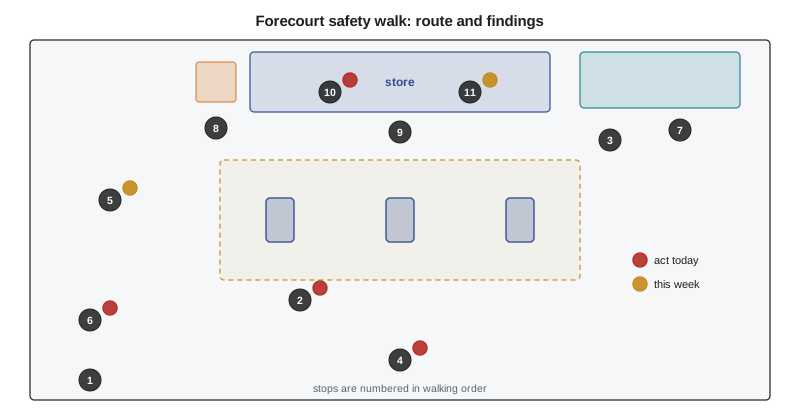
They find nine items. Raj rates each for how likely it is to cause harm and how bad the harm could be, on a simple 1-to-3 scale, and the program below ranks them so the most urgent come first. The ratings are judgments for this example, not a formal risk assessment.
# Rank forecourt walk findings by likelihood x severity (1-3 scales, example judgements).
findings = [
    ("fill port cap for diesel tank not locked", 2, 3),
    ("ice ridge under canopy drip line at air station", 3, 2),
    ("hose on pump 5 kinked and worn near nozzle", 2, 3),
    ("EV charger cable left on walkway", 2, 2),
    ("spill kit at island 2 missing absorbent socks", 2, 2),
    ("no-smoking sign faded on pump 3", 1, 2),
    ("indoor ESO partly hidden by lottery display", 2, 3),
    ("one canopy light out", 2, 1),
    ("washroom sharps container full", 2, 2),
]
ranked = sorted(findings, key=lambda f: -(f[1] * f[2]))
for name, like, sev in ranked:
    score = like * sev
    action = "today" if score >= 6 else ("this week" if score >= 4 else "next maintenance")
print(f"{score:>2} {action:17}{name}")6 today fill port cap for diesel tank not locked 6 today ice ridge under canopy drip line at air station 6 today hose on pump 5 kinked and worn near nozzle 6 today indoor ESO partly hidden by lottery display 4 this week EV charger cable left on walkway 4 this week spill kit at island 2 missing absorbent socks 4 this week washroom sharps container full 2 next maintenance no-smoking sign faded on pump 3 2 next maintenance one canopy light out
Four findings need action today: the ice ridge at the air station, where a customer could fall; the unlocked diesel fill cap, which invites tampering or contamination; the worn hose on pump 5, which could split and spill; and the lottery display partly hiding the indoor emergency shut-off, which costs seconds in an emergency. The worn hose means pump 5 is taken out of service until the contractor replaces the hose. The missing drain socks, the charger cable, the full sharps container and the faded sign are fixed within the week, and the canopy light goes on the maintenance list. For Sofia, the most useful part of the walk is not the list but learning to look: a lottery display is invisible to a customer, but to an attendant it is the thing between her hand and the emergency switch.
Choosing controls
For each finding, Raj and Sofia talk through the hierarchy of controls (Lesson 1, HSE-103), because the quick fix is not always the best one.
- Ice at the air station: salting is an administrative fix that has to be repeated; a gutter on the canopy edge to carry meltwater away from the walkway removes the cause. Leah adds it to the capital requests.
- Unlocked fill cap: lock it now, and add fill caps to the closing checklist so the last person on shift checks them.
- Worn hose: replace it, and add hose condition to the daily forecourt check so wear is caught earlier.
- ESO hidden by a display: move the display, and mark the floor in front of the ESO so nothing is put there again.
- Missing drain socks: restock, and add a monthly spill kit inventory to the records list (Lesson 2).
Knowing whether it worked
An orientation and a safety walk are only useful if they change what happens. Leah and Raj agree on a few simple measures for the next six months, most of them leading indicators that show whether controls are in place rather than waiting for injuries.
| Measure | Target | How it is checked |
|---|---|---|
| New staff with the full stage 2 checklist before working alone | 100% | Orientation records reviewed by Leah |
| Staff who have done all four drills in the last 12 months | 100% by March | Drill tracker (Lesson 11) |
| Deliveries with every critical step observed | At least 90% | Monthly delivery audit (Lesson 8) |
| Opening and closing checklists completed | 100% of shifts | Checklist binder or app |
| Forecourt walk findings closed on time | At least 90% | Walk log |
| Near misses reported | Rising at first, as people learn to report | Incident log |
The last measure deserves a comment. A rise in reported near misses after a good orientation is a sign of success, not failure: it means staff now see hazards and feel able to report them. Leah will worry if the near-miss count drops to zero, because at a busy station that usually means people have stopped reporting.
For supervisors: orientation is not a one-day event
The best orientation plan fails if the new worker is left alone on a busy evening before they are ready because the schedule is short. Protect the stage 2 checklist: no one works alone until it is complete. Pair new workers with your most careful attendant, not just whoever is free. Check in after the first solo shift and the first month: what surprised them, what did they not know, what would they change? And repeat the forecourt walk with experienced staff now and then; they will see things they have stopped noticing.
Worked problem
Sofia's first solo evening
Three weeks later, Sofia is alone on an evening shift. At 9:40 p.m. the tanker arrives early, a customer starts filling a can on his pickup's tailgate, and the console shows a high-water alarm on tank 2. In what order should she deal with these, and how?
Show solution
- The customer filling a can on the tailgate is the immediate ignition risk: stop that pump and tell him by intercom to put the can on the ground.
- Meet the tanker driver at check-in: tell him she has a tank alarm, so the premium delivery must wait until the alarm is understood; check ullage on the other tanks before any hose is connected.
- Record the high-water alarm and call the manager or on-call contact, following the alarm card; water in tank 2 may mean the premium should not be sold or delivered until checked.
- Close pumps 1 and 4 for the delivery, make sure cones are out, and watch the delivery from the window.
- Log all three events before the end of her shift.
Answer: Deal with the immediate ignition risk first, then control the delivery using the ullage check and the alarm, escalate the tank alarm as the card says, and record everything.
Common mistakes
MistakeLetting a new worker work alone before the orientation checklist is complete.
InsteadProtect stage 2: no one works alone until every required item is signed off.
MistakeTreating orientation as a single day of reading.
InsteadPlan it in stages, with practice, shadowing and sign-off.
MistakeFixing walk findings only with reminders and signs.
InsteadUse the hierarchy: remove causes and engineer fixes where possible.
MistakeSeeing a rise in near-miss reports as a bad sign.
InsteadMore reports usually mean people now see and report hazards.
MistakeDoing the safety walk only from behind the till.
InsteadWalk the whole site in the order customers and tankers move through it.
Summary and key terms
- A good orientation is planned in stages, written down, practiced and signed off.
- The emergency shut-off, 911 script, extinguishers, spill kit and robbery basics come before the first shift.
- Deliveries, tank alarms, spill practice and drills must be complete before working alone.
- A forecourt safety walk follows the route of customers and tankers and ranks findings by likelihood and severity.
- Choose controls with the hierarchy, removing causes where possible.
- Measure success with leading indicators, and expect near-miss reports to rise at first.
- Orientation
- The training and introduction a new worker receives before and during their first weeks.
- Shadowing
- Working alongside an experienced worker to learn the job.
- Sign-off
- A record that a training item has been explained and demonstrated.
- Safety walk
- A planned walk through a workplace to find and record hazards.
- Leading indicator
- A measure that shows whether controls are in place before harm occurs.
- Risk ranking
- Ordering hazards by likelihood and severity to decide what to fix first.
Practice problems
Work each problem on paper first, then reveal the answer to check.
What are the three stages of Raj's orientation plan?
Show answer
Before the first shift, before working alone, and the first three months.
What is the most important item before Sofia's first shift?
Show answer
Knowing where the emergency shut-off switches are and how to use and reset them.
Why could Sofia not yet work alone after two weeks?
Show answer
Spill practice, a watched delivery with ullage check, and the delivery spill drill were not done.
In what order should a forecourt safety walk go?
Show answer
Following the route of customers and tankers through the site, from entrance to washrooms and office.
Which four walk findings needed action today?
Show answer
The ice at the air station, the unlocked diesel fill cap, the worn hose on pump 5, and the display hiding the indoor ESO.
What is a better control for ice at the canopy drip line than salting?
Show answer
A gutter to carry meltwater away from the walkway.
Give two leading indicators Leah will track.
Show answer
Any two of: orientation checklists complete, drills done, delivery audit results, checklists completed, findings closed on time.
Why can a rise in near-miss reports be good news?
Show answer
It shows staff are seeing hazards and feel able to report them.
Lesson quiz · 5 questions
Score 60% or more to complete this lesson.
Create a free account to save your progress, take quizzes and earn a certificate.