
HSE-350 · Lesson 5 of 12 · 23 min
Ignition sources and static electricity
Lesson 3 showed that fuel vapor is always present around dispensers and fill ports, at least in small amounts, and that it collects near the ground. Keeping it from igniting therefore depends on controlling ignition sources. Some are obvious, such as a lit cigarette or a welding torch. Others are easy to miss, such as the static charge that builds up on a person sliding across a car seat. This lesson goes through the ignition sources at a fuel station, explains static electricity in plain terms, looks at what the evidence says about mobile phones, and sets out the rules that control ignition on the forecourt.
The ignition sources at a station
- Smoking and open flames: cigarettes, lighters, matches, candles and barbecues. Smoking is banned near dispensers and fill ports by fire codes, and signs must say so.
- Vehicles: hot exhausts and catalytic converters, sparks from electrical faults, and running engines. Fire codes require engines to be stopped during fueling.
- Static electricity: discharges from people, containers and vehicles (below).
- Electrical equipment: lighting, signs, dispensers, card readers, vending machines and power tools. Equipment near dispensers must be designed for hazardous locations, which is why ordinary extension cords, space heaters and power tools must not be used on the forecourt.
- Hot work: welding, cutting and grinding during maintenance; never without a permit and controls (HSE-333).
- Lightning, in storms.
- Friction and impact: dragging metal, a vehicle scraping the ground, or a dispenser knocked over.
What static electricity is
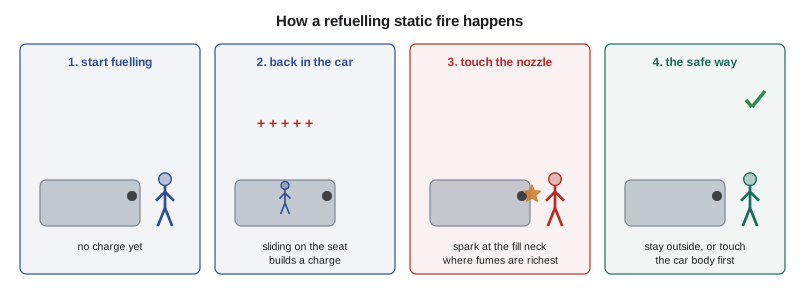
Static electricity is an electric charge that builds up when two materials touch and separate. Walking across a carpet in winter and then getting a shock from a door handle is the everyday example. At a fuel station, charge builds up in three main ways. A person sliding across a car seat, especially in dry winter air and in clothing made of synthetic fabrics, picks up a charge on their body. Fuel flowing through a hose or splashing into a container picks up charge from the friction of the flow. And a container sitting on an insulating surface, such as a plastic truck bed liner or a carpeted trunk, cannot let charge drain away.
A static charge does nothing until it finds a path to ground. Then it jumps as a spark, which can carry enough energy to ignite gasoline vapor, because the vapor needs only a tiny spark to ignite when it is in its flammable range. The spark happens at the moment of contact, typically when a charged person touches the metal nozzle at the fill neck, exactly where the vapor is richest.
What the evidence shows
The Petroleum Equipment Institute, an industry association in the United States, has collected reports of refueling fires for many years. Its records show that static is a real cause of fires at the pump, and that many of the reported incidents involved a person who got back into the vehicle while fueling and then returned to the nozzle. More of these fires happen in cold, dry weather, when static builds up more easily. The pattern is consistent: the fire starts at the fill neck the moment the charged person touches the nozzle, and the person often panics and pulls the burning nozzle out, spreading the fire.
Mobile phones are a different story. Caution stickers on dispensers have long told customers not to use phones while fueling, and many people believe phones ignite vapor. Investigations by the fuel equipment industry have not found a confirmed case of a mobile phone igniting vapor at a fuel station; the reported incidents blamed on phones turned out, on investigation, to be static. Phones remain a distraction, and distracted customers overfill tanks and walk away with the nozzle in the car, so keeping phones away during fueling is still sensible. But the real ignition risk to talk about with customers is static, not phones.
What to do if a fire starts at the fill neck
Customers and workers need to know one simple rule: if a fire starts at the fill neck during fueling, leave the nozzle in the vehicle and back away. Pulling the nozzle out sprays burning fuel over the person and the ground. With the nozzle left in place, the fire at the fill neck usually stays small, and the cashier can stop the pump with the emergency shut-off (Lesson 7). The fire can then be put out with an extinguisher by someone trained, or left for the fire department.
Preventing static fires
- Stay outside the vehicle while fueling. This is the single most effective step and is printed on dispenser signs.
- If you must get back in, touch a metal part of the vehicle body, away from the fill neck, with your bare hand before touching the nozzle again. This discharges your body safely.
- Never use the nozzle's hold-open latch, where provided, and then get back into the vehicle.
- Fill portable containers only on the ground, with the nozzle kept in contact with the container (Lesson 6), never in a truck bed, trunk or on a car seat.
- Do not let children operate the pump.
For workers, the same rules apply when fueling a company vehicle or helping a customer, and staff should wear footwear and clothing that do not build up excessive charge. Most ordinary work boots and cotton clothing are fine; layers of synthetic fleece in dry winter air build up the most charge.
Static risk checklist
Marco uses a short checklist when training cashiers, to help them recognize a customer who is at higher risk of a static fire. The program below scores the factors present in a few situations. The factors and weights are an illustrative teaching tool, not a validated risk model; any situation with a container in a vehicle, or a customer returning to the nozzle after sitting in the car, deserves attention whatever the score.
# Score static-ignition risk factors for fuelling situations (illustrative weights).
factors = {
    "re-entered vehicle during fuelling": 4,
    "container filled in truck bed or trunk": 5,
    "cold, dry weather": 2,
    "synthetic fleece clothing": 1,
    "nozzle hold-open latch used": 1,
    "touched car body before nozzle": -3,
}
situations = {
    "winter, re-entered car, touched body first": ["re-entered vehicle during fuelling", "cold, dry weather", "touched car body before nozzle"],
    "winter, re-entered car, fleece, latch on": ["re-entered vehicle during fuelling", "cold, dry weather", "synthetic fleece clothing", "nozzle hold-open latch used"],
    "summer, stayed outside": [],
    "jerry can in pickup bed": ["container filled in truck bed or trunk"],
}
for name, present in situations.items():
    score = max(0, sum(factors[f] for f in present))
    level = "HIGH - intervene" if score >= 5 else ("watch" if score >= 3 else "low")
print(f"{name:44} score {score:2} {level}")winter, re-entered car, touched body first score 3 watch winter, re-entered car, fleece, latch on score 8 HIGH - intervene summer, stayed outside score 0 low jerry can in pickup bed score 5 HIGH - intervene
The checklist puts the jerry can in the pickup bed and the winter customer who got back into the car with a fleece on and the latch engaged in the high group. The customer who got back in but touched the car body first scores lower, because touching the body discharges the static. The value of a checklist like this is that it trains the eye: once cashiers know what to look for, they notice the person climbing back into their car with the pump running.
Electrical equipment and hazardous locations
Around dispensers, fill ports and vents, fire and electrical codes define hazardous (classified) locations where flammable vapor may be present. Electrical equipment in these areas, such as dispenser electronics and lighting, must be specially designed so that it cannot ignite vapor. For workers, this has practical consequences. Do not bring ordinary electrical equipment into the forecourt: no extension cords run to the pumps for a space heater or a radio, no power tools for a quick repair, no portable fans or lights plugged in near the dispensers. Report damaged electrical equipment on the forecourt, such as a broken light fixture or an exposed wire at a dispenser, and stop the affected dispenser until it is repaired.
Lightning and storms
Lightning can ignite vapor at vents and fill ports and can damage dispenser electronics. Most stations do not close for thunderstorms, but deliveries should stop while lightning is close, because the fill ports are open and the tanker driver is standing at them, and staff should not be out on the forecourt doing tasks that can wait. A common rule of thumb is to wait until 30 minutes after the last thunder before resuming outdoor work and deliveries. Severe weather such as high winds and hail also brings its own forecourt hazards: flying debris, damaged canopy panels and power failures, after which the pumps and the tank monitoring system must be checked before fueling restarts. Lesson 11 covers severe weather as part of emergency planning.
Smoking, flames and vehicles
Fire codes prohibit smoking and open flames near dispensers and require signs saying so, and require engines to be stopped during fueling. Electric vaping devices are not open flames but contain lithium-ion batteries and heating elements, and many stations apply the no-smoking rule to them too. The cashier enforces these rules with the tools available: refusing to authorize the pump until the engine is off or the cigarette is out, using the intercom, or stopping the pump.
For supervisors: make enforcement easy
Cashiers find it hard to confront customers, especially alone at night. Make it easier. Keep the signs clear and visible at every pump. Give cashiers a short script for the intercom, such as: Sir, please put the cigarette out before fueling, the pump will not start until you do. Make it clear that stopping a pump for a safety reason is always supported, even if the customer complains. And log each incident; if the same customers keep breaking the rules, the manager can deal with them.
Worked problem
A customer back in the car
On a cold, dry January evening, Ben sees a customer start fueling, set the hold-open latch, get back into the car, and then step out and reach for the nozzle. What should he do, and what if a flame appears at the fill neck?
Show solution
- Use the intercom at once: ask the customer to touch the car door with a bare hand before touching the nozzle.
- If a flame appears at the fill neck, tell the customer over the intercom to leave the nozzle in the car and step away.
- Press the emergency shut-off to stop all the pumps.
- Call 911, move other customers away from the canopy, and use an extinguisher only if trained and the fire is small and the exit is clear.
- Afterwards, record the incident and check the dispenser before it is used again.
Answer: Warn the customer to discharge static by touching the car body; if a fire starts, tell them to leave the nozzle in and back away, hit the emergency shut-off, call 911 and clear the area.
Common mistakes
MistakeBelieving mobile phones are the main ignition risk at the pump.
InsteadStatic from re-entering the vehicle is the documented cause; phones are a distraction risk.
MistakePulling a burning nozzle out of the vehicle.
InsteadLeave the nozzle in place, back away and stop the pumps.
MistakeRunning an extension cord to the forecourt for a heater or tool.
InsteadKeep ordinary electrical equipment out of hazardous locations.
MistakeLetting a customer fuel with the engine running to keep warm.
InsteadRefuse to authorize or stop the pump until the engine is off.
MistakeTouching the nozzle straight after getting out of the car.
InsteadTouch the metal car body away from the fill neck first, or stay outside the vehicle.
Summary and key terms
- Ignition sources at a station include smoking, vehicles, static, electrical equipment, hot work and lightning.
- Static builds up when people slide across car seats, when fuel flows, and on containers on insulating surfaces.
- Most refueling static fires involve someone who got back into the vehicle and then touched the nozzle.
- No confirmed fire has been traced to a mobile phone; static is the real risk.
- If a fire starts at the fill neck, leave the nozzle in, back away and stop the pumps.
- Keep ordinary electrical equipment out of the hazardous areas around dispensers and fill ports.
- Static electricity
- An electric charge that builds up when materials touch and separate, and can discharge as a spark.
- Ignition source
- Anything with enough energy to ignite a flammable mixture.
- Hold-open latch
- A device on some nozzles that keeps fuel flowing without the customer holding the lever.
- Hazardous (classified) location
- An area where flammable vapor may be present, needing specially designed electrical equipment.
- Discharge
- Letting a static charge flow safely to ground, for example by touching metal.
- Fill neck
- The opening on a vehicle where fuel is put in.
Practice problems
Work each problem on paper first, then reveal the answer to check.
Name five ignition sources at a fuel station.
Show answer
Any five of: smoking, open flames, vehicles, static, electrical equipment, hot work, lightning, friction or impact.
How does a person build up a static charge during fueling?
Show answer
By sliding across a car seat, especially in dry weather and synthetic clothing.
What is the most effective way to prevent refueling static fires?
Show answer
Stay outside the vehicle while fueling.
What should a customer do if they must get back in the vehicle?
Show answer
Touch the metal car body away from the fill neck before touching the nozzle again.
What does the evidence say about mobile phones at the pump?
Show answer
No confirmed case of a phone igniting vapor; static is the real cause; phones are a distraction.
What should happen if a fire starts at the fill neck?
Show answer
Leave the nozzle in, back away, stop the pumps with the emergency shut-off and call 911.
Why not run an extension cord to the forecourt?
Show answer
Ordinary electrical equipment can ignite vapor in hazardous locations.
What can a cashier do about a customer smoking at the pump?
Show answer
Refuse to authorize or stop the pump and tell them to put it out, using the intercom.
Lesson quiz · 5 questions
Score 60% or more to complete this lesson.
Create a free account to save your progress, take quizzes and earn a certificate.