
HSE-214 · Lesson 3 of 12 · 28 min
Recognizing electrical hazards at work
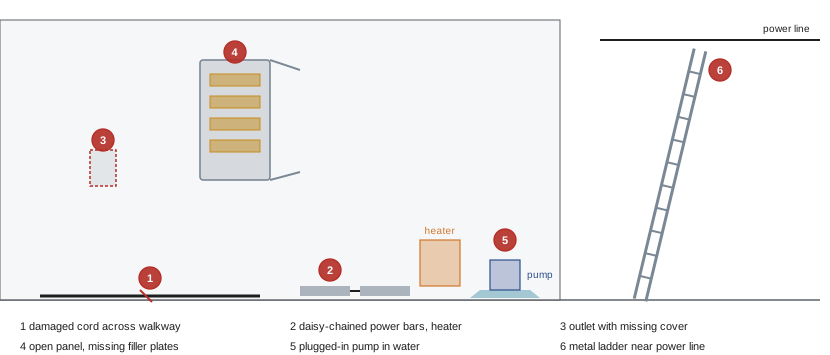
Most electrical injuries to unqualified workers do not happen inside switchgear. They happen at an extension cord running across a wet floor, a power bar overloaded with heaters, a cracked outlet cover, a ladder carried under a power line, or a panel door left open. This lesson trains your eye to spot those everyday hazards, and to understand newer ones such as battery systems, solar arrays and electric vehicle charging. Lessons 4 to 7 then go deeper into cords and tools, ground fault protection, overhead lines and underground utilities.
Damaged equipment and installations
Insulation and enclosures are the first line of defense between people and live parts. Anything that breaks them creates a shock hazard. Common examples include:
- Cords with cut, crushed or frayed jackets, exposed inner conductors, missing strain relief or taped repairs.
- Plugs with missing or bent grounding pins, cracked bodies, loose blades or signs of heat such as melting and discoloration.
- Outlets, switches and junction boxes with missing or broken cover plates, loose devices or scorch marks.
- Panels and disconnects with missing covers, open knockouts, missing breaker blanks (filler plates) or doors that do not close.
- Equipment with damaged housings, missing guards over terminals or signs of water entry.
- Light fixtures with broken lenses, exposed lamp holders or damaged wiring, especially in damp areas.
Damage is often caused by everyday wear: cords run over by carts or forklifts, pinched in doors, pulled by the cord instead of the plug, or left in the sun and cold. Each time you see damage, the correct response is the same: stop using the equipment, remove it from service, tag it and report it.
Overloaded circuits and heat
Every conductor, cord and device has a current rating. When more current flows than it was designed for, it heats up. Heat ages insulation, loosens connections and can start fires. Overloads are most common where people plug many devices into one outlet through power bars and adapters, where space heaters, kettles and coffee makers share a circuit, or where light-duty household cords power heavy tools. Circuit breakers and fuses protect wiring by opening the circuit when current is too high, but they protect the installation, not people: a breaker sized at 15 A will happily let a lethal 100 mA flow through a person.
Worked problem
Will this power bar overload?
An office worker plugs a 1,500 W space heater, a 1,000 W kettle and a 200 W printer into one power bar on a 120 V, 15 A circuit. Is the circuit overloaded?
Show solution
- Total power: \( 1{,}500 + 1{,}000 + 200 = 2{,}700 \) W.
- Current: \( I = P/V = 2{,}700 / 120 = 22.5 \) A.
- Compare with the breaker rating: 22.5 A is far above 15 A, and well above the 80 % (12 A) guideline for loads that run for a long time.
- The breaker should trip, but if it is faulty, oversized, or the power bar itself is the weak point, the cord or bar can overheat first.
Answer: Yes. The load is about 22.5 A on a 15 A circuit. Space heaters and kettles should be on their own circuits, and power bars should never be daisy-chained.
Warm or hot plugs, cords and outlet covers, flickering lights, buzzing sounds, a smell of hot plastic, and breakers that trip repeatedly are all warning signs. Never reset a breaker more than once without finding out why it tripped, and never replace a fuse with a larger one.
Water and wet locations
Water lowers skin resistance and provides a conducting path to ground, which is why wet locations multiply shock risk. Wet locations include outdoor work, washdown areas in food plants, car washes, kitchens, basements, pools and fountains, construction sites after rain, and any area where hoses are used. Electrical equipment used in these areas must be rated for the conditions, protected by ground fault circuit interrupters where required, and kept off the ground. Cords and connections should never lie in water. If a piece of equipment has been submerged, it must be inspected by a qualified person before it is used again.
Improvised and temporary wiring
Temporary wiring is common on construction sites, at events and during renovations, and it is meant to be temporary. Problems arise when extension cords become permanent wiring, when cords are run through walls, ceilings, doorways or windows, when they are stapled or nailed in place, or when people make their own adapters or splices. Other dangerous improvisations include removing the grounding pin from a plug to fit an old outlet, using 'cheater' adapters, overriding interlocks, bridging fuses and wiring equipment directly without a disconnect. Each of these defeats a protection that was built in for a reason.
OSHA 1926.405 sets requirements for temporary wiring on construction sites, and 1926.404(b)(1) requires ground fault circuit interrupters or an assured equipment grounding conductor program for cord-and-plug equipment. General industry rules in 1910.305 limit how flexible cords may be used and prohibit using them as a substitute for fixed wiring.
Contact with overhead and buried lines
Some of the most serious electrical incidents happen outdoors, when equipment or materials come close to power lines. Ladders, scaffold poles, booms, dump truck boxes, cranes, irrigation pipes, pool skimmers and tree branches can all conduct electricity from an overhead line to the ground through the person holding them. High-voltage electricity can also jump, or arc, across an air gap without direct contact. Buried cables are damaged by digging, drilling, driving stakes and boring. Lessons 6 and 7 are devoted to these hazards.
Static, lightning and stored energy
Static electricity builds up when materials rub together, and can ignite flammable vapors and dusts even though the shock to a person is usually only a nuisance. Bonding and grounding of containers and equipment controls static in fuel handling and powder processing. Lightning is a hazard for outdoor work, and the general rule is that when thunder roars, workers go indoors or into a hard-topped vehicle. Capacitors in power supplies, motor drives, welders and photo flashes can hold a dangerous charge after equipment is unplugged, and springs, flywheels and gravity can also store energy. HSE-210 covers stored energy and lockout in detail.
Batteries, solar and electric vehicles
Modern workplaces increasingly contain large direct current systems. These hazards are less familiar, and several of the usual assumptions do not hold.
- Battery systems: uninterruptible power supplies (UPS) in offices and data centers, forklift and floor-scrubber batteries, telecom batteries and energy storage systems store large amounts of energy. They cannot be switched off at the battery terminals, can deliver very high fault currents, and produce flammable hydrogen when lead-acid cells are charged. Lithium-ion cells can enter thermal runaway, releasing toxic, flammable gases and burning intensely.
- Solar photovoltaic arrays: panels produce voltage whenever light falls on them. Turning off the inverter or the main breaker does not de-energize the panels or the wiring between them, and string voltages can reach several hundred volts DC. Rapid shutdown systems reduce this hazard, but only qualified workers should work on arrays.
- Electric vehicles and chargers: electric vehicle battery packs commonly operate at about 400 to 800 V DC. High-voltage cables are usually colored orange. Damaged or crashed vehicles may have live components, and battery fires can reignite hours or days later. Only trained technicians should work on high-voltage systems.
- Data centers and server rooms: large UPS and battery rooms, high-capacity busways and dense power distribution create arc flash hazards. Data center safety courses later in this stream cover these environments.
Worked problem
Energy stored in a UPS battery string
A small UPS in a server room uses a string of 40 batteries, each rated 12 V and 9 ampere-hours. Estimate the string voltage and the stored energy in kilowatt-hours.
Show solution
- String voltage: \( 40 \times 12 = 480 \) V DC.
- Energy per battery: \( 12 \times 9 = 108 \) Wh.
- Total energy: \( 40 \times 108 = 4{,}320 \) Wh, about 4.3 kWh.
- That is enough energy to run a 1,500 W heater for nearly three hours, and the string can deliver a fault current of thousands of amperes for a short time.
Answer: About 480 V DC and 4.3 kWh. A battery string is never 'off', which is why UPS work is for qualified persons only.
Hazards around electrical rooms and equipment
Electrical rooms, panels and disconnects must be kept accessible and clear. Storage in electrical rooms, boxes stacked in front of panels, and blocked disconnects slow down emergency response and create hazards for qualified workers who must open equipment. Doors marked as electrical rooms should be kept closed and, where required, locked. Lesson 11 covers working clearances and what to do in an emergency.
Reporting and acting on hazards
Unqualified workers are not expected to fix electrical problems, but they are expected to recognize and report them. A good reporting habit includes stopping use, warning others, removing the item from service if it is portable (unplug it and tag it 'Do not use'), and telling a supervisor or the maintenance department. If the hazard is part of the building, such as an outlet with a missing cover or a panel door that will not close, keep people away and report it immediately. Never try to make an electrical repair yourself unless you have been trained and authorized for that specific task.
Worked problem
Rating hazards to set priorities
During a walk-through you find: (A) an extension cord with a cut jacket used daily by a cleaner in a washroom; (B) a box stored in front of a panel; (C) a desk lamp with a slightly loose plug in a dry office. Using likelihood (1 to 5) times severity (1 to 5), rank them. Suggested scores: A likelihood 4, severity 5; B likelihood 2, severity 4; C likelihood 2, severity 2.
Show solution
- A: \( 4 \times 5 = 20 \).
- B: \( 2 \times 4 = 8 \).
- C: \( 2 \times 2 = 4 \).
- Act on A immediately: remove the cord from service and provide a GFCI-protected, undamaged cord or battery equipment. Clear B the same day. Replace C's plug or lamp soon.
Answer: A (20), then B (8), then C (4). Wet locations and damaged cords together score highest.
Common mistakes
MistakeTaping over a cut in a cord jacket and carrying on.
InsteadRemove damaged cords from service and have them replaced or properly repaired.
MistakeResetting a breaker again and again until it holds.
InsteadFind out why it tripped; repeated tripping signals an overload or a fault.
MistakeAssuming that turning off the inverter makes solar panels safe.
InsteadPanels produce voltage whenever light falls on them; only qualified workers should touch them.
MistakeDaisy-chaining power bars to reach more devices.
InsteadPlug power bars directly into outlets and keep heating loads on their own circuits.
MistakeStoring boxes in electrical rooms and in front of panels.
InsteadKeep electrical rooms and the space in front of equipment clear and accessible.
Summary and key terms
- Damaged cords, plugs, covers and panels break the insulation and enclosures that protect people.
- Overloads cause heat and fires; breakers protect wiring, not people.
- Water lowers resistance and multiplies shock risk; wet locations need rated equipment and GFCIs.
- Improvised and long-term temporary wiring defeats built-in protections.
- Overhead and buried lines cause many serious outdoor incidents.
- Battery systems, solar arrays and electric vehicles create DC hazards that cannot simply be switched off.
- Unqualified workers recognize, stop, tag and report electrical hazards rather than fixing them.
- Insulation
- Non-conducting material that covers conductors and prevents contact.
- Overload
- Current above the rating of a conductor or device, causing heat.
- Circuit breaker
- A device that opens a circuit automatically when current is too high.
- Wet location
- An area where equipment may be exposed to water or saturation.
- Temporary wiring
- Wiring installed for a limited time, such as during construction.
- Daisy-chaining
- Plugging one power bar or extension cord into another.
- Thermal runaway
- An uncontrolled chain reaction of heating in a battery cell.
- Rapid shutdown
- A system that reduces voltage in solar array wiring when activated.
- UPS
- An uninterruptible power supply that keeps equipment running from batteries during outages.
- Static electricity
- An imbalance of charge on a surface that can discharge as a spark.
Practice problems
Work each problem on paper first, then reveal the answer to check.
What current does a 1,800 W appliance draw at 120 V?
Show answer
15 A, from 1,800 / 120.
Name three signs of overheating in a plug or outlet.
Show answer
Warmth, discoloration, melting, a hot-plastic smell or buzzing.
Why does a breaker not protect people from shock?
Show answer
It trips at amperes; a lethal shock needs only milliamperes.
What should you do with a cord that has a cut jacket?
Show answer
Stop using it, unplug it, tag it out and report it.
Why are solar arrays hazardous even when the inverter is off?
Show answer
Panels generate voltage whenever light falls on them.
What is the approximate voltage of an electric vehicle battery pack?
Show answer
Commonly about 400 to 800 V DC.
What is the voltage of a string of 30 batteries rated 12 V each?
Show answer
360 V DC.
Give two examples of improvised wiring.
Show answer
Cords run through walls or doors, removed grounding pins, homemade adapters or splices.
What gas do lead-acid batteries give off when charging?
Show answer
Hydrogen, which is flammable.
What is the rule for outdoor work when thunder is heard?
Show answer
Stop and go indoors or into a hard-topped vehicle.
Lesson quiz · 5 questions
Score 60% or more to complete this lesson.
Create a free account to save your progress, take quizzes and earn a certificate.