
HSE-214 · Lesson 2 of 12 · 26 min
OSHA electrical standards and the law in the US
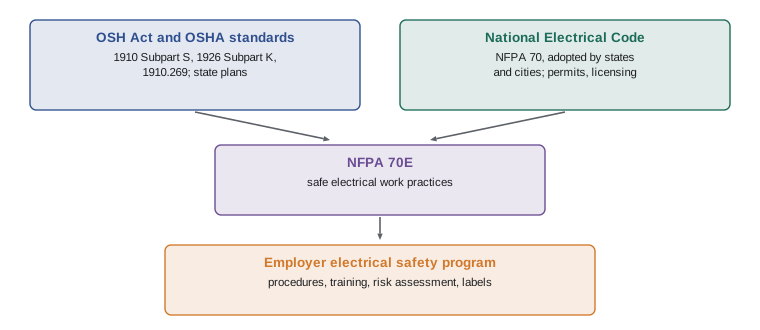
Electrical safety in US workplaces is governed by three overlapping systems. The Occupational Safety and Health Act and OSHA's standards set the duties of employers to protect workers from electrical hazards. Electrical codes, mainly the National Electrical Code adopted by states and cities, govern how installations are designed, installed and inspected, and state licensing laws decide who may do electrical work. Consensus standards, above all NFPA 70E Standard for Electrical Safety in the Workplace, describe the safe work practices that OSHA expects employers to follow. This lesson maps those systems so that you know where the rules come from.
Occupational health and safety law
The OSH Act's general duty clause, section 5(a)(1), requires every employer to provide a workplace free from recognized hazards likely to cause death or serious physical harm. OSHA's specific electrical standards are in 29 CFR 1910 Subpart S for general industry (1910.301 to 1910.399) and 1926 Subpart K for construction (1926.400 to 1926.449). Electric power generation, transmission and distribution work is covered by 1910.269 and 1926 Subpart V. Twenty-two states and territories run their own OSHA-approved state plans for private employers, which must be at least as effective as federal OSHA and sometimes go further; California's Title 8 electrical safety orders are an example.
| OSHA standard | Topic |
|---|---|
| 1910.303 | General requirements, including working space around equipment |
| 1910.304 and 1910.305 | Wiring design, protection, methods and equipment |
| 1910.332 | Training for qualified and unqualified persons |
| 1910.333 | Selection and use of work practices, including de-energizing and approach distances |
| 1910.334 | Use of portable electric equipment, cords and test instruments |
| 1910.335 | Safeguards for personnel protection, including PPE |
| 1926 Subpart K | Construction electrical safety, including GFCI and assured grounding (1926.404) |
| 1910.269 | Electric power generation, transmission and distribution |
Electrical codes and who may do electrical work
The National Electrical Code (NFPA 70) is the model code for electrical installations in the United States. It is revised every three years; the 2026 edition is the newest, but states and cities adopt editions on their own schedules, so a given site may be under the 2020, 2023 or 2026 code. Local authorities having jurisdiction issue permits and inspect installations. OSHA's Subpart S design requirements are based on older NEC concepts, and OSHA does not require compliance with the latest NEC, but local building and electrical codes do.
Electrical work is a licensed trade in most US states and many cities. Installing or altering wiring generally requires a licensed electrician or an apprentice under supervision, working for a licensed contractor, with a permit and inspection. Requirements vary by state and city, and a few states license electricians only at the local level. Unqualified workers are generally limited to simple tasks such as plugging in equipment and resetting breakers, and many employers set stricter internal rules than the law requires.
The workplace electrical safety standard
NFPA 70E Standard for Electrical Safety in the Workplace is the US consensus standard for safe electrical work practices. The current edition is the 2024 edition, revised on a three-year cycle. It covers the electrical safety program, risk assessment, establishing an electrically safe work condition, approach boundaries, arc flash risk assessment, energized electrical work permits, personal protective equipment, labeling and training. NFPA 70E is not itself an OSHA standard, but OSHA uses it to show what hazards are recognized and what protection is feasible, and citations under 1910.333, 1910.335 and the general duty clause often rely on it.
Worked problem
Which rule applies?
A maintenance helper at a manufacturing plant in Ohio is asked to replace a damaged cord cap (plug) on a 120 V floor fan, and later to help an electrician pull wire for a new circuit. Which systems of rules apply to each task?
Show solution
- OSHA applies to both tasks: the employer must train the worker under 1910.332, ensure de-energized work under 1910.333 and inspect portable equipment under 1910.334.
- Replacing a cord cap on portable equipment is equipment repair; the employer should decide whether the helper is trained to do it, using NFPA 70E practices, with the fan unplugged.
- Installing a new circuit is electrical work under the locally adopted NEC; it generally needs a permit and a licensed electrician, with the helper working only under direction and only on de-energized parts.
Answer: Both tasks fall under OSHA and NFPA 70E practice; the new circuit also falls under the local electrical code, permits and licensing rules.
Qualified and unqualified persons
Both countries draw the same basic line. A qualified person has the training, knowledge and demonstrated skill to recognize and avoid the hazards of particular electrical equipment and tasks. Everyone else is unqualified for that task. Being qualified is not a job title: an electrician may be qualified for low-voltage panels but not for medium-voltage switchgear, and a technician may be qualified to test a specific machine but not to open a building's main distribution.
OSHA 1910.332 requires training for both groups. Unqualified persons must be trained in the electrically related safety practices needed for their jobs. Qualified persons must also be trained to distinguish exposed live parts, determine nominal voltage, and know the approach distances in 1910.333. NFPA 70E adds that qualified persons must be retrained at least every three years, and that employers must audit their work at least annually.
Shared duties
Employers must assess electrical hazards, provide safe equipment and installations, keep them maintained, train workers, set up an electrical safety program and supervise work. Supervisors must make sure the right people do the right tasks and that procedures are followed. Workers must use equipment as instructed, report damaged cords, tools and equipment, stay out of areas they are not qualified to enter, and refuse work they believe is dangerous. Suppliers must provide equipment that is certified or listed and comes with instructions.
OSHA requires electrical equipment to be approved, which normally means listed or labeled by a Nationally Recognized Testing Laboratory (NRTL) such as UL Solutions, Intertek (ETL) or CSA Group. Unlisted equipment, often bought online, is a frequent finding in inspections.
Worked problem
Counting the cost of an incident
OSHA cites an employer for a serious violation of 1910.333 after a shock injury. Assume the proposed penalty is the January 2025 maximum for a serious violation, $16,550, and the employer also faces a willful violation at the January 2025 maximum, $165,514. What is the total proposed penalty?
Show solution
- Add the two penalties: \( 16{,}550 + 165{,}514 \).
- Total: \( 182{,}064 \).
- Direct costs such as lost production, investigation, legal fees, higher insurance premiums and equipment damage usually exceed the fine itself.
Answer: $182,064 in proposed penalties. Maximum penalties are adjusted for inflation each year, so check the current figures.
How the systems work together on a real job
Consider a contractor hired to replace lighting in a warehouse in Texas. The city or county electrical authority decides whether a permit is needed and who may do the wiring, based on the locally adopted NEC and state licensing rules. Federal OSHA decides how the work must be done safely: who is qualified under 1910.332, how equipment is de-energized and locked out under 1910.333 and 1910.147, and how far unqualified workers must stay from energized parts. NFPA 70E fills in the detail of the employer's electrical safety program, the risk assessment and the PPE. The warehouse owner, as a host employer, must also make sure its own workers stay out of the work area. Under OSHA's multi-employer policy, more than one employer on the same site can be cited for the same hazard.
Agencies also cooperate. OSHA, state licensing boards and local inspectors may all respond to a serious electrical incident: OSHA looks at the employer's procedures, training and supervision, while local electrical inspectors look at the installation, the equipment and whether licensed work was done properly. The US Chemical Safety Board and NIOSH's Fatality Assessment and Control Evaluation program also publish investigation reports that help employers learn from electrical deaths.
What the workplace standard asks of employers
The workplace electrical safety standard is organized in a way that mirrors the hierarchy of controls. It begins with the employer's electrical safety program and training. It then requires that, wherever practicable, work be done only after an electrically safe work condition has been established. Where energized work is justified, it requires a risk assessment for shock and arc flash, approach boundaries, an energized work permit for most tasks, appropriate PPE and other protective equipment, and barriers to keep unqualified people away. Annexes give guidance on calculations, labels, job briefings, lockout and the selection of PPE. Later lessons in this course explain the main parts from the point of view of a worker who is not qualified.
The standard also makes clear that its requirements apply to the employer and to employees. Employers must provide the program, the training and the equipment. Employees must follow the safe work practices and procedures they have been trained in. This shared responsibility matches the internal responsibility system that underpins occupational health and safety law in both countries.
Keeping up with change
Codes and standards change on regular cycles. The NEC and NFPA 70E are revised every three years, and state and local adoption of a new NEC edition may lag by several years. OSHA amends its standards less often, and its penalty amounts change every year. Employers should assign someone to track changes, update procedures and training, and check which edition applies on each site. Workers should not rely on old training materials without checking that they are still current.
Trade unions, contractor associations and safety organizations such as the Electrical Safety Foundation, the National Safety Council and the Associated General Contractors publish practical guidance that explains these rules for workers and supervisors. OSHA's free consultation service helps small employers find and fix hazards without penalties, and OSHA publishes electrical safety fact sheets and eTools.
Some states go further than federal OSHA. California, Washington, Oregon and Michigan, for example, run state plans with their own electrical safety orders, and several states license electricians at the state level with continuing education requirements tied to each NEC cycle. Employers working in several states must check each one.
Common mistakes
MistakeAssuming the electrical code is the only rule that matters.
InsteadOccupational health and safety law and the workplace safety standard also apply to every task.
MistakeTreating the workplace electrical safety standard as optional because it is not a regulation.
InsteadRegulators and courts treat it as the recognized way to protect workers.
MistakeCalling someone qualified because of their job title.
InsteadQualification is for specific equipment and tasks, based on training and demonstrated skill.
MistakeLetting helpers or laborers do small wiring jobs to save time.
InsteadWiring work belongs to licensed electricians with permits and inspection.
MistakeBuying uncertified electrical equipment online because it is cheaper.
InsteadUse only equipment that carries a recognized certification or listing mark.
Summary and key terms
- The OSH Act general duty clause and OSHA Subpart S, Subpart K and 1910.269 set electrical duties.
- The National Electrical Code, adopted by states and cities, governs installations and permits.
- Electrical installation work is generally licensed by states or cities.
- NFPA 70E-2024 sets out safe electrical work practices that OSHA uses as a benchmark.
- Qualified persons are trained for specific equipment and tasks; everyone else is unqualified for that task.
- Equipment must carry a recognized certification or listing mark.
- Fines and indirect costs from electrical incidents are large, but the human cost is greater.
- General duty
- A broad legal duty to protect workers from recognized hazards.
- Electrical code
- A standard governing the design and installation of electrical systems.
- Consensus standard
- A standard developed by a committee of stakeholders, such as CSA Z462 or NFPA 70E.
- Authority having jurisdiction
- The organization responsible for enforcing a code or standard in an area.
- Licensed electrical contractor
- A business licensed to perform electrical installation work.
- Certification mark
- A mark showing that equipment has been tested to applicable standards by an accredited body.
- Unqualified person
- A person without the training to recognize and avoid the hazards of a particular electrical task.
- Electrical safety program
- An employer’s documented system of policies, procedures and training for electrical safety.
- Permit
- Authorization from the code authority to perform electrical installation work, followed by inspection.
- Regulated trade
- An occupation, such as electrician, that only certified or licensed people may practice.
Practice problems
Work each problem on paper first, then reveal the answer to check.
Which OSHA subpart covers general industry electrical safety?
Show answer
29 CFR 1910 Subpart S.
Which NEC edition is the newest?
Show answer
The 2026 edition, though adoption varies by state and city.
Which standard describes safe electrical work practices in the US?
Show answer
NFPA 70E Standard for Electrical Safety in the Workplace.
What makes someone a qualified person?
Show answer
Training, knowledge and demonstrated skill for specific equipment and tasks.
Who generally may install new electrical circuits?
Show answer
Licensed or certified electricians, or supervised apprentices, under a permit.
Who decides which NEC edition applies to a site?
Show answer
The state or local authority having jurisdiction.
Name two duties of workers under OHS law.
Show answer
Use equipment as instructed, report hazards and damaged equipment, refuse dangerous work.
Why should equipment carry a certification or listing mark?
Show answer
It shows the equipment was tested to safety standards; unmarked equipment may be unsafe.
Is a consensus standard a law?
Show answer
Not by itself, but regulators and courts use it as the benchmark of reasonable practice.
How often are OSHA maximum penalties adjusted?
Show answer
Each year, for inflation.
Lesson quiz · 5 questions
Score 60% or more to complete this lesson.
Create a free account to save your progress, take quizzes and earn a certificate.