
HSE-214 · Lesson 12 of 12 · 28 min
Electrical safety programs and capstone: a workshop hazard assessment
The earlier lessons covered individual hazards and controls. In a real workplace, those controls only work if they are organized into a system: someone decides who is qualified for what, equipment is maintained, cords are inspected, labels are kept current, new hazards are noticed and fixed, and lessons from near misses are learned. This final lesson describes an electrical safety program, looks at what incident investigations teach, and finishes with a capstone hazard assessment of a small workshop.
The electrical safety program
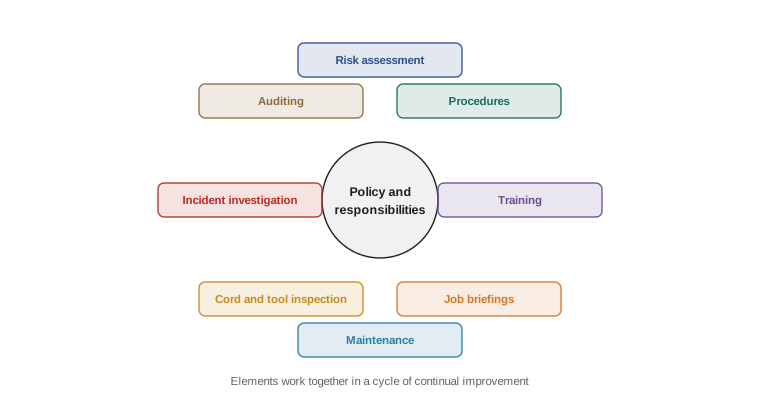
NFPA 70E requires employers to implement and document an overall electrical safety program that directs activity appropriate to the electrical hazards, voltage, energy level and circuit conditions. The program sits within the employer's broader safety and health management system, such as one following ANSI/ASSP Z10 or ISO 45001.
A typical program includes:
- A policy and clear responsibilities, including who designates qualified persons.
- Electrical safety principles and controls, such as de-energizing as the default, the hierarchy of controls and risk assessment.
- Procedures for establishing an electrically safe work condition, lockout, energized work permits, and work near overhead and underground lines.
- A risk assessment procedure for shock and arc flash, and up-to-date labels.
- Job briefings before each job, covering hazards, procedures, special precautions, energy source controls and PPE.
- Training for qualified and unqualified persons, with records and refresher intervals.
- Inspection and maintenance of electrical equipment, cords, tools, GFCIs, test instruments and PPE.
- Incident reporting and investigation, including near misses.
- Auditing of the program and of field work, with corrective actions.
Maintenance matters because electrical equipment that is not maintained can fail violently and can clear faults more slowly than the arc flash study assumed. NFPA 70B Standard for Electrical Equipment Maintenance became a full standard, not just a recommended practice, in its 2023 edition, and NFPA 70E expects equipment to be maintained according to manufacturers' instructions or industry consensus standards.
Training and auditing
Unqualified workers need training in the electrically related safety practices needed for their jobs under 1910.332, like this course, together with site-specific instruction. Qualified workers need detailed training and must be retrained at intervals not exceeding three years under NFPA 70E, and sooner when procedures change, when supervision or inspection shows they are not following the rules, or when they take on new tasks. Field work by qualified persons should be audited at least annually, and the program itself at intervals not exceeding three years.
Worked problem
Planning a training and audit calendar
A plant has 9 qualified electrical workers and 85 unqualified workers. Qualified workers receive 16 hours of refresher training every three years, unqualified workers receive 2 hours of electrical awareness every year, and the safety department audits each qualified worker's field work once a year in a 1-hour observation. How many training and audit hours does the plant need in an average year?
Show solution
- Qualified refresher per year: \( 9 \times 16 / 3 = 48 \) hours.
- Unqualified awareness: \( 85 \times 2 = 170 \) hours.
- Field audits: \( 9 \times 1 = 9 \) hours.
- Total: \( 48 + 170 + 9 = 227 \) hours a year.
Answer: About 227 hours a year, a small cost compared with a single serious electrical incident.
Lessons from incidents
Electrical incident reports from regulators and investigators repeat the same lessons. The three short cases below are composites, based on common patterns rather than any single event.
- The wrong breaker. A maintenance worker switched off what the panel directory said was the circuit for a light fixture, but the directory was out of date. Without testing, he began replacing the fixture and contacted a live 347 V conductor. Lessons: keep directories accurate, lock out, and test before touch every time.
- The ladder and the line. A sign crew raised an aluminum extension ladder near a 25 kV distribution line while repositioning it. The ladder contacted the line and one worker was killed. Lessons: identify overhead lines in the job plan, carry ladders horizontally, use non-conductive ladders and keep the limit of approach.
- The borrowed cord. A cleaner used a damaged extension cord, taped at a cut, to run a wet vacuum in a flooded basement. There was no GFCI. She received a serious shock. Lessons: inspect cords, remove damaged ones, use GFCIs in wet locations and consider battery-powered equipment.
Across all three, the immediate cause was contact with a live part, but the underlying causes were missing information, missing planning and missing protections, each of which the program should have caught.
Capstone: a workshop hazard assessment
You are the safety coordinator for a small fabrication workshop in a leased industrial unit. The shop has a 277/480 V main distribution, a 120/208 V panel for receptacles and lights, welding machines, grinders, a drill press, a battery charging area for two electric forklifts, and a roll-up door that opens onto a yard crossed by a 13.2 kV overhead distribution line. Staff are welders, laborers and a part-time custodian; electrical work is contracted to a licensed electrical contractor. During your walk-through you record the findings below.
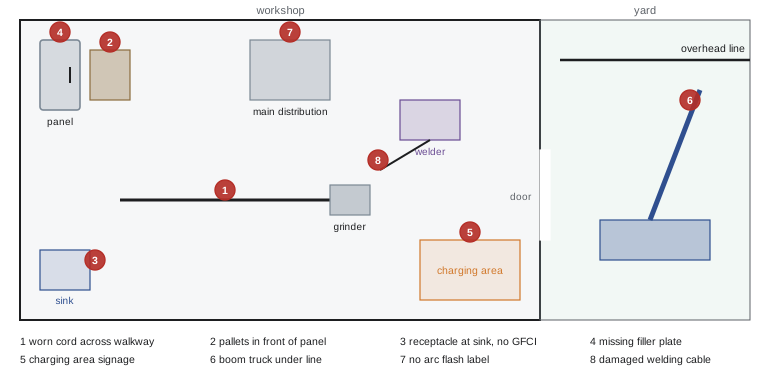
| No. | Finding | Likelihood (1 to 5) | Severity (1 to 5) | Score |
|---|---|---|---|---|
| 1 | Extension cord across walkway to a grinder, jacket worn | 4 | 4 | 16 |
| 2 | Pallets stacked in the working space in front of the receptacle panel | 3 | 4 | 12 |
| 3 | Receptacle within reach of the wash sink, not GFCI protected | 3 | 5 | 15 |
| 4 | Missing breaker filler plate in the receptacle panel | 2 | 5 | 10 |
| 5 | Forklift charging area without ventilation signage or eyewash | 2 | 4 | 8 |
| 6 | Boom truck unloads under the overhead line with no plan or spotter | 3 | 5 | 15 |
| 7 | No arc flash label on the main distribution | 2 | 5 | 10 |
| 8 | Welding cable with damaged insulation near the electrode holder | 4 | 4 | 16 |
Worked problem
Ranking the findings
Using the scores in the table, list the findings that need action before work continues (score 15 or more), and propose one control for each using the hierarchy of controls.
Show solution
- Findings 1 and 8 score 16: replace the worn cord with a properly rated cord routed overhead or with cord protectors, or move the grinder to a fixed receptacle; take the damaged welding cable out of service and replace it.
- Finding 3 scores 15: have the electrical contractor install GFCI protection; in the meantime, use a portable GFCI and keep the area dry.
- Finding 6 scores 15: contact the utility about de-energizing or covering the line during deliveries, change the unloading location so the boom cannot reach within the limit of approach, and require a written procedure and dedicated spotter.
- Findings 2, 4 and 7 (scores 10 to 12) are fixed the same week: clear the working space and mark it on the floor; have the contractor install a filler plate; commission an arc flash risk assessment and labels.
- Finding 5 (score 8): add ventilation signage, no-smoking signs and an eyewash station, and confirm the charging area is ventilated for hydrogen.
Answer: Act immediately on findings 1, 8, 3 and 6, then 2, 4 and 7 within days, and 5 within weeks. Most fixes are simple; the overhead line needs planning with the utility.
Worked problem
Estimating the limit of approach for the yard
What minimum approach distance applies to the boom truck near the 13.2 kV line under 1926.1408, and how high may the boom tip reach if the line is 30 ft above the yard and the truck parks directly beneath it?
Show solution
- 13.2 kV is up to 50 kV, so Table A gives 10 ft.
- Directly beneath the line, the boom tip and load must stay below \( 30 - 10 = 20 \) ft.
- Better still, move the unloading point so that the boom cannot reach the line even at full extension, and use a range limiter set below the limit.
Answer: 10 ft; the boom and load must stay below 20 ft if parked beneath the line, but relocating the unloading point is the better control.
Writing the action plan
A hazard assessment is only useful if it leads to action. For each finding, the action plan records the control, who is responsible, the target date and how completion will be verified. Interim controls protect workers until permanent fixes are in place. The plan is shared with the joint health and safety committee or safety representative, and progress is checked at the next walk-through. The same structure works for any workplace, from an office to a construction site.
| Finding | Control | Owner | Target | Verified by |
|---|---|---|---|---|
| 1 Worn cord | Replace cord; route overhead | Shop lead | Today | Supervisor check |
| 3 No GFCI at sink | Portable GFCI now; permanent GFCI by contractor | Facilities | 1 week | GFCI test log |
| 6 Overhead line | Move unloading point; written procedure; spotter | Operations manager | Before next delivery | Procedure signed; drill |
| 7 No arc flash label | Arc flash risk assessment and labels | Facilities | 60 days | Labels installed; study on file |
Bringing it together
Electrical safety for unqualified workers comes down to a handful of habits: treat every conductor as live until a qualified person proves otherwise, keep your distance from exposed parts and overhead lines, inspect cords and tools before use, use ground fault protection, keep electrical rooms and working spaces clear, call before you dig, never open equipment you are not trained to work on, and report what you see. The organization's job is to make those habits easy, with good equipment, clear procedures, training and a culture that rewards stopping to ask.
Following up
A month after the walk-through, repeat it. Check that each action is complete and working: the GFCI tests are logged, the floor marking in front of the panel is respected, the unloading procedure is being followed and the arc flash labels are installed. Talk to workers about whether the changes made their jobs easier or harder, and adjust where needed. Over time, regular walk-throughs, honest reporting and quick fixes build a workplace where electrical hazards are noticed and removed before they hurt anyone.
Electrical safety is also a good topic for joint health and safety committee inspections, toolbox talks and new-worker orientation. Short, regular reminders about cords, GFCIs, overhead lines and keeping clear of open equipment keep the basics fresh for everyone.
Common mistakes
MistakeTreating electrical safety as the electricians’ problem only.
InsteadEveryone has a role: recognizing hazards, keeping distance, inspecting and reporting.
MistakeDoing a hazard walk-through without an action plan.
InsteadAssign each finding an owner, a date and a way to verify completion.
MistakeLeaving a high-scoring hazard until the next budget cycle.
InsteadUse interim controls immediately while permanent fixes are arranged.
MistakeNever updating panel directories and arc flash labels.
InsteadKeep directories and labels current and review the arc flash assessment at least every five years.
MistakeTraining qualified workers once and never again.
InsteadRetrain at least every three years and audit field work annually.
Summary and key terms
- An electrical safety program organizes policy, procedures, risk assessment, training, maintenance and auditing.
- Maintenance of electrical equipment is part of arc flash and shock prevention.
- Qualified workers are retrained at least every three years; field work is audited annually.
- Incident lessons repeat: outdated information, missing planning and missing protections.
- A hazard assessment scores findings and prioritizes controls using the hierarchy.
- An action plan assigns each finding an owner, a date and a verification method.
- Everyone has a role in electrical safety, whether qualified or not.
- Electrical safety program
- A documented system directing electrical safety activity in a workplace.
- Job briefing
- A discussion before work covering hazards, procedures, energy controls and PPE.
- Field audit
- Observation of work in progress to check that procedures are followed.
- Hazard assessment
- A systematic review that identifies hazards and evaluates risk.
- Risk score
- A number combining likelihood and severity to rank hazards.
- Interim control
- A temporary measure that protects workers until a permanent fix is in place.
- Action plan
- A list of controls with owners, target dates and verification.
- Preventive maintenance
- Scheduled maintenance to keep equipment in reliable condition.
- Continual improvement
- Repeatedly checking and improving a system based on results.
- Composite case
- A teaching example built from common patterns rather than a single real event.
Practice problems
Work each problem on paper first, then reveal the answer to check.
Name four elements of an electrical safety program.
Show answer
Policy, procedures, risk assessment, training, job briefings, maintenance, inspection, incident investigation, auditing.
How often must qualified workers be retrained?
Show answer
At intervals not exceeding three years.
How often should field work by qualified workers be audited?
Show answer
At least annually.
What is the risk score for likelihood 3 and severity 5?
Show answer
15.
What interim control would you use for a receptacle near a sink without GFCI protection?
Show answer
A portable GFCI and keeping the area dry until a permanent GFCI is installed.
If a line is 25 ft high and the minimum distance is 10 ft, how high may a boom reach directly beneath it?
Show answer
Below 15 ft.
What four things does each action plan item need?
Show answer
A control, an owner, a target date and a verification method.
What common lesson links many electrical incidents?
Show answer
Missing information, planning or protections, such as outdated directories or no GFCI.
Why does maintenance affect arc flash hazards?
Show answer
Poorly maintained breakers clear faults slowly, increasing incident energy.
What is a job briefing?
Show answer
A discussion before work of hazards, procedures, energy controls and PPE.
Lesson quiz · 5 questions
Score 60% or more to complete this lesson.
Create a free account to save your progress, take quizzes and earn a certificate.