
HSE-109 · Lesson 7 of 12 · 26 min
Recognizing when someone is struggling and offering support
Colleagues and supervisors are often the first to notice that someone is not doing well. They see each other every day, they know what is normal for a person, and they are often the people a struggling worker trusts most. That makes them an important part of any psychological health and safety program, not as therapists, but as people who can notice, reach out, listen, and help someone connect with the right support. This lesson covers how to recognize signs that someone may be struggling, how to have a supportive conversation, what to do if you are worried about suicide, and how to look after yourself while helping others.
A note before starting: this lesson discusses suicide. If the topic affects you personally, take a break when you need to and consider reaching out to someone you trust, your EAP or a crisis line.
In the US, you can call or text 988, the Suicide and Crisis Lifeline, or chat online, at any time; veterans and service members can press 1 to reach the Veterans Crisis Line. If someone is in immediate danger, call 911.
Recognizing changes
The most useful signal is change from what is normal for that person. Everyone has different habits and styles; a quiet person is not necessarily struggling, and an outgoing person can be. What matters is a noticeable shift, especially when several signs appear together and last for more than a couple of weeks. Signs can be grouped into four areas:
| Area | Possible signs |
|---|---|
| Work performance | Missed deadlines, more errors, difficulty concentrating or making decisions, lower quality, working excessively long hours with less output |
| Behavior | Withdrawal from colleagues, irritability or tearfulness, conflict, lateness or absence, reduced participation, increased use of alcohol or other substances |
| Physical | Tiredness, changes in appearance or self-care, frequent minor illnesses, headaches, noticeable weight change, restlessness |
| Thoughts and feelings expressed | Feeling overwhelmed, hopeless or worthless, statements like "What's the point?", excessive worry, talking about being a burden |
These signs do not tell you what is wrong, and they do not mean the person has a mental illness. They might reflect a family crisis, a physical health problem, grief, money worries, problems at work or a mental health condition. Your role is not to work out which. It is to notice, care, and offer a conversation.
Barriers to reaching out
Many people notice that a colleague seems unwell but say nothing. Common reasons include worry about intruding, fear of saying the wrong thing, not knowing what to do if the person does open up, and uncertainty about whether it is their place. Stigma plays a part on both sides: the person who is struggling may fear being judged, and the colleague may fear embarrassing them. The research and experience of peer support programs suggest that a respectful, private expression of concern is almost always welcome, even if the person is not ready to talk. Saying nothing can feel safer, but it can leave someone feeling unseen at a time when connection matters most.
Having a supportive conversation
There is no perfect script, and the most important things are genuine care, privacy and listening. The following steps are a useful guide, whether you are a colleague or a supervisor.
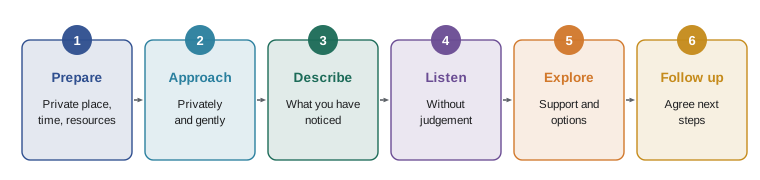
- Prepare. Choose a private, comfortable place and a time when neither of you is rushed. Think about what you have noticed and know what supports are available, such as the EAP, peer support, a crisis line and, for supervisors, workplace adjustments.
- Approach privately and gently. Open with care rather than accusation. For example: "I've noticed you haven't seemed yourself lately, and I wanted to check in. How are you doing?"
- Describe what you have noticed, not what you think it means. Use specific, factual observations: "You've seemed really tired in the morning meetings, and you mentioned you're not sleeping." Avoid labels such as "You seem depressed."
- Listen without judgment. Let the person talk at their own pace. Reflect back what you hear, ask open questions, and accept their feelings without arguing, minimizing ("Everyone gets stressed") or rushing to fix things. Silence is fine.
- Explore support and options. Ask what might help. Share information about the EAP, their family doctor or other health professional, peer support and, if relevant, community services. For supervisors, explore workplace adjustments such as changes to workload, deadlines or schedule. Respect the person's choices; they may not want help right now.
- Agree next steps and follow up. Summarize what you have agreed, offer to check in again, and do so. Follow-up shows that your concern was genuine.
If the person does not want to talk, respect that. Let them know you are there if they change their mind, and leave information about supports. Keep what they share confidential, except where there is a risk to their safety or someone else's, in which case you may need to involve others; be honest about that limit.
What supervisors should and should not do
Supervisors have an additional role, because they control many of the conditions of work and may need to act on performance or attendance. Good practice is to keep the focus on how the person is doing and on what can be changed at work. Supervisors should not ask about a diagnosis or treatment, speculate about mental illness, share what they learn with others who do not need to know, or make promises they cannot keep. If performance is a concern, it is still appropriate to discuss it, but with compassion, and with an explicit offer of support. It often helps to separate the two conversations, or at least lead with care before discussing expectations.
Where a mental health condition may be affecting work, the ADA's interactive process may apply (Lesson 9). Supervisors should involve HR for guidance before taking adverse action when an employee has disclosed a condition or asked for help, and should never ask an employee whether they have a mental illness.
Talking about suicide
If you are worried that someone might be thinking about suicide, the evidence-based advice is to ask directly and calmly. Asking about suicide does not plant the idea or increase risk; it can be a relief for the person and opens the door to help. Use clear words: "Sometimes when people are feeling the way you describe, they think about suicide. Are you thinking about suicide?" Avoid vague phrases like "You're not going to do anything stupid, are you?", which signal that you do not really want to hear the answer.
Signs that call for this question include talking about wanting to die or being a burden, expressing hopelessness, withdrawing from people, giving away possessions, saying goodbye, sudden calm after a period of distress, and increased use of alcohol or drugs. Major losses, such as a relationship breakdown, job loss, financial crisis or a traumatic event, can increase risk.
If the person says yes:
- Stay calm, listen and thank them for telling you. Do not leave them alone if you believe they are in immediate danger.
- Connect them with help now. Encourage them to call or text 988 with you, or contact their doctor, a crisis service or the EAP's crisis line. If there is immediate danger, call 911.
- Help them stay safe. If they have a plan or access to means, the priority is immediate professional help. Do not promise to keep it secret; explain that their safety matters more.
- Follow up. Check in afterwards and continue to offer support.
Safe messaging guidelines from suicide prevention organizations also apply to workplace communication. Talk about suicide openly but carefully, avoid describing methods or details, avoid language that suggests suicide is a solution or is inevitable, avoid sensational or simplistic explanations, and always include information about where to get help.
Mental health training and peer support
Many US workplaces offer structured training that builds these skills. Mental Health First Aid, run in the US by the National Council for Mental Wellbeing, teaches people how to recognize signs of a mental health problem or crisis and provide initial help using an action plan known as ALGEE: assess for risk of suicide or harm, listen nonjudgmentally, give reassurance and information, encourage appropriate professional help, and encourage self-help and other support strategies. Suicide prevention gatekeeper programs such as QPR (question, persuade, refer) teach the basics of asking about suicide and connecting people to help. Peer support programs, in which trained co-workers with lived experience offer support and help with navigation, are common in public safety and health care. These programs complement but do not replace professional care.
Employee assistance programs
Most medium and large employers offer an employee assistance program: a confidential, employer-funded service that provides short-term counseling, crisis support and referrals for workers and often their families, usually by phone, video or in person. Many EAPs also offer financial, legal and family support, and manager consultation lines that help supervisors handle difficult situations. EAP use is typically low, often a few percent of eligible employees a year, partly because of worries about confidentiality and partly because people do not know the service exists. Employers should promote the EAP regularly, explain clearly that it is confidential and that the employer receives only aggregate, anonymous usage data, and make sure supervisors know how to refer people.
Worked problem
Interpreting EAP usage data
An organization of 800 employees receives an annual EAP report showing 36 new cases last year and 58 this year, after a campaign to promote the EAP and train supervisors. The top presenting issues this year were stress and anxiety (40 percent), relationship and family issues (25 percent) and workplace issues (15 percent). Calculate the utilization rates and interpret the change.
Show solution
- Last year: \(36 \div 800 = 0.045\), or 4.5 percent.
- This year: \(58 \div 800 = 0.0725\), or about 7.3 percent.
- Change: \((58 - 36) \div 36 \approx 0.61\), a rise of about 61 percent in new cases.
- Workplace issues as a presenting concern: \(0.15 \times 58 \approx 9\) cases this year.
- Interpretation: the rise coincides with promotion and training, so it most likely reflects greater awareness and trust rather than worse mental health. The data should be read alongside other indicators, such as survey results and absence trends, and only in aggregate.
Answer: Utilization rose from 4.5 percent to about 7.3 percent, a 61 percent increase in new cases, most plausibly a sign that the campaign helped more people seek support. About 9 cases cited workplace issues, a signal worth exploring through confidential surveys rather than individual follow-up.
Looking after yourself
Supporting someone who is struggling can be emotionally demanding, especially if you are close to them or if the situation involves a crisis. It is normal to feel worried, sad or drained afterwards. Look after yourself: talk to someone you trust, use the EAP or a manager consultation line, and set limits on what you can offer. You are not responsible for fixing someone else's problems, and the most helpful thing you can do is often to connect them with people who are trained to help.
Common mistakes
MistakeWaiting until you are sure something is seriously wrong before saying anything.
InsteadReach out early, privately and gently when you notice changes.
MistakeTelling someone what you think their diagnosis is.
InsteadDescribe specific observations and ask how they are doing.
MistakeAvoiding the word suicide because it might give someone the idea.
InsteadAsk directly and calmly; asking does not increase risk and can open the door to help.
MistakePromising to keep a disclosure of suicidal thoughts secret.
InsteadExplain that their safety comes first and help connect them with immediate support.
MistakeTrying to be the person's counselor.
InsteadListen, support and connect them with the EAP, health professionals or crisis services.
Summary and key terms
- Colleagues and supervisors are often the first to notice changes that suggest someone is struggling.
- Look for changes from what is normal for the person, especially several signs lasting more than a couple of weeks.
- A supportive conversation involves preparing, approaching privately, describing observations, listening, exploring support and following up.
- Supervisors should focus on well-being and work adjustments, not diagnosis, and involve HR before discipline when distress is evident.
- If you are worried about suicide, ask directly, stay with the person if in danger and connect them with crisis help.
- Training such as Mental Health First Aid and peer support programs build skills but do not replace professional care.
- Promote the EAP and its confidentiality, and look after yourself when supporting others.
- Supportive conversation
- A private, caring discussion to check in with someone who may be struggling.
- Active listening
- Listening attentively, reflecting back and asking open questions without judging.
- Suicide warning signs
- Behaviors or statements suggesting a person may be thinking about suicide.
- Safe messaging
- Guidelines for talking about suicide that reduce risk and encourage help-seeking.
- Mental Health First Aid
- Training in recognizing and providing initial help for mental health problems and crises.
- Peer support
- Support from trained co-workers, often with lived experience.
- Crisis line
- A free, confidential service offering immediate support to people in distress.
- Manager consultation
- An EAP service that advises supervisors on handling difficult situations.
- Gatekeeper training
- Training that teaches people to recognize suicide risk and connect people with help.
- Utilization rate
- The share of eligible employees who use a service in a period.
Practice problems
Work each problem on paper first, then reveal the answer to check.
What is the most useful sign that someone may be struggling?
Show answer
A noticeable change from what is normal for that person, especially several signs together.
Give an example of an observation-based opening.
Show answer
"I've noticed you've seemed tired and quieter in meetings lately. How are you doing?"
Why should you avoid saying "You seem depressed"?
Show answer
It labels or diagnoses the person instead of describing what you have observed.
Does asking someone whether they are thinking about suicide increase their risk?
Show answer
No. Asking directly can bring relief and open the door to help.
Which number can people in the US call or text in a suicide crisis?
Show answer
988.
What should you do if someone says they are thinking about suicide and you believe they are in immediate danger?
Show answer
Stay with them and call 911 or your local emergency number.
Name two things a supervisor should not do in a supportive conversation.
Show answer
For example, ask about a diagnosis or share the information with people who do not need to know.
30 of 600 employees used the EAP. What is the utilization rate?
Show answer
5 percent.
Why might EAP use be low?
Show answer
Worries about confidentiality and lack of awareness.
What is one way to look after yourself after supporting a colleague?
Show answer
Talk to someone you trust or use the EAP or a manager consultation line.
Lesson quiz · 5 questions
Score 60% or more to complete this lesson.
Create a free account to save your progress, take quizzes and earn a certificate.