
HSE-109 · Lesson 6 of 12 · 25 min
Fatigue, shift work and hours of work
Fatigue is a state of reduced mental or physical capacity caused by inadequate sleep, extended wakefulness, work at times when the body expects to be asleep, or prolonged mental or physical effort. It is both a physical safety hazard and a psychological health hazard. Fatigued workers make more errors, react more slowly and are more likely to be injured or to injure others; over time, chronic fatigue and disrupted sleep are linked to anxiety, depression, burnout and physical illness. This lesson explains the science of sleep and circadian rhythms, the risks of shift work and long hours, the legal limits on hours in both countries and how to assess and control fatigue risk.
Sleep and the body clock
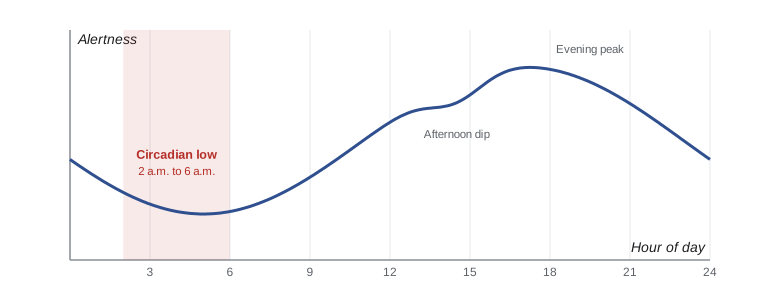
Two systems govern when we feel alert or sleepy. The first is sleep pressure, sometimes called the homeostatic drive. From the moment we wake, a chemical signal builds up in the brain that makes us progressively sleepier the longer we stay awake; sleep clears it. The second is the circadian rhythm, an internal clock of about 24 hours set mainly by light. It makes most people naturally most alert in the late morning and early evening, with a smaller dip in the early afternoon and a deep low between roughly 2 a.m. and 6 a.m. During that early-morning window, alertness, reaction time and judgment are at their worst, even for experienced night workers.
Most adults need about seven to nine hours of sleep a night. Getting less creates a sleep debt that accumulates over consecutive nights. A person who needs 7.5 hours but sleeps 5.5 hours for five nights carries a debt of 10 hours, and their performance can decline to levels similar to someone who has missed a full night of sleep, often without them realizing how impaired they are. Recovery usually takes more than one long sleep.
Extended wakefulness has effects similar to alcohol. Research published in the journal Nature in 1997 by Drew Dawson and Kathryn Reid found that after about 17 hours awake, performance on a tracking task fell to a level similar to that at a blood alcohol concentration of 0.05 percent, and after about 24 hours awake, to a level similar to 0.10 percent. A worker who wakes at 6 a.m. and is still working at 11 p.m. has been awake for 17 hours.
Shift work and night work
Shift work, especially night work and rotating shifts, forces people to work when the body clock expects sleep and sleep when it expects wakefulness. Daytime sleep is typically shorter and lighter than night-time sleep because of light, noise, family life and the circadian push to be awake. Most night workers never fully adapt, because they return to a daytime pattern on days off. The results include chronic sleep loss, fatigue, digestive problems, and higher risks of cardiovascular disease and metabolic disorders; the International Agency for Research on Cancer classifies night shift work as probably carcinogenic to humans. Shift work also strains family and social life, which affects psychological well-being.
Shift schedules can be designed to reduce these harms. Evidence-informed principles include:
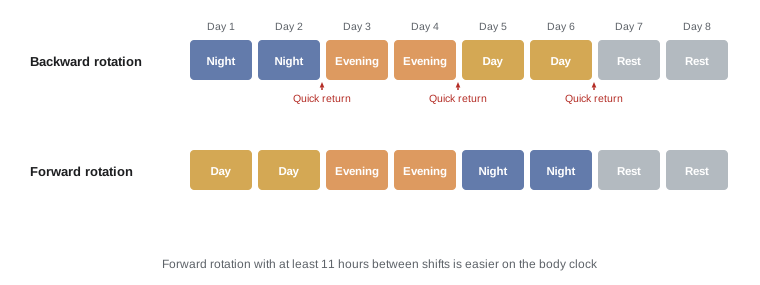
- Rotate forward (day, then evening, then night) rather than backward, because the body clock adjusts more easily to later times.
- Limit consecutive night shifts, commonly to three or four, and consecutive 12-hour shifts, to limit the build-up of sleep debt.
- Avoid quick returns: allow at least 11 hours between the end of one shift and the start of the next, so workers can travel, eat and get a full sleep.
- Provide at least two full nights of rest after a block of night shifts.
- Keep shift start times sensible: very early starts, before about 6 a.m., cut into sleep, and very late finishes affect commuting safety.
- Give schedules well in advance and minimize last-minute changes, so workers can plan sleep and family life.
- Schedule the most demanding or safety-critical tasks away from the circadian low where possible, and allow breaks and, where policy permits, planned short naps.
Long hours and overtime
Long hours add to fatigue whether or not shift work is involved. Risk of error and injury tends to rise with shift length, especially beyond about 10 to 12 hours, and with consecutive long days. Mandatory overtime, on-call duty that disrupts sleep, long commutes and second jobs all reduce the time available for recovery. Remote and hybrid work can blur boundaries so that working hours quietly expand into evenings. As Lesson 5 noted, the WHO and ILO have linked working 55 or more hours a week with higher risks of stroke and heart disease.
Legal limits on hours
In the US, the Fair Labor Standards Act requires overtime pay for non-exempt employees beyond 40 hours a week but sets no maximum hours for adults. A few states restrict mandatory overtime in specific occupations, most commonly nursing, and some cities and states have predictable scheduling laws for retail and food service workers. Safety-critical sectors have federal hours-of-service rules. The Federal Motor Carrier Safety Administration's rules for property-carrying commercial drivers allow up to 11 hours of driving after 10 consecutive hours off duty, prohibit driving beyond the 14th hour after coming on duty, require a 30-minute break after 8 cumulative hours of driving, and limit drivers to 60 hours on duty in 7 days or 70 hours in 8 days, with a 34-hour restart option; electronic logging devices are required for most drivers. The Federal Aviation Administration's Part 117 sets flight and duty limits and rest requirements for passenger airline pilots, and the Federal Railroad Administration enforces statutory hours-of-service limits for railroad workers.
| Rule | FMCSA property-carrying drivers | Notes |
|---|---|---|
| Daily driving | Up to 11 hours | After 10 consecutive hours off duty |
| Duty window | No driving after the 14th hour on duty | Breaks do not extend the window |
| Break | 30 minutes | After 8 cumulative hours of driving |
| Weekly limit | 60 hours in 7 days or 70 hours in 8 days | A 34-hour restart resets the period |
| Records | Electronic logging device | Required for most drivers |
Complying with legal limits does not by itself mean fatigue is controlled. A worker can be within the hours limits and still be dangerously tired because of poor-quality sleep, a sick child, a long commute or a second job. That is why many safety-critical industries now use fatigue risk management systems.
Fatigue risk management
A fatigue risk management system (FRMS) is a data-driven, risk-based approach to managing fatigue, used in aviation, rail, mining, oil and gas, health care and other industries. Instead of relying only on prescriptive hours limits, an FRMS combines several layers of defense: scheduling that allows adequate sleep opportunity; checking whether workers actually obtained enough sleep; recognizing signs of fatigue on the job; reporting and responding to fatigue-related errors and incidents; and learning from data. It requires a policy, clear responsibilities, training for workers and supervisors, a reporting system that does not punish people for reporting fatigue, and regular review.
One widely used check in fatigue management comes from Australian research by Drew Dawson and Kirsty McCulloch. It compares the sleep a worker has had with the time they will be awake. A common version uses three rules: at least 5 hours of sleep in the previous 24 hours; at least 12 hours of sleep in the previous 48 hours; and the hours awake by the end of the shift should not exceed the hours slept in the previous 48 hours. A worker who does not meet these thresholds is at higher risk, and the response might be to discuss it with a supervisor, assign less safety-critical tasks, increase supervision, allow a nap or, in safety-critical roles, stand the worker down.
Worked problem
Checking prior sleep and wake against fatigue rules
A maintenance technician slept 4.5 hours last night and 6 hours the night before. She woke at 5 a.m. and is scheduled to work until 9 p.m. Apply the three prior sleep and wake rules, and calculate her sleep debt over the two nights if she needs 7.5 hours a night.
Show solution
- Rule 1, sleep in the previous 24 hours: 4.5 hours is less than 5 hours, so the rule is not met.
- Rule 2, sleep in the previous 48 hours: \(4.5 + 6 = 10.5\) hours, less than 12 hours, so the rule is not met.
- Rule 3, hours awake at the end of the shift: from 5 a.m. to 9 p.m. is 16 hours, more than the 10.5 hours slept in 48 hours, so the rule is not met.
- Sleep debt: \(2 \times 7.5 - 10.5 = 4.5\) hours over two nights.
- Response: she fails all three checks. Controls could include shortening the shift, assigning lower-risk tasks with a second person for critical work, a planned rest break or nap, and arranging safe transport home.
Answer: All three checks are failed and she carries a 4.5-hour sleep debt, so she is at elevated fatigue risk. The supervisor should apply controls, and in a safety-critical role, consider standing her down from critical tasks.
Recognizing fatigue
Signs of fatigue include yawning, heavy eyelids, rubbing eyes, head nodding, staring blankly, slow reactions, forgetfulness, poor concentration, irritability, reduced communication and microsleeps, brief episodes of sleep lasting a few seconds that a person may not notice. Fatigue impairs self-assessment, so a tired worker often underestimates how impaired they are. Workplaces should make it easy and safe to say "I'm too tired to do this safely" and should treat fatigue reports as useful safety information, not a disciplinary matter. Supervisors should also watch for patterns: repeated overtime, back-to-back shifts and workers who seem to be holding second jobs.
Controls for fatigue
Using the hierarchy of controls, the most effective fatigue controls are in the design of work: adequate staffing so that overtime is not routine; schedules that follow the principles above; limits on consecutive shifts and total hours; and avoiding safety-critical tasks at the circadian low. Environmental controls include good lighting, comfortable temperatures, places for rest breaks and, where appropriate, napping facilities. Administrative controls include fatigue policies, training, reporting systems, task rotation and fatigue checks. Individual measures include good sleep habits, managing caffeine, avoiding alcohol before sleep, darkening the bedroom for daytime sleep and seeking help for sleep disorders such as sleep apnea, which is common and treatable. Safe travel home after night shifts, such as transport or a place to rest, can prevent fatigue-related crashes.
Common mistakes
MistakeAssuming compliance with hours limits means fatigue is controlled.
InsteadCheck actual sleep and other factors, and use a fatigue risk management approach.
MistakeRelying on workers to judge their own fatigue.
InsteadUse objective checks such as prior sleep and wake rules, because fatigue impairs self-assessment.
MistakeDesigning backward-rotating schedules with quick returns.
InsteadRotate forward and allow at least 11 hours between shifts.
MistakeDisciplining workers who report being too tired.
InsteadTreat fatigue reports as safety information and respond with controls.
MistakeScheduling the most safety-critical tasks for 3 a.m. by habit.
InsteadAvoid critical tasks during the circadian low where possible, or add checks and supervision.
Summary and key terms
- Fatigue reduces capacity and harms both safety and psychological health.
- Alertness depends on sleep pressure and the circadian rhythm, which is lowest roughly between 2 a.m. and 6 a.m.
- Most adults need seven to nine hours of sleep; shortfalls accumulate as sleep debt.
- About 17 hours awake impairs performance similarly to a blood alcohol concentration of 0.05 percent.
- Good schedules rotate forward, limit consecutive nights and avoid quick returns.
- Legal hours limits exist, especially for transport, but compliance alone does not control fatigue.
- Fatigue risk management systems combine scheduling, sleep checks, recognition, reporting and learning.
- Fatigue
- Reduced mental or physical capacity from lack of sleep, extended wakefulness or prolonged effort.
- Circadian rhythm
- The body's roughly 24-hour internal clock, set mainly by light.
- Circadian low
- The period of lowest alertness, roughly between 2 a.m. and 6 a.m.
- Sleep debt
- The accumulated shortfall between sleep needed and sleep obtained.
- Quick return
- A gap of less than about 11 hours between shifts.
- Forward rotation
- A schedule that moves from day to evening to night shifts.
- Microsleep
- A brief, often unnoticed episode of sleep lasting seconds.
- Fatigue risk management system
- A data-driven system for managing fatigue risk with multiple layers of defense.
- Hours of service
- Legal limits on driving or duty time in transportation.
- Sleep apnea
- A common sleep disorder in which breathing repeatedly stops during sleep.
Practice problems
Work each problem on paper first, then reveal the answer to check.
When is the circadian low?
Show answer
Roughly between 2 a.m. and 6 a.m.
A worker needs 8 hours but sleeps 6 hours for four nights. What is the sleep debt?
Show answer
4 × 2 = 8 hours.
About how many hours awake produce impairment similar to a BAC of 0.05 percent?
Show answer
About 17 hours.
Why is forward rotation preferred?
Show answer
The body clock adjusts more easily to later shift times.
What is a quick return?
Show answer
Less than about 11 hours between the end of one shift and the start of the next.
How long is the duty window for FMCSA property-carrying drivers?
Show answer
Drivers may not drive beyond the 14th hour after coming on duty.
A worker slept 6 hours last night and 5 the night before and will be awake 13 hours. Does she meet the three prior sleep and wake rules?
Show answer
No. Rule 1 is met (6 hours in 24), but rule 2 fails (11 hours in 48 is less than 12) and rule 3 fails (13 hours awake is more than the 11 hours slept).
Name three signs of fatigue.
Show answer
For example, yawning, slow reactions and microsleeps.
Why can workers not rely on judging their own fatigue?
Show answer
Fatigue impairs self-assessment, so people underestimate their impairment.
Give one design-level control for fatigue.
Show answer
Adequate staffing so overtime is not routine, or schedules with forward rotation and adequate gaps.
Lesson quiz · 5 questions
Score 60% or more to complete this lesson.
Create a free account to save your progress, take quizzes and earn a certificate.