
HSE-109 · Lesson 4 of 12 · 24 min
Psychological health, safety and the law in the US
Psychological health and safety in the US sits at the meeting point of several bodies of law: the Occupational Safety and Health Act, federal anti-discrimination and leave laws, state workers' compensation systems, state employment laws and labor law. Unlike some other countries, the US has no federal regulation that specifically requires employers to assess and control psychosocial hazards, so voluntary standards and guidance, such as ISO 45003 and the Surgeon General's Framework for Workplace Mental Health and Well-Being, play a large part. This lesson gives an overview of the main duties.
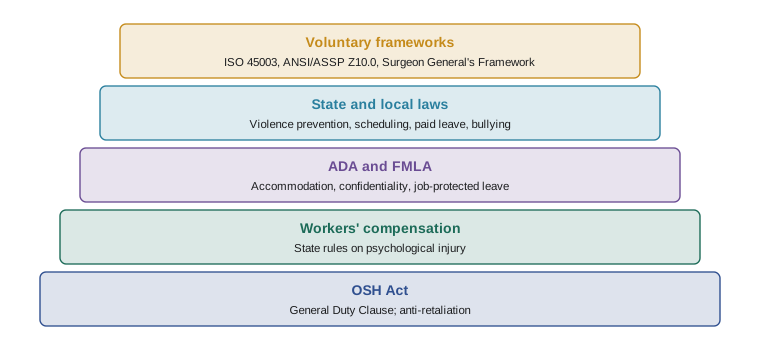
The OSH Act and the General Duty Clause
Section 5(a)(1) of the Occupational Safety and Health Act of 1970, the General Duty Clause, requires every employer to furnish a place of employment free from recognized hazards that are causing or are likely to cause death or serious physical harm. OSHA uses the clause for hazards that have no specific standard, such as workplace violence and some ergonomic hazards. In principle it could apply to psychosocial hazards, but the wording focuses on death or serious physical harm, and OSHA has not used it to cite employers for general workplace stress. OSHA does publish resources on workplace stress and mental health, and the National Institute for Occupational Safety and Health (NIOSH) promotes a Total Worker Health approach that integrates protection from work-related hazards with the promotion of well-being.
Because there is no federal psychosocial standard, protection comes from a patchwork. OSHA's recordkeeping rule (29 CFR 1904) treats mental illness cases as recordable only when an employee voluntarily provides a statement from a physician or other licensed health care professional that the illness is work-related, which means many psychological injuries never appear in OSHA logs. Some states have their own workplace safety rules on violence prevention, such as California's Labor Code section 6401.9, which carry psychological benefits, and a few jurisdictions, such as Puerto Rico, have laws prohibiting workplace bullying. Federal contractors and agencies may also be covered by specific program requirements. Workers who raise concerns about safety, including psychological safety, are protected from retaliation under Section 11(c) of the OSH Act and, when acting together about working conditions, under the National Labor Relations Act.
Privacy and confidentiality of health information
Every part of psychological health and safety depends on trust, and trust depends on privacy. The ADA requires employers to keep any medical information they obtain about employees confidential and in separate medical files, apart from personnel files, with access limited to those who need it. Supervisors may be told about necessary work restrictions and accommodations, first aid and safety personnel may be told if emergency treatment might be needed, and government officials investigating compliance may be given access, but the diagnosis itself should not be shared with co-workers. Many people assume the Health Insurance Portability and Accountability Act (HIPAA) governs all health information at work; in fact HIPAA applies to health plans, health care providers and clearinghouses, not to employers acting as employers, although an employer's group health plan is covered. The Genetic Information Nondiscrimination Act (GINA) restricts employers from requesting, requiring or using genetic information, including family medical history, which can come up in mental health discussions. Several states have additional privacy or medical confidentiality laws. In practice, an employer is generally entitled to know an employee's functional limitations, the expected duration and the accommodation needed, not the full diagnosis or treatment details, and a careless disclosure can create legal liability and destroy the trust that a psychological health and safety program needs.
In practice, the general duty means that an employer who knows, or should know, about a serious psychosocial hazard, such as a supervisor who bullies staff, chronic understaffing that leads to exhaustion, or repeated exposure to traumatic events without support, should take reasonable steps to control it. What is reasonable depends on the risk, the knowledge available and the cost and feasibility of controls, the same test that applies to physical hazards.
What does a reasonable employer actually do to meet these duties? Decisions by courts, tribunals, arbitrators and regulators, together with the voluntary standards, point to a consistent set of practices: having a written policy that addresses psychological health and safety, harassment and violence; identifying psychosocial hazards with worker input and taking reasonable steps to control the significant ones; training supervisors to recognize and respond to problems; providing access to support such as an EAP; responding promptly and fairly to complaints and incidents; accommodating workers with mental health conditions; and keeping records that show what was done. None of these requires perfection. They require that the employer take the risk seriously, act on what it knows and be able to show that it did.
Workers' compensation for psychological injury
Workers' compensation is run by each state, and coverage for psychological injury varies more than almost any other area. Common patterns include:
- Physical-mental claims: almost every state covers mental conditions that result from a physical work injury, such as depression after a serious accident.
- Mental-physical claims: many states cover physical conditions, such as a heart attack, caused by work-related mental stress, although proof requirements can be demanding.
- Mental-mental claims: a mental condition caused by mental stress without physical injury. Some states accept these claims, often only if the stress was extraordinary or unusual compared with ordinary employment; others accept only sudden, traumatic events; and some exclude them almost entirely. Many states have adopted presumptions or special rules covering PTSD for first responders.
- Exclusions: most states exclude stress caused by good-faith personnel actions such as discipline, transfer, demotion or termination.
The Americans with Disabilities Act and the FMLA
Title I of the Americans with Disabilities Act (ADA) applies to employers with 15 or more employees and prohibits discrimination against qualified individuals with disabilities, including mental health conditions that substantially limit a major life activity. Since the ADA Amendments Act of 2008, the definition of disability is interpreted broadly, and EEOC regulations say that conditions such as major depressive disorder, bipolar disorder, PTSD, obsessive-compulsive disorder and schizophrenia should easily be found to be disabilities. Employers must provide reasonable accommodations unless doing so would cause undue hardship, must keep medical information confidential, and may make disability-related inquiries of current employees only when they are job-related and consistent with business necessity. The Family and Medical Leave Act (FMLA) gives eligible employees up to 12 weeks of unpaid, job-protected leave a year for a serious health condition, which can include a mental health condition requiring inpatient care or continuing treatment. Many states and cities also have paid sick leave laws that cover mental health.
State employment laws and labor law
The Fair Labor Standards Act regulates overtime pay but sets no limit on hours for adult workers, so limits on hours mostly come from sector rules such as transportation hours of service (Lesson 6), state laws on rest or mandatory overtime in some occupations such as nursing, and collective bargaining agreements. Some states have adopted laws on predictable scheduling in retail and food service, which reduce a well-known stressor. Union contracts may include workload, staffing and grievance provisions, and labor law protects workers who act together to raise concerns about stress and working conditions.
Voluntary standards and frameworks
ISO 45003:2021 provides international guidance for managing psychosocial risks within an ISO 45001 occupational health and safety management system. ANSI/ASSP Z10.0, the American national standard for occupational health and safety management systems, also supports a systematic approach. The Surgeon General's Framework for Workplace Mental Health and Well-Being, published in 2022, sets out five essentials and is widely used by employers as a guide. NIOSH's Total Worker Health program offers free tools for integrating safety and well-being. Some US organizations use the Canadian national standard, CSA Z1003, as a model. Although voluntary, these frameworks help define what a reasonable employer does and may be cited in litigation, insurance and contracts.
| Source | What it requires or offers | Examples |
|---|---|---|
| OSH Act | General Duty Clause for recognized serious hazards; anti-retaliation protection | Section 5(a)(1); Section 11(c); recordkeeping rule for mental illness |
| Workers' compensation (state) | Compensation for some psychological injuries, with wide variation | Physical-mental claims; mental-mental claims in some states; first responder PTSD rules |
| ADA and state disability laws | No discrimination based on disability; reasonable accommodation; confidentiality | ADA Title I; EEOC regulations; state human rights laws |
| FMLA and leave laws | Job-protected leave for serious health conditions | Up to 12 weeks unpaid FMLA leave; state paid sick leave |
| Voluntary frameworks | Systematic approach to psychosocial risk and well-being | ISO 45003; ANSI/ASSP Z10.0; Surgeon General's Framework; NIOSH Total Worker Health |
Worked problem
Is a worker eligible for FMLA leave, and what does the ADA require?
A worker at a 120-person company in one location has worked there for 14 months and recorded 1,410 hours in the last 12 months. His therapist says he needs six weeks off for treatment of a major depressive episode, followed by a modified schedule. Is he eligible for FMLA leave, and what does the ADA add?
Show solution
- Employer coverage: FMLA covers private employers with 50 or more employees; 120 employees at one site meets this.
- Employee eligibility: at least 12 months of employment (14 months, yes) and at least 1,250 hours in the past 12 months (1,410, yes).
- Serious health condition: a major depressive episode requiring continuing treatment by a health care provider qualifies.
- Leave: up to 12 weeks of unpaid, job-protected leave a year; six weeks plus a reduced schedule if medically necessary are within this, and health benefits continue.
- ADA: the condition is very likely a disability, so the employer must engage in the interactive process and consider reasonable accommodations such as a modified schedule, keep medical information confidential and not retaliate.
Answer: Yes, he is eligible for FMLA leave (50+ employees, 12 months, 1,250 hours). The ADA adds the duty to consider reasonable accommodation, such as the modified schedule, through an interactive process, and to protect confidentiality.
Common mistakes
MistakeAssuming no law applies because there is no OSHA psychosocial standard.
InsteadConsider the General Duty Clause, ADA, FMLA, state workers' compensation and state laws together.
MistakeTreating abusive behavior as performance management.
InsteadDistinguish good-faith management decisions from harassment, which is not excluded from duties or claims.
MistakeThinking voluntary frameworks have no legal weight.
InsteadUse them as benchmarks of reasonable practice that may be cited in litigation, insurance and contracts.
MistakeWaiting for a worker to request accommodation before acting on clear signs of a problem.
InsteadEngage in the interactive process when the employer knows of a disability and need, and handle inquiries lawfully.
MistakeApplying another jurisdiction's rules.
InsteadCheck the specific federal, state and local law that applies.
Summary and key terms
- There is no federal OSHA standard specifically on psychosocial hazards.
- The General Duty Clause covers recognized serious hazards but has not been used for general stress.
- OSHA records mental illness cases only with a professional's statement of work-relatedness provided by the employee.
- State workers' compensation coverage for psychological injury varies widely, especially for mental-mental claims.
- The ADA requires reasonable accommodation of mental health disabilities, and the FMLA provides up to 12 weeks of job-protected leave.
- State laws on violence, scheduling, leave and bullying add further protections.
- ISO 45003, ANSI/ASSP Z10.0 and the Surgeon General's Framework guide good practice.
- General duty
- A broad legal duty to protect workers from hazards, including those without specific rules.
- Chronic mental stress
- Mental stress caused by a substantial work-related stressor over time.
- Traumatic mental stress
- An acute reaction to a sudden, shocking work event.
- Presumption
- A legal rule that a condition is work-related for certain occupations unless shown otherwise.
- Duty to accommodate
- The obligation to adjust work for a worker with a disability, short of undue hardship.
- Undue hardship
- The point at which accommodation would impose excessive cost or risk.
- Mental-mental claim
- A claim for a mental condition caused by mental stress without physical injury.
- Interactive process
- A good-faith dialogue between employer and worker to identify accommodations.
- Bona fide occupational requirement
- A job requirement that is genuinely necessary and cannot be adjusted without undue hardship.
- ISO 45003
- International guidelines for managing psychosocial risks at work.
Practice problems
Work each problem on paper first, then reveal the answer to check.
What does the General Duty Clause require?
Show answer
A workplace free from recognized hazards causing or likely to cause death or serious physical harm.
Is there a federal OSHA standard on psychosocial hazards?
Show answer
No.
When is a mental illness case recordable on OSHA logs?
Show answer
When the employee voluntarily provides a professional's statement that it is work-related.
What is a mental-mental claim?
Show answer
A claim for a mental condition caused by mental stress without physical injury.
How many employees must an employer have for ADA Title I to apply?
Show answer
15 or more.
How much FMLA leave can an eligible employee take?
Show answer
Up to 12 weeks of unpaid, job-protected leave in a 12-month period.
What hours requirement applies for FMLA eligibility?
Show answer
At least 1,250 hours worked in the previous 12 months.
Which section of the OSH Act protects workers who raise safety concerns?
Show answer
Section 11(c).
Name two voluntary frameworks used in the US.
Show answer
For example, ISO 45003 and the Surgeon General's Framework for Workplace Mental Health and Well-Being.
What do most states exclude from stress claims?
Show answer
Stress from good-faith personnel actions such as discipline or termination.
Lesson quiz · 5 questions
Score 60% or more to complete this lesson.
Create a free account to save your progress, take quizzes and earn a certificate.