
HSE-103 · Lesson 4 of 12 · 25 min
Recognizing hazards: inspections, observation and reporting
Hazards cannot be controlled until someone notices them. Some hazards are obvious, but many are hidden by familiarity, by routine, or because they only appear during unusual work. Organizations that are good at safety use several complementary ways of finding hazards: workplace inspections, observing tasks, listening to workers, analyzing incidents and near misses, reviewing information such as manuals and safety data sheets, and anticipating hazards before new work or equipment arrives. This lesson covers the main sources of hazard information, how to plan and carry out workplace inspections, energy-based and "what could go wrong" techniques, observing work as it is really done, hazard reporting systems, near misses and incident data, and the human factors that make people miss hazards.
Sources of hazard information
Hazard recognition draws on many sources:
- The workplace itself: walking through work areas and watching tasks.
- Workers and supervisors: the people who do the work daily often know where the problems are, including workarounds and near misses never reported.
- Records: incident and injury reports, first aid logs, near miss reports, workers' compensation claims, inspection reports, maintenance logs and equipment downtime records.
- Documents: equipment manuals and manufacturers' instructions, safety data sheets, drawings, procedures and permits.
- Monitoring: air sampling, noise surveys, heat measurements and health surveillance results.
- External information: regulator alerts, industry incident reports, manufacturer recalls, insurer bulletins and safety associations.
- Changes: new equipment, processes, materials, staff, contractors or buildings, which introduce new hazards (Lesson 10).
No single source is enough. Inspections find conditions but may miss behaviors and intermittent tasks; records show what has already happened; workers know the daily reality but may not recognize chronic hazards. Combining sources gives the fullest picture.
Workplace inspections
Workplace inspections are planned, systematic examinations of work areas, equipment and practices to identify hazards and check controls. Many jurisdictions require regular inspections, often carried out with or by members of the joint health and safety committee or health and safety representative. Types of inspection include:
- Planned general inspections: regular walk-throughs of all areas on a set schedule, often monthly.
- Pre-use and pre-shift checks: operators check equipment such as forklifts, ladders, cranes and vehicles before use.
- Specialized inspections: by competent persons for specific equipment, such as scaffolds, rigging, pressure vessels, fire protection and electrical systems, often required by regulation and manufacturers.
- Informal inspections: supervisors and workers noticing and correcting hazards during daily work.
- Special inspections: after incidents, before new processes start, or after severe weather.
Planning and carrying out an inspection
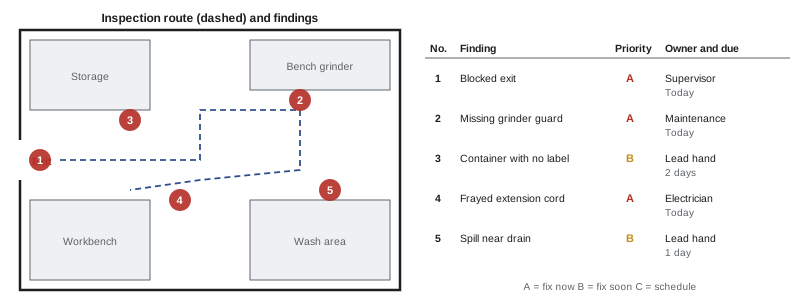
Effective inspections are planned. Before starting, define the area and scope; review previous inspection reports and outstanding corrective actions, incident records, and relevant procedures; and prepare a checklist tailored to the area. Bring appropriate PPE, a camera or tablet, a flashlight and measuring tools if needed. During the inspection, walk through the area methodically, look up, down and behind equipment, talk to workers about their tasks and concerns, observe work in progress, check that controls such as guards, ventilation, labels, exits and emergency equipment are in place and working, and note hazards with their location and a photograph. Do not attempt to fix serious hazards yourself unless trained and authorized, but ensure imminent dangers are dealt with immediately by stopping the work or isolating the hazard. Afterward, write a report that describes each hazard specifically, rates its priority, recommends corrective actions, assigns responsibility and target dates, and follows up until each item is closed.
| Element | Good practice |
|---|---|
| Checklist | Tailored to the area; prompts but does not limit observation |
| Team | Includes workers and supervisors; committee members where required |
| Observation | Look at conditions and at how work is actually done |
| Recording | Specific location, description, photograph, priority |
| Corrective action | Responsible person and target date for each item |
| Follow-up | Track to completion; verify that fixes work |
Checklists: uses and limits
Checklists help inspectors remember common hazards and make inspections consistent, but they also have limits. A checklist cannot anticipate every hazard, and inspectors who only tick boxes may stop looking for anything not on the list. Generic checklists downloaded from the internet may not reflect the actual hazards of a workplace. Good checklists are specific to the area, are reviewed and updated after incidents and changes, include open questions such as "What else could cause harm here?", and leave space for comments and photographs. They are a starting point, not a substitute for careful observation and judgment.
Energy-based hazard recognition
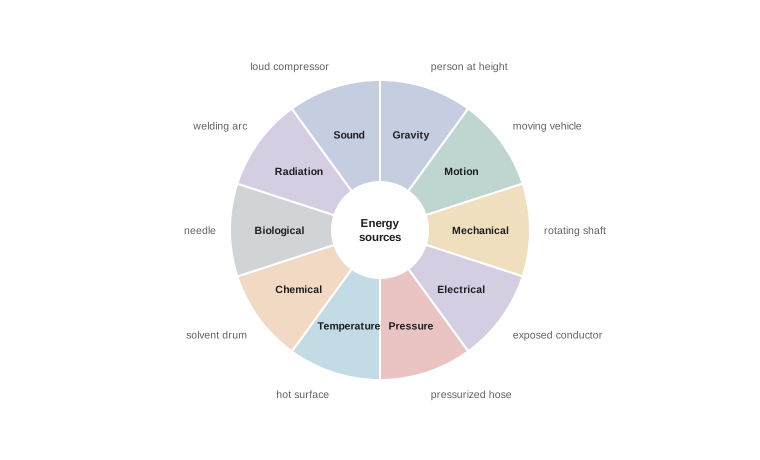
Research in construction and industrial safety has shown that people often fail to recognize a large share of the hazards present in a task, particularly unusual ones. One effective technique is to look systematically for sources of energy, since most serious injuries involve the uncontrolled release or transfer of energy to a person. An energy wheel lists categories such as gravity, motion, mechanical, electrical, pressure, temperature, chemical, biological, radiation and sound, and prompts the observer to look for each. The more energy involved, the more severe the potential harm: a heavy load suspended overhead, a high-voltage line, a pressurized line or a vehicle moving at speed all represent high-energy hazards that deserve the strongest controls. Some organizations focus specifically on high-energy hazards capable of causing serious injuries and fatalities, using research showing that such hazards are most dangerous when direct controls, such as guards, isolation and barriers, are absent.
Observing work as it is really done
There is often a gap between work as imagined, described in procedures and drawings, and work as done, how people actually carry out tasks under real conditions with real constraints. Workers adapt to missing tools, time pressure, equipment faults and changing conditions, and these adaptations can introduce hazards, or sometimes reveal better ways of working. Observing tasks directly, at different times and shifts, including start-up, changeover, cleaning and maintenance, and asking workers to explain what they do and what makes the job difficult, reveals hazards that no inspection checklist will find. Observations should be respectful and focused on learning about the work, not on catching people breaking rules; workers who feel blamed will hide problems.
Worked problem
Finding the hidden hazard in a routine task
A bakery's inspection checklist shows the dough mixer guard in place and the emergency stop working. Yet a worker suffered a hand injury at the mixer last year. What might observation reveal?
Show solution
- Observe the full cycle, including scraping dough from the bowl, adding ingredients and cleaning at the end of the shift.
- Ask the operator how they deal with dough sticking to the bowl during mixing.
- The operator explains that, under time pressure, people sometimes lift the guard slightly and scrape while the mixer slows down, because the interlock only stops the motor once the guard is fully open.
- Record the hazard: hand contact with a coasting mixing arm during scraping. Controls could include a guard interlock that prevents opening until motion stops, a scraping tool, and changing the recipe or bowl coating to reduce sticking.
Answer: Observation reveals a workaround during scraping, with the mixer coasting, that the condition-based checklist could not detect.
Hazard reporting systems
Workers are often the first to notice hazards, so organizations need simple, trusted ways for them to report. Effective reporting systems make it easy to report, through forms, apps, QR codes, suggestion boxes or simply telling a supervisor; respond quickly, acknowledging reports and explaining what will be done; protect reporters from blame or reprisal, which is also a legal requirement in both countries; track reports to closure; and share results, so that people see that reporting makes a difference. Low numbers of hazard reports usually indicate not a safe workplace but a lack of trust or an inconvenient system. Supervisors play a crucial role: how they react to the first reports sets the tone for whether people keep reporting.
Near misses and incident data
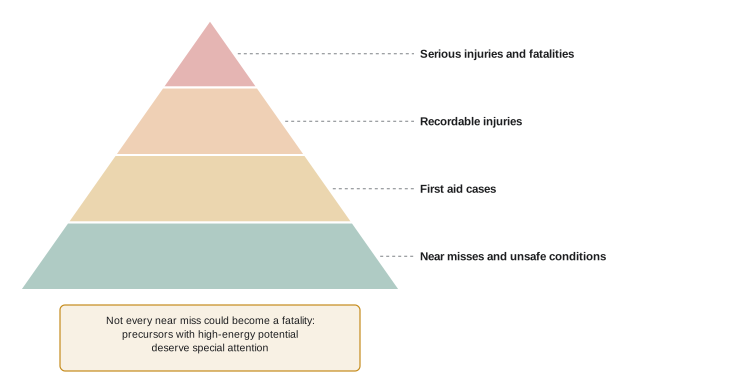
A near miss, or close call, is an event that could have caused harm but did not, such as a load slipping from a sling and landing a meter from a worker. Near misses are valuable because they reveal hazards and control failures without the cost of an injury. Many organizations encourage near miss reporting and investigate significant ones as seriously as injuries. Incident and injury data, analyzed over time, also reveal patterns: frequent hand injuries in one department, back injuries on a particular shift, or vehicle incidents at one intersection. However, injury rates are lagging indicators that measure past harm; they say little about the potential for serious injuries and fatalities, which are rare events. A workplace with a low injury rate can still have uncontrolled high-energy hazards. Leading indicators, such as inspection completion, hazard reports closed and training delivered, help measure proactive work.
Human factors in hazard recognition
People miss hazards for predictable reasons. Familiarity breeds complacency: hazards that have been present for years without incident become invisible. Attention is limited, and people under time pressure or fatigue focus on getting the job done. Expectations shape perception: people see what they expect to see and miss what is unusual. Optimism bias leads people to believe that harm happens to others. Social pressure discourages speaking up, particularly for new or junior workers. Techniques to counter these factors include using fresh eyes, such as workers from other departments or outside reviewers; structured methods such as energy wheels and checklists; pausing before work to consider what has changed; and building a culture in which questioning is expected and welcomed.
Using records and outside information
Hazard recognition does not rely only on looking at the workplace today. Records reveal patterns that a single walk-through cannot. Injury and illness logs, first aid records, workers' compensation claims, near miss reports and absenteeism data can show where and how people are being hurt. Maintenance records show which equipment fails often and which safety devices are frequently repaired or bypassed. Purchase records show which chemicals are actually in use. Complaints and grievances may point to psychosocial hazards such as harassment or excessive workload. Outside sources add knowledge from beyond the workplace: manufacturers' manuals and safety data sheets, regulator alerts and fatality reports, industry association guidance, insurance loss-control reports, and investigations of incidents at similar workplaces. A hazard that has injured someone in another company is a hazard here too, until shown otherwise.
Non-routine work and the hidden hazards
Many serious incidents occur during non-routine work: maintenance, cleaning, clearing jams, start-up and shutdown, changeovers, troubleshooting, emergencies and one-off tasks. These activities often involve bypassing normal guards, entering areas not usually occupied, working with stored energy and improvising tools or methods. Because they are infrequent, there may be no written procedure, and workers may lack experience. Hazard recognition should deliberately look at these activities: ask maintenance staff, cleaners and contractors what they do and what worries them, observe changeovers and jam clearing, and review work orders for tasks that recur often enough to need a formal assessment. Night and weekend work, when staffing and supervision are thin, deserves similar attention.
Finally, remember that hazard recognition improves with practice and with diversity of viewpoint. An inspection team that includes a new worker, an experienced worker, a supervisor and someone from another department will see more than any one of them alone, because each notices different things and questions different assumptions.
Record each hazard found with its location, the date, who found it and what was done, so that patterns can be seen over time and repeat problems are not forgotten between inspections.
Common mistakes
MistakeRelying only on checklists.
InsteadCombine checklists with open observation and questions.
MistakeInspecting without talking to workers.
InsteadAsk workers about their tasks and concerns.
MistakeRecording findings without follow-up.
InsteadAssign responsibility and dates, and track to closure.
MistakeTreating a low injury rate as proof of safety.
InsteadLook for high-energy hazards and precursors.
MistakeBlaming people who report hazards or near misses.
InsteadThank, respond and protect reporters.
Summary and key terms
- Hazard information comes from the workplace, workers, records, documents, monitoring and changes.
- Inspections should be planned, systematic and followed up.
- Checklists help but cannot replace observation and judgment.
- Energy-based recognition highlights high-energy hazards.
- Observing work as done reveals workarounds and hidden hazards.
- Trusted reporting systems and near miss reporting reveal hazards early.
- Human factors such as familiarity and time pressure cause hazards to be missed.
- Workplace inspection
- Systematic examination of work areas and practices.
- Pre-use check
- Inspection of equipment before use.
- Checklist
- List of items to prompt inspection.
- Energy wheel
- Tool listing energy types to prompt hazard recognition.
- Work as done
- How work is actually carried out.
- Work as imagined
- How work is described in procedures.
- Near miss
- Event that could have caused harm but did not.
- Lagging indicator
- Measure of past harm, such as injury rates.
- Leading indicator
- Measure of proactive safety activity.
- Complacency
- Reduced attention to familiar hazards.
Practice problems
Work each problem on paper first, then reveal the answer to check.
Name four sources of hazard information.
Show answer
Inspections, workers, records, manuals, SDSs, monitoring, alerts.
Name three types of inspection.
Show answer
Planned general, pre-use, specialized, informal, special.
What should an inspection report include?
Show answer
Specific hazards, priority, actions, responsible person, dates.
What is a limitation of checklists?
Show answer
They cannot anticipate every hazard and may stop people looking.
Name five energy types on an energy wheel.
Show answer
Gravity, motion, mechanical, electrical, pressure, temperature, chemical.
What is the gap between work as imagined and work as done?
Show answer
Differences between procedures and real practice.
Why are near misses valuable?
Show answer
They reveal hazards without injury.
Why are injury rates limited?
Show answer
They are lagging and say little about serious-injury potential.
What do low hazard report numbers often indicate?
Show answer
Lack of trust or an inconvenient system.
Name two human factors in missing hazards.
Show answer
Familiarity, time pressure, fatigue, expectation, optimism bias.
Lesson quiz · 5 questions
Score 60% or more to complete this lesson.
Create a free account to save your progress, take quizzes and earn a certificate.