
HSE-103 · Lesson 2 of 12 · 25 min
Legal duties to assess and control hazards in the US
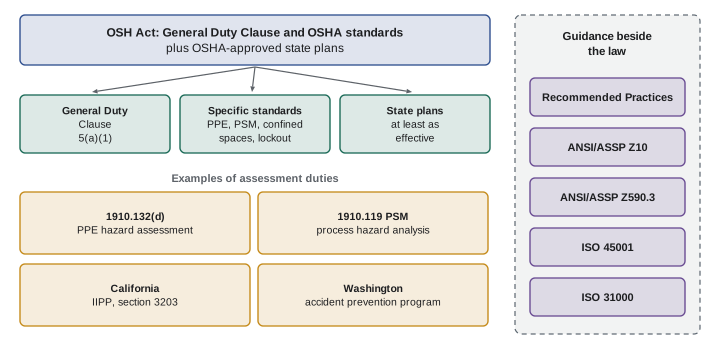
In the United States, occupational safety and health law is set mainly by the federal Occupational Safety and Health Act of 1970 and the standards issued by the Occupational Safety and Health Administration (OSHA), together with OSHA-approved state plans that cover about half the states and territories. There is no single federal rule requiring every employer to carry out a general written hazard assessment, but several OSHA standards require hazard assessments for specific hazards, the General Duty Clause requires employers to address recognized serious hazards, and many state laws and consensus standards go further. This lesson explains how these pieces fit together.
The OSH Act and the General Duty Clause
The OSH Act requires each employer to comply with OSHA standards and, under Section 5(a)(1), known as the General Duty Clause, to furnish employment and a place of employment free from recognized hazards that are causing or are likely to cause death or serious physical harm. OSHA uses the General Duty Clause to cite employers for serious hazards not covered by a specific standard, such as workplace violence in some settings, heat stress or ergonomic hazards. To prove a General Duty Clause violation, OSHA must generally show that a hazard existed, that it was recognized by the employer or its industry, that it was causing or likely to cause death or serious physical harm, and that a feasible means of abatement existed. In practice, this means employers need to know the recognized hazards of their work, which is exactly what hazard assessment provides. Section 5(b) also requires employees to comply with standards and rules that apply to their own conduct.
Standards that require hazard assessment
Several OSHA standards explicitly require hazard assessments. The personal protective equipment standard, 29 CFR 1910.132(d), requires employers to assess the workplace to determine whether hazards are present that require PPE, and to verify the assessment through a written certification identifying the workplace evaluated, the person certifying it and the date. The Process Safety Management standard, 29 CFR 1910.119, requires a process hazard analysis using methods such as what-if, checklist, HAZOP, FMEA or fault tree analysis for processes involving highly hazardous chemicals, updated at least every five years. Other standards, such as those for confined spaces (1910.146), respiratory protection (1910.134), hazardous energy control (1910.147), excavations and fall protection in construction, require employers to evaluate hazards and choose appropriate controls. OSHA's Recommended Practices for Safety and Health Programs, published in 2016, describe hazard identification and assessment as a core element of every effective program, though they are guidance rather than a regulation.
State plans and state program requirements
State plans must be at least as effective as federal OSHA and many go further. California's Injury and Illness Prevention Program regulation, Title 8 section 3203, requires employers to establish, implement and maintain a written program that includes procedures for identifying and evaluating workplace hazards, including scheduled periodic inspections, and for correcting unsafe conditions in a timely manner. Washington requires all employers to have an accident prevention program, and several states require safety and health programs for employers with high injury rates or above certain sizes, or as a condition of workers' compensation self-insurance. California has also adopted specific requirements for workplace violence prevention plans for most employers since 2024 and for heat illness prevention. Where a state plan has its own rules, employers in that state must follow them in addition to, or instead of, the federal rules.
Recordkeeping and enforcement
OSHA enforces its standards through inspections, citations and penalties, which are adjusted annually for inflation. Many employers with more than ten employees in non-exempt industries must record serious work-related injuries and illnesses on OSHA Form 300 and related forms, and report fatalities within 8 hours and in-patient hospitalizations, amputations and losses of an eye within 24 hours. Records of hazard assessments, inspections and corrective actions help employers show that they identified and addressed hazards, which matters during inspections and in contesting citations. Willful violations that cause a worker's death can lead to criminal prosecution under the OSH Act, and some states and local prosecutors have brought criminal charges under state law after serious workplace fatalities.
Standards and management systems
Beyond the law, voluntary standards describe good practice for hazard assessment and occupational health and safety management. They are often referenced by regulators, courts, insurers and clients as benchmarks of what a reasonable organization does.
| Standard | Scope |
|---|---|
| ANSI/ASSP Z10.0 | Occupational health and safety management systems |
| ANSI/ASSP Z590.3 | Prevention through design |
| ANSI/ASSP/ISO 45001 | International OHS management system standard adopted in the US |
| OSHA Recommended Practices (2016) | Guidance on safety and health programs |
| ISO 31000 | Risk management principles and guidelines |
| IEC 31010 | Risk assessment techniques |
ISO 45001, published in 2018, requires organizations to establish processes for ongoing, proactive hazard identification that take into account routine and non-routine activities, human factors, the design of work areas and equipment, past incidents, emergencies and changes, and to assess and control risks using the hierarchy of controls. ISO 31000 provides general principles for risk management in any field. Neither replaces the law, but both are widely used to design effective systems.
Duties of supervisors and workers
OSHA standards place duties primarily on employers, and employers act through their supervisors, so supervisors play a central role in recognizing hazards, enforcing rules and correcting unsafe conditions; their knowledge of a violation is often attributed to the employer. Employees must comply with standards and rules that apply to their own conduct. Workers have the right to a safe workplace, to receive information and training about hazards in a language and vocabulary they understand, to review injury records, to file confidential complaints with OSHA and to be protected from retaliation under Section 11(c). OSHA regulations recognize a limited right to refuse dangerous work when there is a reasonable belief of imminent danger of death or serious injury, there is no time to have it corrected through normal channels, and the employer has been asked to correct it.
Worked problem
Linking an assessment to legal duties
A small California landscaping company starts a new service: trimming trees near roads using an aerial lift. What legal requirements apply to assessing the hazards?
Show solution
- California's IIPP rule requires procedures for identifying and evaluating hazards whenever new processes or equipment introduce new hazards.
- The employer must assess hazards such as power lines, traffic, falls, chainsaw cuts and falling limbs, and correct them in a timely manner.
- A PPE hazard assessment and written certification are required under the PPE rules, and specific Cal/OSHA rules apply to aerial devices, tree work, power line clearances and work zones.
- Employees must be trained on the hazards, and the assessment should be updated if the work changes.
Answer: Hazard identification and evaluation under the IIPP, a certified PPE assessment, compliance with specific aerial lift, tree work and power line rules, and training.
What the law expects in practice
Across both countries, regulators and courts expect broadly the same things: that employers identify the hazards of their work, including foreseeable non-routine work; that they assess the risks and control them using effective measures, preferring elimination and engineering controls; that they involve and inform workers; that they train and supervise; that they keep reasonable records; and that they review and update their approach when conditions change or incidents occur. The rest of this course explains how to do these things well.
Showing good faith in practice
OSHA does not use the Canadian term due diligence, but employers benefit in similar ways from being able to show that they identified and controlled hazards. Under OSHA's penalty policies, employers may receive reductions for good faith, size and history, and a strong safety and health program is evidence of good faith. A documented hazard assessment process also helps employers defend against citations, including the affirmative defense of unpreventable employee misconduct, which requires the employer to show that it had work rules designed to prevent the violation, adequately communicated them, took steps to discover violations and effectively enforced the rules when violations were found. Records that help include written hazard assessments, training records, inspection and corrective action logs, disciplinary records and investigation reports.
OSHA penalties are adjusted for inflation each year. Serious and other-than-serious violations carry penalties of up to about sixteen and a half thousand dollars per violation, and willful or repeated violations up to about ten times that amount, with figures set by regulation each January. State plans set their own penalties, which must be at least as effective as federal penalties. Beyond penalties, employers face workers' compensation costs, civil liability to non-employees, contract requirements from clients who demand safety programs and good injury records, and insurance premiums that reflect claims experience. Supervisors play a key role in practice even though the OSH Act places the main duty on employers.
Standards that support the law
Voluntary standards do not carry the force of law unless a regulation or contract adopts them, but they describe recognized good practice and are often used by regulators, courts and auditors to judge whether an employer acted reasonably. ISO 45001, the international standard for occupational health and safety management systems, requires organizations to establish processes for ongoing, proactive hazard identification and for assessing and controlling risks, taking into account routine and non-routine activities, people and organizational factors, past incidents and emergencies. ISO 31000 provides general guidance on risk management that applies to any kind of risk, including safety, and describes risk assessment as identification, analysis and evaluation, followed by treatment, monitoring and communication. Knowing these standards helps when working for clients or parent companies that require them, and when building a program that will hold up under scrutiny.
Workers' rights that support assessment
The OSH Act and OSHA regulations give workers rights that support hazard assessment, even though the law does not use the Canadian three-rights language. Workers have the right to information about hazards, including safety data sheets, injury and illness logs, and the results of exposure monitoring. They have the right to file a confidential complaint and request an OSHA inspection, to take part in inspections through a representative, and to be protected from retaliation for raising safety concerns or reporting injuries. OSHA's Recommended Practices urge employers to involve workers in finding and fixing hazards, and some standards, such as Process Safety Management, explicitly require consultation with employees and their representatives on hazard analyses. Workers who face retaliation generally must file a complaint within 30 days.
Employers should also remember that on multi-employer work sites, OSHA may cite creating, exposing, correcting and controlling employers, so host employers and contractors must coordinate hazard assessment.
In practice, OSHA compliance officers commonly ask to see written hazard assessments, training records and injury logs during inspections, and they interview workers to find out whether hazards were discussed with them and whether the controls described on paper are actually used on the job. Employers who can show a living, current assessment process are in a far stronger position than those who produce a document written only after the inspector arrived.
Keeping these records organized and easy to retrieve matters, because evidence that cannot be found when an inspector, insurer or court asks for it offers little protection to the employer or its workers.
Common mistakes
MistakeAssuming no assessment is needed because the law does not use the word.
InsteadGeneral duties require hazards to be identified and controlled.
MistakeKeeping assessments that are generic and out of date.
InsteadKeep assessments specific, current and documented.
MistakeTreating voluntary standards as law.
InsteadUse standards as good practice alongside legal requirements.
MistakeLeaving workers out of assessments.
InsteadInvolve and inform the workers who do the work.
MistakeForgetting supervisors' duties.
InsteadMake sure supervisors know and control the hazards of their work.
Summary and key terms
- US law combines the OSH Act, OSHA standards and state plans.
- The General Duty Clause covers recognized serious hazards without a specific standard.
- Specific standards such as PPE and PSM require hazard assessments.
- State rules such as California's IIPP require hazard identification programs.
- Records of assessments and corrections support compliance during inspections.
- Voluntary standards such as ISO 45001 and ISO 31000 describe good practice.
- Supervisors and workers also have duties and rights.
- Occupational health and safety law
- Law governing safety at work.
- General duty
- Broad legal duty to protect workers.
- Internal responsibility system
- Shared responsibility of workplace parties (Canada).
- General Duty Clause
- OSH Act Section 5(a)(1) on recognized serious hazards (US).
- Due diligence
- Taking every reasonable precaution to prevent a violation.
- State plan
- OSHA-approved state occupational safety program.
- Hazard prevention program
- Federal Canadian program under COHSR Part XIX.
- Process hazard analysis
- Systematic analysis required under OSHA PSM.
- ISO 45001
- International OHS management system standard.
- Right to refuse
- Worker right to refuse dangerous work under defined conditions.
Practice problems
Work each problem on paper first, then reveal the answer to check.
What does the General Duty Clause require?
Show answer
A workplace free from recognized hazards likely to cause death or serious harm.
Which OSHA standard requires a certified PPE hazard assessment?
Show answer
29 CFR 1910.132(d).
How often must a PSM process hazard analysis be revalidated?
Show answer
At least every five years.
What does California's IIPP require for hazards?
Show answer
Procedures to identify, evaluate and correct hazards, with periodic inspections.
When was OSHA's Recommended Practices document published?
Show answer
2016.
Name two voluntary standards for risk management.
Show answer
ISO 45001, ISO 31000, CSA Z1002, ANSI/ASSP Z10.
What does ISO 45001 require hazard identification to consider?
Show answer
Routine and non-routine work, human factors, design, incidents, emergencies and changes.
Name a duty of supervisors.
Show answer
Ensure safe work and advise workers of known hazards.
Name a worker duty.
Show answer
Work safely, use protective equipment, report hazards.
What do regulators expect across both countries?
Show answer
Identify, assess and control hazards, involve workers, train, record and review.
Lesson quiz · 5 questions
Score 60% or more to complete this lesson.
Create a free account to save your progress, take quizzes and earn a certificate.