
HSE-103 · Lesson 3 of 12 · 25 min
Types of hazards
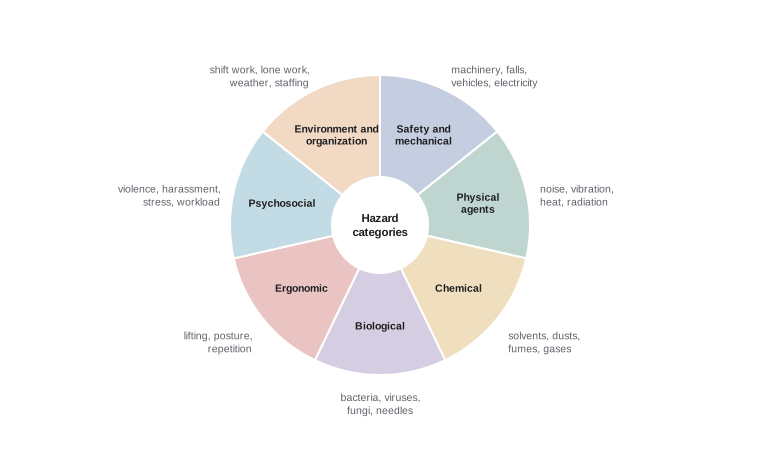
Recognizing hazards is easier when you know what to look for. Hazards come in many forms, and a useful way to avoid missing them is to work through categories systematically. This lesson surveys the main categories of workplace hazards: safety or mechanical hazards that cause immediate injury, physical agents such as noise and heat, chemical hazards, biological hazards, ergonomic hazards, psychosocial hazards, and hazards arising from the environment and the organization of work. For each category, it gives examples, typical harms and the kinds of controls involved. Many hazards span categories, and the goal is not perfect classification but making sure nothing is overlooked. Other courses in the safety stream cover individual hazards in depth.
Safety and mechanical hazards
Safety hazards are those that can cause immediate injury, often through the release of energy. They are the most visible hazards and the cause of most traumatic injuries:
- Moving machinery and parts: nip points, rotating shafts, cutting blades, presses and conveyors that can entangle, crush, cut or amputate.
- Falls: from heights such as roofs, ladders, scaffolds, mezzanines and vehicle beds, and on the same level through slips and trips.
- Falling and flying objects: dropped tools, materials falling from shelves or loads, fragments from grinding.
- Vehicles and mobile equipment: forklifts, trucks, loaders and cranes striking or crushing people, rollovers.
- Electricity: shock, electrocution, arc flash and arc blast from contact with energized parts or faulty equipment.
- Stored and hazardous energy: pressure, springs, hydraulics, gravity and chemical energy that can be released unexpectedly during maintenance.
- Fire and explosion: flammable liquids, gases, dusts and hot work.
- Confined spaces and excavations: engulfment, cave-ins and hazardous atmospheres.
Many safety hazards involve energy, and asking "what energy is present here, and how could it reach a person?" is a powerful recognition technique. Energy sources include gravity, motion, mechanical, electrical, pressure, temperature, chemical, radiation, sound and biological energy. Lesson 4 returns to energy-based hazard recognition.
Physical agents
Physical agents are forms of energy that can harm health, often gradually:
- Noise: prolonged exposure to high noise levels causes permanent noise-induced hearing loss and tinnitus. A common rule of thumb is that if you must raise your voice to be heard by someone an arm's length away, noise levels may be hazardous.
- Vibration: hand-arm vibration from power tools can cause vibration white finger and nerve damage; whole-body vibration from vehicles contributes to back problems.
- Heat and cold: heat stress can cause heat exhaustion and life-threatening heat stroke; cold exposure can cause hypothermia and frostbite.
- Radiation: ionizing radiation from sources such as industrial radiography and medical imaging; non-ionizing radiation from ultraviolet light (welding arcs, sunlight), lasers, radiofrequency and microwaves.
- Lighting: poor lighting contributes to trips and errors; glare and flicker cause eye strain.
- Pressure: work in compressed air or diving, and changes in atmospheric pressure.
| Hazard category | Examples | Typical harm |
|---|---|---|
| Safety and mechanical | Machines, heights, vehicles, electricity | Immediate traumatic injury |
| Physical agents | Noise, vibration, heat, cold, radiation | Hearing loss, heat illness, burns, long-term damage |
| Chemical | Solvents, dusts, fumes, gases, corrosives | Poisoning, burns, lung disease, cancer |
| Biological | Viruses, bacteria, molds, bloodborne pathogens | Infection, allergy, disease |
| Ergonomic | Lifting, repetition, awkward postures | Musculoskeletal injuries |
| Psychosocial | Stress, violence, harassment, fatigue | Mental and physical illness, injury |
Chemical hazards
Chemical hazards arise from substances that can harm people through their physical or chemical properties. They include liquids, solids, dusts, fumes, mists, vapors and gases, and the products of processes, such as welding fumes, silica dust from cutting concrete, diesel exhaust and wood dust. Chemicals can enter the body by inhalation, skin or eye contact, ingestion and injection. Effects may be acute, such as burns, poisoning or asphyxiation, or chronic, such as occupational asthma, dermatitis, organ damage and cancer. Physical hazards from chemicals include flammability, explosiveness, reactivity and pressure. HSE-102 covers hazard communication, labels and safety data sheets in detail; in risk assessment, the key questions are which substances are present or produced, how people could be exposed, how much and for how long, and which controls reduce exposure. Measurement of airborne contaminants by an occupational hygienist is often needed to assess exposure accurately.
Biological hazards
Biological hazards are living organisms or their products that can harm health: bacteria, viruses, fungi, parasites, and toxins or allergens they produce. Workers at risk include health care and laboratory workers, first responders, people who work with animals or animal products, agriculture and food processing workers, waste and wastewater workers, and anyone exposed to contaminated water, soil or mold in buildings. Exposure routes include inhalation of aerosols, contact with blood and body fluids, needlestick injuries, bites, and contact with contaminated surfaces. Assessment considers the organism, how it spreads, the tasks that create exposure, the health of workers, and the availability of controls such as vaccination, ventilation, safe sharps, hygiene and PPE. Infection control courses in the safety stream cover these hazards further.
Ergonomic hazards
Ergonomic hazards arise from a mismatch between the demands of work and the capabilities of the human body. They include heavy or frequent lifting, pushing and pulling, repetitive motions, awkward or static postures, forceful exertions, contact stress, vibration, and poorly designed workstations and tools. They lead to musculoskeletal injuries, such as back injuries, tendinitis, carpal tunnel syndrome and shoulder disorders, which are among the most common and costly workplace injuries in both Canada and the United States. Ergonomic hazards are easy to overlook because their effects build up over time and because workers may accept discomfort as part of the job. Recognizing them requires watching how tasks are actually done and asking workers about pain and difficulty. HSE-107 covers manual handling and ergonomics.
Psychosocial hazards
Psychosocial hazards arise from the way work is designed, organized and managed, and from the social context of work. They include excessive workload and time pressure, low control over work, poor support from supervisors and co-workers, unclear roles, job insecurity, long or irregular hours and fatigue, isolation and working alone, workplace violence and harassment, discrimination, and exposure to traumatic events. They can cause stress, anxiety, depression, burnout and post-traumatic stress, and they increase the risk of physical injuries, cardiovascular disease and errors. Many jurisdictions now explicitly require employers to assess and control risks of workplace violence and harassment, and standards such as CSA Z1003 and ISO 45003 provide guidance on psychological health and safety. HSE-108 and HSE-109 cover these topics.
Environmental and organizational hazards
Some hazards come from the wider environment or the organization of work rather than a single source. Weather, such as heat waves, storms, lightning, ice and wildfire smoke, affects outdoor workers and travel. Working alone or in remote locations increases the consequences of any incident because help may be delayed. Shift work and long hours cause fatigue, which impairs judgment and reaction time. Inadequate staffing, poor communication, unclear procedures, production pressure, and lack of training or supervision are organizational factors that make hazards more likely to cause harm. Contractors and multiple employers on a site create coordination hazards. Climate change is increasing exposure to extreme heat and severe weather for many outdoor workers, and many organizations now include climate-related hazards in their assessments.
Worked problem
Using categories to assess a task
A municipal worker cleans out a storm sewer catch basin using a vacuum truck on a busy street in July. Use hazard categories to list the hazards.
Show solution
- Safety and mechanical: traffic striking the worker; moving vacuum hose and boom; falls into the open catch basin; lifting the heavy grate.
- Physical agents: noise from the vacuum truck; heat stress in summer sun.
- Chemical: hydrogen sulfide and other gases from decomposing material; vehicle exhaust; possible fuel or oil contamination.
- Biological: bacteria and viruses in sewage-contaminated water and sediment.
- Ergonomic: awkward postures guiding the hose; lifting the grate.
- Psychosocial and organizational: time pressure to finish a route; working with traffic close by; coordination with traffic control.
Answer: Working through each category reveals traffic, falls, gases, biological contamination, heat, noise and ergonomic hazards that might be missed by focusing only on the obvious.
Acute and chronic, obvious and hidden
Hazards differ in how quickly they cause harm and how easy they are to see. Acute hazards, such as an unguarded blade, cause immediate injury and are usually obvious. Chronic hazards, such as low-level solvent vapors, silica dust or repetitive motion, cause harm gradually, sometimes years later, and may be invisible or unnoticed. Occupational diseases often receive less attention than injuries because the link between exposure and disease is delayed and less visible, yet in both countries occupational disease, especially occupational cancer and lung disease, causes a large share of work-related deaths. Good assessment gives as much attention to chronic and hidden hazards as to obvious ones, using measurement, health surveillance and expert advice where needed.
Hazards that vary by person
The same hazard can present different risks to different people. New and young workers are injured at higher rates because they lack experience and may hesitate to ask questions. Workers with limited English or French proficiency may not understand warnings and instructions. Pregnant workers may face additional risks from certain chemicals, radiation, heavy lifting and infectious agents. Older workers may be more affected by heat or certain physical demands, though they often bring experience that reduces risk. Workers with disabilities may need adapted procedures, equipment or emergency plans. Contractors and visitors may be unfamiliar with the site. Risk assessment considers who is exposed, not just what the hazard is, and plans controls and communication accordingly.
Hazards that overlap categories
Many real hazards do not fit neatly into one category, and recognizing the overlaps helps avoid gaps. Silica dust from cutting concrete is a chemical hazard, but the activity also involves noise, vibration, flying particles and awkward postures. Night shift work is a psychosocial and work organization hazard, but fatigue also increases the likelihood of safety incidents with machinery and vehicles. Working alone combines psychosocial hazards, such as the risk of violence, with the safety hazard of being unable to summon help after an injury. Heat stress is a physical hazard made worse by heavy physical work, impermeable PPE, dehydration and some medications. Mold in a damp building is a biological hazard that is often linked to a building defect and may also involve chemical cleaning agents during remediation. When assessing a task, work through every category even if the task seems to belong to just one; the most serious hazard is sometimes the one in an unexpected category.
Health hazards and latency
Safety hazards usually cause immediate, visible injuries, so they tend to get attention. Health hazards, such as chemicals, noise, radiation, vibration and some biological agents, often cause harm that develops slowly over months or years, called latency. Noise-induced hearing loss accumulates gradually and painlessly; asbestos-related cancers may appear twenty to forty years after exposure; silicosis and occupational asthma may develop after years of exposure. Because the harm is delayed, workers and managers may underestimate these hazards, and injury statistics rarely show them. Occupational diseases are estimated to cause far more work-related deaths each year than traumatic injuries. Good hazard assessment gives health hazards equal attention, uses exposure monitoring to measure them, and considers the cumulative effects of long-term, low-level exposure as well as short, high exposures.
When in doubt about which category a hazard belongs to, the category matters less than recognizing the hazard. Categories are a memory aid that prompts the assessor to look at the full range of ways work can cause harm, from the obvious, such as a sharp blade, to the hidden, such as a solvent vapor, a virus or chronic stress.
Teams that get used to sorting hazards into categories during inspections soon find that they spot more hazards overall.
Common mistakes
MistakeFocusing only on obvious safety hazards.
InsteadWork through every hazard category systematically.
MistakeIgnoring chronic hazards because effects are delayed.
InsteadAssess long-term exposures such as dust, noise and solvents.
MistakeOverlooking psychosocial and organizational hazards.
InsteadInclude workload, fatigue, violence and harassment.
MistakeAssuming every worker faces the same risk.
InsteadConsider new, young, pregnant and other workers specifically.
MistakeDebating classification instead of controlling hazards.
InsteadUse categories as a checklist, not an end in themselves.
Summary and key terms
- Safety hazards cause immediate injury, often through released energy.
- Physical agents include noise, vibration, heat, cold and radiation.
- Chemical hazards act through inhalation, contact, ingestion and injection.
- Biological hazards include bacteria, viruses, fungi and their products.
- Ergonomic hazards cause musculoskeletal injuries.
- Psychosocial and organizational hazards affect mental and physical health.
- Assessment considers chronic, hidden and person-specific risks.
- Safety hazard
- Hazard that can cause immediate injury.
- Physical agent
- Energy such as noise, heat or radiation that harms health.
- Chemical hazard
- Substance that can harm through its properties.
- Biological hazard
- Organism or its product that can harm health.
- Ergonomic hazard
- Mismatch between work demands and the body.
- Psychosocial hazard
- Hazard from work design, organization or social context.
- Acute effect
- Harm that occurs immediately or soon after exposure.
- Chronic effect
- Harm that develops over time.
- Route of entry
- Way a substance enters the body.
- Hazardous energy
- Energy that can cause harm if released.
Practice problems
Work each problem on paper first, then reveal the answer to check.
Name four types of safety hazards.
Show answer
Machinery, falls, vehicles, electricity, stored energy, fire.
What question helps recognize safety hazards?
Show answer
What energy is present and how could it reach a person?
Name three physical agents.
Show answer
Noise, vibration, heat, cold, radiation.
Name the four routes of entry for chemicals.
Show answer
Inhalation, skin or eye contact, ingestion, injection.
Give two groups at risk of biological hazards.
Show answer
Health care, laboratory, agriculture, waste workers.
Name three ergonomic risk factors.
Show answer
Heavy lifting, repetition, awkward postures, force.
Name three psychosocial hazards.
Show answer
Workload, low control, violence, harassment, fatigue.
Why are chronic hazards often overlooked?
Show answer
Effects are delayed and less visible.
Name two groups who may face greater risk.
Show answer
New and young workers, pregnant workers, workers with language barriers.
Why use hazard categories?
Show answer
As a checklist so that nothing is missed.
Lesson quiz · 5 questions
Score 60% or more to complete this lesson.
Create a free account to save your progress, take quizzes and earn a certificate.