
GCP-190 · Lesson 5 of 12 · 24 min
Review: Innovating with data and AI
▶ Video coming soon A video version of this lesson is on the way.
The second review session is the one Owen has been dreading and Jules has been looking forward to. Ravi Menon, Birchline's data and analytics lead, joins Farah for the hour because he is the person who will actually run BigQuery and Looker once the old data warehouse is switched off. "Data and AI are two sections of the exam guide," Farah says, "but they belong together. AI runs on data, and most of the value of data comes from what you do with it." This lesson reviews section 2, exploring data transformation with Google Cloud, and section 3, innovating with Google Cloud artificial intelligence. Together, in the guide we read, they made up a little over a third of the exam.
Section 2 has three objectives: describe the role data plays in transformation, decide which Google Cloud data products fit which business uses, and explain how analytics, business intelligence and streaming add value. Section 3 has two: describe basic AI and machine learning concepts and their business value, and explain how Google Cloud's AI offerings create value. Questions in both sections are mostly about choosing the right kind of product for a described need, so the review focuses on that choice.
Why data matters to transformation
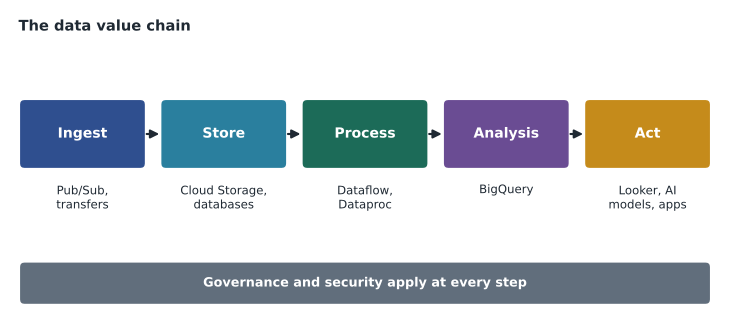
Data turns opinions into evidence. Birchline's buyers used to order winter stock based on last year's sales and their own instincts. With sales, weather and online browsing data in one place, they can see which lines sell where and when, and adjust orders before the season starts. The exam expects you to understand the data value chain: data is collected, stored, processed, analyzed and then used to make a decision or power a product. A weak link anywhere limits the value. Data that is spread across disconnected systems, in different formats and of uneven quality, is hard to use. Part of transformation is breaking down those silos.
Two more ideas come up often. Structured data has a fixed format, such as rows and columns in a sales table. Unstructured data does not, such as product photos, customer emails or video. Semi-structured data sits between, such as JSON records. Different storage and analysis tools suit different kinds. The other idea is the difference between a database, which supports day-to-day transactions such as taking an order, and a data warehouse, which supports analysis across large amounts of historical data. A data lake stores raw data of many kinds, often in Cloud Storage, for later processing. Google also describes combining lake and warehouse ideas so that analytics can reach data wherever it is stored.
Choosing data products
The exam does not test configuration, but it does expect you to know what the main data products are for. Cloud Storage holds objects, such as files, images and backups, at any scale, with storage classes for frequently and rarely accessed data. Cloud SQL is a managed relational database for MySQL, PostgreSQL and SQL Server, suited to traditional applications such as an order system. AlloyDB is a PostgreSQL-compatible database for demanding transactional and analytical workloads. Spanner is a relational database that scales horizontally with strong consistency across regions, suited to global applications that need both scale and transactions. Firestore is a serverless document database often used for web and mobile apps. Bigtable is a wide-column NoSQL database for very large, fast workloads such as time-series or sensor data. BigQuery is the serverless data warehouse for analyzing very large data sets with SQL.
| Need | Product | Key idea |
|---|---|---|
| Store files, photos, backups | Cloud Storage | Object storage with classes by access frequency |
| Traditional relational app database | Cloud SQL | Managed MySQL, PostgreSQL or SQL Server |
| Global scale with strong consistency | Spanner | Horizontally scalable relational database |
| Web or mobile app documents | Firestore | Serverless document database |
| Huge, fast key-based workloads | Bigtable | Wide-column NoSQL for time-series and similar data |
| Analyze very large data with SQL | BigQuery | Serverless data warehouse |
| Ingest event streams | Pub/Sub | Messaging for streaming events |
| Process batch or streaming data | Dataflow | Managed data processing pipelines |
| Dashboards and governed metrics | Looker | Business intelligence platform |
For analytics, BigQuery is central. It separates storage from compute, scales automatically and lets analysts query huge data sets with SQL without managing servers. It can also run machine learning models with BigQuery ML. For streaming, Pub/Sub receives events, such as clicks on Birchline's shop or sales at the tills, and Dataflow processes them in real time or in batches. Dataproc runs managed Apache Spark and Hadoop for teams that already use those tools. For business intelligence, Looker provides governed dashboards and a shared definition of business metrics, and Data Studio (formerly Looker Studio) provides simpler self-service reports and dashboards. Ravi plans to give store managers Looker dashboards showing stock and sales by store, refreshed through the day.
AI and machine learning concepts
Artificial intelligence is the broad field of making computers perform tasks that normally need human intelligence. Machine learning is a part of AI in which systems learn patterns from data rather than following hand-written rules. Generative AI is a kind of AI that creates new content, such as text, images or code, using large models trained on vast amounts of data. The exam expects you to know these differences and when machine learning is a good fit: when there is a pattern to learn, enough good-quality data to learn it from, and a decision or prediction worth making at scale. Machine learning is a poor fit when a simple rule would do, when the data is scarce or unreliable, or when the cost of errors is high and decisions must be fully explainable.
Data quality matters more than the choice of algorithm. A model trained on incomplete, outdated or biased data will make poor predictions. That is why section 3 links back to section 2: good AI depends on good data practice. Responsible AI is also part of the section. Google publishes AI principles, and questions may ask about fairness, transparency, privacy, accountability and keeping people in charge of important decisions. Treat these as business concerns, not just ethical ones, because a model that treats customers unfairly is also a reputational and legal risk.
Google Cloud AI offerings
Google Cloud offers AI at several levels, and many questions ask which level fits. At the simplest level are pre-trained APIs, such as Vision, Speech-to-Text, Text-to-Speech, Translation and Natural Language, which add common AI abilities to an application without training a model. Next is BigQuery ML, which lets analysts build and use models with SQL where the data already lives. Then comes Vertex AI, Google Cloud's platform for building, training, deploying and managing machine learning models, including AutoML for training custom models with little code and tools for data scientists who want full control. Vertex AI also gives access to Google's Gemini models and other foundation models for generative AI, and Google offers tools for building AI agents and enterprise search on top of them. Product names in this area change often, so learn the levels and their purposes and check current names in the exam guide.
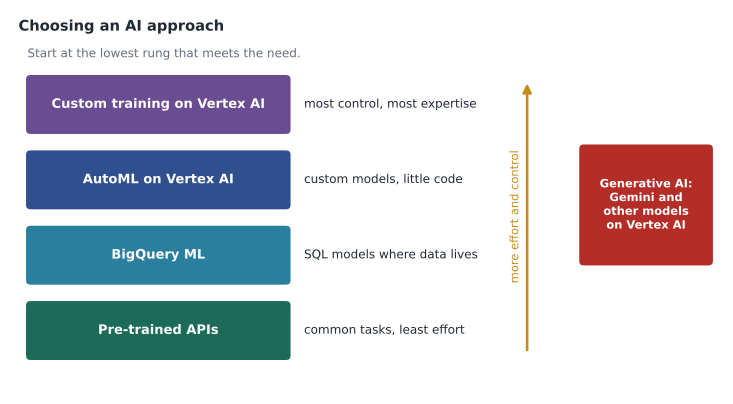
A useful rule is to start at the lowest rung that meets the need. If Birchline wants to translate product descriptions into French and Spanish, the Translation API is enough. If Ravi's analysts want to predict which customers are likely to stop buying, BigQuery ML lets them do it with the sales data already in BigQuery. If the buyers want a model that recognizes defects in photos of jackets from a specific factory, AutoML can train a custom image model with labeled examples. If Jules wants a shopping assistant that answers customer questions using Birchline's own product catalog, a generative AI approach built on Gemini models with Birchline's data is appropriate.
Practice scenarios
Data governance and quality
Section 2 also expects you to understand why governance matters. Data governance is the set of policies, roles and tools that decide who can use which data, for what purpose, and with what quality standards. Without it, a data platform quickly fills with duplicated, inconsistent and poorly understood tables, and people stop trusting the numbers. Good governance includes a catalog of what data exists and what it means, clear owners for important data sets, access controls that follow least privilege, and checks on quality and freshness. Google Cloud offers tools for discovering, cataloging and governing data across storage and analytics services, and BigQuery supports fine-grained access controls down to columns and rows. For the exam, focus on the value: trusted, discoverable data that the right people can use safely.
Privacy is part of governance. Customer data must be handled according to law and to the promises an organization makes to its customers. Techniques such as removing direct identifiers, masking sensitive fields and aggregating data before analysis reduce risk while keeping much of the value. Ravi's team at Birchline masks customers' email addresses in the analytics copy of the order data, so analysts can count repeat buyers without seeing who they are.
More practice scenarios
Three more original scenarios. First: a delivery company wants to show drivers' live locations on a dispatch map and keep the history for later analysis. Which combination fits? Pub/Sub to collect location events, Dataflow to process them, and BigQuery to store the history for analysis. Second: a museum wants visitors to search its collection by describing what they are looking for in everyday words, using the museum's own catalog. Which kind of AI fits? A generative AI approach that grounds a Gemini model in the museum's catalog, rather than a model trained from scratch. Third: a bank's analysts already work in BigQuery and want to flag unusual transactions with a simple model, without moving data. Which option fits? BigQuery ML.
Look at how each answer follows from the need and the constraints. Streaming plus history points to a pipeline ending in BigQuery. Natural language over the organization's own content points to generative AI grounded in that content. Analysts already working in SQL point to BigQuery ML. Practice naming the need in a few words before thinking of products.
One more distinction is worth practicing: batch and streaming. Batch processing handles data in large chunks on a schedule, such as Birchline's nightly stock reconciliation. Streaming processing handles events continuously as they arrive, such as updating a stock count the moment an item sells online. Streaming costs more effort but supports decisions in minutes rather than the next morning.
Worked problem
Choosing the data product
A ticket-booking company stores bookings for events in many countries and needs a relational database that keeps bookings consistent across regions and scales as demand grows. Which product fits best, and why not Cloud SQL or BigQuery?
Show solution
- The need is transactional: bookings must be consistent, which points toward a relational database.
- The constraints are global reach and growth beyond a single region.
- Spanner provides horizontally scalable relational transactions with strong consistency across regions.
- Cloud SQL suits regional applications and has scaling limits; BigQuery is for analysis, not transactions.
Answer: Spanner.
Worked problem
Choosing the AI level
A city library wants to add automatic captions to recorded talks in several languages. It has no data scientists and a small budget. Which AI approach fits best?
Show solution
- The task is common: turning speech into text and then translating it.
- The constraints are no specialists and a small budget.
- Pre-trained APIs for speech-to-text and translation meet the need with no model training.
Answer: Pre-trained APIs. Custom training would add cost and effort without a clear benefit.
At the end of the session, Ravi sketches the products on the whiteboard in the order Birchline will use them. Jules photographs the sketch and later turns it into a set of flash cards, one product per card, with the need on the front and the product on the back.
Common mistakes
MistakeUsing a transactional database for large-scale analysis.
InsteadUse BigQuery for analytics; use Cloud SQL or Spanner for transactions.
MistakeAssuming every AI need requires a custom model.
InsteadStart with pre-trained APIs or BigQuery ML when they meet the need.
MistakeTreating machine learning and generative AI as the same.
InsteadMachine learning learns patterns to predict; generative AI creates new content.
MistakeIgnoring data quality when discussing AI.
InsteadModels are only as good as the data they learn from.
MistakeConfusing Looker and Data Studio.
InsteadLooker is a governed BI platform; Data Studio is simpler self-service reporting.
Summary and key terms
- Data creates value through a chain: ingest, store, process, analyze and act, with governance throughout.
- Match products to needs: Cloud SQL and Spanner for transactions, BigQuery for analytics, Cloud Storage for objects.
- Pub/Sub and Dataflow handle streaming; Looker provides business intelligence.
- Machine learning learns patterns from data; generative AI creates new content.
- Google Cloud AI runs from pre-trained APIs through BigQuery ML and AutoML to custom training and Gemini on Vertex AI.
- Choose the simplest AI approach that meets the need, and consider responsible AI.
- Data warehouse
- A system for analyzing large amounts of historical data.
- Data lake
- A store of raw data of many kinds for later processing.
- BigQuery
- Google Cloud's serverless data warehouse.
- Spanner
- Google Cloud's horizontally scalable, strongly consistent relational database.
- Vertex AI
- Google Cloud's platform for building, deploying and managing machine learning and generative AI.
- Pre-trained API
- A ready-made AI service for a common task, used without training a model.
Practice problems
Work each problem on paper first, then reveal the answer to check.
Which product analyses very large data sets with SQL?
Show answer
BigQuery.
Which two products usually handle streaming ingestion and processing?
Show answer
Pub/Sub and Dataflow.
What is the difference between machine learning and generative AI?
Show answer
Machine learning learns patterns to predict; generative AI creates new content.
What is the simplest AI option for translating text?
Show answer
The Translation API.
What does BigQuery ML let analysts do?
Show answer
Build and use machine learning models with SQL where the data lives.
Name one principle of responsible AI.
Show answer
Fairness, transparency, privacy or accountability.
Which database suits a simple regional web app with MySQL today?
Show answer
Cloud SQL.
Lesson quiz · 5 questions
Score 60% or more to complete this lesson.
Create a free account to save your progress, take quizzes and earn a certificate.