
GCP-190 · Lesson 1 of 12 · 23 min
How the Cloud Digital Leader exam works
▶ Video coming soon A video version of this lesson is on the way.
On the last Monday of November 2026, Farah Qureshi books the small boardroom at Birchline Outfitters in Columbus for an hour and writes six short phrases on the whiteboard: transformation, data, AI, modernization, security, operations. Owen Mitchell, eight years on Birchline's IT team and now part of the cloud migration team, has finished the two Google Cloud foundation courses and wants to know what happens next. Jules Baptiste, the product manager for the online shop, has come too. Jules is not technical, but the leadership team has asked every manager on the migration to earn the Cloud Digital Leader certification, and Jules wants to sit the exam alongside Owen. "Before we study anything," Farah says, "you need a map of the exam itself. If you know what it measures and how it is built, you will study the right things and stop worrying about the wrong ones." This course is that map, plus the practical preparation that turns what you know into a pass on exam day.
GCP-190 is the final course of the Cloud Digital Leader program on this site. GCP-101 gave you the building blocks of Google Cloud: regions and zones, the resource hierarchy, identity and access, billing, and the main compute, storage and networking services. GCP-102 took the business view: why organizations move to the cloud, how data and AI create value, how infrastructure and applications are modernized, and how security and operations work in the cloud. This course does three jobs. It explains how the exam works and how to book and sit it. It reviews every section of the current exam guide with original practice scenarios. And it helps you plan your final weeks so that you arrive on exam day ready and calm.
What the certification is for
Google Cloud groups its certifications into three levels. Foundational certifications, such as Cloud Digital Leader, check broad knowledge of what the cloud can do for an organization. Associate certifications, such as Associate Cloud Engineer, check that you can deploy and operate solutions. Professional certifications, such as Professional Cloud Architect, check deep design and implementation skill in one area. Cloud Digital Leader sits at the foundational level and is aimed at a wide audience: managers, sales and finance staff, project leads, students and technical people starting out. It does not ask you to write commands or configure services. It asks whether you can explain what Google Cloud products do, why an organization would choose one approach over another, and what business value a cloud decision creates.
That focus matters for how you study. Owen has spent years running servers, so he is tempted to dive into details such as machine types and network routes. Jules has never opened the Google Cloud console and worries the exam will be too technical. Farah tells them both the same thing: the exam lives in the middle. You need to recognize the main products by name and purpose, understand cloud concepts well enough to explain them to a colleague, and judge which option best fits a described business need. Owen will need to resist going too deep; Jules will need to learn enough vocabulary to read the scenarios with confidence.
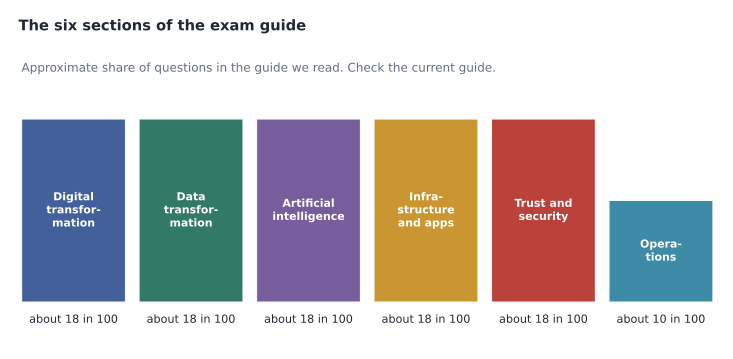
The six sections of the exam guide
Google publishes an exam guide for every certification, and the guide is the single most important document for your preparation. The Cloud Digital Leader guide we read for this course in November 2026 divides the exam into six sections. Section 1 is digital transformation with Google Cloud: why the cloud is changing how businesses work, and the fundamental cloud concepts behind that change. Section 2 is exploring data transformation: the role data plays in transformation, which Google Cloud data products fit which business uses, and how analytics, business intelligence and streaming add value. Section 3 is innovating with Google Cloud artificial intelligence: basic AI and machine learning concepts and how Google's AI offerings create business value. Section 4 is modernizing infrastructure and applications: how organizations move to the cloud, the business value of Google's infrastructure offerings, and the value of application programming interfaces. Section 5 is trust and security: basic cloud security concepts and the value of Google's layered approach to security. Section 6 is scaling with Google Cloud operations: controlling cloud costs and the basics of modern operations, reliability and resilience.
The version of the guide we read gave approximate weights for each section: roughly 18 out of every 100 questions for each of the first five sections and roughly 10 out of 100 for the operations section. Google revises its guides from time to time, and the certification page noted that a new version of the exam had gone live, so check the guide on Google's site before you plan your study time. The weights still give a useful rule of thumb: no single section dominates, so a weak area can cost you, and the operations section is smaller but not optional.
| Section | Main ideas | Covered in | Review lesson |
|---|---|---|---|
| 1. Digital transformation | Why the cloud changes business; fundamental cloud concepts | GCP-102 | Lesson 4 |
| 2. Data transformation | Value of data; data products; analytics and streaming | GCP-101, GCP-102 | Lesson 5 |
| 3. Artificial intelligence | AI and ML concepts; Google Cloud AI offerings | GCP-102 | Lesson 5 |
| 4. Infrastructure and applications | Migration paths; compute and infrastructure; APIs | GCP-101, GCP-102 | Lesson 6 |
| 5. Trust and security | Cloud security concepts; defense in depth | GCP-101, GCP-102 | Lesson 7 |
| 6. Operations | Cost control; reliability and resilience | GCP-101, GCP-102 | Lesson 7 |
The exam at a glance
Google's certification page, checked for this course in November 2026, describes the Cloud Digital Leader exam as 90 minutes long with 50 to 60 multiple choice and multiple select questions. The registration fee is 99 US dollars, plus tax where it applies. The exam is offered in English, Japanese, Spanish, Portuguese and French. You can take it online with a remote proctor or in person at a testing center, and the page names Pearson VUE as the testing center network. There are no prerequisites, and the recommended experience is simply having worked alongside technical professionals. A pass is valid for three years. Google does not publish a passing score, so be wary of any website that claims to know one.
Some of those facts have changed over the years. Older blog posts mention a different testing provider, a shorter list of languages or a different number of sections. That is normal: certification programs evolve, and summaries go out of date. Throughout this course, when we give a fact about the exam we say when we checked it, and we ask you to confirm it on Google's own pages before you book. Lesson 2 shows you which pages to read.
| Item | What Google's page said in November 2026 |
|---|---|
| Length | 90 minutes |
| Questions | 50 to 60, multiple choice and multiple select |
| Fee | 99 US dollars plus tax where applicable |
| Languages | English, Japanese, Spanish, Portuguese, French |
| Delivery | Online proctored, or onsite at a Pearson VUE testing center |
| Prerequisites | None |
| Validity | Three years |
| Passing score | Not published |
What the questions look like
Every question on the exam is either multiple choice, with one correct answer, or multiple select, where the question tells you how many answers to choose. Most questions are short business scenarios: an organization wants to do something, has a constraint, and needs the best option. A retailer wants to analyze years of sales data without managing servers. A hospital must keep certain records in one country. A start-up wants to release features faster without hiring an operations team. The options are usually all real Google Cloud products or real cloud concepts, so you cannot pass by spotting made-up names. You pass by understanding which option fits the need best, which is why lesson 3 spends a whole lesson on reading scenarios carefully.
Because the questions are about fit, many of them hinge on a single phrase. "Without managing infrastructure" points toward managed or serverless services. "Globally consistent transactions" points toward Spanner. "Petabytes of analytics data" points toward BigQuery. "Reduce costs for steady workloads" points toward committed use discounts. Farah calls these phrases signposts, and part of this course is building your own list of them. Lesson 8 collects the pairs of products and features that candidates most often confuse.
# Average time per question for the range Google publishes
minutes = 90
for questions in (50, 55, 60):
    seconds = minutes * 60 / questions
print(questions, "questions:", round(seconds), "seconds each on average")50 questions: 108 seconds each on average 55 questions: 98 seconds each on average 60 questions: 90 seconds each on average
What this code does
The 90-minute exam time is converted to seconds and divided by each possible number of questions in the published range. This gives the average time available per question. With 60 questions that is 90 seconds each, and with 50 it is 108 seconds.
The numbers above are a first look at pacing. Even at the top of the published range, you have about a minute and a half for each question. That is generous for a foundational exam, but scenario questions take longer to read than simple recall questions, and nerves eat time. Lesson 9 turns this into a practical timing plan with checkpoints.
Who the candidates are
Two candidates appear throughout this course. Owen Mitchell has spent eight years on Birchline's IT team looking after servers, backups and the help desk. He now works on the migration team under Farah and plans to go on to the Associate Cloud Engineer certification after Cloud Digital Leader. He has booked his Cloud Digital Leader exam for the second half of January 2027 at a testing center near Birchline's Columbus head office. Jules Baptiste manages the online shop, Birchline's busiest sales channel, and has never worked in IT. Jules plans to take the exam online from home in late January, after the holiday rush. Between them, they show the two most common kinds of Cloud Digital Leader candidate: the technical person broadening out and the business person learning the language of the cloud.
The two have different strengths and risks. Owen knows infrastructure well and can picture how a database or a virtual machine works, but he tends to read too much into questions and to choose the most technical answer even when a simpler managed option fits better. Jules thinks naturally in terms of customers, costs and outcomes, which is exactly what many questions ask about, but needs to learn product names and core concepts well enough not to be thrown by vocabulary. Lessons 9 and 10 build a study plan for each of them, and you can borrow whichever parts suit you.
Worked problem
Reading a section name as a study task
Jules reads the section name "Innovating with Google Cloud artificial intelligence" and asks what to study. Farah asks Jules to turn the two objectives under that section into concrete questions. What might those questions be?
Show solution
- The first objective is about AI and machine learning concepts and business value. Concrete questions: What is the difference between AI, machine learning and generative AI? What kinds of business problems suit machine learning? Why does data quality matter for a model?
- The second objective is about Google Cloud's AI offerings. Concrete questions: When would a business use a pre-trained API rather than build a custom model? What does Vertex AI do? What is BigQuery ML for? Where do Gemini models fit?
- Turning each objective into three or four plain questions gives a checklist Jules can answer out loud, which is a better test of readiness than rereading notes.
Answer: A good study task is a question you can answer in your own words. Turn every objective in the exam guide into a few such questions.
Farah finishes the meeting by drawing a circle around the six phrases on the whiteboard. "Everything on the exam comes from one of these," she says. "Learn what each section means, learn the products that live in it, and practice choosing between them. The rest of this course is about getting you from here to exam day without surprises." Owen takes a photo of the whiteboard. It becomes the first page of his study log.
Common mistakes
MistakeStudying deep configuration details for a foundational exam.
InsteadFocus on what products do, why they are chosen and the business value they create.
MistakeTreating third-party passing scores as official.
InsteadGoogle does not publish a passing score; prepare to know the material well.
MistakeRelying on old blog posts for exam facts.
InsteadCheck Google's certification page and exam guide; programs change.
MistakeIgnoring the operations section because it is smaller.
InsteadEvery section is tested, and a skipped section can cost the pass.
MistakeChoosing the most technical answer by habit.
InsteadChoose the option that best fits the stated business need and constraint.
Summary and key terms
- Cloud Digital Leader is Google Cloud's foundational certification about the business value of the cloud.
- The exam guide has six sections: transformation, data, AI, infrastructure and applications, security, and operations.
- In November 2026 Google listed the exam at 90 minutes, 50 to 60 questions, 99 US dollars plus tax, valid three years.
- Questions are multiple choice or multiple select, usually short business scenarios.
- Google does not publish a passing score.
- Check the certification page and the current exam guide before you plan or book.
- Cloud Digital Leader
- Google Cloud's foundational certification on cloud concepts and business value.
- Exam guide
- Google's published document listing the sections and objectives an exam can cover.
- Foundational level
- The entry level of Google Cloud certification, below associate and professional.
- Multiple select
- A question type where you choose a stated number of correct answers.
- Signpost
- A phrase in a scenario that points toward a particular kind of answer.
- Proctor
- The person who supervises an exam, in person or remotely.
Practice problems
Work each problem on paper first, then reveal the answer to check.
How many sections does the exam guide we read have?
Show answer
Six.
How long did Google list the standard exam in November 2026?
Show answer
90 minutes.
Does Google publish a passing score?
Show answer
No.
How long is a pass valid?
Show answer
Three years.
What two question types appear on the exam?
Show answer
Multiple choice and multiple select.
Name the section that the guide we read weighted lowest.
Show answer
Scaling with Google Cloud operations.
Why does Farah warn Owen against the most technical answer?
Show answer
Because questions ask for the best fit to a business need, and a simpler managed option is often that fit.
Lesson quiz · 5 questions
Score 60% or more to complete this lesson.
Create a free account to save your progress, take quizzes and earn a certificate.