
GCP-190 · Lesson 3 of 12 · 22 min
Reading scenario questions carefully
▶ Video coming soon A video version of this lesson is on the way.
Owen's first practice set goes badly in an instructive way. He knows the products well, but he gets eleven of twenty questions right. When Farah goes through the wrong answers with him, almost none of them are about knowledge. In one, he picked a database that would work instead of the one that best fit "with minimal management". In another, he answered a question about cost when the scenario's real constraint was a deadline. In a third, he chose one answer to a question that asked for two. "You are not short of facts," Farah tells him. "You are short of reading." This lesson is about reading Cloud Digital Leader questions the way they are written: as short business cases with one key need, one or two constraints and options that are all plausible.
Jules has the opposite problem. Jules reads scenarios carefully and spots the business need quickly, but sometimes cannot tell two product names apart. Both problems are fixed by the same method: read the question in a fixed order, pull out the signposts, decide what kind of answer you need before you look at the options, and then compare the options against that need. Lesson 8 tackles the vocabulary side; this lesson tackles the reading.
The anatomy of a scenario question
Most Cloud Digital Leader questions have four parts, even if they are only two or three sentences long. There is a context, which tells you who the organization is and what it does. There is a need, which is what the organization wants to achieve. There are constraints, which limit acceptable answers: cost, time, skills, location of data, regulation or the amount of management the organization can take on. And there is the ask, the actual question at the end, which tells you what kind of answer to give: a product, a concept, a benefit, a first step or the best approach. Candidates who lose marks usually skip the constraints or misread the ask.
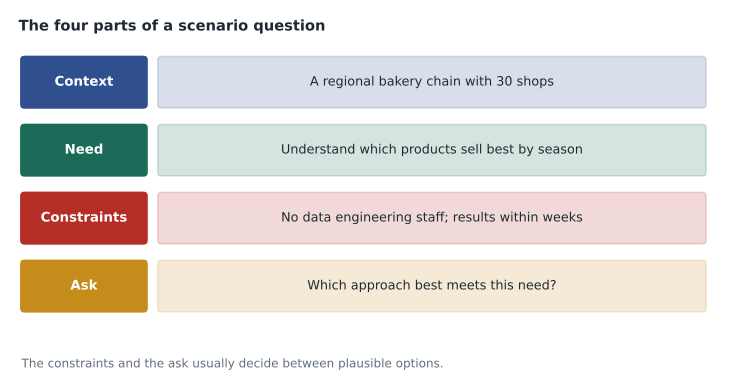
Here is an original example in the style of the exam. A regional bakery chain with thirty shops wants to understand which products sell best in each season. It has no data engineering staff and wants useful results within weeks. Which approach best meets this need? The context is a small business with sales data. The need is analysis of sales patterns. The constraints are no specialist staff and speed. The ask is for an approach. Before reading any options, you can already say what a good answer looks like: a managed, serverless analytics service with simple dashboards, not a cluster to build and run. If an option says to load the sales data into BigQuery and explore it with a business intelligence tool, that fits. An option to build a custom machine learning platform does not, even though it is technically possible.
A reading routine
Farah teaches Owen and Jules a five-step routine that takes about fifteen seconds once it becomes a habit. First, read the ask, the last sentence, so you know what you are looking for. Second, read the whole question once at normal speed. Third, name the need in a few words and list the constraints. Fourth, predict the shape of the answer before looking at the options: managed or self-managed, a data product or a security control, a cost lever or a reliability practice. Fifth, read every option and compare each one with your prediction, eliminating any that break a constraint.
| Step | What you do | Why it helps |
|---|---|---|
| 1. Read the ask | Look at the final sentence first | You know what kind of answer to look for |
| 2. Read once | Read the whole question at normal speed | You see the full situation before judging |
| 3. Name need and constraints | Say the need in a few words; list limits | Constraints decide between plausible options |
| 4. Predict | Decide the shape of a good answer | Options are less likely to pull you off course |
| 5. Compare and eliminate | Test each option against the need and constraints | Wrong options usually break a constraint |
Signpost phrases
Certain phrases appear again and again in cloud scenarios because they describe common business priorities. Learning what each one usually points toward is not a trick; it is learning the language of the subject. "Minimal management", "no infrastructure to manage" or "small operations team" point toward fully managed or serverless services. "Lift and shift" or "move quickly without changing the application" point toward rehosting on virtual machines or a VMware environment in the cloud. "Modernize" or "release features faster" point toward containers, microservices and managed platforms. "Analyze large amounts of data with SQL" points toward BigQuery. "Real-time" or "streaming" points toward Pub/Sub and Dataflow. "Keep data in a specific country" points toward choosing regions and data residency controls. "Least privilege" points toward granting narrow IAM roles.
Signposts are clues, not answers. A question might mention streaming data but ask about a security control, or mention cost but make a deadline the deciding constraint. Always return to the ask. Owen's mistake with the deadline question came from seizing on the word "cost" in the context and ignoring that the ask was about getting a result before a holiday sale.
| Signpost phrase | Usually points toward |
|---|---|
| Minimal management; no servers to manage | Fully managed or serverless services |
| Lift and shift; move as is | Rehosting on virtual machines or a cloud VMware environment |
| Release features faster; modernize | Containers, microservices, managed platforms, APIs |
| Analyze very large data with SQL | BigQuery |
| Real-time events; streaming | Pub/Sub and Dataflow |
| Data must stay in one country | Region choice and data residency controls |
| Only the access they need | Least privilege with IAM roles |
| Steady, predictable usage; lower cost | Committed use discounts |
Best answer, not a working answer
On a foundational exam, several options often describe things that would technically work. The question asks which is best given the need and constraints. A self-managed database on a virtual machine can store a shop's orders, but Cloud SQL does it with backups, patching and replication managed for you, which is better when the scenario says the team is small. A custom model can recognize objects in photos, but a pre-trained Vision API is faster and cheaper to adopt when the need is common and the organization has no data scientists. When you find yourself thinking "that would work too", ask which option meets every constraint with the least effort and risk.
Google's own guidance for its exams also favors its recommended practices. If one option follows a well-known Google Cloud recommendation, such as using managed services, granting least privilege, designing for failure across zones or using committed use discounts for steady workloads, and another option ignores it, the recommended practice is usually the better answer. That is not because the exam is a sales pitch; it is because the recommendations exist to make cloud adoption safer and cheaper, which is what the scenarios ask about.
Multiple select questions
Multiple select questions tell you how many answers to choose, for example "Choose two". Treat each option as a true or false statement about the scenario, mark the ones you are confident of, and then choose the most likely remaining option to reach the required number. Never select more or fewer than asked. Owen lost a mark in his first practice set by choosing one answer to a choose-two question because he was sure of only one. A reasoned second choice gives you a chance; a blank gives you none.
Negative and absolute wording
Watch for words that flip or narrow the meaning of a question. "Which is not a benefit" asks for the one false statement, so it is easy to answer backwards. "Most cost-effective", "first step" and "best" narrow the field. In options, absolute words such as "always", "never", "guarantees" and "eliminates all risk" are often a sign of a wrong answer in cloud questions, because good cloud practice is about reducing and managing risk, not removing it. The cloud does not guarantee that an application will never go down; designing across zones and regions makes outages less likely and shorter.
Common distractor patterns
Wrong options on a well-written exam are not random. They are built to catch particular mistakes, and recognizing the patterns makes elimination faster. The first pattern is the right product for a different need: an option names a real, useful product that solves a problem the scenario does not have. A question about protecting a web application from attack might offer BigQuery, which is excellent but irrelevant. The second pattern is the right idea taken too far: an option proposes the strongest possible control, such as encrypting everything with keys held in a separate hardware module, when the scenario only asks for a simple, low-effort improvement. The third pattern is the outdated approach: an option describes the on-premises way of doing something, such as buying spare servers for peak demand, when the cloud way, scaling on demand, fits better.
The fourth pattern is the partial answer. In a multiple select question, one option may be true but incomplete, while another is true and directly answers the ask. The fifth is the wrong level of the organization: the scenario asks what a business leader should do first, and an option describes a detailed technical step that a leader would delegate. Questions aimed at leaders often prefer answers about goals, people and process, such as setting up a cloud center of excellence or agreeing on success measures, before tools.
Owen adds a column to his mistakes log for the distractor pattern that caught him. After two weeks, he sees that most of his errors fall under the right idea taken too far: as an infrastructure person, he is drawn to the most thorough control even when a lighter one fits. Knowing that, he pauses whenever an option feels impressively complete and asks whether the scenario actually needs that much. Jules's errors fall mostly under the right product for a different need, which is a vocabulary problem that lesson 8 addresses.
Worked problem
Applying the routine
Practice on this original question: A national insurance company is moving a customer portal to Google Cloud. Customer records must stay in Canada, the security team is small, and the company wants to detect misconfigurations quickly. Which two actions best meet these needs? Options: (A) Deploy the portal in a Canadian Google Cloud region. (B) Use Security Command Center to find misconfigurations and vulnerabilities. (C) Give all developers the Owner role so they can fix problems quickly. (D) Store backups in a single multi-region bucket in the United States.
Show solution
- Ask: two actions. Need: move the portal securely. Constraints: data in Canada, small security team, quick detection of misconfigurations.
- Prediction: one answer about location of data, one about a managed security tool.
- A meets the residency constraint. B is a managed tool for finding misconfigurations, which helps a small team.
- C breaks least privilege and creates risk. D breaks the residency constraint.
Answer: A and B. Each meets a stated constraint; C and D each break one.
By the end of the week, Owen has redone his first practice set using the routine and scores seventeen out of twenty. He has not learned any new facts; he has stopped answering questions that were not asked. Jules uses the same routine and finds that predicting the shape of the answer makes unfamiliar product names less frightening, because Jules can often eliminate options by what they claim to do.
Common mistakes
MistakeAnswering from the context instead of the ask.
InsteadRead the last sentence first and answer exactly that.
MistakeChoosing an option because it would work.
InsteadChoose the option that best meets every constraint with least effort.
MistakeTreating a signpost phrase as the answer.
InsteadUse signposts as clues, then confirm against the ask.
MistakeSelecting one answer when the question says choose two.
InsteadAlways select exactly the number asked.
MistakeTrusting options with words like guarantees or never.
InsteadGood cloud practice reduces risk; absolute promises are usually wrong.
Summary and key terms
- Scenario questions have a context, a need, constraints and an ask.
- Read the ask first, read the whole question, name need and constraints, predict the answer's shape, then compare options.
- Signpost phrases point toward kinds of answer but must be checked against the ask.
- Several options may work; choose the best fit for every constraint.
- Recommended Google Cloud practices usually mark the better option.
- Select exactly the number of answers asked, and beware of absolute wording.
- Context
- The part of a question that describes the organization and situation.
- Constraint
- A limit that an acceptable answer must respect, such as cost, time, skills or data location.
- Ask
- The actual question, usually the last sentence.
- Distractor
- A plausible but wrong option.
- Elimination
- Removing options that break a constraint or answer a different question.
- Absolute wording
- Words such as always, never or guarantees that overstate a claim.
Practice problems
Work each problem on paper first, then reveal the answer to check.
What is the first step of Farah's routine?
Show answer
Read the ask, the final sentence.
What does "minimal management" usually point toward?
Show answer
Fully managed or serverless services.
What should you do if you are sure of only one answer in a choose-two question?
Show answer
Select it and the most likely second option.
Why are options with "guarantees" often wrong?
Show answer
Cloud practice reduces and manages risk; it rarely guarantees outcomes.
Which part of a question usually decides between plausible options?
Show answer
The constraints, together with the ask.
What does "keep data in a specific country" point toward?
Show answer
Choosing regions and data residency controls.
What changed in Owen's second attempt at the practice set?
Show answer
His reading, not his knowledge.
Lesson quiz · 5 questions
Score 60% or more to complete this lesson.
Create a free account to save your progress, take quizzes and earn a certificate.